August 15, 1945. Japan has just surrendered, but inside a small bamboo hut in the Philippines, fear still hangs heavy in the air. Young women forced to serve as so-called comfort girls sit in silence, waiting for what they believe will come next. They expect the same cruelty they had endured for years. But something shocking happens instead.
American soldiers walk in not with threats, not with orders, but with food, soap, even music. The women are stunned. For the first time, no one even tries to touch them. Why did this happen? And how did it change everything they thought they knew about war?
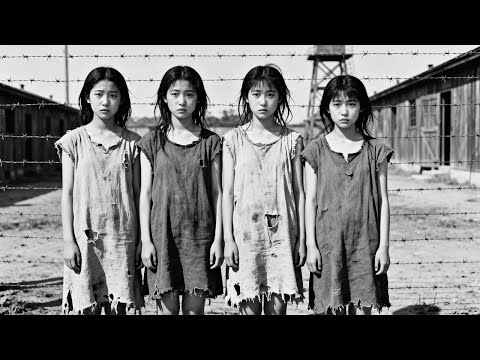
The paradox was cruel. For years, uniforms had meant possession, orders, and the certainty of being touched whether they wanted it or not. The system that held them was both vast and banal. Comfort stations stretching from Burma to Shanghai, staffed by women who were told they were serving an empire, when in truth they were captives of its machinery.
Numbers vary, but even the most cautious historians estimate between 50,000 and 200,000 women passed through this network. Many were Korean. An Allied report in 1944 suggested as many as 80 to 90%, though Chinese, Filipino, Indonesian, Taiwanese, and Dutch women were also forced into service. Ledgers tracked them like inventory. Some were assigned to barracks on the outskirts of Manila, others to makeshift huts in the jungles of Burma.
A Japanese Army medical officer once described the system in chillingly bureaucratic terms. Women were inspected, listed, and rotated to meet quotas. Survivors later recalled being lined up for weekly checks, where humiliation came not only from the prodding of doctors, but from the tally marks that followed. One woman, remembered decades later, said simply, “We were not people. We were schedules.”
The sensory world of these places was unforgettable. The acrid smell of disinfectant mixed with sweat. The clatter of mess tins outside walls of bamboo. The faint incense burned by some women trying to mask the odor of fear. Nights were the worst. The drone of insects outside contrasted with the jarring rhythm of boots on gravel, signaling another entry, another round. Some women faced 15 to 30 men in a single day, according to testimonies later gathered by US medics and international commissions.
The contrast between the emperor’s lofty surrender and the grinding reality inside these rooms could not have been sharper. But even before surrender, cracks in the system were showing. Supplies ran thin. Soldiers, desperate and hungry, sometimes shared their rice rations with the women, not out of kindness, but fatigue. In those final months, diaries suggest a strange collapse of formality. Japanese guards too exhausted to enforce order. Women clinging to scraps of humanity in whispered songs.
A Korean survivor, Kim Hak-sun, who would speak publicly decades later in 1991, remembered that by the war’s last days, “the soldiers were frightened of losing, but we had no place to go. We were trapped in their fear and our own.”
Statistics painted the larger picture. By summer 1945, the Imperial Army had scattered comfort stations across at least 10 territories. Manila alone had dozens, serving thousands of troops. Medical records seized by the Allies later indicated that over 70% of women were malnourished, more than half suffered from venereal disease, and almost all bore permanent scarring, both physical and psychological. These figures, buried in archives for years, revealed the system’s true cost. An army’s illusion of control, paid for by a generation’s broken lives.
And yet, in August 1945, the machinery suddenly stopped. Orders from Tokyo no longer carried force. The guards who had ruled these huts listened to the radio, their faces blank, their authority dissolving in static. Outside, Allied convoys rolled closer, their diesel fumes mingling with the humid air. The women inside did not yet know what to expect. They only knew that a change was coming, and with change came terror. What kind of men would arrive? Would they be harsher than the last?
The sound of new boots on gravel brought silence. Paper screens quivered. Then instead of commands came the creak of crates being lowered, the hiss of a harmonica note, the metallic pop of a tin being opened.
The paradox deepened. War had ended. Yet for the women inside, the greatest shock was not defeat, but the sudden absence of the very violation they had come to expect.
The first signs of liberation were not words, but smells and sounds. Diesel fumes from American trucks drifted into the compounds, mingling with the damp, musty air of bamboo walls. Instead of the sharp bark of Japanese commands, the women heard unfamiliar drawls and laughter, the clatter of metal crates being lowered onto gravel.
For women conditioned to brace their bodies at the sound of boots, the pause was unbearable. They expected the routine to resume. Orders, inspections, the inevitable touch. But what entered through the paper screens was not demand, but the metallic pop of a tin can being opened.
Witnesses later described the moment with disbelief. A Korean woman recalled, “They set down food, real food, and stepped back. We did not understand. We thought it was a trick.” A Filipino survivor remembered the sweet, sticky taste of canned peaches, so foreign to her tongue that she wept while eating them.
The paradox was crushing. Uniforms still filled the doorways, but for the first time, no hands reached for them. Some American soldiers tried to speak. Few shared a common language, so gestures did the work. A bar of chocolate unwrapped, a cigarette lit and handed across with an awkward smile, a harmonica note echoing into the humid air. Each small act carried more weight than any proclamation of surrender.
“One man put his rifle against the wall and played music,” recalled a Dutch captive, “and we realized he would not touch us. That sound was freedom.”
The contrast could not have been sharper. For years, comfort stations had functioned as prisons without locks, where women’s bodies were claimed nightly in the name of discipline. Now suddenly the very men who could have exercised the same power chose restraint. The shock was physical. Some women recoiled, convinced violence would follow if they reached for the food. Others froze, unable to imagine that touch could be withheld.
“We thought they were waiting,” said one survivor, “waiting to show kindness, then take what they wanted. But they never did.”
The statistics from US Army medical teams underlined the scale of what they found. In Manila, reports noted that more than half of the women liberated suffered from venereal infections and over 70% showed signs of malnutrition. Many were too weak to stand when soldiers arrived. Army doctors recorded that several weighed less than 80 pounds, their ribs protruding, their skin paper-thin from years of deprivation.
To the medics, this was evidence of systemic exploitation. To the women, the first taste of canned peaches or a spoonful of condensed milk was almost unbearable. “It was too sweet,” one said later. “We were not used to sweetness anymore.”
The sensory impressions of liberation stayed with them. The sharp bite of soap on skin scrubbed raw after years without it, the heavy fabric of American ration sacks repurposed as blankets, the strange twang of English words echoing in rooms that had known only commands in Japanese. One Korean girl later recalled, “The first time I washed with real soap, I cried. My body remembered what it was like to be clean.”
Trust, however, did not come easily. Trauma had trained them to expect betrayal. Even as days passed without violation, many women refused to sleep, waiting for the inevitable reversal. American soldiers, unprepared for the depth of suspicion, often left gifts at the doorway and retreated, not realizing that this very act, leaving women alone, untouched, was the greatest gift of all.
The paradox of restraint became its own kind of shock. In a world where uniforms had always meant possession, the refusal to touch was revolutionary. And yet this revolution began not with speeches, but with soap, peaches, and a harmonica played in a bamboo hut as the war slipped into silence.
But behind those simple gifts lay another layer of the story, the clinical records, interviews, and statistics that sought to measure suffering in numbers, even as no number could capture the weight of years stolen. The crates of food and the harmonica songs told one story. The paperwork and reports told another.
For the US Army, liberation was also intelligence. Medical officers and psychological warfare units moved quickly to record what they found, their language clinical and sterile against the flesh-and-blood suffering it tried to capture. One Manila report noted that roughly 75% of females examined showed evidence of venereal disease, malnutrition, or chronic infection. A field officer wrote bluntly: “These girls have been worked beyond the point of collapse.”
The paradox struck again. Japanese officers had once kept ledgers tallying clients per day; now American medics compiled charts noting lesions per case and calories needed. Both turned bodies into data, though one sought to exploit while the other aimed to heal. “They measured us like cattle,” one Korean woman recalled decades later. “But at least this time, the measuring came with medicine.”
Survivors described the sting of iodine on open sores, the metallic taste of quinine tablets pressed into their palms, the cold steel of thermometers under their tongues. Some wept not from pain but from the realization that someone intended to cure rather than control. An army nurse wrote in her diary: “They had forgotten what gentleness felt like. Even a bandage was met with suspicion.”
Yet the most enduring memories were not written in reports. They lived in the smallest gestures. The soldier who tied a sandal strap. The medic who handed over a clean cloth. The nurse who lingered just long enough to ask softly, “Are you all right?” These fragile mercies began to restore something greater than health. They began to restore trust.
Trust came haltingly, in fragments. One young woman turned a bar of soap over in her hands again and again, half expecting it to be taken back. “It was the first gift I had received that did not ask for my body in return,” she recalled. Another remembered an American private carving tiny birds from scrap wood, leaving them near the door without a word. Rough and uneven, those figures carried more tenderness than years of forced attention.
Food became a language of its own. The sharp sweetness of canned peaches, the heavy warmth of bread thick with butter. Women spoke of sitting in silence, clutching tins, too overwhelmed to eat at first. Slowly, the act of swallowing became an act of reclaiming life. “It was like tasting freedom,” one Filipina survivor said.
A few began to laugh again, softly, as if testing whether the world would punish them for joy. A harmonica tune at dusk drew shy smiles. A girl traced the melody with her finger in the air, unwilling to speak, but unwilling to let it pass unnoticed. For years, decisions had been stripped away: when to eat, when to sleep, when to endure. Now even the choice to refuse a ration or keep a carved bird as her own became an act of ownership. A survivor later wrote, “For the first time, I remembered that I had a name.”
When the war ended, silence followed like a shadow. The Tokyo War Crimes Tribunal convened in 1946, cataloging massacres and forced labor with clinical precision, yet the system of enforced prostitution received scant attention. The words comfort station rarely surfaced. Justice had chosen its categories, and sexual slavery did not fit easily into the boxes drawn in 1946.
Many survivors buried the past, forced into silence by stigma. In Korea, families disowned daughters who returned. In the Philippines, women married quietly and told no one. “I did not tell even my children,” one Korean survivor admitted. “I lived like a ghost in my own house.”
But silence is never complete. In 1991, Kim Hak-sun stepped before cameras and declared she had been taken at seventeen. Her words ignited a global reckoning. Filipino lolas stood before microphones, voices quivering but insistent. Chinese survivors brought suit in international courts. In 1993, Japan issued the Kono Statement acknowledging military involvement, though the language was hedged and later contested. Statues rose in Seoul, Manila, San Francisco, and Berlin, each a young woman seated in silence, her chair beside her empty, a demand for remembrance, not pity.
The story began with bamboo screens trembling in the night and ended with names etched on plaques. They had come as captives, their identities stripped into numbers. They lived to see themselves restored as witnesses. In a war remembered for bombs and battleships, the enduring weapon was not destruction, but testimony. And the Americans, whose restraint so shocked the survivors in 1945, left behind a paradoxical memory: that in the midst of total war, mercy could carry its own power. Soap instead of chains. Peaches instead of orders. Silence instead of command.
Above all, it is a reminder that even in the most brutal landscapes of war, the smallest acts of humanity can echo longer than the thunder of guns. What small act of dignity will you choose to remember today?
Report this article
Select a reason for reporting:






