June 6th, 1944, 06:45 hours. Seven miles off the coast of Normandy, the English Channel heaved with gray swells. On the pitching deck of a landing craft, six British gunners crouched behind a 25,000-pound armored vehicle bolted to the deck of a flat-bottomed boat. Its gun barrel pointed at a coastline nobody on board could see.
The order crackled over the tannoy: “Fire.” The gun roared. A 25-pound high-explosive shell screamed toward Gold Beach as the craft lurched through four-foot swells. The crew reloaded, fired again, and again. They were still seven miles from France, and this vehicle—built in a Canadian locomotive factory using a tank chassis nobody wanted—was about to deliver one of the most extraordinary artillery performances of the entire invasion.
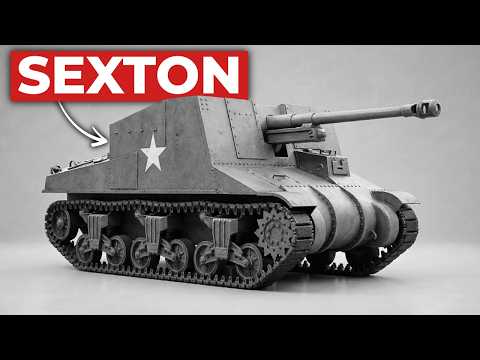
This is the story of the Sexton self-propelled gun. But to understand how it came to be, we must first go back to a time when Britain’s artillery was costing lives.
By 1942, the standard British field gun, the Ordnance QF 25-pounder, was the finest gun-howitzer of the war. It could hurl a 25-pound shell over 13,000 yards. A trained crew could fire five to eight rounds per minute. Its unique charge system—using separate red, white, and blue cloth bags that matched the Union Jack—gave gunners up to seven different charge levels for any range or angle. Every division in the British and Commonwealth armies used it. Every supply depot stocked its ammunition. The entire logistics chain revolved around one caliber: 87.6 mm.
But the 25-pounder was a towed gun. In the fast-moving desert war of North Africa, towed artillery could not keep pace with armored advances. Tanks would push forward, outrun their fire support, and face German counterattacks without artillery cover. The solution was self-propelled artillery—guns mounted on tracked chassis that could move with the tanks.
Britain’s first attempt was catastrophic. The Bishop, built by the Birmingham Railway Carriage and Wagon Company, mounted the 25-pounder in a fixed steel box on top of a Valentine tank hull. The cramped superstructure limited the gun’s elevation to just 15 degrees. This cut maximum range to 6,400 yards—less than half the gun’s true capability. Crews resorted to building earth ramps and driving onto hillsides just to gain extra elevation. The Valentine’s weak 131-horsepower diesel engine was overloaded by the added weight. Speed dropped to 15 mph. The fighting compartment held only 32 rounds. About 100 were built before the War Office admitted the Bishop was a failure.
So, Britain turned to America. The M7 Priest, an American 105-mm howitzer mounted on an M3 chassis, arrived in British service by October 1942, just in time for Second El Alamein. The Priest worked. It was mobile, reliable, and its crews could keep pace with armor. Britain ordered 2,500 for 1942 and 3,000 more for 1943.
There was one devastating flaw. The Priest fired American 105-mm ammunition. Every other gun in a British division fired 25-pounder rounds. Suddenly, Royal Artillery supply officers had to maintain an entirely separate logistics chain, sourcing American ammunition through American depots, and funneling it through British supply lines, just for one vehicle type in each division. In the chaos of a mobile campaign, this was not merely inconvenient. It was dangerous. If 105-mm stocks ran dry, the Priest became 23-ton paperweights while mountains of 25-pounder shells sat in nearby dumps, completely useless to them.
Britain needed a self-propelled 25-pounder, and the answer came from an unexpected place.
In Canada, a locomotive factory in Montreal had been building tanks that would never see combat. The Ram was Canada’s first domestically designed cruiser tank, developed because after Dunkirk, Britain could not supply its dominions with armor. Montreal Locomotive Works produced 1,948 Rams between November 1941 and July 1943. But in March 1942, the decision was made to standardize all British and Canadian armored units on the M4 Sherman. The Ram was outclassed. Official Canadian war history would later compare it to the infamous Ross rifle as an example of unsuccessful Canadian weapon design. Not a single Ram ever fired a shot in anger as a tank.
This left Montreal Locomotive Works with production lines, tooling, skilled workers, and a tank chassis that nobody wanted. The strategic logic was irresistible. On June 23, 1942, the first Sexton prototype rolled out of the Montreal factory. Canadian engineers had taken the Ram chassis, opened up the top, and mounted a 25-pounder gun-howitzer in a low, open-topped fighting compartment. The vehicle weighed just under 26 tons. A Continental R975 radial aircraft engine producing 400 horsepower gave it a top road speed of 25 mph and a range of roughly 125 miles. It carried 105 rounds of 25-pounder ammunition—more than three times what the Bishop could hold, and significantly more than the Priest’s 69 rounds of 105 mm.
According to British Army trial reports from early 1943, the Sexton was found highly satisfactory. No significant complaints, no skepticism. After the Bishop disaster, the War Office was simply relieved to have something that worked. The T51, a parallel American attempt to mount a 25-pounder on a Priest chassis, had its riveted gun cradle destroyed during the very first live-firing test. It was canceled in March 1943. The Sexton was approved for mass production.
The naming was pure accident. The British had stumbled into an ecclesiastical convention. The Bishop was named for its tall turret resembling a bishop’s miter. The Priest earned its nickname because its machine gun station looked like a pulpit. When the Canadians initially designated the new vehicle Deacon on April 29, 1943, they quickly discovered that name was already assigned to an armored lorry with a 6-pounder gun. The replacement name, Sexton—a church custodian who rings bells and digs graves—continued the unplanned tradition.
Montreal Locomotive Works produced 2,150 Sextons between 1943 and 1945. The first 124, designated Mark I, used the original Ram tank hull. The remaining 2,026, designated Mark II, were built on the Grizzly hull, Canada’s version of the Sherman M4A1. The Sexton entered combat in September 1943 with the British Eighth Army in Italy.
Now, before we get into the extraordinary combat record, if you are enjoying this deep dive into a weapon most channels have never covered, hit subscribe. It takes a second and helps the channel grow. Now, let us talk about D-Day.
The run-in shoot was one of the most audacious artillery innovations of the entire war. Self-propelled guns bolted to the decks of landing craft would fire on German beach defenses during the final approach, filling the critical gap between the naval bombardment lifting and the infantry hitting the sand. At Gold Beach on the morning of June 6th, three field regiments equipped with Sextons—roughly 72 guns in total—prepared for the run-in shoot. The 86th Hertfordshire Yeomanry Field Regiment, the 90th City of London Field Regiment, and the 147th Essex Yeomanry Field Regiment.
According to the war diary compiled by Lieutenant Sydney Beck of 341 Battery, the 86th Regiment had pioneered this technique during experiments at Studland Bay beginning in July 1943. The mechanics were ingenious. Two guns sat forward on each landing craft, two aft, all aligned with the bow. Direction was controlled by swinging the ship’s heading. Range was managed by a motor launch equipped with radar sailing 200 yards ahead, feeding corrections over loudspeakers down to the gun decks. Mechanical instruments called Coventry clocks ticked down range at a rate matching the landing craft’s speed. Corrections dropped 100 yards at a time.
The 86th Regiment opened fire at 06:45, still seven miles from the French coast. Their shells struck the Larivière causeway, targeting machine gun nests dug into the seawall. The war diary records the fire doing great work on the causeway before shifting to a lighthouse area suspected of housing a German observation post.
By 08:45, a troop went into action directly on the narrow beach strip with water lapping on their tracks, engaging enemy positions threatening the 7th Green Howards as they attacked the Mont Fleury battery. The Green Howards rushed the demoralized garrison and overpowered it. On the western end of Gold Beach, the 511th Battery of the 147th Essex Yeomanry knocked out two German anti-tank guns at Le Hamel using direct fire, open sights at close range. The 90th City of London Regiment was the first artillery to land on Jig sector, supporting the 231st Brigade’s advance toward Bayeux.
According to veteran accounts, the volume of fire from Sexton batteries on D-Day was staggering—72 guns each capable of sustained rates of five rounds per minute, with engagements running throughout the entire day. These batteries expended thousands of rounds between the run-in shoot and nightfall. The often-repeated claim that the Sexton fired more rounds on D-Day than any other British vehicle has never been verified by official records, and it is worth noting that M7 Priests, not Sextons, supported Sword and Juno beaches with roughly 168 guns between them. What is verified is that at Gold Beach, Sexton batteries provided continuous fire support from seven miles out at sea all the way through the inland advance—a feat no towed gun could have achieved.
The Normandy campaign that followed revealed the Sexton’s true value. During Operation Epsom in late June, 450 guns supported the 15th Scottish Infantry Division, with Sexton batteries delivering rolling barrages that helped repulse counterattacks by the 12th SS Panzer division. During Operation Goodwood in July, 760 guns were allocated with nearly 300,000 rounds of ammunition. The 13th Royal Horse Artillery directed fire onto 88-mm flat guns at Cagny, and crew accounts record destroying at least six Panther tanks with concentrated high-explosive fire.
Battery Sergeant Major Ernest Powdrill, who earned the Military Cross, left one of the most vivid surviving accounts of Sexton combat. On August 3rd, 1944, his battery found itself deep in enemy territory in the Normandy bocage, literally surrounded by roaming German tanks and infantry. Captain Peplow engaged three Tiger tanks with high-explosive shells at close range—a desperate act, given that the 25-pounder’s armor-piercing round could only penetrate roughly 70 mm at point-blank range, nowhere near enough for a Tiger’s 102-mm frontal plate.
The Sexton fought across every major campaign in Northwest Europe. During Operation Market Garden in September 1944, batteries supporting the 30th Corps fired 150 rounds per gun in a single engagement supporting the 7th United States Armored Division’s canal crossing in the Netherlands. During Operation Veritable in February 1945, over 1,000 guns fired in the largest British barrage since El Alamein, and the Sexton’s tracked mobility proved decisive on flooded terrain where wheeled vehicles could not move. The 147th Essex Yeomanry earned the distinction of being the first Royal Artillery unit to fire its guns on German soil on November 21st, 1944. For the Rhine crossing in March 1945, over 4,000 Allied guns fired for four hours. 12th Corps alone allocated 1,500 rounds per 25-pounder gun. A total of 225,061 rounds were fired in just three days.
Now consider the German equivalent. The Wespe mounted a comparable 10.5 cm howitzer on a Panzer II chassis. Its range was nearly identical, but it carried only 32 rounds—less than a third of the Sexton’s 105. This shortage was so severe that the Germans built 159 dedicated ammunition carriers with the gun removed just to keep their batteries supplied. Only 676 gun-armed Wespes were ever produced. The Sexton outnumbered it more than three to one.
The American M7 Priest fired a heavier shell, but its sustained rate was only three to four rounds per minute against the Sexton’s five to eight. In total weight of metal delivered per minute, the Sexton matched or exceeded the Priest. And critically, it fired the same ammunition as every other field gun in the British Army. That single advantage—ammunition commonality—was the entire reason the Sexton existed. And it was enough.
The Sexton remained in British service with the Army of the Rhine until 1956. Portugal operated them into the 1980s—more than 35 years of continuous service. India, South Africa, and the Netherlands all fielded Sextons after the war. At least 15 to 20 survive in museums worldwide, including a reportedly running example at the Royal Armouries at Fort Nelson.
On that gray morning off Gold Beach, a gun built in a Canadian locomotive factory—using a tank chassis declared obsolete before it ever saw combat—proved something British military engineering demonstrated again and again: the best weapon is not always the biggest, the newest, or the most advanced. Sometimes it is the one that fires the right ammunition from the right place at the right time.
The Sexton did exactly that, from seven miles out at sea, through the hedgerows of Normandy, across the Rhine, and into the heart of Germany. The war diaries recorded what the numbers confirm: British engineering solved the problem others could not.
So here is my question for you—if you had to choose between a weapon that is technically superior but logistically isolated, or one that is modest but shares ammunition with your entire army, which would you trust with your life on the morning of an invasion?
Report this article
Select a reason for reporting:






