They grew up in idyllic gardens, surrounded by toys and affection, while just beyond the walls, unspeakable atrocities unfolded. For the children of Nazi leaders, childhood was a bubble of privilege—until the war ended and the truth crashed in. How do you live with a surname that stands for genocide? Some denied, some defended, and a rare few chose to confront the horror.
This is the story of those who inherited the darkest legacy of the twentieth century—and the impossible burden of their fathers’ crimes.
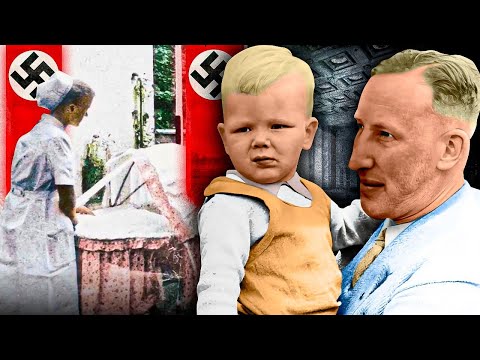
For Brigitte Höss, daughter of Rudolf Höss, the commandant of Auschwitz, childhood meant playing in a villa just 200 meters from the gas chambers. The screams and the constant hum of crematorium ovens were simply background noise. “We lived in a paradise,” she later recalled, without a trace of irony. Her father was a loving man who read bedtime stories—how could he also be the architect of mass murder?
Rolf Mengele, son of the notorious “Angel of Death,” Josef Mengele, idolized his father until a fateful meeting in 1977. By then, the young man had embraced communist ideals, while the old man remained an unrepentant Nazi. “I will never understand how human beings could behave that way,” Rolf confessed after their encounter. He rejected his inheritance, abandoned his surname, and settled in Munich as a lawyer—a quiet act of defiance against a name that had become synonymous with evil.
But not all heirs chose silence or shame. Gudrun Himmler, daughter of Heinrich Himmler, devoted her life to rehabilitating her father’s image. In her only interview, given in 1959, she declared: “I want to change the historical perception of my father.” She joined Stille Hilfe, an organization that helped former Nazis escape justice, and turned her apartment into a shrine to the Reichsführer-SS. For Gudrun, her father was a misunderstood hero—a conviction she held until her death.
In contrast, Niklas Frank, son of Hans Frank, the Governor-General of occupied Poland, chose a path of brutal honesty. In his book My Father, A Reckoning, he described his father as “an unrepentant criminal responsible for the deaths of millions.” His siblings cut all contact with him. Childhood friends turned away. Yet Niklas persisted, driven by a need to understand how the man who told him bedtime stories could also be the Butcher of Poland.
These are just a few of the stories—tales of denial, complicity, and rare courage. The heirs of the Nazi elite faced a choice: cling to the myth of their parents’ innocence or confront the horrifying truth. Their decisions would define not only their own lives but also the memory of a regime that nearly destroyed the world.
For Ricardo Eichmann, the youngest son of Adolf Eichmann, the truth arrived not through family confession but through a magazine. At thirteen or fourteen, he opened a publication and saw the image that would define his life: the noose that hanged his father after the trial in Jerusalem. In that instant, the quiet Argentine childhood—the Mercedes-Benz plant, the suburban house in Olivos—collapsed into a single, unbearable fact.
Unlike his older brothers Klaus and Horst Adolf, who clung to their father’s ideology, Ricardo chose erasure. He buried himself in books, studying prehistory, classical archaeology, and Egyptology at Heidelberg. “I envied children whose fathers had died in accidents,” he admitted. At least those children knew the truth without the weight of a name that meant genocide.
When shown a photograph of his brother Horst in an SS uniform, Ricardo’s face tightened. He never shared his anguish with his siblings, maintaining contact with only one of them. “If you want to know what they think, it’s better to ask them yourself,” he said, the distance in his voice absolute.
Yet the Eichmann story in Argentina had another branch. Horst Adolf had a daughter, Verónica, with Carmen Beatriz Bretin Lindeman. Carmen, a textile entrepreneur, defended the German perspective in interviews, calling Adolf Eichmann “my grandfather” while denying the scale of the genocide and supporting revisionist views. Verónica still resides in Misiones—a quiet inheritor of a name that refuses to stay buried.
Not every heir fled from the shadow. Edda Göring, born on June 2, 1938, was announced to the Reich with bells and 628,000 congratulatory telegrams. Hitler was her godfather. “The Führer came, Püppi was very excited,” her mother Emmy wrote in her diary. Edda sat on Hitler’s lap, received a Cranach painting looted from a Polish museum, and played in a model house gifted by Luftwaffe officers.
After the war, she became a fixture at Bayreuth gatherings, a ghost of the old elite moving through Munich’s Lehel district. In 2015, at seventy-seven, she filed a legal claim for compensation for her father’s confiscated estate. “This is about compensation for the expropriation of my inheritance,” she wrote, requesting a modest sum to live with dignity.
The Bavarian Parliament rejected her unanimously. Yet Edda persisted, attending court with the same aristocratic poise she had shown as a child. Journalist Wolfgang Witt wondered aloud: was it nostalgia for lost luxury, or pressure from those who might inherit from her? Either way, she never abandoned the fight.
But the heirs were not the only ones grappling with tainted fortunes. The industrialists who financed the Reich—Günther Quandt, Ferdinand Porsche, Friedrich Flick—kept their empires intact. Flick, sentenced to seven years for using slave labor, was released after two and reclaimed his title as Germany’s richest man by 1960. Only one of the five major businessmen was ever truly tried. The rest restructured, rebranded, and watched their companies become global icons.
Harold Quandt, captured in Benghazi, received a farewell letter from his mother Magda Goebbels before she poisoned her six children in Hitler’s bunker. “Be loyal—loyal to yourself, loyal to the people, and loyal to your country,” she wrote. Harold returned to inherit a vast industrial empire, including a 14% stake in Daimler. He never spoke publicly about his mother’s act.
The silence of the heirs was not always a choice. Some were simply never told. Klaus Höss, the eldest son, learned the truth in fragments—a whispered argument, a photograph hastily hidden. He moved to Sydney, married a German woman named Lilo, and raised a daughter, Christine. He drank himself to death in the 1980s, cirrhosis of the liver, as if the family name could be dissolved in alcohol.
Brigitte Höss took a different route. In 1950 she fled to Spain, where her beauty and elegance landed her work as a model for Balenciaga in Madrid. She never spoke of her origins. In 1961 she married an Irish-American engineer and followed him through Liberia, Greece, Iran, and Vietnam. Her life shifted from luxury to poverty overnight, yet she rebuilt her identity far from the shadows of Auschwitz.
For decades she kept silent. She worked in high-end boutiques in Washington, D.C.—Saks Jandel among them—earning the trust of employers who had no idea she was the daughter of the Auschwitz commandant. On one occasion, after a night of drinking, she revealed her secret. Her boss, a Jewish woman who had fled Germany, met the confession with understanding.
In 2013, at eighty and facing terminal cancer, Brigitte agreed to a single interview with journalist Thomas Harding. He was seeking information about his great-uncle, Hans Alexander, who had captured Rudolf Höss after the war. She recounted the day soldiers raided her home, the fear of reprisals, the struggle to maintain anonymity. She kept a photograph of her parents on their wedding day—a memory of simpler times.
Yet even as she acknowledged her father’s central role in the machinery of extermination, she continued to question the number of the Holocaust’s victims. Love for a father and condemnation of his actions remained at war within her. She never burdened her children or grandchildren with the weight of her story.
The fortune of the Quandt family followed a different trajectory. When Günther Quandt died in 1954 while vacationing in Cairo, his empire passed to his surviving sons, Harold and Herbert. Among the most valuable assets was a 14% stake in Daimler—of which they owned four fifths. By the 1960s, the Quandts were among the wealthiest families in Germany, their name emblazoned on BMW, their past buried beneath corporate rebranding.
Harold Quandt never spoke publicly about his mother’s farewell letter. He never explained how a woman who had poisoned her six children could write of loyalty. He simply ran the business, quietly, effectively, as if the war had been a minor interruption.
The same pattern repeated across the industrial landscape. Ferdinand Porsche served a brief prison term, then returned to build sports cars beloved by the world. Friedrich Flick, sentenced to seven years for slave labor, walked free after two and reclaimed his title as Germany’s richest man. Only one of the five major businessmen was ever truly tried. The rest restructured, rebranded, and watched their companies become global icons.
But the heirs of the Nazi elite could not rebrand so easily. Their names were not trademarks. Their inheritance was not measured in shares but in shame.
Gudrun Himmler died in 2018, unrepentant to the end. She had spent her final years in Munich, surrounded by memorabilia of her father, still insisting that history had judged him wrongly. Her great-niece, Katrin Himmler, married to a descendant of a Jewish family, wrote a book called The Himmler Brothers, reflecting on the family’s legacy and the atrocities of Nazism. The two women never reconciled.
Niklas Frank, now in his eighties, continues to speak. He has written more books, given more interviews, and never softened his verdict. “I hated that man who even dead continued to control me like a puppet,” he said of his father. His siblings never forgave him. He never asked them to.
The heirs of the Third Reich are dying now, one by one. With each death, a chapter closes—but the question remains: what do we owe the children of monsters? Understanding? Condemnation? Or simply the space to choose, as Niklas did, to break the silence?
Some chose silence, some chose denial, and a few chose the harder road of reckoning. Their stories do not end with them—they echo into the lives of grandchildren and great-grandchildren who still carry names they never asked for. Katrin Himmler’s book was a bridge built across generations, an attempt to turn inherited shame into a lesson for the future. Yet for others, the past remains a locked room, the key thrown away.
What unites these heirs is the impossibility of escape. They can change their surnames, move continents, bury themselves in academia or anonymity—but the name follows. History has already written the verdict on their fathers, and no court, no petition, no nostalgic gathering can undo it. The only freedom left is the freedom to choose how to live with the truth.
Some, like Niklas Frank, chose to speak. Others, like Brigitte Höss, chose to hide. And still others, like Edda Göring, chose to fight for the remnants of a stolen fortune. Their choices are not equal—but they are all human. The children of monsters are not monsters themselves. They are simply people handed a burden no one should have to carry.
The last of them are fading now. With each passing year, the voices that could still bear witness grow quieter. Soon there will be no one left who remembers the bedtime stories, the garden parties, the father who kissed them goodnight. Only the names will remain—and the question of what we do with them.
What would you do if you discovered your family’s name was written in the book of infamy—would you hide it, defend it, or spend your life trying to rewrite it?
Report this article
Select a reason for reporting:






