In 1929, every aircraft in the world moved through the air on a propeller. The Air Ministry accepted this. The Royal Aircraft Establishment accepted it. Rolls-Royce, Bristol, and Napier were all busy perfecting pistons, and nothing else. One man wrote this limitation down as a habit, not a law. He was a Royal Air Force cadet. His name was Frank Whittle. He was 22 years old, five feet tall, rejected twice by medical exams, the son of a Coventry mechanic, and he had no engineering degree.
Six years later, the patent renewal notice arrived. The fee was £5. He didn’t have it.
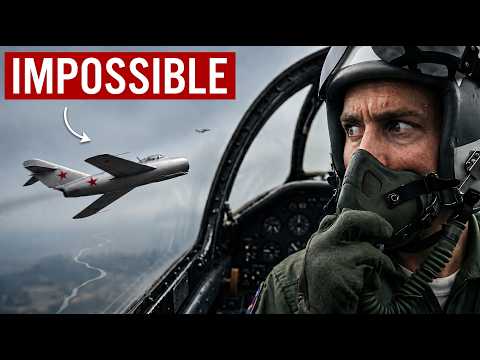
On 23 October 1951, nine American bombers flew toward an airfield called Namsi. Six of them never came back. The engines that shot them down were descendants of his invention. American pilots were forbidden to chase them.
The thesis was handwritten. It was submitted in 1928 by a flight cadet during his final term at the Royal Air Force College in Cranwell, and its title was ‘Future Developments in Aircraft Design’. The argument was mathematical. As altitude increases, air resistance decreases. An aircraft that could climb high enough would face almost nothing in its path and could fly faster and farther than anything below.
The obstacle was propulsion. In thin air, a propeller cannot grip anything properly. In thin air, a piston engine has too little air to burn fuel. Every major British aeronautical establishment knew these two facts and treated the resulting altitude limit as a property of the sky, not a failure of the machine.
The instructors who read the paper had neither the mathematical knowledge to refute it nor the need to. A cadet’s thesis had no institutional weight. It was graded, praised, and filed. At that stage of a career, being proven wrong in public was a risk an ambitious young officer could not afford, and being right was worth nothing.
The cadet spent most of his free time at the college’s model aircraft society, which was accepted as an alternative to official sports; he built and flew models instead of the games he disliked.
In October 1929, while reworking the altitude problem, he removed the propeller from the equation entirely and replaced it with a gas turbine that threw jets of air backward. There was no precedent for this, no material at the time could withstand the stress, and no one in Britain was paid to think about it.
He was right about the altitude limit. He was wrong in thinking anyone would listen.
In 1930, the idea was sent to the Air Ministry, which passed it to the person most qualified to judge it. Alan Arnold Griffith of the Royal Aircraft Establishment was a genuine turbine expert, and he found an error in the calculations. He concluded the design was impractical. The ministry refused further involvement.
That verdict has been treated harshly ever since, but it deserves better consideration. Griffith was protecting public money against an unproven concept at a time when the British aircraft industry was fighting for every pound. Metals that could hold turbine blades at high temperatures for hours did not exist. His own research pointed toward a completely different architecture. He was not maintaining a habit. He was upholding an engineering standard, and that standard was real.
The result was just a piece of paper. Since the ministry had no official interest, the patent was not placed on the secret list. It was approved and then published, making the world’s first turbojet design freely available in any technical library on earth.
German engineers read it. Others who were interested read it too.
Four or five years later, the renewal time came. Sources differ on whether the patent lapsed in 1934 or 1935, and the difference changes nothing. The £5 sat on a kitchen table in a household living on a junior officer’s pay, with a child on the way, alongside other bills. It was not paid. The patent entered the public domain.
This rejection was the reason he had kept the rights to himself in the first place. No one planned it.
In January 1923, a 15-year-old boy passed the Royal Air Force entrance exam with high marks and reported to Halton as an aircraft apprentice. He lasted two days. He was too short and his chest measurement was too small, so the medical officer sent him home.
He left, followed a diet and exercise regimen devised by a physical training instructor, added three inches to his height and three inches to his chest, and presented himself again six months later. He was rejected a second time and told there would be no third chance.
He applied anyway to a different establishment, without mentioning the two previous attempts, and this time he was accepted. The force that would later depend on him had measured him twice and turned him away twice, and both times it had measured nothing but his body.
What followed was the education that made the difference. He spent three years as an apprentice fitter, grinding metal, stripping engines, learning by hand what a workshop could and could not produce.
In 1926, his commanding officer nominated him for one of five cadet ships at the RAF College. In 1928 he was commissioned, sent to the officers’ engineering course at Henlow, and from there to Peterhouse, Cambridge, where he took first place in the Mechanical Sciences Tripos.
That sequence is the full answer to his cause. Britain had better theoreticians. It had better-funded laboratories. It had no other person who had spent his adolescence at a bench and his twenties in a lecture theatre and who knew, without asking anyone, the difference between a correct design and a buildable one.
The company came last and it came from outside the system. In 1936, two former RAF officers, Ralph Dudley Williams and James Collingwood Tinling, formed Power Jets with a £2,000 bank loan. The firm had a name, a cheque book, and no office. British Thomson-Houston in Rugby let them work in a corner of their electrical factory, a borrowed corner of another company’s plant. That was the entire industrial base of British jet propulsion.
At the first meetings, no one present had ever built a gas turbine. There was no laboratory, no metallurgy, and no margin. That is what determined the design.
A jet engine had two ways to compress air. The choice between them was the whole story.
An axial compressor drove air straight through rows of small aerofoil blades along the length of the machine, each one a precision part. It gave a high pressure ratio, meaning more thrust from a given volume of air, and its narrow front reduced drag. It was elegant, Griffith preferred it, and it was the path the German engineers took.
It demanded blade metallurgy and manufacturing tolerances that British industry in the mid-1930s could not supply in quantity and would struggle to supply under bombing.
A centrifugal compressor did the same work with a single impeller that flung air outward as it spun. One large forging instead of hundreds of small blades. This technology was already in mass production in the British engine industry, because every high-altitude piston engine in service used a supercharger built on the same principle.
To this he added reverse-flow combustion, where hot gases turned back inside the engine itself so the whole assembly could be made shorter. And a short engine was something an airframe company could actually build a fuselage around.
The advantages were specific. It needed less precise parts. It could tolerate inferior steel. It could be built in months rather than years.
The disadvantages were equally specific, and he knew them. A wheel pushing air sideways is wide, and width means frontal area, which means drag, which a designer has to hide somewhere inside the aircraft. A lower pressure ratio meant heavy fuel consumption and a hard ceiling on efficiency.
Above all, the architecture had a fixed limit to its improvement. An impeller could handle only so much air, and so the design could not simply be scaled up. Britain understood this so well that within a decade it abandoned the type for the axial avenue and never looked back.
Every one of those sacrifices was made for the same reason. He was not building the best possible engine. He was building the engine a country could actually manufacture, given the wrong alloys, the wrong tolerances, and no time. And he was betting that the war would be won by the engine that could be built quickly rather than the engine that was best.
That bet was correct. It also had a price, which no one in the drawing office needed to write down, because it was not an engineering cost. An architecture chosen to suit an industry under pressure was something any industry, or any person, under pressure could build the moment they had the drawings or the hardware. Simplicity is not a defence. It is an invitation.
He had built a tool, not a secret.
On 12 April 1937, the first engine ran at the Rugby works. He opened the fuel valve. The speed rose slowly for a second or two, then climbed rapidly with a piercing scream, and part of the combustion casing glowed red. Men in the room ran for the door. He later described standing his ground, unable to move, watching the machine run faster than he had told it to.
The drawing on the table behind him, in its plain layout, now carried many corrections, and more were to come. The compromise with reality was on the table, and its price had just been set.
What followed was not a triumph but a negotiation. The engine ran, but it ran on borrowed time, borrowed money, and borrowed space. Every hour of testing was logged by hand, and every hour was a withdrawal from a finite account.
Then came the interruption no one had planned for. It did not come from an enemy. It came from inside the building.
On 15 May 1941, at 7:40 in the evening, Gloster’s chief test pilot, Flight Lieutenant Jerry Sayer, released the brakes at RAF Cranwell and lifted the Gloster E.28/39, serial W4041/G, into the air. It had no propeller. The flight lasted seventeen minutes. Sayer wrote his observations on the back of his hand.
The engine that carried him had a life of ten hours. That number governed the entire programme. Every taxi run, every ground test, every seventeen-minute sortie consumed a measurable fraction of the project’s only resource, and a fitter kept the running total on a card in a log book.
The most important word came later, and it came from Derby. Stanley Hooker visited the United States in the summer of 1944 and saw two General Electric engines of 4,000 pounds thrust already running on test beds. He returned determined to beat them.
At Rolls-Royce, working with Adrian Lombard on Whittle’s established architecture but in their own design, he produced a 5,000-pound-thrust engine in roughly five months. It first ran on 27 October 1944. They called it the Nene. It was the most powerful turbojet in the world, and it belonged to a company that had the industrial capacity to build it in quantity.
The engine worked. From that moment, it was no longer his.
In September 1946, Clement Attlee’s government approved the export of Rolls-Royce Nene and Derwent turbojets to the Soviet Union. Sir Stafford Cripps was President of the Board of Trade and his name is often attached to the decision, though the final authority was the Prime Minister’s. The number of engines is disputed. Twenty-five, forty, and fifty-five all appear in reliable accounts, and Derwents went in the same shipment. Dozens is the safe word.
The deal carried a written condition. The engines were not to be used for military purposes and were not to be copied.
Between 3 and 22 December 1946, a Soviet delegation including engine designer Vladimir Klimov and aircraft designer Artem Mikoyan toured the Rolls-Royce works, examined the hardware, and took notes in British factories with British permission. They submitted their report to the Politburo on 10 January 1947.
Stalin is remembered as saying that no fool would sell his secrets, and the line is quoted everywhere but documented nowhere. It should be treated as memory, not record.
Soviet foundries could not match British alloy. It did not matter. The copy went into production as the RD-45. And when the metallurgy failed under stress, Klimov’s bureau redesigned the engine with the materials the Soviet Union had, and it emerged as the VK-1 at roughly 6,000 pounds thrust.
The architecture had been chosen in 1936 so that a workshop with poor steel could build it. It was a tool, not a secret, and it now worked exactly as intended for the people who held it.
On 30 December 1947, test pilot Viktor Yuganov flew the prototype I-310 from Ramenskoye. It had swept wings at 35 degrees, one 37 mm cannon, and two 23 mm cannons, and it was designed to destroy heavy bombers. In service it became known as the MiG-15. From 1 November 1950 it was seen over the Yalu River.
Western opinion held that its origin must be German, or that Soviet industry could never have built such a machine. Its actual origin was in British export paperwork.
American pilots borrowed the Japanese word honcho, meaning squad leader, for the skilled Soviet pilots they fought, men they were not officially fighting.
The condition was in writing. There was no enforcement behind it.
The change did not come at once. It came in four stages, and every stage is documented.
The first stage was political. A United Nations mandate forbade entry into Chinese territory, which meant the MiG bases in Manchuria were never attacked and Sabres were not permitted to chase across the river. From this comes the claim that American pilots were ordered not to fight the MiG-15. That claim is false. No order forbade them to fight. The order only said where they could not pursue. Pilots broke that rule regularly. Gun camera film would disappear and only one man would take the full punishment.
The other side was just as constrained. Soviet pilots of the 64th Fighter Aviation Corps were forbidden to cross the front line or fly over the sea, and had to stay within a line between the Yellow Sea coast and Pyongyang and Wonsan. They flew aircraft with Chinese markings, carried Chinese documents, wore Chinese uniforms, and were initially ordered to use Korean on the radio until it became impossible.
Both sides fought with their hands tied. Both sides kept it secret.
The second stage was industrial. On 23 October 1951, nine B-29s of the 307th Bombardment Wing left Kadena for Namsi airfield. Three were shot down over the target. Three more were so badly damaged that they had to make emergency landings before reaching home. Twenty-seven men died. As a percentage, it was the heaviest loss the United States suffered on a major bombing mission. Within weeks, heavy bombers were permanently withdrawn from daylight operations over the north.
What died that day was not a squadron. It was a doctrine. The Air Force Chief of Staff came personally to hear the crews and asked to speak to a tail gunner first.
The third stage was tactical. Later Sabre versions arrived with hydraulic controls and radar-ranging gun sights. The MiG had a simple gyro sight with no ranging capability, which made deflection shooting difficult. American pilots also began to learn in theatre that the MiG fell into a spin easily and often could not recover, and that it was less stable than the Sabre near the speed of sound. Every lesson was bought at a price.
The fourth stage was intelligence. From 27 April 1953, the United States offered $100,000 for an intact MiG-15. No pilot came forward. On 21 September 1953, after the armistice, Lieutenant No Kum-sok landed a MiG-15 at Kimpo without obstruction. He came in on a morning when local radar was off for routine maintenance, and later said he had never heard of the reward.
Eight days later, an aircraft in American markings flew out of Kadena, and the defector briefed the men preparing to fly his own aircraft. Captain Harold Collins flew it first. Chuck Yeager followed, under a tarpaulin on Okinawa’s hard standing.
A three-year estimate was exhausted in fifteen days. At last the aircraft could be fully tested. But the decisions behind it could not.
In April 1944, Power Jets was nationalised. Private shareholders received £135,563 and an extra ten shillings for the company’s assets. Whittle, as a serving officer, kept his share, which placed him outside the settlement. The Air Ministry sent him £10,000.
The official language was orderly. A restructuring had been completed. A national research establishment had been formed by merging the company with part of the Royal Aircraft Establishment to retain the country’s rare talent. The reality was that the new body was confined to research and excluded from engine design and development, leaving the design office that had built Britain’s first working turbojet with no authority at all. The team dispersed into private industry within months and was hired immediately, because every engine maker in the country was looking for people who understood turbines.
The same minister appears at both ends of the story. Sir Stafford Cripps was Minister of Aircraft Production when the company was taken over, and President of the Board of Trade two years later when the engines went east. He did not make any decision alone, and he cannot be held solely responsible for any of them.
The physical cost was paid by the man, and it is on record. In 1940, the strain of meeting the contract broke his health. In 1944, nationalisation broke it again. He resigned from the board in 1946 and later wrote that the government had smothered the company. That judgement is his own, and it should be read that way.
In May 1948, the Royal Commission on Awards to Inventors granted him £100,000, tax-free. Two months later he was knighted. On 26 August 1948, he was retired from the Royal Air Force on medical grounds in the rank of Air Commodore. He was 41.
In 1944 the state took the company. In 1946 the state gave away the design.
In the Soviet Union, 13,130 MiG-15s were built, and at least 4,180 more were produced elsewhere under licence. The model equipped the Chinese and North Korean air forces, and versions of the same engine were manufactured in Chinese factories.
In 1958, Rolls-Royce deputy chairman Whitney Straight visited Beijing and found the company’s engines being built there without any licence at all. Rolls-Royce eventually assembled a bill of £27 million. It was never paid, and there was no court to present it to.
The other record that collapsed was the Americans’. During the war, the Air Force credited its Sabre pilots with 792 MiG kills against 78 of their own aircraft lost. After the war, its own investigation, ‘Sabre Measure Charlie’, halved that ratio. Later studies by Robert Dorr, John Lake, and Warren Thompson put the real figure near 2:1. A Rand study based on post-Cold War archives concluded 1.8:1 overall and 1.3:1 for MiGs flown by Soviet crews. The institution audited its own mythology and did not publish the result.
The Soviet accounting was no better. The 64th Fighter Aviation Corps recorded 64,000 sorties, 1,872 aerial battles, 335 aircraft lost, and 120 pilots and 68 anti-aircraft gunners killed. Their total of victories was inflated, a fact their own historians concede. Until the 1970s and 1980s, the Soviet Union did not publicly acknowledge that Soviet pilots had fought in the war at all, which meant that men who flew 200 combat sorties could not tell anyone where they had been for thirty years.
The 1946 verdict must hold two things at once. That year Britain was bankrupt, rationing dollars, and selling whatever it had. The arithmetic was defensible. But the foresight was not. Both were true at the same time, and the second became clear only after the first had been acted upon.
Both governments had a preferred number. Neither number was the actual record.
The record of what he built is short, and it is not in dispute. In 1937, the first working turbojet ran in a borrowed factory. In 1941, the first British aircraft flew without a propeller. The reverse-flow combustion layout. The engine family that became Welland, Derwent, Nene, and Tay. The design licensed in the United States to Pratt & Whitney as the J42.
The list of what was lost is also long: a patent allowed to lapse over a renewal fee, a company nationalised in April 1944, £10,000 for his share, and design forbidden in the design office. Two breakdowns, in 1940 and 1944. A career ended at 41 by a doctor’s certificate. An engine exported on promise alone, with nothing behind it. Licence fees claimed and never paid. A country he left in 1976 and never returned to while alive.
He died in August 1996 at his home in Columbia, Maryland, after two years as a research professor at the United States Naval Academy. He had been right that the propeller was a habit, not a law of nature. He had been wrong in thinking that whoever built the first powerful engine from inferior steel would get to keep it.
W4041/G still sits in a display case in South Kensington, with nothing written in front of it. Four thousand miles away in Dayton, Ohio, the MiG-15bis sits much the same. No Kum-sok’s aircraft is preserved at the National Museum of the United States Air Force, where it was moved in 1957 when no answer came to an offer to return it. Follow its engine’s history and you end up in a Soviet foundry, a British export licence, and a borrowed corner of an electrical factory in Rugby, by way of Derby.
Two glass cases, one lineage, an ocean in between. A machine with no owner. It works for whoever picks it up.
In both cases the argument is still unresolved, and it was never an engineering argument. Whether the 1946 decision was arithmetically defensible or a failure of foresight is a verdict, not a proven fact. And if you have a view on that, tell us below.
A like and a subscription help this kind of research reach the people looking for it.
Report this article
Select a reason for reporting:






