What happens when the most brutal regime in modern history rots from the inside out? Behind the iron salute and polished boots was a world of stolen art, forged documents, offshore fortunes, and favors traded like currency. These weren’t just war criminals. They were embezzlers, black market kings, and bureaucratic vultures feeding off their own empire. This is the untold story of how the Nazi regime wasn’t just evil—it was corrupt to its bones.
Welcome to a deep descent into the darkest corners of power, where loyalty had a price tag and even genocide had a ledger. The men who built the Third Reich didn’t just destroy lives—they built personal fortunes from the wreckage, turning ideology into a smokescreen for staggering greed.
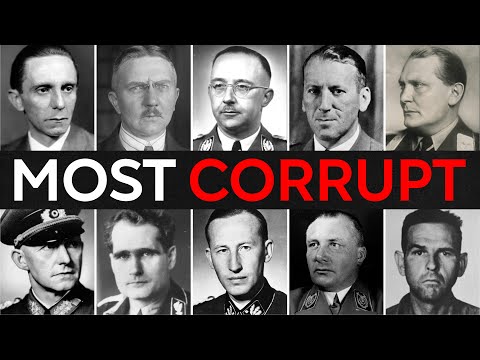
Hermann Göring didn’t just bend the rules—he smoked cigars rolled in them. As Hitler’s right-hand man and head of the Luftwaffe, Göring industrialized corruption, packaging it with velvet ribbons and selling it to himself at a markup. His office was a revolving door for art thieves, war profiteers, and anyone who could funnel millions of Reichsmarks into his bottomless pockets.
He appointed himself Plenipotentiary of the Four-Year Plan, granting unchecked access to the German economy, which he looted with such abandon that even fellow Nazis muttered behind his back. Every railway shipment he rerouted for personal plunder was a bomb not dropped, a tank not fueled. War was a business, and Göring was its CEO. But he forgot that even empires of gold eventually rust.
Joseph Goebbels preached sacrifice while dining on imported champagne and lakeside villas. The master propagandist controlled every film reel, radio wave, and newspaper headline—and more importantly, every budget line. Funds meant for morale-boosting campaigns took curious detours into lavish gifts for his mistress, estates for loyalists, and personal luxuries that would have made Versailles blush.
He called it messaging. Others called it fraud. Goebbels understood that perception was everything, and he weaponized it like a scalpel, hiding his grift behind grand speeches and infernos of national pride. But even as Berlin crumbled, his wine cellar remained well stocked.
Heinrich Himmler believed in blood, soil, and spreadsheets. The head of the SS ran his empire like a deranged accountant—meticulous, cold, and always looking for a profitable angle. Under his watch, the SS didn’t just police the regime. It owned a portfolio: brick factories, arms plants, construction firms, and entire forced labor systems converted into financial engines.
Himmler quietly siphoned profit from the suffering of millions. Ideology was the branding. Profit was the product. He created the SS Economic and Administrative Main Office to manage the empire, but in practice it became a laundering machine, washing brutality into dividends, embezzlement into policy. His private circle knew it. His underlings feared it. Himmler pretended to be the monk of the movement—celibate in public, sanctimonious in tone—but behind the curtain was a man addicted to control and the wealth that came with it.
And just beyond him stood another kind of shadow broker, the gatekeeper to Hitler himself. Martin Bormann was not a name the average German knew, but every corridor of power echoed with his footsteps. He didn’t need parades, medals, or speeches. All he needed was Hitler’s ear, and he had it clamped shut in his grip.
As the Führer’s private secretary, Bormann functioned as gatekeeper, fixer, and silent puppeteer, pulling strings behind velvet curtains while others took the stage. But where there’s access, there’s leverage. Land transfers, business licenses, inheritance waivers—if it could be signed, it could be sold. Entire estates were seized under legal pretense and redirected into his personal orbit. He built a quiet empire on forged signatures and vanishing paper trails. By war’s end, his name was more feared in the chancelleries than the Waffen-SS.
But for all his power, one man’s loyalty would soon turn from mystic to liability—a true believer whose faith fractured governance from the inside. Rudolf Hess was the ghost in the machinery, ethereal, obsessive, and just detached enough to damage everything he touched. He wasn’t flashy like Göring or cunning like Bormann. He was, at first glance, a true ideologue, and that made him dangerous in subtler ways.
Hess empowered cultish loyalty within the party, greased the wheels of Hitler’s mythmaking, and enabled inner circles where reality became a distant rumor. He played the role of Deputy Führer like a mystic administrator, promoting favored cronies and ideologues into key positions without regard for competence or consequence. Nepotism wasn’t a byproduct. It was the plan. His office became a clearing house for irrational appointments, factional infighting, and bureaucratic stalemates. Governance rotted under his influence—not through theft, but through spiritual sabotage.
And when he suddenly vanished from the Reich, he left behind a vacuum. One quickly filled by men who knew how to turn paper into power. Men like Hans Lammers, who never met a loophole he couldn’t weaponize.
Hans Lammers didn’t march, shout, or scheme. He filed. As head of the Reich Chancellery, Lammers turned legalism into a form of corruption so subtle it often looked like competence. But behind the calm facade was a man engineering a bureaucracy of favors, privileges, and political IOU’s. He was the grease in the Nazi legal machine, transforming Hitler’s vague decrees into binding policies—policies that just happened to enrich his friends, empower loyalists, and create overlapping jurisdictions that guaranteed chaos. Chaos he could navigate, of course.
Land deals, exemption clauses, forged timelines—Lammers could bend the law like soft copper. He built a career on being indispensable to everyone while accountable to no one. His signature appeared on documents that robbed thousands while lining the pockets of a few. He didn’t scream at meetings. He just rewrote the meeting minutes.
And quietly waiting in the wings was a man who would do all his corruption loud, lewd, and with a grin smeared in ink. Julius Streicher—if the Nazi Party was a criminal syndicate, Streicher was its town lunatic with a printing press.
As publisher of Der Stürmer, Streicher drenched the streets of Germany in venomous propaganda, all while skimming, extorting, and pillaging his way to personal wealth. He didn’t just spread hatred—he built an industry for it, charged rent on it, and pocketed the change. Streicher abused his power as Gauleiter of Franconia to seize Jewish-owned businesses, confiscate real estate, and funnel donations into his personal coffers.
He treated Nuremberg like his private estate, where enemies vanished from property registries and allies mysteriously acquired villas. Even the Nazi leadership, famously lenient with corruption when convenient, eventually had enough. He was stripped of official power—not for his ideology, that was encouraged, but for his sheer shameless greed.
Yet somehow that wasn’t the low point. The bar would be lowered even further by a man with a doctorate, a state budget, and a liquor cabinet where morality went to die. Robert Ley ran the German Labor Front the way a drunk uncle runs a casino—loud, erratic, and with absolutely no oversight.
As the regime’s supposed champion of the worker, Ley siphoned off millions from labor programs while workers toiled in worsening conditions. Entire initiatives like Strength Through Joy—once built as morale-boosting vacations for loyal citizens—became shell corporations for fraud, self-promotion, and off-the-books excess. Ley’s offices were stocked with luxury furnishings, his country estates bloomed like monuments to hypocrisy, and his personal behavior spiraled into public embarrassment.
Yet he retained power because his department still delivered quotas—at least on paper. In reality, Ley’s mismanagement sabotaged the very backbone of the Nazi industrial machine: its labor force. But when things broke under his watch, he had a convenient excuse. The saboteurs were everywhere. A useful lie later repurposed by another official who turned paranoia into an economic strategy and looting into a governing principle.
Ernst Kaltenbrunner arrived late to the Nazi inner circle but wasted no time building an empire of corruption under the guise of internal security. As head of the Reich Main Security Office, he inherited a vast network of fear and monetized it. Bribes flowed through his office like water through a dam about to burst. Passports, prisoner transfers, confiscated valuables—everything had a price.
Kaltenbrunner ran his domain less like a government agency and more like a mafia racket where guilt could be bought, sentences adjusted, and silence incentivized. Unlike others who masked greed with ideology, he made little effort to hide the transactional nature of his power. He understood the machinery of terror and how to skim from every cog.
But even he looked modest next to the man orchestrating the largest property theft operation in Nazi-occupied Europe—a man who treated extermination like accounting and kept the profits tax-free. Odilo Globocnik treated occupied territories like a personal shopping district with no closing hours and no receipts.
As SS and Police Leader in Lublin, he oversaw some of the most systematic theft operations in the entire regime. Property, valuables, housing, furniture, livestock—if it wasn’t nailed down, he confiscated it. If it was nailed down, he brought a crowbar. Under his command, entire administrative networks were redesigned to funnel wealth upward into his pockets and sideways into the pockets of his friends.
Even fellow Nazis whispered about Globocnik’s appetite for enrichment, partly because he didn’t bother to hide it. He built estates, funded pet projects, and surrounded himself with loyalists who understood that efficiency didn’t mean good governance—it meant good extraction. His corruption wasn’t sloppy. It was methodical, an accountant’s version of plunder.
And yet for all his greed, Globocnik still managed to look restrained next to the political prodigy who weaponized bureaucracy like a scalpel and turned loyalty into a commodity traded at the highest levels of the Reich. Reinhard Heydrich was corruption in its most elegant form—cold, sharp, and disguised as competence.
He didn’t steal because he needed to. He stole because control was easier when everything owed you something. As head of the RSHA, Heydrich built networks that rewarded loyalists, punished dissent, and quietly siphoned wealth from occupied regions under the umbrella of state necessity. Intelligence files became bargaining chips. Appointments became currency. Favors acquired interest.
People said Heydrich had a mind like a machine, but they forgot machines can be calibrated for profit. He manipulated supply chains, influenced contracts, and granted permissions that just happened to enrich his inner circle. Even his rivals admitted he understood the economics of power better than any banker.
But when a man builds an empire on favors, someone has to manage the recruiting booth—the place where influence gets packaged, sold, and stamped with an SS seal. That job fell to someone far less elegant, but far more opportunistic.
Gottlob Berger didn’t aim for sophistication. He aimed for volume. As chief of SS recruitment, he discovered that access to manpower meant access to resources—and that access meant leverage. He treated recruitment like a marketplace where positions, exemptions, and transfers could be negotiated for a price. Some paid with favors, others with loyalty, and a good number with assets that mysteriously changed ownership.
Berger blurred the line between official authority and personal gain until the two were indistinguishable on paper. Every shortage was an opening. Every new division, a business model. And as his influence spread, so did the corruption inside the SS’s industrial empire—paving the way for the man who turned that empire into a full-scale economic machine built on exploitation.
Oswald Pohl engineered one of the largest forced labor profiteering systems in modern history, skimming it with bureaucratic precision. Slave labor wasn’t just tolerated—it was cost-effective. Resources flowed in, lives were extinguished, and profits quietly surged upward. Pohl’s genius lay in making cruelty look like balance sheets.
But even Pohl couldn’t match the raw, feral greed of Amon Göth, who ran Płażów like a casino where the house always won. He seized homes, hoarded valuables, and ran black market operations so flagrant that even the SS took notice. His downfall came not from conscience, but from embarrassing the wrong people. When the SS itself decides you’re too corrupt to continue, what comes next?
Karl Koch was so corrupt even the SS couldn’t cover for him. As commandant of Buchenwald, he turned the camp into a personal piggy bank—extortion rings, stolen property auctions, and accounting written in invisible ink. He didn’t just steal from victims. He stole from the Reich itself. When his crimes began to damage SS prestige, they did what every paranoid bureaucracy does: they cleaned house.
But the system that enabled him didn’t vanish. It simply promoted someone who could steal with more discretion and far more volume. Richard Glücks made crime look like a policy memo, streamlining corruption into efficiency reports. Under his watch, camps didn’t just produce suffering—they produced quotas.
Outside the fences, Erich Koch governed East Prussia with the morals of a loan shark, building institutions around bribes. Albert Forster turned ideology into paperwork and paperwork into deeds. Arthur Greiser wielded corruption like a hammer—straightforward, brutal, always self-serving. He knew how to turn violence into dividends.
Fritz Sauckel fed the Nazi economy with millions of forced laborers, seeing people as inventory and supply chains as bank accounts. Wilhelm Frick designed the loopholes. Baldur von Schirach plundered the Hitler Youth budget with performative patriotism. Josef Terboven treated Norway like a colonial estate.
Karl Hanke ran Lower Silesia with theatrical cruelty, treating his final months like a liquidation sale. Göring, in uniform, was the emperor of military corruption—every contract had a tollgate, and he owned the keys. Walter von Reichenau requisitioned far beyond need. Gerd von Rundstedt allowed the system to run, knowing full well what it produced.
Eduard Wagner built a shadow empire of logistics manipulation. Heinz Reinefarth oversaw organized pillage in Warsaw. Felix Steiner turned ideology into opportunity through foreign volunteer divisions. Alfred Jodl traded favors for quiet kickbacks. And Hjalmar Schacht—he didn’t steal openly. He legalized theft.
The moral rot outlived them all, proving that even the most brutal regimes can be undone from within, one quiet transaction at a time. So here’s the question: if corruption could rot an empire built on fear, what does it say about the systems we trust today? Drop your thoughts below—we read every one.
Report this article
Select a reason for reporting:






