In the shadow of defeat, Germany rebuilt its war machine in secret. Engineers and officers worked under the guise of civilian projects, their true goal hidden—to reclaim lost supremacy. With the rise of the Nazi regime, the entire industry aligned with the war machinery, and what began as technical modernization transformed into a feverish pursuit of absolute superiority. Every innovation had to demonstrate the reach of the new Reich. From mobile fortresses to wingless fighters, these were machines that seemed to anticipate the future. In them converged the vision of engineers and the obsession of a state determined to turn science into power.
This is the story of 20 abandoned Nazi vehicles whose discovery revealed the hidden scope of Third Reich engineering. Among them, the Landkreuzer P. 1000 Ratte—a 1,000-ton tank armed with naval cannons—and the Focke-Wulf Triebflügel, a vertical takeoff fighter that defied convention. These projects combined technological audacity and industrial precision, but many were doomed by their own ambition. What remains are relics of a regime that pushed engineering to its limits, and sometimes, to the point of absurdity.
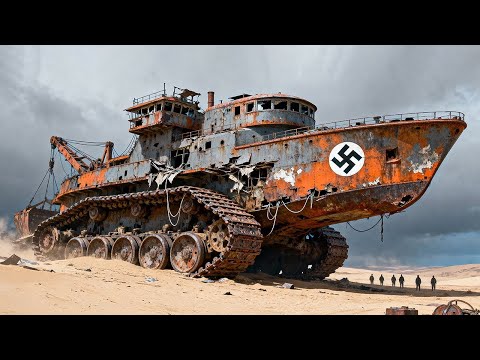
The Landkreuzer P. 1000 Ratte was conceived as the world’s largest tank. In early 1942, at the height of his confidence, Hitler approved one of the most excessive projects of his regime. The idea was proposed by Edward Grote, an engineer at Krupp, who imagined a vehicle so enormous it could be compared to a warship on tracks. His proposal was formalized on June 23 of that year and presented to the Führer himself as a 1,000-ton tank—the heaviest ever conceived.
The design sought to combine the armor of a battleship with the mobility of a land vehicle. The Ratte was to measure 35 meters in length, almost 14 in width, and 11 in height, with a calculated weight of 1,000 metric tons—more than five times that of the Maus, the largest tank Germany actually built. Its frontal armor would reach up to 36 cm thick, made of hardened steel. The planned crew exceeded 20 people and could even have reached 40, handling the engines, cannons, ventilation systems, and internal communications. Its appearance resembled a true mobile fortress.
To move such a mass, engineers planned to use marine engines similar to those employed in ships and torpedo boats. Two configurations were considered: two MAN 24-cylinder engines or eight Daimler-Benz MB 501 20-cylinder engines, together capable of generating more than 16,000 horsepower. In theory, the vehicle could reach about 40 km/h, but in practice, no road or bridge would have supported its weight. The system would even include breathing tubes similar to those of submarines to keep the engines active when crossing deep areas.
Its main armament would be a double turret with 280 mm cannons, the same as those carried by the Gneisenau-class battleships. One of the three original cannons from the naval mount would be eliminated to reduce weight and gain storage space. These weapons would fire explosive and piercing projectiles capable of destroying entire fortifications or enemy tanks at great distance. In addition, the Ratte would be equipped with a 128 mm anti-tank cannon, several 15 mm autocannons, and up to eight 20 mm anti-aircraft cannons placed in defensive turrets. It was also planned to include a compartment with two BMW R12 motorcycles for reconnaissance tasks, a medical area, and even a small toilet—details that reflect the colossal size of the vehicle.
The idea arose in part as a response to reports about the Soviet KV-1 and KV-2 tanks, which had surprised German forces on the Eastern Front. Hitler, fascinated by the idea of creating an invincible machine that imposed fear and power, gave the green light to preliminary development. However, within his own government, Albert Speer, Minister of Armament, was opposed from the beginning. He argued that no logistics system could manufacture or move such a monster. Despite his objections, in December 1942, the plans were completed and the name Ratte was officially registered.
At the beginning of 1943, Speer finally managed to get the project cancelled. His reasons were evident: the tank could not cross bridges, it would destroy the roads it passed through, and it would get trapped in any terrain. Its size made it a perfect target for Allied aviation, and its theoretical speed did not compensate for its vulnerability. Furthermore, no railway could support its weight, nor were there tunnels wide enough to transport it. In practice, it was impossible to use. After the end of the war, the project documents were found in a bunker near Berlin, along with other equally unfeasible designs. Thus ended the history of the largest tank that Germany dreamed of building—a colossal steel fantasy that never rolled.
In 1944, when the war was clearly tilting against Germany, the engineers at Focke-Wulf received orders to create a new type of aircraft that could defend the airspace without depending on runways. The continuous Allied bombings had destroyed many bases, and the high command needed an aircraft capable of taking off and landing vertically from any available terrain. This ambitious project was named Triebflügel—a German word meaning “thrust wing.” The design was so unusual that it resembled nothing known. Instead of traditional wings, the Triebflügel had a large central rotor placed in the middle of the fuselage. That rotor had three long blades, and at the tip of each, a small jet engine was installed.
To start the movement, the apparatus would use auxiliary rockets. Then, when the blades spun at sufficient speed, the air would activate the main engines—called ramjets—which would keep the rotor spinning continuously. It was a mixture between helicopter and jet fighter, a concept ahead of its time. On the ground, the aircraft rested on its tail, and its cylindrical body was reinforced with four cross-shaped fins that served to stabilize it and control its orientation. At the base, it had a main cushioned wheel, and at the end of each fin, small swivel wheels that helped maintain the vertical position before takeoff. The entire landing gear folded inward once the apparatus switched to flight mode.
The pilot sat in the front part of the fuselage, right below the rotor. From there, he had to control the tilt of the blades, which determined both speed and lift. The fuel was stored in tanks inside the fuselage and distributed through an internal pipe system to the engines at the tips. One of the most innovative points of the design was that it did not generate counter-torque, since the ramjets spun on their own, eliminating the need for a tail rotor as in conventional helicopters.
During takeoff, the blades tilted to generate vertical thrust, lifting the aircraft as if it were a rocket. Once a certain height was reached, the pilot had to gradually tilt the craft until placing it in a horizontal position. At that moment, the blades functioned as giant propellers, propelling the plane forward at high speed. To maintain level flight, the apparatus had to keep a slight upward angle, and that is why the nose cannons were designed with a tilt that compensated for that position.
The planned armament was notable for its size: two 30 mm cannons and two 20 mm cannons mounted in the front. If built, the Triebflügel would have been capable of attacking Allied bomber formations from short range, destroying them with a few shots. According to calculations, its maximum speed could approach 1,000 km/h—an impressive figure for a project of that era. Landing, however, was the most dangerous part. The pilot had to reduce speed, slow the rotation of the blades, and return the craft to a vertical position. At that moment, his view was oriented toward the sky, and the ground was out of his field of vision, making it extremely difficult to calculate the distance when landing. In addition, the spinning blades blocked almost all rear visibility. Even the Focke-Wulf engineers themselves admitted that this maneuver was very risky and would require pilots with exceptional training.
Only a wooden model was built, used for wind tunnel tests where its aerodynamics and stability were studied. Before a functional prototype could be developed, Allied troops occupied the facilities and the project was cancelled. The plans and documents were confiscated and later analyzed by American engineers, who studied the concept for several years, though they never applied it to any subsequent development.
The Kugelpanzer is one of the most enigmatic projects of the Third Reich. Its appearance seemed more like an experiment than a war vehicle: a metal sphere with a small rear hatch and a front slit for observation. Only one known exemplar was built, and its fate ended in Soviet hands at the end of the Second World War. To this day, its exact function remains a subject of debate among historians and military technology experts. It was discovered in Manchuria in 1945 when the Red Army occupied Japanese facilities in Harbin and Mukden. Among the seized vehicles appeared this round machine, painted gray and with a barely visible serial number. The Soviets transported it to the Kubinka Tank Museum near Moscow, where it is still preserved.
Its German origin is confirmed by the internal parts, which bear Reich industrial seals. Although there is no official record of its development in the German army archives, the vehicle had a completely spherical structure formed by two large metal wheels that served both as hull and rolling system. At the rear, it had a third smaller wheel that acted as a stabilizer. It measured around 1.5 meters in width and 1.8 meters in height, with an approximate weight of 1.8 tons. Its armor, only 5 mm thick, protected only against light weapons, suggesting that it was not intended for direct combat, but for observation or support tasks.
At the rear was a hinged hatch large enough for a crew member to enter and sit in the center. In front of him was a narrow peep hole and two side slits for observation. Direction and speed control was done with two levers, similar to those of German light tanks. It carried no installed armament, although some reports mention an internal mount for a radio or optical sight. The engine, located at the rear, was a single-cylinder air-cooled one with about 25 horsepower, probably taken from a motorcycle. Thanks to it, it could reach between 6 and 8 km/h on flat terrain. Soviet tests showed that the vehicle moved with stability but was difficult to maneuver on slopes. Its range did not exceed 40 km, and the suspension system was very rudimentary. The wheels were attached directly to the chassis, causing irregular movement on hard surfaces.
There are no records of series production or official usage orders. German experimental projects were usually identified with the VK acronym, but the Kugelpanzer never appeared under that classification, reinforcing the idea that it was an isolated prototype. Due to its size and characteristics, experts believe it may have been designed as an observation vehicle or perhaps for laying communication cables under enemy fire. Another theory links it to artillery reconnaissance tasks, where the operator could advance protected to adjust fire. The fact that it was found in Asia has given rise to theories about its shipment to the Imperial Japanese Army as a technological sample. During the war, Germany and Japan exchanged military projects, and some models, such as Type 9 submarines, were sent to the Pacific. It is possible that the Kugelpanzer was part of one of those exchanges, although there is no documentary evidence to confirm it, nor evidence of its use by the Japanese.
Today, the Kugelpanzer remains a historical mystery. It is preserved unrestored at the Kubinka Museum, showing its strange metallic silhouette and its empty interior. Its origin, purpose, and true tactical value remain unknown.
Other designs followed the same arc—brilliant on paper, impossible in the field. The Dornier Do 335 Pfeil, with its push-pull twin engines, became the fastest piston aircraft of the war, yet barely 35 were built and none saw combat. The Messerschmitt Me 323 Gigant hauled tanks through the air, but its slow, canvas-covered bulk made it a floating target. “Flying with a winged building,” pilots called it—and dozens were shot down in a single afternoon.
Some machines were never meant to return. The Fieseler Fi 103R Reichenberg, a manned V1, demanded a pilot guide it to the target and leap out seconds before impact. Even Hitler hesitated. “The idea was ineffective and morally unacceptable,” argued Adolf Galland—and the suicide weapon was shelved.
Others were pure sabotage: the Schienenwolf, a steel hook that tore rails like paper, delaying the Soviet advance by days. And the Borgward IV, a remote-controlled demolition tank, foreshadowed the unmanned vehicles of a distant future.
In the end, these 20 machines shared one fate. They were not defeated by enemy fire, but by their own excess—too heavy, too slow, too late. What remains are blueprints and rusting hulls, monuments to genius misused.
If one of these machines had reached the battlefield in time, could it truly have changed the war—or was Germany’s obsession with wonder-weapons the real defeat? Share your thoughts below.
Report this article
Select a reason for reporting:






