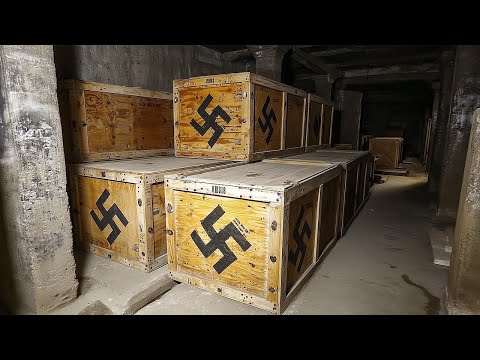
In the quiet town of Hagen, Germany, a construction crew renovating an old school attic made a discovery that would send shockwaves through the community. Behind a crumbling wall, they found a secret compartment, carefully sealed for over 75 years. Inside, wrapped in meticulous preservation, lay an intact Nazi stash—flags with swastikas, armbands, photographs of Adolf Hitler, and Hitler Youth documents. The objects were so well-preserved that the colors remained vivid, as if time had stood still. This was no random collection; it was a deliberate attempt to conceal a dark ideology, hidden in plain sight.
But this was just one of many astonishing discoveries from World War II that have resurfaced decades later. From the icy depths of the Arctic to the murky bottom of the Atlantic, from hidden bunkers beneath Berlin to a counterfeit operation that nearly destabilized Britain, the remnants of the conflict continue to emerge, each find offering a new window into the past. These are not just relics; they are time capsules, holding secrets that were meant to stay buried.
In 2004, Russian explorers pulled a Bell P-39 Airacobra from a frozen lake in the Arctic, almost perfectly preserved with the pilot’s remains still inside. The American fighter, supplied to the Soviets under Lend-Lease, had crashed during a training mission in 1944. Its discovery not only solved a decades-old mystery but also honored a forgotten hero. Similarly, in 1989, oceanographer Robert Ballard located the wreck of the battleship Bismarck at a depth of nearly 5,000 meters, resolving debates about its final moments.
Then there was the Panther tank found in a private basement in Germany in 2015, fully operational and ready for war. The owner, a 78-year-old collector, had hidden it for decades along with Nazi-era rifles and a bronze statue of Hitler. The case sparked a national debate about the fine line between historical preservation and glorification. And in 2022, crates of gold ingots marked with Reich symbols were recovered in Poland, hidden by officers fleeing the Eastern Front.
Each discovery brings with it uncomfortable questions. What do we do with these artifacts? How do we remember a past that many would rather forget? As we delve into these 20 most amazing discoveries, we uncover not just the physical remnants of war, but the stories of those who lived through it, and the secrets they tried to take to their graves.
In the Austrian Alps, another secret lay submerged for decades. Lake Toplitz, a deep, dark body of water surrounded by thick forest, became the final resting place for one of the most audacious deception operations in history. Beginning in 1942, the Nazis had forged British pound notes with such precision that even bank experts could not tell them apart. The plan, known as Operation Bernhard, was to flood the United Kingdom with counterfeit currency and cripple its economy.
The operation produced more than 130 million counterfeit pounds—the largest currency counterfeiting scheme ever devised. But as the Third Reich crumbled in 1945, the printing plates, documents, and vast bundles of fake notes were transported to the Austrian Alps and dumped into Lake Toplitz. For years, rumors of sunken Nazi gold drew treasure hunters to the lake, but what they found was stranger: waterlogged crates of counterfeit banknotes, some still legible, along with printing equipment and secret documents.
Today, these forged notes sit in museums like the Bank of England Museum, silent witnesses to a war fought with ink and paper as much as with bullets.
Far to the north, in the frozen waters of Lake Marti Yava in the Russian Arctic, another time capsule waited. In 2004, explorers discovered a Bell P-39 Airacobra, an American fighter supplied to the Soviets under Lend-Lease, almost perfectly preserved beneath the ice. The aircraft had crashed during a training mission in 1944, and inside the cockpit lay the remains of its pilot, Lieutenant Ivan Baranovski.
Thanks to the extreme cold, the plane’s original markings were still legible, and its instruments remained intact. The discovery allowed Baranovski to finally receive the military honors he had been denied for sixty years. The restored Airacobra now stands at the Central Museum of the Russian Air Force in Monino, a symbol of the unlikely alliance between the United States and the Soviet Union.
But the Arctic was not the only place where the war’s ghosts lingered. In the depths of the Atlantic, the battleship Bismarck rested in silence. When Robert Ballard located it in 1989, the hull was almost intact, the Imperial Eagle still visible on the bow. Detailed analysis of the wreck settled a long-standing debate: the Bismarck had not been sunk solely by British shells, but deliberately scuttled by its own crew to avoid capture.
The site was declared a war grave, and no commercial exploration has ever been permitted. More than 2,000 men died when the ship went down, and their descendants have made pilgrimages to the coordinates, dropping wreaths into the sea above the wreck.
In the Pacific, another giant waited. The Musashi, twin sister to the Yamato, was one of the largest battleships ever built. It sank in 1944 during the Battle of Leyte Gulf after taking at least 19 torpedoes and 17 bombs. For decades, its location remained unknown until 2015, when an expedition led by Microsoft co-founder Paul Allen found it at a depth of over 1,000 meters in the Sibuyan Sea.
Underwater footage revealed the ship’s massive gun turrets and recognizable bridge structures, frozen in the darkness. The discovery was hailed in Japan as an act of remembrance, and many descendants of the fallen sailors expressed their gratitude.
But the sea was not the only place where the war’s secrets lay hidden. Beneath the streets of modern Berlin, another kind of ghost waited in the dark. The Führerbunker, Adolf Hitler’s last refuge, had been sealed and erased from maps by the Soviets after the war. For decades, its exact location was a mystery, fueling conspiracy theories and wild speculation. It wasn’t until after German reunification that historians finally pinpointed the site—a nondescript parking lot near the Brandenburg Gate.
In 2006, a discreet information plaque was installed, marking the spot where the Nazi regime met its end. The bunker itself remains partially intact beneath the asphalt, its concrete walls and sealed corridors inaccessible to the public. The German government has taken strict measures to prevent it from becoming a shrine for extremists. There is no monument, no museum—only a sober plaque and the weight of history.
In the quiet village of Bletchingly, Surrey, a very different kind of secret was found in 2012. A resident renovating his fireplace discovered the bones of a carrier pigeon, a small red cylinder still tied to its leg. Inside was a coded message, written in a series of cryptic abbreviations and sent by an agent in occupied Normandy shortly after D-Day.
Despite the efforts of experts at GCHQ, the code has never been broken. It remains one of the last unsolved messages of the war, a tiny capsule of espionage trapped in a chimney for nearly seventy years. The pigeon and its message are now housed at the Bletchley Park Communications Museum, a silent testament to the birds that served as vital messengers in wartime.
Far from the skies of England, another secret lay beneath the waters of Lake Michigan. During the war, the US Navy used the lake as a training ground, and more than 300 aircraft sank in its depths. In 2009, one of them—a Douglas SBD-5 Dauntless dive bomber—was recovered almost intact from a depth of 60 meters. The cold, fresh water had preserved the fuselage, controls, and even the cockpit instruments.
After years of restoration, the aircraft was delivered to the National Naval Aviation Museum in Pensacola, Florida. It now stands as a tribute to the pilots who trained far from the front, their silent work essential to victory.
In the forests near Smolensk, Russia, a far darker discovery had emerged decades earlier. The Katyn mass graves, found in 1943, contained the bodies of more than 22,000 Polish officers and intellectuals murdered by the Soviet NKVD in 1940. For nearly fifty years, the Soviets blamed the Nazis, and the truth was suppressed. Only after the fall of communism did Russia officially acknowledge its responsibility.
Today, the Katyn Forest is a place of mourning, with a joint Polish-Russian memorial complex inaugurated in 2000. The exhumed bodies, many still in uniform with stopped watches and letters in their pockets, remain a powerful reminder of a crime that history tried to bury.
And in the Atlantic, another kind of treasure was waiting. The SS Gairsoppa, a British freighter torpedoed by a German U-boat in 1941, sank with more than 200 tons of silver ingots destined for the British treasury. In 2011, the American company Odyssey Marine Exploration located the wreck at a depth of nearly 5,000 meters—the deepest salvage of precious metals in history.
Over 1,200 silver ingots were recovered, each marked with inscriptions from the Royal Mint and banks in British India. The cargo was shared between the company and the British government, and the ingots are now displayed in museums as a testament to the price of war.
In Vilnius, Lithuania, a different kind of treasure had been buried—not silver, but words. Before the war, the city was known as the Jerusalem of the North, home to one of the most vibrant Jewish communities in Europe. When the Nazis occupied Vilnius in 1941, a group of Jewish prisoners known as the Paper Brigade was forced to sort and pack confiscated books and manuscripts. Risking their lives, they hid a significant portion of this heritage in metal boxes and beneath the floors of abandoned buildings.
It wasn’t until 2017 that archaeologists using ground-penetrating radar located a cache beneath a library in Vilnius. More than 170 rare books, religious manuscripts, and community documents were recovered, written in Hebrew, Yiddish, and Lithuanian. They were the words, ideas, and prayers of a community that Nazism had sought to erase.
As these discoveries continue to emerge—from the depths of the ocean to the walls of ordinary buildings—they remind us that the past is never truly buried. Sometimes it waits in silence, just a few centimeters beneath the surface, until a hammer blow or a sonar ping brings it back into the light.
Some secrets, however, were never meant to be found. In the Bavarian town of Mittenwald, a hiker stumbled upon a rusted metal box half-buried beneath a fallen tree in 2019. Inside lay a diary, its pages brittle but legible, written by a young Wehrmacht soldier named Friedrich. The final entry, dated April 29, 1945, read: “They are coming from the west. I have hidden the eagle where no one will look—beneath the feet of the innocent.”
Historians traced the diary to a nearby church, where, after weeks of careful excavation, they found a bronze Nazi eagle buried beneath the stone floor of the children’s confessional. The symbolism was chilling: a regime’s symbol hidden under the feet of those it had indoctrinated.
Today, the eagle sits in a museum case, not as a trophy, but as a warning. “We do not display these objects to glorify,” the curator explained. “We display them so that no one can ever say it didn’t happen.”
Each discovery—the tank in the basement, the gold in Poland, the words in Vilnius—forces us to confront a simple truth: the past is not a distant country. It is a neighbor who never moved away.
So what would you do if you found a piece of history hidden in your own home? Would you keep it, destroy it, or share it with the world? The answer may say as much about us as it does about the past.
Report this article
Select a reason for reporting:






