December 1944. The Ardennes Forest, Belgium. The coldest winter in a generation. Before dawn on the 16th, German guns opened up along a front the Americans thought was quiet. In the snow, a GI clutched a weapon that looked like a mistake—two pieces of stamped sheet metal, a wire stock, a barrel screwed onto a tube. It cost $20.94. The men called it the grease gun. Across the frozen hills, the enemy carried some of the finest small arms of the war. Before the snow melted, that ugly little tool would earn one man the Medal of Honor and outlive every beautiful weapon that ever looked down on it.
But the story you’ve heard—the one about German soldiers laughing at the cheap American gun until their own precision weapons froze solid—is mostly a myth. And the truth is far more interesting. The grease gun wasn’t a lucky accident. It was a cold, calculated bet on arithmetic over elegance, and it would be tested in the bloodiest battle the U.S. Army fought in Europe.
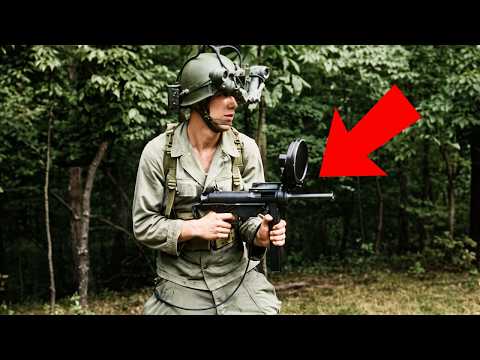
Aberdeen Proving Ground, Maryland. Autumn 1942. Ordnance officers dragged a strange new gun through mud, sand, and grit. It kept firing when finer weapons choked. It was crude, homely, and exactly what America needed.
The country was raising an army of millions and shipping it across two oceans. It couldn’t build enough Thompsons—the beloved, beautifully machined submachine gun that cost $45 and hours of skilled labor. For the price of one Thompson, America could arm two men with the ugly gun. In a war measured in millions, that gap was decisive.
George Hyde, a German-born designer, threw away everything expensive. The grease gun had 73 parts. Two pieces of stamped steel welded together. Only the bolt and barrel needed machining. It could be built by workers who had never made a gun, in a factory that had never made a gun. The contract went to Guide Lamp Division of General Motors—a company that made headlights.
The early guns were a disaster. Workers ran the welds too hot and warped the receivers. Inspectors rejected nearly 20,000. But once fixed, the line wouldn’t stop. The grease gun was born.
On paper, it looked unimpressive. It fired the fat .45 caliber round from a 30-round magazine, cycling slowly at 450 rounds per minute. A slow gun is a controllable gun. Where faster weapons climbed off target, the grease gun thudded out heavy rounds a man could aim. Across a room, across a street, it was murderous.
It went to war on D-Day, jumping into Normandy with the paratroopers. Some loved it—no assembly needed, just yank the bolt and fire. Others called it junk. Both opinions would follow it for the rest of its life.
Then came the Ardennes. On December 16, 1944, Hitler hurled his last reserves through the same forest that had stunned France in 1940. Fog pinned the Allied air forces to the ground. The fighting fell to men on the ground, at the range of a rifle, a grenade, a submachine gun.
Among the American armor was the 761st Tank Battalion—the Black Panthers, an all-black unit in a segregated army. A famous photograph shows one of their tank commanders, Corporal Carlton Chapman, sitting in his hatch, his grease gun resting beside him. That’s where the gun lived. For a tank crewman, the worst moment came when a German shell found the hull. The inside filled with smoke and fire. A man clawed out into the snow, into the open, with enemy infantry close enough to see his face. What he grabbed on the way out was the little grease gun. It was the weapon of the worst seconds of a tanker’s life.
For the infantry, the grease gun found its purpose on patrol and in the villages. A squad crosses a white field toward stone houses. The door goes in. The first man through has a second to decide who in that dark room is a threat. A bolt-action rifle gives him one shot. The grease gun gave him 30. He could sweep a room, a stairwell, a cellar with a hammering burst of heavy slugs. It was brutal, and it was exactly what that kind of fight rewarded.
The men noticed. Small unit leaders of the 99th Infantry Division wrote it into an official report: “The M3 submachine gun is the best weapon we use for patrolling.” Coming from men who had complained about the same gun a year before, that was as close to affection as the grease gun ever got.
And then there was the house at Rimling. January 8, 1945. Technical Sergeant Charles Carey Jr. of the 397th Infantry Regiment went to work with a grease gun in his hands. German infantry and armor had pushed into the town. Snipers held the houses. Carey led a small group forward through the fire, and then he did something the official record can barely hold. He walked up to a building full of enemy soldiers alone with the little .45 caliber gun. The Medal of Honor citation records what happened next in a single staggering sentence: “He entered alone, and a few minutes later emerged with 16 prisoners.”
Acting on what those men told him, the Americans pulled 41 more Germans out of the houses around it. Carey wasn’t finished. Over the next day, he grabbed a bazooka and knocked out a German tank, then cut down its crew as they scrambled clear, then went back out under fire again and again for the wounded. On January 9, a German sniper found him. He was killed leading from the front, the same way he had fought for two days straight.
He received the Medal of Honor after his death for a stand in the snow that began with one man and a $20 gun walking into a house full of the enemy—and walking back out with 16 of them marching in front of him. That is the promise the ugly little gun actually kept. It kept it in a real town on a real day in the hands of a real man who did not come home. No frozen German rifles required.
So who were the men on the other end of that grease gun in the snow? They were not a cartoon. The German soldier in the Ardennes was often a hardened professional, well armed with bolt-action Mausers, the reliable MP 40, the terrifying MG 42, and in growing numbers the Sturmgewehr 44—the first true assault rifle, a generation ahead of anything the Americans carried. The comforting idea that the grease gun faced a beaten, ragged enemy is another myth. This was the largest and bloodiest single battle the U.S. Army fought in the war, and the Germans coming through the snow were among the best-armed soldiers on the planet, fighting with the fury of men who knew this was their last real chance to win in the west.
And some of those German troops were far worse than professional. The spearhead of the northern attack was a battle group of the 1st SS Panzer Division led by Joachim Peiper. On December 17, in a snowy field near Malmedy, Peiper’s men machine-gunned more than 80 American prisoners of war. Not far away, they murdered 11 Black American soldiers of the 333rd Field Artillery Battalion in the village of Wereth. Whatever their skill as soldiers, these were men who slaughtered captives and the helpless. That is the enemy those men had to stop at close range, and it is worth remembering exactly what was at stake in those frozen villages.
But honesty cuts both ways, and the grease gun carried real faults that no legend can paper over. Its worst weakness was its magazine. It fed rounds up in a single stubborn column that jammed easily the moment dirt or grit got in, and it was miserable to load by hand. The catch that held the magazine was loose, and magazines had a habit of dropping off on their own. A correspondent for the Army magazine Yank, Sergeant Mack Morris, watched infantrymen bend that loose catch with a ball hammer just to make it grip. The original cocking handle was another weak point—a fragile little crank that could snap clean off if the gun was dropped or banged hard, leaving a soldier holding an expensive club.
The army fixed the worst of it late in the war with an improved model, the M3A1. The redesign strengthened the flimsy rear sight and the loose magazine catch, opened up the ejection port so it fouled less, and turned the wire stock itself into a set of tools—a barrel wrench, a cleaning rod, and a loader for that miserable magazine. But there was one flaw no redesign could ever reach. The grease gun had been sold as a throwaway, a weapon a man could break and leave in the mud. That throwaway idea made far more sense in a factory than it ever did to a soldier stranded behind enemy lines with a broken gun in his hands.
The gun was never a refined weapon, and the men who carried it never pretended otherwise. It was crude, it was cheap, and it worked well enough at the distance that decided a close fight. In that war, well enough multiplied by hundreds of thousands was a war-winning idea.
Here is the part that should settle the argument for good. The grease gun was designed to be almost disposable. It was so cheap the army half expected to use it up and toss it aside. Instead, it refused to die. It fought through the rest of the Second World War, then Korea, then Vietnam. Its afterlife reads like a tour of the entire Cold War. When Korea came, the Ithaca Gun Company built more than 30,000 more. China copied it outright. Argentina built its own version. American special operators carried silenced grease guns through the jungles of Vietnam, the fat .45 caliber round leaving the muzzle with almost nothing but a whisper. American tank crews were still stowing the M3A1 in their vehicles into the 1990s, still reaching for the same stubby weapon when they rolled toward the Gulf War. It became the longest-serving submachine gun in the history of the United States military. The weapon the army had built to use up and throw away was still in armories half a century on.
The men who first cursed it in Normandy were gray-haired grandfathers by the time it finally went out of service. The beautiful guns did not last like that. The finely made weapons of that war sit behind glass now in museums and private collections, admired for exactly the craftsmanship that made them slow and costly to build.
Which brings us back to that soldier in the snow of the Ardennes holding a weapon that looked like a mistake. Two pieces of stamped metal, a wire stock, a barrel on a tube. It was never built to be admired. It was built to be counted and handed to one more man and one more after him until there were simply too many of them to ever be stopped. They laughed at the $20 gun that looked like something off a garage bench, and that $20 tool was still standing, still firing, still doing its ugly honest work in the cold long after the war that mocked it had ended.
But the men who carried it into the Ardennes did not know any of that. They knew only the cold, the dark, and the next tree line. And for one of them, the little gun would become something else entirely—a tool of survival in a battle that had only just begun to show its true face.
The snow did not care about medals or myths. It fell on the dead at Malmedy and the living at Bastogne alike, and it fell on the grease gun in a thousand frozen fists. What the Ardennes proved was simpler than any legend: wars are not won by the most beautiful weapon, but by the one you can put into the most hands before the enemy reaches the door.
Charles Carey walked into that house with a $20 tool and walked out with sixteen prisoners because the gun did exactly what it was built to do—nothing more, nothing less. It was never elegant. It was never loved. It was simply there, in the hatch, in the snow, in the hands of men who needed it to work.
And when the war ended, the beautiful guns went behind glass. The ugly one kept serving for another fifty years. That is the revenge—not of craftsmanship over crudeness, but of arithmetic over vanity.
So the next time you see a weapon that looks like a mistake, ask yourself: was it built to be admired, or built to be counted? Which one would you want in the snow?
Report this article
Select a reason for reporting:






