If you close your eyes and think of the Vietnam War, what do you hear? For most, it’s the deafening roar of American firepower—the rhythmic wop-wop of Huey blades, the earth-shaking thunder of B-52 strikes, the crack of M16s on full auto. That was the American way of war: overwhelm the enemy with steel and explosives. But deep in the sweltering mangroves of Phuoc Tuy Province, a different war was being fought. Here, the jungle didn’t roar—it whispered. And in that whisper, the Viet Cong heard something far more terrifying than bombs: the silence of the Australian SAS.
They didn’t arrive in a storm of helicopter wash. They didn’t wear steel pots or carry jamming-prone M16s. They wore soft-brimmed bush hats, carried heavy SLRs, and—most unnervingly—they didn’t smoke, talk, or use deodorant. They were the Phantoms of the Jungle, and to the Viet Cong, they were a nightmare American firepower could never replicate.
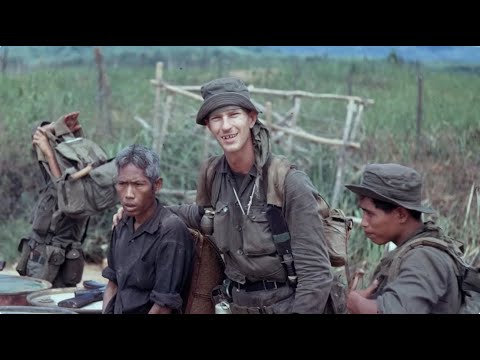
The Viet Cong were masters of the ambush. Against the Americans, they held the initiative—they could smell the tobacco, hear the radio squawk, and vanish before contact. But with the Australians, that equation reversed. Captured documents later revealed a chilling directive: “If you encounter Australians, withdraw immediately. Do not engage unless cornered.” Why? Because the Australians stripped away the insurgents’ greatest advantage: invisibility.
Patrols vanished without a shot. Supply caches were destroyed with pinpoint accuracy, yet no footprints were found. Entire VC platoons felt watched, only to scan the treeline and see nothing but swaying bamboo. They called them Ma Rung—the Phantoms of the Jungle. This wasn’t just a nickname; it was a recognition of supernatural tradecraft.
The Australian SAS operated in small teams—four to six men—moving so slowly they might cover only a few hundred yards in an hour. They didn’t seek to conquer territory; they sought to infest it. They became the eyes and ears the massive American war machine desperately lacked. But this capability didn’t appear out of thin air. These men were the product of a specific, rigorous lineage—the students of the British SAS, forged in the Malayan Emergency and the jungles of Borneo.
While the US military rewritten the book on air mobility and heavy assault, the Australians perfected a deadly art form passed down from their British mentors. The British taught them that in the jungle, silence is more lethal than a machine gun, and patience is the only armor that matters. They learned not to fight the jungle but to merge with it—to move with its rhythm, to use its cover, to become invisible.
By the time the first Australian combat troops arrived in Vietnam in 1965, the SAS had spent nearly a decade honing these skills. They weren’t going in blind. They were entering the war with a polished toolkit designed for exactly this environment. But a classroom is one thing; the exam is another. The Viet Cong were not the Malayan communist rebels. They were better armed, better organized, and backed by the regular North Vietnamese Army. The Americans looked at their light kits, their funny hats, and their bolt-action attitudes with skepticism. They were about to realize that in the thick canopy of Vietnam, a knife in the dark is exactly what you need.
When the Americans went into the jungle, they went looking for a fight. When the Australian SAS went in, they went looking for information. And to get information in Phuoc Tuy Province without getting killed, you had to do something that went against every instinct of a modern soldier: you had to slow down.
The American grunt saw the jungle as a green hell of vines and wait-a-minute thorns—an obstacle to bulldoze. Patrols hacked through vegetation with machetes, moving with urgency, their progress marked by snapping branches and radio chatter. The SAS patrol, by contrast, didn’t look like a military maneuver. It looked like a hunt.
They moved in what became known as the SAS shuffle. A point man wouldn’t stomp his boot down; he’d place the toe first, rolling weight gently to the heel, feeling for dry twigs before committing. If he felt something snap, he froze. The whole team froze. They would stand like statues in the dripping humidity, sometimes for ten minutes, just listening. Was that a monkey—or the click of an AK-47 safety catch?
This caution meant their pace was excruciating. A standard infantry unit might cover five kilometers in hours. An SAS patrol might take six hours to cover one. To an outsider, it looked like madness. But the point man wasn’t just looking for enemy soldiers—he was reading the jungle like a forensic crime scene.
The British had taught them that the jungle tells a story if you know the language. A broken spiderweb meant someone had passed recently. A leaf turned to reveal its lighter underside meant a foot had scuffed it. They smelled the air for the faint sweet scent of nuoc mam fish sauce or the acrid odor of unwashed bodies—betraying a VC position hundreds of yards away.
This focus required discipline bordering on the inhuman. They called it hard routine. Once inserted—usually by helicopter into a tiny clearing, vanishing into the treeline within seconds—the hard routine began. There was no talking. None. For weeks, men communicated entirely by hand signals: a raised fist for halt, a flat hand for get down, a finger across the throat for enemy.
No campfires. While Americans back at base ate hot chow, the SAS ate cold rations from tins. They didn’t heat water for tea because the smell of burning hexamine could drift a mile. They didn’t smoke, shave, or use insect repellent—the chemical smell was a dead giveaway. They simply let the mosquitoes bite and the leeches latch on.
Imagine the psychological toll. You are deep in enemy territory, outnumbered hundreds to one, soaked in sweat, covered in fungal infections, exhausted. Yet you cannot make a sound. You cannot sneeze. You cannot cough. If you relieve yourself, you bury it immediately and camouflage the spot. You become a ghost in the truest sense—present, but leaving no physical evidence of your existence.
This invisibility gave them a terrifying advantage. The VC felt safe deep in the thick bamboo, believing the terrain protected them. But the SAS didn’t use trails. They moved through the nastiest scrub specifically because the enemy didn’t expect anyone to be there. There are stories of patrols walking right into the middle of VC rest camps before anyone realized what was happening. In one instance, an SAS point man parted some fern fronds and found himself face-to-face with a VC sentry looking the other way, listening for the loud footsteps of American soldiers. The sentry never heard the Australian three feet behind him.
By early 1967, the results were undeniable. The Australians were gathering intelligence of such quality that they were mapping entire tunnel systems and supply routes without the enemy knowing they’d been compromised. But gathering intelligence was only half the job. The British had taught them to watch. Vietnam demanded that they strike.
And when the SAS decided to stop watching and start shooting, the Phantom didn’t just haunt the jungle. It devoured it.
War is often described as long periods of boredom punctuated by moments of sheer terror. For the American infantryman in Vietnam, those moments were usually prolonged—hours of exchanging lead, calling in air strikes, maneuvering flanks. But for the Australian SAS, the war didn’t happen in hours. It happened in seconds.
There is a specific, chilling mathematics to an SAS ambush. It is the practical application of the British hit-and-run doctrine, refined to a razor’s edge. If the art of the shadow was about being invisible, this phase was about becoming a sudden, overwhelming force of nature. The SAS called it the deliberate ambush.
Imagine the scene. You are deep in enemy territory. You are five men. Intelligence suggests a Viet Cong supply column is moving down a specific jungle track. You don’t have a company of Marines behind you. You have your rifles, your wits, and a bag of M18A1 Claymore mines.
The setup is a masterpiece of geometry. The patrol locates a kill zone—a stretch of trail where the enemy is most vulnerable and has nowhere to run. They plant the Claymores, curved plastic boxes packed with C4 and hundreds of steel ball bearings, facing the trail. They camouflage the wires meticulously. Then they wait.
This is where the discipline becomes a weapon. The patrol might wait for twelve hours, twenty-four hours, or even two days. They lie in the dirt, weapon stocks pressed to their shoulders, sweating, cramping, insects crawling over their skin. They do not move. They wait for the optimum moment.
In American doctrine, the tendency was often to open fire as soon as the enemy was sighted—a reaction to a threat. The Australian doctrine was different. You let the enemy walk right into your lap. You let the scout pass. You let the point man pass. You wait until the main body—the officer, the heavy weapons carrier, the radio operator—is directly in front of the Claymores.
April 1967. Route 328, east of Nui Dat. An SAS patrol from 2 Squadron is in position. They have waited eighteen hours. Finally, dusk approaches. A squad of twelve Viet Cong fighters appears, moving confidently, carrying AK-47s, RPGs, and mortar shells. They are chatting quietly, weapons slung over their shoulders. They have no idea that five Australians are lying in the bush less than twenty meters away.
The ambush commander holds the clacker—the detonator for the Claymores. He watches the enemy file into the zone. He counts them. He waits until the entire column is exposed. The silence of the jungle is absolute.
And then the commander squeezes the clacker.
Click.
The explosion is instantaneous and deafening. The Claymores turn the trail into a shredding machine. Thousands of steel bearings scream through the kill zone at waist height. This is the initiation. In that same split second, the five SAS troopers open fire with their SLRs and M16s. But they don’t just spray bullets. They fire controlled, rapid shots into specific targets. The drill is brutal: double tap, two rounds to the chest. If the target is still moving, one to the head.
The violence is compressed, concentrated, and absolute. In the incident on Route 328, the ambush lasted exactly four seconds. Four seconds. In the time it takes you to take a deep breath and exhale, twelve enemy soldiers were neutralized. There was no return fire. There was no maneuvering. The enemy didn’t even have time to unsling their rifles.
But what happened next separates the SAS from almost everyone else. A conventional American unit, having wiped out an enemy squad, would secure the perimeter, radio it in, maybe search the bodies for intel, and wait for a chopper. They would claim the ground.
The SAS did the opposite. They ran immediately.
After the ceasefire signal, the patrol would conduct a search lasting no more than a minute or two—grabbing documents, weapons, or maps—and then they would bug out. Why? Because of the math. The SAS knew that in Phuoc Tuy Province, you were never just fighting a squad. That squad was the tip of an iceberg. The noise of the ambush was a dinner bell for every other Viet Cong unit within three miles. The Australians knew that a reaction force—angry, heavily armed, and numbering in the hundreds—would be on its way within minutes.
The patrol would vanish back into the jungle, moving at a sprint for the first few hundred meters to clear the area, then dropping back into their ghostly, slow-motion stealth. By the time the Viet Cong reinforcements arrived at the kill zone on Route 328, just twenty-four minutes later, all they found were their fallen comrades and the smell of cordite. The Australians were gone. The jungle was silent again.
This tactic was psychologically devastating to the Viet Cong. It wasn’t a battle; it was an assassination. When you fight an American unit, you get a chance to be a hero. You get to shoot back. You get to die for the cause in a blaze of glory. When you met the SAS, you just died.
The VC survivors of other engagements started to spread the word. The Australians didn’t fight fair. They didn’t stand and fight. They struck like lightning and evaporated like smoke. But as terrifying as the ambushes were, the greatest impact the SAS had wasn’t just in the bodies they left on the trail. It was in the minds of the men who were still alive.
The SAS had managed to do the impossible. They had terrified the terrorists.
By 1967, the war had settled into a bloody rhythm, but in Phuoc Tuy, the SAS were inflicting a different kind of damage—not to bunkers, but to the enemy’s mind. Captured VC directives revealed the truth: “Do not engage Australian reconnaissance units unless you are sure of victory. If you encounter them, withdraw immediately.”
An insurgent force was telling its soldiers to run from a handful of men. It wasn’t cowardice—it was survival. The VC commanders realized that firing at four ghosts meant artillery was already inbound, or that the ghosts would hunt them down one by one on the way home.
The numbers told the story. Between 1966 and 1971, the SAS conducted roughly 1,200 patrols. They confirmed 492 enemy killed and captured 106 more. Their own combat losses: three. A kill ratio of 164 to 1.
They paid for it in jungle rot, leeches, and sleepless nights. But they proved that a small group of disciplined men, armed with patience and silence, could paralyze an army. The hunters had become the hunted.
So here’s the question: If you were a Viet Cong commander, would you rather face the roar of American firepower—or the silence of the Phantoms? Let us know in the comments.
Report this article
Select a reason for reporting:






