By the second week of February 1942, Tokyo had already declared victory. Japanese newspapers printed maps of Timor shaded in conquered red, and the operation was filed as complete. Every Allied soldier on the island, the announcements said, had laid down his arms. They were wrong.
Three hundred Australian commandos, hidden in the high country above Dili, had simply missed the announcement—and they weren’t planning to correct it. These were the men of the 2/2 Independent Company, part of a small Allied garrison called Sparrow Force. Their original job was to slow any Japanese push down the island chain toward Darwin, alongside the 2/40th Battalion and a few smaller Dutch and British units. When the Japanese landing came on the 20th of February, it was bigger than anything the planners had prepared for.
The 2/40th fought for three days at Dili airfield, ran out of ammunition by the second night, ran low on water on the third morning, and laid down their arms on the 23rd. The independent companies were a new idea in the Australian army—trained by British instructors who’d run irregular operations in occupied Europe, and given weeks of demolitions, weapons handling, scouting drills, and unarmed combat. The 2/2 was formed in early 1941, drawn mostly from men in Western Australia, and was put ashore at Dili in December of that year, with the Pacific War already breaking open.
The men who arrived in Dili looked nothing like regular infantry, with slouch hats turned up at the side, sleeves rolled, weapons carried slung, and no saluting between ranks. The 2/40th Battalion already on the airfield wasn’t sure what to make of them. The 2/2 had been pulled out of Dili weeks before the landing. Malaria was tearing through the garrison, and the doctors wanted the company moved up into cooler ground for prevention.
While the main battalion was being marched into prison camps, the commandos were sitting on a ridge above the town with rifles, Bren guns, several weeks of rations, and no orders from anyone above them. Their families in Western Australia were already getting the standard telegram about men presumed lost. The decision they made over the next 10 days set the shape of everything that came afterwards.
Major Bernard Callinan and Major Alexander Spence sat down with the senior officers around a small fire in a coffee plantation and worked through the options. Walking out wasn’t possible. The company was on an island and Australia was beyond range without ships. Their answer was to stay on Timor, fight on ground of their own choosing, hold out as long as the country could keep them alive, and try to make contact with home.
Within a week, the company had broken into platoon-sized groups and gone into terrain the Japanese maps barely bothered to mark. The first weeks after the surrender announcement were chaotic. Small parties of commandos moved between villages on foot, trading kit for food where they could, and picking up Timorese guides as they went. Several detachments lost contact with battalion headquarters for 10 or 12 days at a time. By the end of March, runner networks had been put back together and the company was operating again as a single force, even though it never assembled physically in one place.
What followed was a campaign the Japanese never fully understood. The Australians had no air cover, no artillery, and no medical resupply beyond what they carried in. They’d lost their radios in the first days of the invasion and had no way to talk to home. They had Bren guns, rifles, grenades, knives, and the help of the Timorese—which turned out to matter more than anything else they brought onto the island.
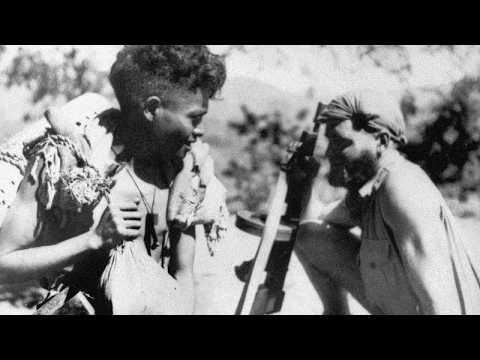
The Timorese decision was immediate and locally made. Whole villages put themselves under the Australians, feeding the commandos out of their own food stores and hiding them in barns and bush camps when the Japanese came searching. Local boys, known as criados, attached themselves to individual soldiers and became guides, scouts, porters, and in some cases shooters. A handful of them were as young as 12. They carried ammunition up mountain paths that grown men struggled with in the heat. The relationships between the commandos and their criados became close enough that several Australians later said the boys had been the only thing keeping them alive in the bush.
The criados gathered intelligence the Australians could never have got on their own. Boys walked openly into Japanese positions to draw water or sell vegetables, counting weapons and soldiers, and walking back out the same afternoon. The information they brought back let Australian sections set up ambushes on roads the Japanese had assumed were quiet—and many of those boys were lost when the Kempeitai sweeps started.
By the middle of March, the Australians had a working intelligence network across most of Portuguese Timor. They knew which villages were safe and which had been compromised by Japanese pressure. They knew which roads the patrols used and which Japanese officers ran which sectors. The commandos began ambushing supply columns on the road between Dili and the interior, hitting them hard then disappearing back into the bush before any pursuit could form. The Japanese sent platoons after them and the platoons came back missing men.
Tokyo’s first response was to send more men. By the end of March, fresh Japanese infantry were arriving in Dili by ship and patrols were sweeping the hills in company strength. The patrols achieved nothing. Australian sentries watched them go past from positions in the high grass and reported their movements down the line by runner before the Japanese had finished crossing the next ridge.
But the campaign had a clock on it. Without contact with Australia, the company would burn through its ammunition and medicine and slowly starve in the hills. Spence and Callanan needed a radio.
The radios they’d brought with them had been destroyed during the first weeks of the invasion, and the only way to get a message out was to build a transmitter from whatever could be scavenged across the Japanese-held island. The signalers were given the job. Sergeant John Sergeant, Signaler Max Loveless, and a small team began stripping every piece of electrical gear they could lay hands on.
Parts came from an abandoned Dutch transmitter dumped in a ravine outside Dili. The generator came from a wrecked civilian car at the edge of a coffee plantation. A household radio receiver was pulled from an empty Portuguese house, with an antenna strung out of insulated copper wire between two trees on a cleared ridge. The first transmission went out on the 19th of April.
The signallers called the rig Winnie the War Winner after Churchill, and they keyed Morse code into the static for hours over two days. Darwin picked them up on the second evening. The duty operator at the receiving station didn’t believe the message at first and demanded confirmation. The signallers came back with names of officers, unit codes, identifying signal phrases, and personal details only the 2/2 would know.
The first signal Darwin got was a single call sign sent three times in Morse: Timor Force. The operator at the Australian end thought it was a Japanese deception trick. The signallers worked through code phrases for the better part of a day before headquarters in Darwin accepted the message as real. By that evening, the news was on its way to General Blamey’s office in Brisbane.
Headquarters checked the names against the records. The men Tokyo had announced as captured or lost two months earlier were transmitting from Portuguese Timor and asking for resupply. The signal also carried the first list of Australian losses since the invasion. Several of those names had already been written into next-of-kin telegrams that hadn’t yet been mailed to Western Australia.
Within a week, the Royal Australian Navy was planning the first supply run. The corvette HMAS Kuru ran into the south coast of Portuguese Timor at the end of May, dropping crates of ammunition, food, medicine, replacement boots, and signal stores onto an isolated beach south of Suai. The Voyager, the Vendetta, and several smaller ships followed across the next months. The runs were done at night without lights, navigated by dead reckoning, and the crews had to be back over the horizon before Japanese aircraft began their dawn patrols.
The supply chain ran on a thin margin. HMS Voyager was lost on the run in September 1942, grounded on a reef off Betano Bay while running stores in. The crew got off and was extracted by a second ship, but the wreck stayed visible from the beach for the rest of the war. The Japanese never quite worked out which beaches the Australians were using.
The campaign settled into a rhythm. The Australians struck Japanese columns on the roads, picked off isolated outposts, blew bridges, and pulled back into the high country before the response could form. They had information the Japanese couldn’t match. Every Timorese with a goat track in his head was reporting to them within hours. The Japanese had armor, aircraft, artillery, and numerical superiority of about 40 to 1. None of it helped them find men who weren’t where they were looking.
A typical ambush was put in by a platoon of about 30 men on a stretch of road where the bush came close to the verge. The men dug in along 100 meters of cover with Bren guns covering each end of the kill zone and grenadiers placed in the middle. They waited for the Japanese column to commit fully into the trap before opening fire. The fire lasted 90 seconds at most, then the Australians were back over the ridge before any Japanese reinforcement could close from either side.
In June, a section ambushed a Japanese supply column on the road to Aileu and burnt the trucks where they sat. The garrison commander in Dili sent a battalion up the road to find the raiders. The battalion arrived to find no Australians, no Timorese willing to talk, the burnt remains of the supply trucks sitting across the road blocking it, and the heavier axles dragged off into the bush by villagers for scrap. The road itself stayed closed for two weeks while engineers cleared it.
The Japanese tried air reconnaissance, ground sweeps, infiltration patrols, and bribery of local Timorese leaders through the second half of 1942. The air patrols couldn’t see anything under the bush canopy. Ground sweeps walked into ambushes set up by the men they were hunting. Infiltration patrols made up of small parties pretending to be civilians were spotted by the criados the moment they came into a village. By the end of October, Japanese intelligence in Dili admitted in writing that they had no clear idea where the Australian main body was on any given day.
Tokyo’s commanders in Dili started losing patience with their own field reports. The papers going up the chain admitted that the operation in Portuguese Timor had become a real fight rather than a cleanup. Australian raids were costing the garrison vehicles, supplies, fuel, and lives, and the units sent up into the hills came back depleted without prisoners or results. By June, Japanese intelligence officers were estimating the Australian force at over a thousand men. The real figure was 300 and falling slightly through casualties and sickness.
Tokyo decided to try something other than a manhunt. They had an Australian honorary consul in custody, David Ross, caught up in the invasion and held in Dili since February. They sent him into the hills under a white flag with a written demand for surrender from the senior Australian officer. Ross walked for days through Japanese checkpoints and Timorese country until he found Spence’s headquarters in a small village in the interior.
Spence read the document. Then he sent Ross back with a verbal answer that the company quoted to itself for the rest of the war. The cleaned-up version is that the Japanese could keep their offer. The original wording, paraphrased here, was four words long and very direct about what the Japanese could do with the demand. Ross delivered it to the garrison commander in Dili exactly as he’d received it.
The reply came in the form of a leaflet drop two weeks later. The leaflets declared the Australians outlaws—bandits, in the Japanese phrasing—and stripped them of any claim to prisoner of war status under the Geneva Convention. Any commando taken alive would be shown no mercy at the place of capture. The leaflets ended up pinned in Australian bivouacs as wallpaper.
The Japanese followed through. Captured Australians were lost on the spot through the rest of 1942, and the pattern wasn’t limited to the commandos. The Japanese began punishing the Timorese for the help they’d been giving—burning villages where the Australians had sheltered, taking headmen who had to sign guides, detaining families for interrogation. The Kempeitai ran the operation, and they ran it carefully and at scale.
By August, the Japanese had decided that the only way to finish the Australian campaign was to remove the country underneath it. They moved fresh battalions in from the Dutch East Indies, bringing the total Japanese force on Timor to around 12,000. The new mission was to make sure no Timorese could afford to feed the commandos, and the policy was carried out village by village across the interior.
The counteroffensive that began in August was led by units of the 48th Division, with Kempeitai detachments attached for population control. The biggest single engagement ran across a feature the Australians called Three Spurs, where platoons held off battalion-strength attacks for most of a day before pulling back into the bush. Japanese losses across the operation ran into the hundreds. The cost to the local population became unsustainable.
Tens of thousands of Timorese were lost across the year of fighting and the longer occupation that followed. Some had helped the Australians directly; most weren’t even involved. Families that had fed Australian patrols in March were no longer alive by November. Every village that fed them was being marked for destruction by the same Kempeitai patrols hunting them.
In September the 2/4 Independent Company came ashore on the south coast, bringing fresh men and ammunition and orders to push deeper into Dutch Timor. For three months the combined force pinned an entire Japanese division into defensive postures. The strategic effect was bigger than anyone in the field could see: 12,000 Japanese soldiers on Timor were 12,000 who weren’t on the Kokoda Track.
By December the cost had become unbearable. Headquarters ordered the withdrawal. Through December and into January 1943, the Navy lifted men off the southern beaches in small parties under cover of darkness, the seriously ill carried down by stretcher. The Japanese shelled the coast through the New Year and missed others entirely. The last lift went out in mid-January, almost a year to the day after the landing.
The arithmetic told the story. Japanese losses on Timor were over a thousand men, with far higher figures in wounded and equipment destroyed. The 2/2 had lost 22 men across the whole war, about 10 of them on Timor. The next-of-kin telegrams that hadn’t yet been mailed were quietly destroyed in Western Australian post offices.
Winnie the War Winner came home and now sits in the Australian War Memorial in Canberra—a few valves and wires on a wooden frame, the smallest piece of equipment in any display case in the building. The label tells the visitor that it’s a radio. It doesn’t tell them that the signal this rig sent in April 1942 was the first proof that 300 Australians on a Japanese-held island had been running their own war for two months without anyone in the world knowing they were still alive.
What do you think history owes the Timorese who paid for that signal with their villages?
Report this article
Select a reason for reporting:






