The evening of June 23rd, 1942, was winding down at RAF Pembrey in South Wales when a sound cut through the dusk—a deep, uneven growl that belonged to no British engine. Ground crews froze. Banking calmly into the landing circuit was a Focke-Wulf 190, its black crosses unmistakable. It was not under attack. It was not being chased. It was simply lowering its landing gear as if coming home.
What none of the men on the ground knew yet was that this single aircraft was about to hand the Royal Air Force the answer to a problem they had been desperate to solve for almost a year. And what the German pilot climbing down from the cockpit did not know was that the moment his boots touched British tarmac, his war was over.
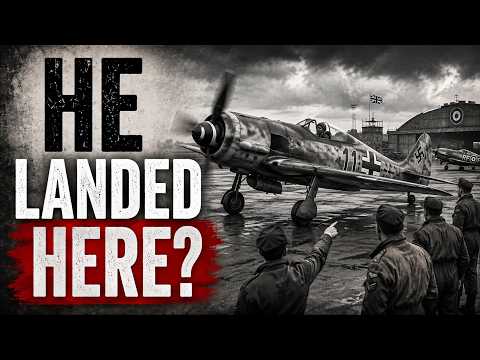
For months, British intelligence had drawn up plans so reckless they read like fiction, chasing this exact prize. Now it was taxiing toward the dispersal area under its own power, flown there by the one man in the Luftwaffe least likely to ever hand it over. To understand how strange this moment really was, we have to go back to a problem the British had no idea how to solve.
By late 1941, a new German fighter had started appearing over occupied France. It did not look radically different from the machines the Luftwaffe had been flying for years. But the moment British pilots met it in the air, they understood something had changed. This was the Focke-Wulf 190, and it was faster than anything the Royal Air Force had in frontline service.
It could dive away from a Spitfire with ease, opening distance in seconds. And in a rolling turn—the kind of tight snapping maneuver that decided most dogfights in the first three seconds—it could outturn a Spitfire so completely that British pilots often found themselves helpless mid-maneuver, watching an enemy simply flick out from underneath them and reappear on their tail.
Squadron after squadron flew sweeps over northern France that spring, and squadron after squadron came home with fewer aircraft than they had left with. The losses were not the result of poor flying. They were the result of an aircraft nobody in Britain fully understood.
In the officer’s messes at fighter stations across the south of England, the conversation kept circling back to the same aircraft. Men who had flown through the Battle of Britain two years earlier, who had grown used to feeling that the Spitfire gave them at least a fighting chance against anything the Luftwaffe sent up, now found themselves describing a very different kind of fear.
It was not the fear of being outnumbered. British pilots had lived with that since 1940. It was the fear of being outclassed by the machine itself—of doing everything right, flying the aircraft to its absolute limit, and still watching an enemy fighter simply outperform them at every turn.
Wing commanders wrote reports up the chain, trying to describe maneuvers they had only half seen. Aircraft that rolled faster than anything on the British side, that vanished into dives no Spitfire pilot dared follow. The reports made their way to the Air Ministry, and the Air Ministry in turn understood that a technical answer was needed fast—because pilots could not be expected to keep flying against an enemy whose full capabilities remained a mystery.
For the men running British intelligence, one goal now sat above every other. They needed an intact Focke-Wulf 190. Not photographs, not the twisted, burned wreckage of one that had gone down in flames, which told engineers almost nothing useful. A whole, flyable aircraft sitting in a British hangar where technicians could open every panel and measure every control surface.
For British engineers, the frustration was not simply about pride or about winning the technical argument between two air forces. Every week that passed without answers was a week measured in lost pilots—men who did not come home from routine sweeps because nobody on the British side could tell them exactly what their enemy’s aircraft could and could not do.
A machine, however dangerous, is not truly unbeatable. It has limits, weaknesses, altitudes where it struggles, speeds where its controls turn heavy in a pilot’s hands. But none of that could be found from wreckage alone. And none of it could be found from watching an enemy aircraft flash past at full speed. It had to be found by taking the machine apart piece by piece on the ground.
The Luftwaffe understood exactly what was at stake, and they had already taken steps to prevent it. Pilots flying the new fighter were placed under direct orders never to take it anywhere near the English coastline. If a Focke-Wulf 190 went down over the Channel or crashed on a raid, the risk of it falling into British hands—even in pieces—was treated as a real strategic threat. Better to lose the pilot than to lose the aircraft’s secrets.
British planners grew desperate enough that they began drafting proposals that on paper sound like something out of an adventure novel rather than a wartime intelligence file. One plan called for a German-speaking Royal Air Force pilot to fly a captured Messerschmitt, repainted and marked as a Luftwaffe aircraft, directly onto an occupied French airfield. Once on the ground, he would simply approach the closest Focke-Wulf 190, present himself as an officer needing to borrow it, and fly it straight back across the Channel before anyone realized what had happened.
It was audacious to the point of reckless—the kind of scheme that could easily end with a British pilot facing a firing squad rather than delivering an aircraft. And it very nearly never had to happen at all, because of what was about to unfold over the Channel on a single ordinary evening in June.
That evening began with a routine intercept, and the man at its center had absolutely no idea that he was about to hand British intelligence exactly what it wanted. His name was Oberleutnant Armin Faber, an experienced Luftwaffe fighter pilot with four confirmed victories already to his name.
Faber was not, on paper, the kind of pilot anyone would expect to be flying a frontline combat sortie that afternoon. His actual role was administrative. He served as Gruppen-Adjutant, essentially the staff officer for the third group of Jagdgeschwader 2, known as Richthofen—one of the most storied fighter wings in the entire Luftwaffe, based at Morlaix in Brittany.
His days were normally filled with paperwork, scheduling, and the countless small logistics that kept a fighter group running. But Faber was still a pilot, and on the afternoon of June 23rd, he asked for and received special permission to fly an operational sortie alongside the group’s seventh squadron—the unit actually equipped with the new Focke-Wulf 190.
It should have been an unremarkable request. Instead, it placed him in the cockpit of the very aircraft the British had spent the better part of a year trying and failing to obtain.
Faber was not a young hothead looking to prove himself. By the standards of 1942, he was a seasoned officer who had already seen his share of combat—a man trusted enough to be handed the administrative running of an entire fighter group. Colleagues who flew alongside him that summer would later describe someone competent and steady in the air, not reckless, not a man given to unnecessary risks.
That detail matters, because what happened later that evening cannot be explained by carelessness or by a pilot too green to know better. It happened to a capable, experienced officer—which is exactly what made the outcome so unsettling for the men who later tried to understand it.
The mission that afternoon was straightforward on paper. A formation of British Boston bombers had struck targets inside occupied France and was now returning across the Channel, escorted by Spitfires flying out of squadrons based near Exeter—including pilots of the Czechoslovak No. 310 Squadron, men who had fled their homeland years earlier and were now flying combat missions over the very continent the Germans had overrun.
Faber’s group scrambled to intercept the formation as it crossed back toward the English coast. What followed was fast, low, and violent—the kind of engagement where a single second of hesitation gets a man killed. Aircraft twisted through the sky at impossibly close range, engines screaming, tracer fire cutting past canopies close enough for pilots to see the muzzle flashes of the guns aimed at them.
The Channel stretched out gray and featureless below the fight. No landmarks, no fixed points, nothing but water in every direction once an aircraft dropped out of formation. It was exactly the kind of environment where a pilot’s sense of direction depended entirely on instruments and training, because the horizon offered no help at all.
In the chaos, Faber found himself cut off from the rest of his formation, alone against a Spitfire flown by Sergeant František Trejtnar of No. 310 Squadron. Trejtnar pressed the attack hard, and for several long minutes it was Faber who was being hunted rather than hunting. He threw the Focke-Wulf through violent evasive maneuvers, using every ounce of the aircraft’s superior handling just to stay alive, flying north over the coast near Exeter.
As the fight dragged on, by the time an opening finally appeared, only one of his two cannons was still functioning. Faber took the one chance he had. He hauled the aircraft up and over in a tight Immelmann turn, climbing hard and rolling out the top of the maneuver directly into the glare of the setting sun—a maneuver designed to hide his aircraft from his pursuer for just long enough.
He came out the other side of the turn facing Trejtnar’s Spitfire almost head-on and fired the one cannon he had left. The Spitfire took the hit and went down. Trejtnar managed to bail out before the aircraft crashed near the village of Black Dog in Devon, though he came down with a shrapnel wound in his arm and a broken leg from a hard landing under his parachute.
For Faber, it was a hard-won victory in a fight that had nearly killed him. But it had also pulled him dangerously far from the rest of his formation, burned through a large share of his fuel, and left the light beginning to fail over the water below.
He was alive. He had won his fight. His hands would have still been unsteady on the controls, the adrenaline of close combat draining away and leaving behind the kind of bone-deep exhaustion that only a pilot who has just survived a fight to the death can fully understand. His engine had taken punishment of its own during the maneuvering, and every gauge in front of him mattered now in a way it had not an hour earlier.
Fuel was the most urgent of all of them—the needle lower than he would have liked, the sun sliding down toward the water, and Brittany still a long way off across open Channel. He was now about to make the one decision that would end his war within the hour, a decision that had nothing to do with skill in the cockpit, and everything to do with a compass needle pointed the wrong way.
Alone over the Channel, Faber checked his compass and set a course for home. Brittany lay roughly south—a heading near 180°. What he actually flew was very close to the exact opposite: a course near due north instead of due south. Pilots call it a reciprocal heading error, a documented hazard of high-stress flying. Exhaustion has a way of making a man see confirmation of what he already believes rather than the plain evidence in front of him.
He saw land and read it as Brittany. It was the south coast of Wales. He had mistaken the Bristol Channel for the English Channel—two bodies of water separated by 180° of compass error and nothing else. Low on fuel, he scanned for an airfield and found one: RAF Pembrey, a training station with no armed fighters and no manned guns.
He waggled his wings in greeting and even pulled off a small victory roll, announcing his kill to men in the wrong uniform. He landed cleanly and taxied in. Sergeant Jeff, the duty pilot, grabbed the only weapon on hand—a flare pistol—and ran across the open tarmac. He climbed onto the wing and leveled it at the cockpit before the propeller stopped.
Faber slid back the canopy expecting his ground crew. Instead he saw RAF blue-gray and a flare gun three feet from his face. The full weight of it hit him at once: he had delivered Germany’s most guarded fighter, intact and fueled, into enemy hands. He was reportedly so overwhelmed that he attempted to take his own life. The attempt failed.
At Farnborough the aircraft was reassembled, repainted, given the serial MP499, and flown hard by test pilots. They found the ailerons ran on rigid push rods—explaining the devastating roll rate. But above 20,000 feet the Focke-Wulf’s performance fell away sharply, and at high speed its controls turned heavy. An aircraft that outturned a Spitfire at 8,000 feet became a different, more vulnerable machine once a fight climbed high.
Within weeks, new doctrine reached frontline squadrons: never outdive a Focke-Wulf, draw the fight upward, turn tight and hold it. Advice built entirely from measurements off one aircraft, and it began saving lives almost immediately.
Faber spent the rest of the war as a prisoner, his name a footnote. In September 1991 he returned to a small museum in Shoreham and quietly donated his officer’s dagger and pilot’s badge. The museum still holds the armored windscreen from his aircraft beside fragments of Trejtnar’s Spitfire—two pieces of wreckage from the same violent evening, resting a few feet apart.
There was no spy, no sabotage, no commando raid. The greatest technical intelligence the RAF gained on its most dangerous enemy arrived because one tired pilot read his compass backward at the worst possible moment—and because a sergeant with a flare gun ran toward the unknown. Sometimes the biggest shifts in a war come not from the boldest plans, but from one small human mistake at exactly the wrong moment.
So here is the question worth asking: if a single misread compass could hand an air force its greatest secret, how many other turning points in history were never planned at all—and would we even recognize one if it landed in front of us? Tell us what you think in the comments.
Report this article
Select a reason for reporting:






