In November 1918, the guns finally fell silent, but the silence that followed was not one of peace. It was a stunned stillness, the kind that hangs over a continent trying to comprehend the magnitude of what it had just done to itself. The war had ended, but its presence remained, etched into the land, buried in the mud, and seared into the souls of millions.
In 1919, travelers crossing the former Western Front saw a world transformed. Fields once golden with wheat were now cratered moonscapes, forests reduced to splintered skeletons, and villages erased from existence. The conflict had not simply ended; it had marked the earth in a way that made forgetting impossible.
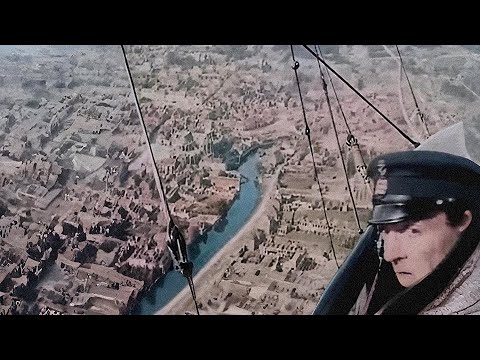
The First World War was a collision between eras. It began with 19th-century ideas—cavalry charges, bright uniforms, romantic notions of glory—and collided headfirst with the technologies of the industrial age. Machine guns, heavy artillery, chemical weapons, and armored vehicles rendered old doctrines obsolete. It was as if the modern world had arrived too suddenly, and the result was catastrophe on an unimaginable scale.
In the summer of 1914, crowds cheered as young men marched off to war, believing they would be home by Christmas. Soldiers carried flowers in their rifle barrels, gifts from civilians who saw them as heroes bound for a brief, glorious campaign. But by winter, the optimism had collapsed. The German advance was halted not by brilliant maneuvers but by sheer firepower, and the Battle of the Marne proved that rapid movement was over. Armies dug trenches, and the Western Front solidified into a maze of defensive lines from the North Sea to Switzerland.
The trench became the entire world for the soldiers who fought there. These narrow, muddy channels grew into complex networks, reinforced with sandbags, wood, and the bodies of countless battles. The front line was not a single place but a living organism, shifting after every attack, growing deeper and more fortified with each passing month. Conditions inside were a universe away from the patriotic fantasies of 1914. The ground was waterlogged, turning walkways into rivers of mud thick enough to swallow men. Shellfire never stopped. Rats thrived on corpses, lice infested uniforms, and frostbite attacked feet that remained wet for days. Above all lingered the constant smell of smoke, rot, and decay.
Artillery became the real killer, firing millions of shells that turned farmland into a dangerous landscape even decades later. Entire forests were shredded, hills vanished, and craters overlapped in patterns that looked lunar. At Verdun in 1916, the French and Germans fought over a few fortifications for 10 months, firing more than 60 million shells. Soldiers described the ground as a living thing, constantly shaking and vomiting up earth, smoke, and fragments of bodies. On the first day of the Somme, nearly 20,000 British soldiers were killed—still the deadliest day in British military history—yet the front barely moved.
As the war dragged on, new weapons appeared. Poison gas, introduced in 1915, transformed the battlefield into a nightmare of creeping clouds and frantic scrambles for masks. Tanks arrived in 1916, enormous metal beasts that broke down more often than they advanced but symbolized the beginning of mechanized warfare. Aircraft evolved from flimsy reconnaissance planes into essential tools for spotting artillery and eventually into weapons themselves. The psychological toll was just as significant. Soldiers lived under constant pressure, and shell shock attempted to describe a trauma that went far deeper. Many men returned home unable to speak of what they had seen, unable to reconcile civilian life with the world of the trenches.
By 1918, exhaustion had consumed both sides. The German spring offensives failed, and fresh American troops reinforced the Allies. When the counteroffensives began, Germany could no longer withstand them. On November 11, the armistice was signed. Soldiers stepped out of trenches they had lived in for years, and cities erupted in celebration. But on the former front lines, the landscape remained scarred, silent, and unrecognizable. Villages had vanished, farmland was buried beneath debris and unexploded shells, and forests were reduced to skeletons. Millions of men did not return. In 1919, with peace declared but recovery far away, the Western Front became a vast open-air monument, not built of stone but of terrain shaped by suffering, courage, destruction, and endurance.
In the first months after the armistice, the former Western Front remained an enormous graveyard hidden beneath overturned earth. Farmers returning to their land discovered fields unrecognizable, covered with twisted metal, collapsed trenches, and the remnants of barbed wire fences that once stretched for miles. More than a million unexploded shells still lay buried beneath the soil, waiting to be disturbed by plows or footsteps. Clearing these munitions would take decades and in some parts of Europe continues even today.
Entire regions were declared red zones, areas so devastated that governments considered them impossible to reclaim for human life or agriculture. Villages such as Fleury, Beaumont, and Ornes—once home to generations—simply ceased to exist, erased by artillery barrages. Their names survived only as markers on maps, reminders of communities swallowed by war. Forests that had stood for centuries were reduced to splintered fragments. Hills had been leveled, valleys filled in by collapsed trenches and shell craters. Even the bird song seemed hesitant to return in some places.
As reconstruction began, the question Europeans asked themselves was not just how to rebuild their land, but how to rebuild meaning. Before 1914, many believed the world was moving toward progress—technological, political, even moral. But the war revealed that progress could be turned against humanity with terrifying speed. The same factories that once produced locomotives now manufactured artillery shells. Chemistry, once a symbol of innovation, gave birth to poison gas. Aviation, a marvel of human ingenuity, had become a tool of reconnaissance and destruction.
Veterans returning home often felt caught between interpretations of the war, unable to fully articulate what they had witnessed. Many found themselves haunted by memories that reappeared without warning—the whistle of incoming shells, the glow of flares over no man’s land, the sound of boots sloshing through mud in the dead of night. The grief of nations was reflected in the memorials constructed after the war. France and Belgium built ossuaries and cemeteries to gather the remains of soldiers found across open fields. Britain and the Commonwealth erected vast cemeteries with simple white headstones arranged in perfect rows. Germany, facing economic collapse, created graveyards of dark stone and iron.
One of the most symbolic creations was the concept of the unknown soldier. Countries such as Britain, France, Italy, and the United States chose an unidentified soldier from the battlefield to represent all those who had died without recognition. These tombs became places of pilgrimage, destinations for families who had no grave to visit, no body to bury. The unknown soldier embodied the anonymity of industrial warfare—the way it consumed individuals and transformed them into numbers in official reports.
Meanwhile, the political landscape of Europe had changed dramatically. Four empires had collapsed—the German, Austro-Hungarian, Ottoman, and Russian. Entire maps were redrawn. New countries were created and old ones reemerged. The Treaty of Versailles imposed heavy reparations and severe territorial losses on Germany, sowing seeds of resentment that would grow in the decades ahead. The war had ended, but its consequences continued to unfold in complex and often volatile ways.
For many veterans, returning home felt surreal. The cities they came back to were familiar yet distant. People went about their daily lives unaware of what the front had truly been like. Some veterans found it difficult to describe their experiences because civilian language seemed inadequate. How could anyone understand what it meant to live for weeks under bombardment, to see the ground itself behave like a living creature, shifting violently with every shell impact? Governments attempted to support returning soldiers, but the emotional wounds of the war were not easily treated. Some veterans avoided discussing the war altogether, choosing silence over explanations that might reopen old wounds. Others wrote memoirs, trying to transform their memories into something coherent.
As 1919 progressed, efforts to reclaim the land intensified. Engineers drained flooded trenches, cleared barbed wire, and mapped areas contaminated by chemical weapons. Civilians returned to rebuild homes from rubble, sometimes using bricks scavenged from ruined towns. Farmers planted crops again, even though plows often struck unexploded shells buried just below the surface. Children played near crater fields, unaware of the hidden dangers beneath their feet. Slowly, life seeped back into places that had once been dominated by death.
But the scars remained, visible in the landscape and invisible in the memories of those who had lived through the conflict. Forests regrew, but their shapes were altered by the patterns of craters. Rivers returned to their courses, but new marshlands formed in areas churned by bombardment. Roads were rebuilt, yet sometimes followed new paths, routed around places too contaminated to reclaim. Beneath the surface, the soil itself carried chemical residues from years of gas warfare and explosives.
In many ways, the Western Front became a paradoxical symbol—both a place of immense destruction and a testament to human resilience. It showed how deeply war could wound the land, yet how determined people were to return, rebuild, and move forward. For the soldiers who visited the former front lines after the war, the experience was overwhelming. Some returned to find the spot where they once fought, only to discover it unrecognizable—a quiet field where a battlefield had been, or a cemetery where their trench had stood. Others avoided the front entirely, unwilling to revisit those memories. A few came to pay respects to fallen comrades, standing silently among rows of graves that stretched farther than they could see.
By the time the 1920s began, the former Western Front was still a place of ghosts. Farmers worked fields that had once been killing grounds. Travelers passed memorials marking battles whose names were already etched into collective memory—Ypres, Passchendaele, Verdun, the Somme. And beneath the quiet surface lay the remains of a conflict that had reshaped the world. The war was over, but its imprint—carved into the land and into the minds of millions—would endure for generations.
What do you think—can a landscape ever truly heal from such wounds, or do the scars simply become part of who we are?
Report this article
Select a reason for reporting:






