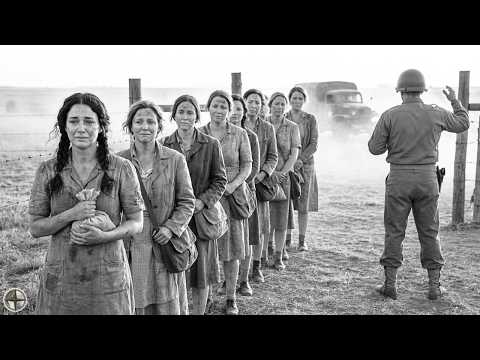
March 15th, 1946. Camp Gruber, Oklahoma. The gates were finally open. The war was over. And 24-year-old Ingrid Hoffman was free to leave.
But she was not moving. She stood frozen, her small bag clutched against her chest, tears streaming down her face. She was not crying from happiness. She was crying because she did not want to go.
American guards watched in confusion. Most prisoners ran toward freedom. But these German women were doing the opposite. They were begging to stay. They were writing letters. They were pleading with anyone who would listen. They were gripping the fence like it was the only safe place left on Earth.
Because maybe it was. Outside that fence, across the ocean, their cities were rubble. Their families were gone. Their homes were ash. Inside the camp, they had food, safety, and dignity. They had something Germany could no longer offer: a future.
These women had been taught that America was the enemy. They had been told Americans were monsters. But behind the barbed wire, they discovered a terrifying truth. Everything they believed was a lie.
Most people have never heard of them. When we think of German prisoners of war, we imagine soldiers, men in gray uniforms, men with rifles and helmets, men captured on battlefields across Europe. But there was another group, a group history has mostly forgotten.
German women. They were called the Wehrmacht Helferinnen. In English, this means armed forces helpers. They were not soldiers in the traditional sense. They did not carry guns into battle. They did not fight in trenches, but they wore uniforms. They served the Nazi war machine. And when the war ended, they became prisoners just like the men.
By the spring of 1945, over 500,000 German women had served in some military capacity. Some worked as nurses near the front lines, others operated telephone switchboards, some decoded messages. Others tracked enemy aircraft using radar equipment. A smaller number worked directly with anti-aircraft batteries, helping aim the guns that shot at Allied bombers.
They were young. Most were between 18 and 30 years old. Many had joined because they believed in Germany. Others joined because they had no choice.
Ingrid Hoffman was one of them.
She had grown up in a small town near Frankfurt. Her father was a school teacher. Her mother worked in a bakery. When Ingrid turned 19 in the winter of 1943, she received a letter. It was not a request. It was an order. She was to report for duty as a signals operator with the Luftwaffe, the German Air Force.
She had never wanted to join anything, but in Hitler’s Germany, wanting did not matter. She later wrote in her diary, “I remember the day I left home. My mother stood at the door. She did not cry. She was too afraid to cry. I carried one small bag. I did not know where I was going. I did not know when I would return. I did not know if I would return at all.”
For two years, Ingrid worked at a communication center in Belgium. She relayed messages between units. She listened to static for hours. She slept in cold barracks and ate watery soup. And then in January 1945, the Americans came.
Her unit was captured near the city of Liège. She expected to be shot. That is what the propaganda had told her. Americans were monsters. Americans killed prisoners. Americans showed no mercy.
Instead, a young American officer handed her a blanket and a cup of coffee. The coffee was hot. The blanket was warm. And for the first time in months, Ingrid felt something strange. She felt safe.
The US military did not know what to do with the German women they captured. There were no rules for this. The Geneva Convention covered male prisoners of war, but women? This was new. This was unexpected.
At first, the women were held in temporary camps in France and Belgium. Conditions were harsh, food was limited, space was tight. But the Americans quickly realized they needed a better solution. So they made a decision. They would send the women across the ocean. They would send them to America.
Camp Gruber near the town of Muskogee in Oklahoma had been built in 1942. It was originally a training camp for American soldiers. Thousands of young men had passed through its wooden barracks before shipping out to Europe or the Pacific. But by 1944, the camp had a new purpose. It became a prisoner of war camp. First for German men. Then starting in early 1945 for German women.
The journey across the Atlantic took nearly three weeks. The women traveled on a converted cargo ship. The sleeping quarters were cramped. The air below deck smelled of salt and sweat and engine oil. Many of the women were seasick. Others were simply terrified. They had no idea what waited for them in America. They had only their fears and the lies they had been told.
When the ship finally docked in New York, the women were loaded onto trains. The journey to Oklahoma took three more days. They stared out the windows at a country they did not recognize. Green fields, clean towns, cars on every road, children playing in yards. There were no bomb craters. There were no ruined buildings. There was no hunger visible anywhere.
One woman, a nurse named Elsa Weber, later recalled the moment they arrived at Camp Gruber. “The train stopped. We stepped onto the platform and I looked around and thought, ‘This cannot be real.’ The sky was so big, the land was so flat, everything was so quiet. I had expected a prison. I had expected chains and guards with whips. Instead, I saw wooden buildings and a fence and grass, just grass stretching forever.”
By April 1945, over 150 German women were housed at Camp Gruber. They lived in separate barracks from the men. They had their own mess hall, their own routines, their own world within a world. And slowly, day by day, something began to change inside them. Something none of them had expected.
But this was only the beginning. What happened next would challenge everything they believed.
The first morning at Camp Gruber, Ingrid Hoffman woke to a sound she did not recognize. Silence. No sirens, no explosions, no shouting officers — just silence. And then, somewhere in the distance, a bird singing.
She lay in her bunk for several minutes, staring at the wooden ceiling, wondering if she was dreaming. Then came the smell. Bacon. Real bacon, frying somewhere nearby. The scent drifted through the barracks like a ghost from another life. In Germany, she had not eaten bacon in over two years. Meat of any kind had become a luxury.
But here, on her first morning, as a prisoner in America, the air smelled like breakfast.
The mess hall was a simple wooden building with long tables and benches. The women lined up with metal trays. They expected thin soup. They expected stale bread. They expected the same hunger they had known for years.
Instead, they received eggs, toast with butter, bacon strips, coffee with real sugar, and orange juice — something many of them had never tasted before.
Elsa Weber remembered that first breakfast clearly. She wrote about it years later. “I stared at my tray. I did not move. The woman next to me asked if I was feeling sick. I told her no. I told her I was trying to understand. In Germany, we were free and we were starving. Here, we were prisoners and we were being fed like queens. Nothing made sense anymore.”
This was the paradox that would define their time in Oklahoma. Everything they had been taught about America was wrong. Nazi propaganda had painted Americans as brutal, uncivilized, cruel. They had been told that American soldiers tortured prisoners, that American prisons were death camps, that surrender meant suffering beyond imagination.
But the reality was three meals a day. The reality was clean water and warm showers. The reality was medical care when they were sick. The reality was guards who did not beat them, did not scream at them, did not treat them like animals.
Camp Gruber operated under strict rules, but those rules were fair. The women woke at six each morning. They did chores around the camp. They worked in the kitchen, the laundry, the small garden where vegetables were grown. They earned eighty cents per day for their labor. The money could be spent at a small canteen that sold cigarettes, soap, candy, and writing paper.
The camp commander was a man named Colonel Howard S. Patterson. He was in his mid-fifties, with gray hair and tired eyes. He had served in the First World War. He had seen enough death to fill several lifetimes.
When the women first arrived, he gathered his staff and gave them clear instructions. “These are prisoners,” he said. “But they are also human beings. Treat them accordingly. No cruelty, no abuse, no exceptions.”
Not everyone agreed with this approach. Some of the guards had lost friends in the war. Some had lost brothers. They did not understand why they should show kindness to the enemy. But Colonel Patterson was firm. He believed that treating prisoners with dignity was not weakness. It was strength. It was what separated America from the nations it had fought against.
By the summer of 1945, the camp had established a school. Classes were held three times a week in a large barracks that had been converted into a classroom. A German-American teacher named Mrs. Gertrude Reinhardt taught English, American history, and basic mathematics. She had fled Germany in 1936, escaping the rising tide of Nazi persecution. Now she stood before women who had served that very regime, and she taught them with patience instead of anger.
The women were suspicious at first. They thought it was a trick. They thought the lessons were propaganda designed to brainwash them. But Mrs. Reinhardt did not preach. She did not lecture about politics. She simply taught. She showed them newspapers from across America. She explained how democracy worked. She answered their questions honestly, even when those questions were difficult.
Ingrid attended every class. She had always loved learning. In another life, she might have gone to university, but the war had stolen that future. Now, in a prisoner of war camp in Oklahoma, she found something she had lost. Hope.
She discovered American authors like Ernest Hemingway and John Steinbeck. She read about the American Revolution. She learned words in English that had no direct translation in German. Words like freedom and opportunity meant something different here, something larger.
The camp also had a small library with over four hundred books in both German and English. There was a recreation area where the women could play volleyball or simply sit in the shade. On Sunday mornings, a local priest came to hold Catholic mass. Protestant services were held in the afternoons. The women were allowed to practice their faith without interference.
By autumn, something remarkable had happened. The women stopped thinking of Camp Gruber as a prison. It did not feel like captivity. It felt like shelter. The fence that surrounded them was not keeping them in. It was keeping the war out. Inside those wooden walls, they had found peace. Outside, the world was still burning.
But peace never lasts forever. Soon, letters began to arrive from Germany. And with those letters came news that would change everything.
The mail arrived on Thursdays. Every week the women gathered near the administration building, waiting for their names to be called. Some stood quietly. Others fidgeted with nervous hands. A few pretended they did not care. But everyone waited. Everyone hoped. A letter from home meant someone was still alive. It meant the world they left behind still existed in some form.
But by the autumn of 1945, the letters that arrived carried a different kind of news. The news was not good.
The news was devastating.
Ingrid Hoffman received her first letter in September. It came from a cousin she had not seen in three years. The letter was short, only one page, but that single page destroyed the last image she held of home.
Her parents’ house was gone. A bombing raid in March had flattened the entire street. Her father had died in the blast. Her mother had survived but was now living in a refugee shelter near Kassel. The bakery where her mother once worked no longer existed. The school where her father once taught was rubble.
Ingrid read the letter three times. Then she folded it carefully, walked outside, and sat on the ground behind her barracks. She did not cry. She could not cry. The tears simply would not come. Instead, she felt hollow, empty, like someone had reached inside her chest and removed something important.
She was not alone in her grief. Throughout Camp Gruber, similar scenes played out week after week. Women received news of dead husbands, dead parents, dead siblings, missing children, cities erased from maps. Entire neighborhoods turned to ash.
The Germany they remembered was gone. What remained was a broken country divided into four zones, occupied by foreign armies, starving and desperate.
Elsa Weber received word that her hometown of Dresden had been destroyed in February 1945. Over twenty-five thousand people had died in a single night of bombing. Her sister was among them. Her sister had been twenty-two years old. She had worked as a seamstress. She had never worn a uniform. She had never supported the war, but she had died anyway, buried under burning rubble while fire consumed the city.
Elsa later wrote, “When I read that letter, I understood something terrible. The Germany I wanted to return to did not exist anymore. It was not waiting for me. It was not anywhere. It had been burned away. And I was supposed to go back to this place to do what? To stand in the ashes and weep?”
The women began to talk differently after the letters arrived. Before, they had spoken about going home. They had made plans. They had counted the days. But now those conversations stopped. Instead, they asked different questions. What was left? Who was left? Where would they even go?
The American guards noticed the change. The women who had once seemed eager for freedom now seemed afraid of it. They worked harder in the kitchen and the laundry. They attended more classes. They spent longer hours in the library. They did everything they could to stay busy, to keep their minds away from the darkness waiting across the ocean.
One guard, a young corporal named Samuel Brooks, spoke about it years later in an interview. “I didn’t understand at first,” he said. “These women were prisoners. The war was over. They should have been happy, but they weren’t. They looked scared. And then I started hearing what was in those letters. Whole families gone. Whole cities gone. And I realized something. For them, freedom meant going back to nothing. Prison meant safety. It was backwards. It made no sense, but it was true.”
By November 1945, the mood in Camp Gruber had shifted completely. The women no longer spoke about home as a destination. They spoke about it as a memory, something that once existed but no longer did. The future they had imagined was replaced by fear and uncertainty.
Ingrid wrote in her diary during this period. “I think about Oklahoma all the time now. The sky, the quiet, the food, the kindness. I think about what it would mean to stay here, to never go back. Is that betrayal? Am I betraying my mother by wanting this? She is alone in a shelter eating scraps, sleeping on a cot. And I am here eating bacon, reading books, feeling safe. I feel guilty. But I also feel something else. I feel like this is where I belong. And that thought terrifies me more than anything.”
The paradox had become unbearable. These women were prisoners who felt free. They were captives who felt cared for. And now they faced a choice no one had prepared them for. Return to a homeland that was destroyed — or fight to stay in a country that had once been their enemy.
But the choice was not really theirs to make. The Geneva Convention was clear. Prisoners of war had to be sent back once the war ended. The rules did not ask what the prisoners wanted. The rules did not care about destroyed cities or dead families. The rules simply demanded repatriation.
And so the orders came. Papers were signed. Dates were set. The women of Camp Gruber would be sent home whether they wanted to go or not.
But some of them were not ready to accept that fate. Some of them decided to fight back.
The announcement came on a cold December morning. An officer read from an official document: all German prisoners would be repatriated by spring 1946. The room fell silent. No one moved. No one spoke.
That evening, seven women gathered behind the laundry barracks. Ingrid was among them, along with Elsa and a young radio operator named Liesel Braun. “We do not have to accept this,” Liesel whispered. “The Americans have laws. We can write letters.”
So they wrote. Dozens of letters to congressmen, churches, and newspapers. A Methodist pastor in Muskogee, Reverend Whitfield, took up their cause. The Tulsa Tribune ran a front-page story: German Women Prisoners Fear Return to Ruins.
But the military was unmoved. “Our hands are tied,” a spokesman said. The Geneva Convention demanded repatriation. The petitions failed.
On a gray February afternoon, Ingrid sat on her bunk and stared at the wall. In her diary she wrote: “Is a piece of paper more important than a human life? I do not have the answer. I only know that soon I will leave the only place where I have ever felt safe.”
The trucks arrived in March. Elsa gripped Ingrid’s hands at the gate. “Promise me this is not the end.” Ingrid could not lie. “I will try. That is all I can promise.”
They would not meet again for eleven years.
Ingrid found her mother in a refugee camp near Kassel — thin, gray, broken. They held each other in the mud. For two years Ingrid cleared rubble and washed clothes for American soldiers. In 1948 her mother died of pneumonia. There was no money for a headstone — only a wooden cross.
After the funeral, Ingrid made her decision. She had nothing left in Germany. She would go back to America.
The process took years. She worked as a translator, saved every penny, studied English until she could speak it without hesitation. In 1952 her application was approved. When she saw the Statue of Liberty rising from the harbor, she stood on the deck and cried — not from sadness, but from relief.
She settled in Tulsa, less than fifty miles from Camp Gruber. She became a secretary, joined a church, built a life piece by piece. Every year on the anniversary of her departure, she drove out to where the camp had once stood. The barracks were gone. The fence had been torn down. Only the land remained, flat and quiet, covered in grass and wildflowers.
At least forty of the 150 women eventually returned to America. Elsa arrived in 1957 and settled in Chicago. She and Ingrid remained friends for the rest of their lives.
Ingrid Hoffman died in Tulsa in 2001, at eighty years old. After the service, her granddaughter found a photograph tucked into an old Bible — a wooden fence stretching across an empty prairie. On the back, in faded ink, were four words: Where I found home.
Sometimes home is not where you are born. Sometimes it is where you are safe. Sometimes it is simply where you are allowed to become who you were always meant to be.
What would you have done in Ingrid’s place — begged to stay, or boarded the ship in silence? Tell me in the comments below.
Report this article
Select a reason for reporting:






