The sun was high over the Timor Sea, glinting off the wings of thirty-three Spitfires as they plunged from 32,000 feet. Squadron Leader Eric Gibbs, a veteran of the Battle of Britain, had every advantage: height, surprise, and the sun at his back. Below, a formation of Japanese Zeros and bombers droned toward Darwin. It was May 2, 1943, and the textbook attack was about to become a deadly lesson.
Gibbs rolled his Spitfire into a near-vertical dive, the engine screaming as the altimeter spun. Behind him, the pilots of 54 Squadron—many of them fresh from the skies of England—followed with the confidence of men who had beaten the Luftwaffe. They had been told: “Don’t dogfight the Zero.” But in the chaos of combat, instinct would override orders, and the result would be catastrophic.
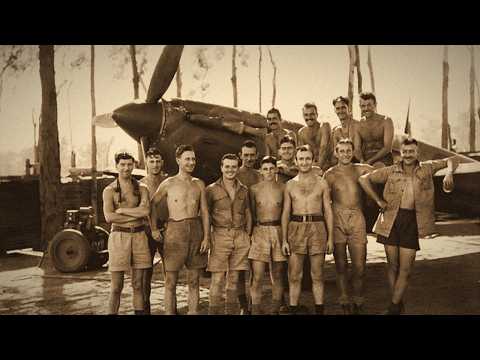
Within seconds, the fight had dropped to 7,000 feet, and the Spitfires were turning in tight circles, exactly as they had been trained to do against German fighters. But the Zero was not a Messerschmitt. At low speed, it could out-turn any Allied aircraft, and the Spitfire pilots were playing right into its hands.
“At least 13 Spitfires will come down. Five of them to Japanese guns,” the orders had warned. That prophecy would prove chillingly accurate. As Gibbs lined up a Zero in his sights, he had no idea that the next sixty seconds would defy everything he had learned about air combat.
The warning had come at 9:26 that morning from a radar station on Bathurst Island. Flying Officer Jordan, a radio engineer from Lismore, picked up the blips: aircraft 160 miles northwest of Darwin, heading east. Within minutes, every Spitfire pilot off duty was scrambled. At 9:40, Wing Commander Primrose, a former Sydney solicitor, ordered all three squadrons into the air.
They came from different fields: 54 Squadron from Darwin itself, 452 from Strauss, and 457 from Livingstone. Thirty-three Spitfires met over Hughes airfield at 10,000 feet, and one man led them higher. Wing Commander Clive Caldwell, a legendary ace from the Western Desert, had been credited with more enemy aircraft than any other Australian. The men called him “Killer,” and he hated it.
Caldwell climbed into the sun, positioning his wing above the incoming raid. But the Japanese had altitude too—and they were not the easy prey the Spitfire pilots expected. The bombers crossed Darwin Harbor at 27,000 feet, and the Spitfires were still below them. By the time Caldwell’s men reached 32,000 feet, the Zeros sat 4,000 feet above, waiting.
“The real numbers we know now were 18 bombers and 27 fighters.” The anti-aircraft guns opened up—219 rounds—but not a single hit. The bombers dropped their load, damaging two buildings and killing one soldier. Caldwell watched and held his fire, waiting for the perfect moment. He gave the order: 54 Squadron would hit the Zeros, 457 would bomb the bombers, and 452 would guard their exit.
For eight long minutes, the Spitfires waited 40 miles out to sea, fuel burning. Then Caldwell called Gibbs: “The attack was on.” Gibbs picked a Zero and dove. The Japanese pilot never saw him. The Zero went down trailing smoke. But what happened next defied all expectations.
As the Spitfires pulled out of their dives, the Zeros turned to meet them head-on. The escort didn’t run—it charged. Only four of 457’s eleven Spitfires got through to the bombers. The rest were sucked into dogfights, turning tight circles at 7,000 feet. It was exactly where the Zero was deadliest.
Gibbs saw a Spitfire spinning down. His cannon stopped firing. Caldwell’s guns jammed. Another pilot’s guns froze solid. “Count the machinery failing in that one fight,” the official history would later note. The Spitfires had climbed to 30,000 feet, where the air was below freezing, and then dove into combat. Gun stoppages were rampant.
When the fight ended, five Spitfires had been lost to enemy action. Two pilots were dead. The Australians believed they had destroyed six enemy aircraft, but the truth was harder: only one bomber had been shot down. The Zeros had done their job.
Caldwell came on the radio: “Check your petrol. Return to base if necessary.” Gibbs looked at his gauge: 22 gallons left. He turned for home, 40 miles of sea ahead. He landed with two gallons in his tanks. Five other Spitfires ran out of fuel and came down in the scrub. Three more had engine failure. In total, 13 aircraft were lost—fewer than half to Japanese guns.
The news hit Australia hard. For once, the communique was honest: “Our own air losses were heavy.” The press blamed bad weather and headwinds. The pilots seethed. Air Commodore Bladin demanded a correction. The Chief of the Air Staff blamed Caldwell for holding the attack too long. Caldwell fired back: every pilot had been properly directed.
The truth was more nuanced. The Spitfires had been trained to turn with the enemy—a lesson that had won the Battle of Britain but was fatal against the Zero. Over the following weeks, pilots dissected the fight. The conclusions were blunt: carry more fuel, intercept the raiders earlier, and never dogfight the Zero.
The order was reissued, harder this time. From now on, Spitfire pilots would dive at full speed, fire only when close, and keep going. No turning. No pulling round to see if the enemy was hit. It felt like running away, but it was the opposite. A fast Spitfire was untouchable; a slow one was a death sentence.
The first test of the new tactics came on June 20. Forty-six Spitfires intercepted a raid, and the results were devastating: nine bombers and five fighters destroyed for the loss of two pilots. It was the most successful fight at Darwin up to that time. But the lesson had been bought with blood—and the story was far from over.
By the end of June, the wing was fighting a second enemy, and it was not Japanese. Losses had cut Number One Fighter Wing down to a low strength. Air Commodore Bladin signalled Melbourne for 22 replacement Spitfires at once. He also asked for 11 new engines, because the pilots were flying on worn-out ones.
The records show what that meant in the air. Worn engines were giving slow speeds in battle, and formation leaders were throttling back just to stop their own aircraft falling behind. Melbourne answered that up to 17 Spitfires would arrive within a week, and another 18 were being unloaded from ships and assembled in a hurry. Training was cut because too many aircraft on the strips could not fly.
Now look at what that did to the new tactics. The whole method depended on speed and height. Dive fast, get away fast, climb back fast. Now the machines were losing the very speed the method needed, and every hard climb to 30,000 feet wore them down further.
On the 6th of July, the Japanese came again. The radar at Cape Fourcroy picked them up at 10:37, 160 miles out. Seven minutes later, 33 Spitfires were airborne. This time the climb worked. At 32,000 feet, the Spitfire pilots saw the raid coming in over Peron Island at 29,000. Twenty-six bombers in three broad arrowhead formations and about 21 fighters.
For once, the Spitfires sat between the Japanese and their target, and above them. Caldwell’s plan was the lesson of two months put into orders. 452 would take on the fighter escort. 54 would hit the bombers head-on. 457 would stay 7,000 feet above, flying alongside, watching, and strike wherever the fight opened up.
At 11:35, he sent 452 in. The Zeros began forming a defensive circle about 2,000 feet above the bombers. Flight Lieutenant Hall led White Section, four Spitfires straight into them. They shot down two Zeros and kept seven more so busy they could no longer protect the bombers. It was the plan working as written, and it still cost.
452 lost three Spitfires. Flight Lieutenant Makin, a student from Adelaide serving in the Royal Air Force, came down in a forced landing when his engine failed. Sergeant Richardson, a bank clerk from Hamilton near Newcastle who had flown with 167 Squadron in Britain, parachuted when his failed too. Flying Officer Lloyd, a grazier from Roma in Queensland, was hit by enemy fire and bailed out. Three Spitfires lost, and two of them to their own engines.
Meanwhile, Gibbs led 54 at the bombers. Three of his Spitfires could not keep up. Their engines were simply too worn. After six months of tropical service and rapid climbs, Gibbs’s squadron found the engines were passing the limit of their efficiency. Gibbs reported that the problem had assumed a serious aspect quite suddenly.
So only seven Spitfires of 54 went at the whole bomber force. They shot down four and damaged two for two Spitfires lost. 457 followed the bombers towards Fenton. About 20 miles out, Caldwell sent in two sections, eight aircraft. The Zeros met them. The Spitfires shot down two bombers.
Three of their pilots never came home. Flying Officer Hamilton, Flying Officer Robinson, a student from Turkey who had turned 21 less than a fortnight earlier, and Pilot Officer McDow. Twenty bombers reached Fenton and dropped 140 bombs. The anti-aircraft guns fired 88 rounds and hit nothing. The Spitfires kept attacking through the flak and brought down another bomber almost over the gunners’ heads.
Caldwell made a lone head-on pass at a bomber crossing the coast. Then he found two Zeros turning in on him. With his oxygen gone, he did the one thing the whole new doctrine was built on. He broke off and went home. Bladin signalled again, calling it imperative that all Spitfires allotted this area from southern sources be delivered immediately.
As it turned out, the 6th of July was the last Japanese raid in strength over Darwin for a long time. Now take the six months as a whole. The Spitfire squadrons had lost 44 aircraft. Only 17 of those losses were due directly to enemy action. Twenty-seven Spitfires were lost to something else. Fuel, engines, accidents on rough strips, the wear of a climate the aircraft was never designed for.
Against that, the Spitfires were credited with 63 enemy aircraft destroyed and another 13 probably destroyed. That credited figure needs the same honesty as the losses. On the 2nd of May, the Australians claimed six destroyed. Yet Oggers concedes the escort had done its job and only one bomber had gone down in the main fight. The Japanese claimed 21 Spitfires that day when eight were destroyed and only five fell to their guns.
Every air force in the war overclaimed, because a burning aircraft vanishing into cloud looks like a kill from two miles away. Later historians who worked through the Japanese records, among them Anthony Cooper in his book Darwin Spitfires, have argued the Spitfire claims were well above what the Japanese actually lost. The exact score is still argued over. What is not argued is the other column. Most of the Spitfires the wing lost were lost to something other than a Zero.
The clearest proof of the new way came on the morning of the 7th of September, 1943. By then, the Japanese had a problem of their own. Their reconnaissance planes over Darwin almost never came back. On the morning of the 20th of August, three of them came over and 457 destroyed all three. Flight Lieutenant Watson got so close to his that it blew up and covered his Spitfire in oil.
The Japanese sent a fourth that afternoon. Caldwell and his number two, Flight Sergeant Padula, an assistant hotel manager from Cobar, caught it 20 miles off the coast at 26,000 feet. It was a Dinah doing about 300 miles an hour. Caldwell closed to 200 yards before he fired everything he had. One engine caught fire and pieces of it struck his Spitfire. Padula hit it too. Caldwell followed it down to the sea and circled. He saw a Japanese airman in a black flying suit and helmet lying spread-eagled on the water, face up. One pass from behind and above at full speed. That was the whole method in a single kill.
So on the 7th they sent one twin-engined reconnaissance aircraft with a heavy fighter escort. The first warning came at eight with the raiders 180 miles out. The radar operators thought at first it was a single aircraft. Then it was clear many were coming, and 48 Spitfires took off. What happened next split cleanly in two, and the split tells the story.
54 and 452 were near Port Patterson when they saw 21 Japanese aircraft 16 miles west of Sattler and higher than they were. The Zeros attacked before the Spitfires could climb above them. One Zero was destroyed and two probably destroyed. Flying Officer Hines of 54, a student from Kent in England, was shot down and killed. He was 21. Pilot Officer Tully, a Queensland grazier, bailed out. So did Squadron Leader Macdonald, commanding 452. A cannon shell from a Zero exploded inside his cockpit, and he was badly burned before he got out. He was flown to the medical receiving station in a Tiger Moth by Squadron Leader Clyde Fenton, the famous flying doctor of Katherine from the 1930s.
457 had taken off earlier. It had height. It came down on the same Zeros from above straight after that clash and shot down four of them. Flight Lieutenant Watson got one. Flight Lieutenant Mlan got one. Flying Officer Smithson, the fitter from Oakley, got one. Flight Sergeant White and Flying Officer Gregory shared the fourth. Every Spitfire of 457 came home undamaged.
Same morning, same Zeros, same Spitfires. The squadrons that met the Zeros from below lost a pilot and two aircraft for one confirmed kill. The squadron that came down from above fired and did not stay to turn, lost nothing, and got four.
One more detail from that season settles it. For some months, the Spitfire squadrons tested anti-G suits invented by Professor Frank Cotton of Sydney University to stop pilots blacking out in hard turns and pullouts. The suits fitted badly in the tropical heat. Pilots could pour the sweat out of their boots when they took them off, but they worked. They were, in the official history’s words, excellent in the dogfighting type of maneuver.
Then comes the sentence that ended the trial. Spitfire pilots were not permitted to dogfight because the advantage would lie with the more maneuverable enemy fighter planes. Australia had built a suit that made its pilots better at turning, and the pilots were no longer allowed to turn.
Down in Brisbane that same winter, American technical intelligence officers at Eagle Farm had rebuilt a flying Zero from Rex captured in New Guinea. They flew it in mock fights against a Spitfire V. Their finding matched what the Darwin pilots had paid to learn. Below about 20,000 feet, the Zero was the better fighter.
So go back to 2010 on the 2nd of May. 32,000 feet over the Timor Sea. Eric Gibbs rolling over into a 400 mph dive with every advantage a fighter pilot could want. Those men were not beaten by a worse airplane. The Spitfire was faster than the Zero in level flight and in a dive. They were beaten in the one band of sky where the Zero was better, and they flew down into it themselves when their hands did what the Fighter Command school had drilled into them. Turn with him. Get on his tail. Win the circle over Kent.
That instinct had saved Britain. Over the Timor Sea, it was the one thing the Zero was waiting for. The pilots who survived did something no fighter pilot finds easy. They stopped trusting their own instincts and started trusting a rule. And the proof is in the numbers of one September morning: four Zeros down, and every Spitfire of 457 home.
Gibbs landed with two gallons in his tanks. The men who followed him learned to come home with more—and to leave the turning to the enemy. If someone in your family flew or fixed aircraft in the Northern Territory, served at Darwin or on the Timor run, or flew with the Air Force anywhere in any war, tell me about them in the comments.
Report this article
Select a reason for reporting:






