Berlin, mid-August 1933. The camera pans across the Brandenburg Gate as stormtroopers march in perfect formation—just as they had seven months earlier, on the night Adolf Hitler seized power. The footage was shot for a film called Hans Westmar, but what makes it extraordinary is the film stock itself: 35mm color, a costly rarity in Germany at the time.
This was the dawn of a new era, captured in hues that made the dictatorship look vibrant, modern, and inevitable. And it was only the beginning.
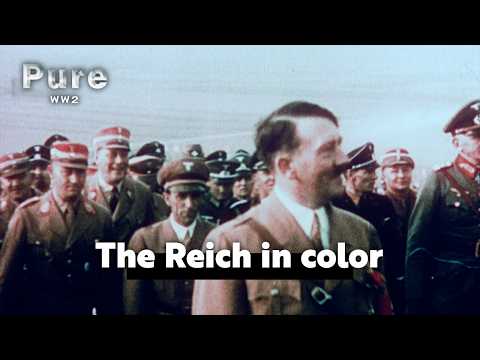
September 30, 1934. The Reich Harvest Festival in Goslar. Farmers from across the Third Reich gather before the Imperial Palace, waiting for Adolf Hitler. A young German woman writes in an essay: “Above all, the Harvest Festival is our way of thanking God for His abundant blessings, and also our way of thanking the Reich government, which restored full prosperity to the farming community.”
Just weeks earlier, Hitler had outmaneuvered his biggest rival, Röhm. Now, with President von Hindenburg dead, he was both Führer and Reich Chancellor. The director Kwasniewski—a pioneer of color cinematography—chose this day to shoot one of the first cultural films using the new two-color film stock. The result was still imperfect, but history was being written in color.
At the Bückeberg near Hameln, a grandstand was built for a mass rally. Hundreds of thousands of farmers streamed in to pledge loyalty to the dictator. Kwasniewski deployed two camera teams equipped with color film. When the film was screened for the press in December 1934, one critic dismissed it as an experiment that couldn’t compare to nature. Another praised the outstanding color shots, especially of traditional costumes.
The Swiss journalist Konrad Warner described the propaganda spectacle in a 1944 report: “As they waited for Hitler and his entourage, the people felt excitement and anticipation. Then, as the motorcade approached across the plain below, thousands of voices shouted ‘Heil!'” The sound surged like a hurricane toward the man who knew how to control and manipulate the German nation.
Hitler could only advance slowly through the crowd, flanked by rural women in traditional dress, pressing forward to see him, to shake his hand, to look into his blue eyes. The enthusiasm of thousands chanting “Heil!” whipped every individual into a frenzy, amplifying the effect of his personality even further.
Despite the technical shortcomings, color film was here to stay. In summer 1937, the first 16mm color film from Agfa hit the German market. Despite its high price, many amateur filmmakers were willing to spend vast sums to use it.
In Hamburg, master pastry chef Kurt Leifeld spent his free hours filming his city. He preferred American-made products. In 1935, Kodak had developed color film, marketed in Germany as well. From May to September 1938, Leifeld documented life and work in Hamburg’s famous warehouse district and harbor—including the Kehrwieder building, whose tower was a landmark visible from afar.
Hamburg’s port had once thrived on international trade, but the Great Depression had hit hard. Much of the commercial fleet was decommissioned, and shipyard workers were laid off en masse. Yet harbor tours to coastal resorts remained popular. From the piers and the old Elbe tunnel, ships headed down the river. Leifeld even filmed the Wilhelm Gustloff, a luxury cruise liner meant to symbolize the classless nature of Nazi society.
The “Strength Through Joy” organization wasn’t for top Nazis, but the party expected anyone allowed to sail to Norway for a week to behave appropriately. Through credit-financed work programs and Senate contracts, the Nazis managed to reduce unemployment—largely thanks to increased rearmament contracts from the German Navy. By 1936, Hamburg’s six major shipyards were once again providing nearly 20,000 jobs.
Leifeld’s recordings are rare documents of a vanished era: 1,300 electric cranes and hundreds of steam cranes unloading goods from around the world. His 20-minute documentary won first prize in a competition. His shots captured many ships that exist today only in the memories of older Hamburg residents—like the Monte Rosa, a passenger ship that in 1931 ran a regular schedule to the east coast of South America.
One of the first amateur filmmakers who could afford 16mm color stock was Hitler’s chief pilot, Hans Baur. In Berlin, on September 27, 1937, Baur filmed the state visit of Italian Fascist leader Benito Mussolini. In front of the Technical University, the Führer presented the Duce with a display of Prussian tradition and showed his guest the results of German rearmament. Baur was allowed to film from a back row of the VIP stand.
After the fall of the Third Reich, these unique documents from Hitler’s inner circle were considered lost. They were only rediscovered in 1988 among the estate of a former American soldier from Tennessee. As head of the translation unit for US intelligence in Munich in 1945, Herbert Zankoff learned where the Agfa color footage shot secretly by Hitler’s pilot was buried. He secured it and took it with him to Chattanooga.
The military parade showcased weapons of all kinds and lasted three hours. Mussolini was particularly impressed by the German military march—so much so that upon his return, he introduced the same quick-step style to the Italian armed forces. Hitler saw this massive display as an expression of his growing self-confidence: “We have become a force to be reckoned with again. We have broken the Treaty of Versailles. We have the same weapons as our opponents—perhaps even better ones.”
In autumn 1937, the Third Reich’s display of restored power wasn’t limited to domestic soil. At the Paris World’s Fair, the Germans were given a site directly next to the Eiffel Tower for their massive pavilion. The Soviet Union had built its exhibition hall directly opposite. In terms of sheer size, the communist dictatorship certainly rivaled Germany.
Hitler had commissioned his new favorite architect, Albert Speer, to design the German pavilion. The two spent many nights in Berlin and on the Obersalzberg studying drafts and drawings.
On Sunday, February 27, 1938, a Nuremberg amateur filmmaker captured a carnival procession. A local Nazi newspaper wrote: “It is not always necessary to ask whether you are surrounded by supporters or enemies. Instead, you must free yourself from the constraints that befit the pretentious, not the great Germans of our era—an era that offers incredible impressions and proves again and again that harmony and solidarity among a great people are the most magnificent gifts of the National Socialist state.”
In 1944, Swiss businessman René Juvet published a factual report on his experiences in the Third Reich. He described a conversation from autumn 1937: “My friend was overjoyed. He had expected many things, but not what he was now seeing with his own eyes. What happy, optimistic people, I thought. I told him: You haven’t seen everything yet. Above all, you forget the price the German nation had to pay: the loss of personal freedom and truth in public life.”
By then, Hitler had long since decided to lead Germany into a new war and to tighten measures against the Jewish population. As a result, one carnival float displayed caricatures of Jews on gallows, as if it were completely normal. According to eyewitnesses, the float was met with loud applause.
In Quedlinburg in 1938, an SS member captured this color footage of his supreme commander. Heinrich Himmler was visiting the town. He came to Quedlinburg every year to honor his great idol. King Henry I was buried in the cathedral, and Himmler had turned the church into a national shrine. The SS leader wanted to replace Christianity with a cult of Germanic rituals. His loyalty was directed to the swastika. His goal in life was to exterminate the Jewish nation.
The color films captured it all—the cheering crowds, the choreographed parades, the smiling faces in traditional dress. But behind the vibrant hues lay a darker truth: the same cameras that recorded the regime’s spectacle also documented its crimes.
Herbert Zankoff’s 1988 discovery in Chattanooga revealed footage that had been hidden for decades—not because it was lost, but because it was damning. “These images show how a nation was seduced,” Zankoff later wrote. “And how easily we looked away.”
Kurt Leifeld’s Hamburg films, once celebrated, now serve as evidence of a city complicit in its own transformation. The Wilhelm Gustloff, that symbol of Nazi egalitarianism, would later become a tomb for thousands of refugees fleeing the very regime that built it.
The color film stock that once made the dictatorship look modern now preserves its crimes in unforgiving clarity.
What do these rediscovered images teach us about the stories we choose to remember—and the ones we try to forget?
Report this article
Select a reason for reporting:






