June 22, 1941. Hitler’s armies tore into the Soviet Union, and within months, Stalin’s Red Army was starving, freezing, and on the brink of collapse. Then American ships began arriving, loaded with trucks, boots, and endless crates of food—and the tide of war shifted. But did Stalin himself secretly admit that the Soviets would have lost without America’s unmatched weapon supply?
The winter of 1942 found the Soviet Union clinging to its last thread. Snow buried villages and roads, yet food was so scarce that black bread was sliced into tiny portions for entire families. Mothers stood in line for hours, clutching ration cards like gold, while soldiers at the front starved on thin soup and a few scraps of cabbage. Factories in Moscow and Stalingrad ran day and night, but the machines were old, spare parts were missing, and workers often fainted from hunger.
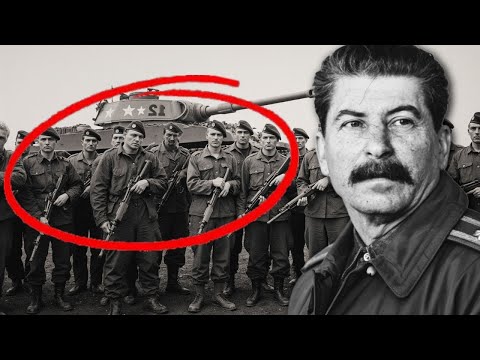
The land itself was torn apart. Bombs flattened entire neighborhoods, bridges were destroyed, and trains crawled along the rails, late and overloaded. Even the law seemed to breathe fear. The secret police watched every word, and no one dared say the Red Army was weak. To complain meant to disappear. Yet within this world of suffering, there was still pride. Soviet officers wore their medals with straight backs, even if their boots leaked melted snow. Young soldiers sang anthems of the motherland while carrying rifles that sometimes had to be shared between two men.
They were told again and again that their strength alone would crush the German invader. Radio voices praised the workers, the peasants, the soldiers, and above all, Stalin. But behind the loud words, hunger and cold whispered louder. The front lines revealed the truth. An infantryman in his trench clutched a rifle so old that its bolt jammed in the frost. His coat was patched with scraps from another uniform. His gloves were half torn. He dreamed of warm bread or meat, but instead chewed on a frozen beet. On the road behind him, smoking trucks sputtered and broke down. Horses dragged sleds loaded with supplies, but even the horses looked like skeletons.
The Red Army was proud but exhausted, and the soldiers knew it, even if they dared not say it aloud. Rumors began to slip in like the cold wind. Dockworkers in Murmansk spoke of ships that had come from far across the sea. Ships loaded with crates bearing strange letters: “United States.” Some said these crates held food unlike anything seen in years. Others claimed they carried boots that would not tear in the snow, or trucks that ran strong even in deep mud. At first, no one believed it. They thought it was another tale, a trick to lift tired hearts. America was described as a land of greedy capitalists, not a friend. Why would such a country help the Soviet Union?
But when the first soldiers saw one of those crates opened, and a can of meat glistening inside, whispers spread. Could it be true that a distant nation, across the ocean, had more food and machines than it knew what to do with? If so, what else might arrive? What else might change? The question hung in the freezing air, heavy as smoke, and no one yet dared to answer.
The first time the soldiers saw the supplies arrive, they felt as if they were stepping into a different world. Trucks rolled into the depot with paint so new it still gleamed under the gray sky. On the sides of the crates, large black letters were painted: USA. And when the lids were opened, the smell of rich food rose into the cold air. Inside were rows of canned meat, sealed butter, and even chocolate bars wrapped in silver paper. A soldier who had not tasted real sugar in months held a piece of candy in his palm, staring at it as if it were a jewel. He bit into it slowly, and the sweetness spread across his tongue in a way that made his eyes water.
The contrast grew sharper with every new arrival. Soviet bread was dark and heavy, sliced into portions that barely filled the stomach. Now, in the depots, stood crates filled with white flour, fine and soft as snow. Soldiers who had grown used to watery cabbage soup now watched American cooks stir pots that smelled of meat and beans. On a cold morning, the men lined up and were handed small cups of a brown fizzy drink from bottles marked Coca-Cola. The drink stung their tongues with bubbles, but it left a sweet taste none of them had known before. They laughed, wiping their mouths on their sleeves, half amazed and half shy at enjoying something so strange.
Then came the machines. Studebaker trucks roared forward, their engines powerful, their wheels digging into mud where old Soviet trucks would have sunk. Men climbed onto the flatbeds, astonished by the smoothness and the lack of rust. The driver turned the key, and the engine hummed instead of coughing smoke. Soldiers watched the truck pull a full load of shells through a field of muck without stalling once. Some clapped their hands, shaking their heads in disbelief.
The clothing told its own story. American boots were sturdy, with thick soles that insulated against the cold, unlike the patched felt boots that soaked up melted snow. Wool socks came in neat bundles, smelling faintly of oil and cotton. One soldier pulled on a new pair of gloves and whispered that his hands had not felt such warmth since before the war began. Around them, Soviet uniforms looked worn and thin, patched so many times they were more thread than cloth.
Every scene, every taste, every sound pressed the same idea deeper into their minds. America was not weak, as they had been told. America was rich, powerful, and overflowing with supplies that seemed endless. The more they saw, the more uneasy they became, for this was not what they had been taught. If these ships kept coming, if these trucks and crates never stopped, then perhaps it was true that the Red Army would have collapsed without this help. The thought lingered like a shadow they could not shake, whispering of changes that would surely come.
On an evening in early spring, when the ice was melting into gray rivers along the roads, a Soviet officer sat at a small desk with a candle guttering beside him. Before him rested a can of peaches from an American crate. He opened it with his knife, and the sweet smell filled the room, brighter than the candle smoke. He lifted a single slice on his fork, golden and dripping with syrup, and placed it in his mouth. The taste burst on his tongue, rich and soft, utterly different from the bitter cabbage and hard bread he had known. For a moment he closed his eyes and thought: This must be what sunlight tastes like. Later, in his notebook, he wrote a single line: “It is like eating light itself.”
In the days that followed, similar moments repeated. A young soldier rode in the back of a Studebaker as it hauled heavy guns through mud that reached the knees of the men walking on foot. He had seen old Soviet trucks stall and sink, forcing soldiers to push them until their hands froze in the icy water. But now the American truck kept moving, steady and strong, and he gripped the rail tightly as the ground shook beneath him. He whispered to the man beside him: “Without this, we would still be stuck.” His words were quiet, but they carried a weight he could not deny.
The Red Army had been told it stood alone, that its strength came only from its people and its leader. But here, in their hands and under their feet, were gifts that told another story. Wool socks that kept out the cold, radios that carried clear voices across miles of snow, cans of meat that pushed back the specter of hunger. Each one spoke of a country across the ocean whose power seemed without end. The soldiers felt it, even if they did not speak it aloud. The old songs of pride now seemed hollow compared to the roar of the new engines.
The officer who had tasted the peaches began to notice the change in his own thoughts. He no longer believed the radio words as he once had. How could America be weak when ships brought more evidence of its wealth every week? He dared not say it openly, but in the silence of his tent he wrote: “Without this help, we would not have held.” The words frightened him, for he knew they contradicted everything he had been taught. Even Stalin himself, in the dark corridors of the Kremlin, was said to have admitted the truth to his closest circle. The Red Army had fought with courage, but courage alone would not have carried them this far. It was the endless flow of food, trucks, boots, and weapons from across the ocean that kept the front alive. And in that admission lay a shift no one could undo—a quiet knowledge that changed how the soldiers saw the world and themselves.
The war did not end with a single cheer, but with a long, weary sigh that spread across the land. The Soviet soldiers, drained by years of blood and hunger, finally began their slow journey home. Trains rattled eastward, carrying men in faded uniforms and women who had worked at the front. Everyone was packed shoulder to shoulder, silent as they watched the ruined countryside. Towns were blackened skeletons. Villages had roofs patched with straw and walls leaning like old men. The smell of smoke still clung to the air, though months had passed since the last battles.
Yet in the pockets of these weary travelers were small keepsakes—reminders of another world they had seen. A pair of warm socks with “Made in USA” faintly stitched on the edge. A small piece of chocolate wrapped in silver. A photograph of a Studebaker truck, its bed stacked with shells that had rolled straight to the front.
When they stepped off the trains and walked toward their villages, families rushed to them with tears wetting their faces, embracing them tightly, counting missing teeth and scars. The joy was sharp, but so was the pain of absence. Many had not returned. Homes were emptier than before, and food was still scarce. Mothers cooked thin porridge from barley and potatoes, and children held tin bowls waiting their turn.
Yet the soldiers who had eaten Spam and tasted canned peaches could not forget the difference. As they lifted watery soup to their lips, the memory of rich meat attacked them without warning. They chewed coarse bread that cut the mouth and remembered white wheat flour soft as snow. They tried to keep silent, but whispers slipped around the tables. “If you had only seen the crates, if you had only tasted those peaches.” But they had to be careful. The state had eyes everywhere, and it was forbidden to give credit to anyone outside the motherland.
Speeches over the radio and posters in the cities told the same story. The victory was purely Soviet, born of the strength of workers and the genius of Stalin. Yet in the privacy of their homes, when windows were shut and lamps dimmed, stories were told in hushed voices. A man told his son about boots that did not wear out in the snow. Another told his daughter about a fizzy drink that tickled his tongue and made him laugh, even though death surrounded him on all sides.
The children’s eyes widened in wonder. These things seemed like fairy tales, food and drink meant for kings, yet their fathers swore they were real. The contrast was even more painful when these men tried to live again in the world they had left. A farmer returned to his field with tools that bent and broke, and thought of the powerful American machines that plowed through mud without stopping. A driver climbed into an old Soviet truck that coughed and smoked, and remembered how the Studebakers had roared steadily like living beasts. A young officer wore his patched uniform at a formal ceremony, feeling the cloth scratch his skin, while he recalled the soft gloves that had warmed his hands on frozen nights.
Everywhere he looked, he saw the gap between what his land gave him and what he had once received from across the ocean. But he also felt a strange shame. For though he knew the truth, he could never speak it aloud. To admit openly that their survival had depended on American food and machines meant risking oneself. Men had disappeared for less. So he carried the secret inside him, a secret that burned in his heart but also gave him strength. He looked at his children, thin but alive, and thought: “We lived because of those crates. You are here because of them.” He never wrote it down, never spoke it above a whisper, but the knowledge remained.
Years passed, and the war became a story told in classrooms and festivals. The state polished its narrative, erasing the parts it did not like, painting the Red Army as an iron wall that needed nothing but itself. But beneath that paint were cracks. Families remembered the stories of chocolate, trucks, and boots that did not wear out. Children who had listened with wide eyes grew into adults with a quiet doubt, questions that did not match the radio lessons. They wondered how a country portrayed as greedy and weak could provide so much. They wondered if strength was not only in armies and metals, but also in fields that produced more food than could be eaten, and factories that made machines beyond counting.
An old soldier, his hair now gray, walked through his village one autumn morning. The leaves had turned gold and red, and smoke rose from chimneys where families cooked simple meals. He leaned on his cane and watched children run in the road. Their shoes were worn, their clothes thin. He remembered the boots that had carried him through snow, the trucks that had pulled him from mud, the peaches that had tasted like sunlight. A neighbor greeted him and asked if the stories of those strange supplies were true. The old man smiled a tired smile and said quietly: “Without them, I would not be standing here today.” His words hung in the air like a truth too heavy to deny, yet still too dangerous to proclaim.
What the men brought home was more than socks, cans, or gloves. It was the memory of a different way of life, filled with abundance that seemed endless. They had glimpsed a power not built on fear, but on plenty. And though they could not speak of it openly, it changed how they judged the world. To them, victory no longer meant only winning battles. It meant who could feed their people, who could clothe them, who could move armies across oceans and still have surplus.
The legacy of that knowledge lived in silence, passed in whispers, and in the way a man would pause before repeating a speech. It lived in the eyes of children who asked, “What was it like?” and in the hearts of fathers who answered with tales of delicious drinks and powerful trucks. And it lived in the final reflection of those who had fought and returned, knowing that the war was not won by pride alone. It was won by an endless flood of supplies that crossed the seas, and by the strength of a country beyond compare that gave more than anyone thought possible.
One soldier, near the end of his life, wrote a final note in his diary, in trembling but clear words. They told us we won alone, but I know the truth. We endured because America fed us, clothed us, and carried us through the storm. Without them, the Red Army would have collapsed. And I hope one day this truth will be known. That truth, hidden for years, was the lesson he left behind. It was not a tale of weakness, but a memory of how abundance, more than fear or pride, kept him alive. And in that memory lies the message for all who came after. Sometimes the greatest weapon is not the rifle in the hand, but the food in the belly and the boots on the feet.
What would you have done if you had been in their place—would you have dared to speak the truth?
Report this article
Select a reason for reporting:






