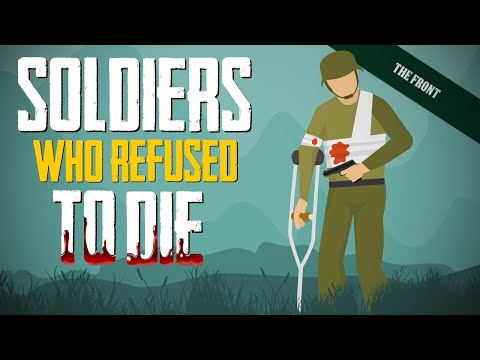
War is a merciless sculptor, chiseling away at the human body and soul. Yet, in the crucible of World War II, some men refused to be broken. Their stories defy logic, medical science, and the limits of human endurance. These are the soldiers who stared into the abyss and spat in its eye.
Imagine a man so small he was called a child, yet so fierce he held off two hundred enemies alone. Picture a pilot with half his skull shattered, flying for hours to safety. Envision a soldier who lost limbs, an eye, and still charged into battle. Their bodies were ravaged, but their spirits remained unyielding.
Take Lachhiman Gurung, a 4-foot-11 Gurkha who, on a May night in 1945, had his right hand blown off by a grenade. With blood pouring from his wounds, he picked up his rifle with his left hand and fought off thirty-one Japanese soldiers. He survived, blind in one eye, and served until 1947.
Then there was Simo Häyhä, the White Death, who took an explosive bullet to the jaw. His face was torn apart, yet he lived to see peace. And Saburo Sakai, a Japanese ace, who was shot in the head, half-paralyzed, and still flew his damaged Zero back to base.
These men weren’t just lucky; they were indomitable. Their stories are a testament to the resilience of the human spirit. But their ordeals were far from over.
Alexey Maresyev crawled for eighteen days through snow with shattered legs, gangrene setting in. He lost both legs but learned to fly again with prosthetics. And Sir Adrian Carton de Wiart, shot in the face, gut, and skull, lost an eye and a hand, yet fought in two World Wars and lived to eighty-three.
Their suffering was immense, their recoveries miraculous. But what drove them? Duty, honor, or sheer stubbornness? Perhaps a bit of each.
As we delve deeper into these extraordinary lives, we’ll uncover the moments that defined them—the split-second decisions that meant life or death. These are not just stories of survival; they are legends of the human will.
Matt Urban was cut from a different cloth. Wounded in North Africa, Normandy, and Belgium, he refused evacuation every single time. After shrapnel from a tank shell tore into his left leg, he gave orders from a stretcher rather than leave his men. A month later, a shell fragment lodged beside his heart, and still he stayed.
Then came the bullet through his neck while charging a machine gun position. The tracheotomy saved his life but destroyed his voice. His men, believing him dead, called him the Ghost when he returned. He whispered his way through the rest of the war, never again allowed near the front lines.
And then there was Robert John Harper, a name few would recognize. Stationed in the Aleutian Islands, he picked up a live grenade to save his comrades. It exploded in his hand, taking his trigger finger and embedding shrapnel in his skull.
The medics zipped him into a body bag and marked him dead. But as they carried him away, a groan escaped the bag. They unzipped it, checked his pulse, and found a live one. Surgery removed the shrapnel and replaced part of his skull with titanium.
Harper never returned to combat. Missing a trigger finger, he was sent home to Lansing, Michigan, where he met a woman working in wartime industry. They married, built a life, and his story might have faded into obscurity—except his great-grandson told it decades later.
These men were not invincible. They bled, screamed, and suffered just like anyone else. But when the moment came, they chose to endure. They clung to life with a ferocity that bordered on the inhuman.
Their stories remind us that the human body is fragile, but the human will is not. In the face of annihilation, they stood their ground. And in doing so, they became something more than soldiers—they became legends.
But the war had more horrors in store for those who survived. The scars they carried were not just physical. Many would struggle for decades with the memories of what they had seen and done.
For every soldier who survived against the odds, there were countless others whose stories ended in silence. The men we’ve discussed were the exceptions—the statistical anomalies that defied medical textbooks and common sense. But their survival came at a cost.
Take Lachhiman Gurung. After the war, he returned to Nepal, but the shrapnel in his body never stopped moving. Doctors removed fragments from his leg and face for years, each surgery a reminder of that night in the trench. His right hand remained useless, a claw-like appendage he learned to live without. Yet he never complained. When asked about the grenade, he reportedly said only that he had orders to hold the position.
Saburo Sakai’s survival was equally improbable. The bullet that carved through his skull left him with crippling headaches and partial blindness. He flew again, but the war had changed him. After Japan’s surrender, Sakai became a Buddhist monk, devoting his life to peace. He refused to speak of the war for years, haunted by the friends he had lost and the enemies he had killed.
Alexey Maresyev’s story became Soviet propaganda, but the man behind the legend was more complex. His prosthetics caused constant pain, and every step was a battle. He flew dozens of missions after losing his legs, but the psychological toll was immense. He drank heavily in his later years, haunted by the eighteen days he spent crawling through the snow, listening to wolves howl in the distance.
Sir Adrian Carton de Wiart, the seemingly indestructible man, had his own demons. Despite his cheerful demeanor and love of battle, he suffered from chronic pain throughout his life. The shrapnel embedded in his body from a dozen wounds caused constant discomfort. He wore a black patch over his missing eye, but the socket never fully healed, requiring regular cleaning and care.
Matt Urban, the Ghost, lived with a hole in his throat for the rest of his life. His voice never returned, reduced to a rasping whisper. He communicated through notes and gestures, a fate that frustrated a man who had once commanded hundreds. His collapsed lung, the eventual cause of his death, was a direct result of the wounds he refused to let take him from the battlefield.
And Robert John Harper, the man who came back from the dead, never spoke of the grenade. His family knew the story only through his great-grandson, who pieced it together from letters and military records. Harper lived a quiet life in Michigan, working at a factory and raising children. He died in 1978, his titanium skull plate a silent testament to the war he never discussed.
The war had ended, but for these men, the battle never truly stopped. The physical scars healed, but the memories remained. They had survived against all odds, but survival came with its own burden.
Their stories, however, did not end in silence. They echoed through generations, carried by grandchildren and great-grandchildren who pieced together fragments of lives lived in the shadow of war. Robert John Harper’s great-grandson held the titanium plate in his hands once, tracing the edges with his fingers, trying to imagine the explosion that put it there. He never could. Some things are beyond imagination.
For Lachhiman Gurung, the Victoria Cross arrived in 1945, but the real reward was the quiet life he built in Nepal. He farmed, raised a family, and rarely spoke of the night he held the trench alone. When villagers asked about the missing fingers and the scars, he simply said he had done his duty. Nothing more needed to be said.
Saburo Sakai’s transformation from ace pilot to Buddhist monk surprised many who knew him. He had spent years killing from the sky, and now he spent decades praying for peace. In his later years, he met with American pilots he had once fought, shaking hands with men who had tried to kill him. The war was over. The healing had begun.
Alexey Maresyev’s fame brought him honors and a hero’s welcome, but the quiet moments were the hardest. He would sit alone, staring at his prosthetic legs, remembering the snow, the pain, the wolves. He once told a reporter that crawling for eighteen days taught him one thing: the human body can break, but the human spirit bends only if you let it. He never let it.
Sir Adrian Carton de Wiart outlived almost everyone who knew him in battle. He retired to Ireland, fished, hunted, and lived as if his body had not been shattered a dozen times over. When asked the secret to his longevity, he reportedly laughed and said, Never trust a doctor who tells you to rest. He died at eighty-three, still carrying shrapnel from three wars.
Matt Urban, the Ghost, faded into civilian life in Michigan, working quietly and raising a family. His voice never returned, but his legacy did. In 1980, he received the Medal of Honor, decades after the wounds that should have killed him. He accepted it with a whisper and a nod, a ghost finally recognized by the living.
These men were not invincible. They were not gods or superheroes. They were soldiers who faced the worst the world could offer and refused to yield. Their bodies bore the marks of war, but their spirits carried the weight of survival. That weight was heavy, but they carried it anyway.
The war ended in 1945, but for these men, the battle never truly stopped. The physical scars healed, but the memories remained. They had survived against all odds, but survival came with its own burden.
And yet, they lived. They loved. They built lives from the rubble of destruction. They proved that even in the darkest moments, the human will can shine brighter than any explosion, any bullet, any grenade. Their stories are not just about war—they are about the indomitable spirit that refuses to die.
So the next time you hear of a soldier who survived the impossible, remember: behind every statistic, every medal, every scar, there is a human being who chose to fight, to endure, to live. Their stories deserve to be told, again and again, until the end of time.
What story of survival—from war or peace—has inspired you the most? Share it in the comments below, because every story of resilience deserves to be heard.
Report this article
Select a reason for reporting:






