February 12, 1943, Henderson Field, Guadalcanal. The tropical dawn bleeds orange over the Coral Sea as twenty-four strange, bent-wing birds sit on the steaming runway. Their gull wings curve downward like talons, their massive propellers catching the first light. These are the F4U Corsairs—untested, unpredictable, and about to change everything.
Major William Gise runs a weathered hand along the cold metal of his fighter. At 32, he’s seen enough combat to know when something is about to shift. Behind him, First Lieutenant Ken Walsh adjusts his helmet with trembling hands. “Twenty-five hours,” Walsh mutters. “That’s all we’ve got in these things.” Twenty-five hours of flight time in machines that promise to revolutionize air combat—or kill them all.
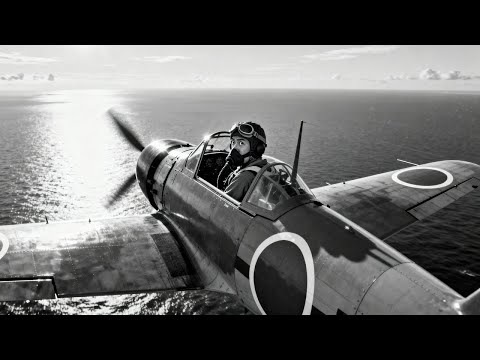
For 39 months, the Japanese Zero has ruled the Pacific skies. American Wildcats died in droves, unable to catch the high-altitude bombers that pounded Henderson Field every night. But today, hope sits on the runway in the form of 2,000-horsepower engines and six .50-caliber guns. The Corsair’s whispered promises: speeds over 400 mph, climb rates that defy belief, firepower that can shred a Zero in seconds.
Three thousand miles north, at Rabaul, Japan’s most feared ace adjusts his leather helmet. Hiroyoshi Nishizawa—the Devil—has 36 confirmed kills. He and his fellow pilots have dominated every air battle for three years. The American Wildcats are predictable, slow, vulnerable. This morning’s briefing promises another routine interception.
But Nishizawa’s confidence masks a growing concern. Japanese pilot training has become rushed; new pilots arrive with barely 200 flight hours. The Americans, meanwhile, seem to have an endless supply of replacement aircraft. Still, the Zero remains supreme—its low-speed maneuverability legendary, its 20mm cannon deadly.
What none of the Japanese pilots understand is that their technological advantage is about to evaporate in minutes. Back at Henderson Field, Ken Walsh struggles into the Corsair’s cockpit. The seat sits higher, the engine cowling stretches impossibly far ahead, and the massive propeller creates a blind spot that makes taxiing dangerous. He literally cannot see directly in front of the aircraft on the ground.
When he hits the starter, the sound is unlike anything he’s experienced—a deep rumbling thunder that shakes the island. Major Gise’s voice crackles through the radio: “Gentlemen, today we escort B-24s to Bougainville. The Japanese will come up to meet us. Protect the bombers and learn what these birds can do.”
What Gise doesn’t say is that they’re essentially test pilots flying experimental aircraft into combat. The Navy rejected the Corsair for carrier operations due to visibility problems and tricky landing characteristics. The Marines received them almost by accident—a consolation prize that might become a death trap.
As the formation taxis toward the runway, the Corsairs create an otherworldly sound. The air intakes on their massive engines produce a distinctive whistling noise that carries for miles. Ground crews have nicknamed it the whistling death, but they have no idea how prophetic that name will prove.
Walsh feels the Corsair’s power as he lines up for takeoff. The engine’s torque tries to pull the aircraft sideways. The acceleration is intoxicating and terrifying. Nothing has prepared him for the raw power pressing him back into his seat as the bent-wing fighter leaps into the tropical sky.
Climbing through 10,000 feet, Walsh begins to understand what they’ve been given. The Corsair climbs like an elevator, reaching altitudes that would take his old Wildcat twice as long. The controls feel responsive and powerful—the aircraft eager to fight despite its size.
But questions gnaw at every pilot. Will the Corsair’s speed advantage overcome its unfamiliarity? Can they master its quirks before meeting Japanese aces who know every trick? Most critically, will their minimal experience prove fatal when the bullets start flying?
As VMF-124 heads north toward Bougainville, Japanese radar operators track the incoming formation. “24 enemy fighters and bombers approaching from the southeast,” the routine report crackles. What they cannot know is that the nature of aerial warfare is about to change forever.
The engagement begins at 25,000 feet, 40 miles southeast of Bougainville, at exactly 1:47 p.m. Nishizawa spots the American formation first—a familiar sight of lumbering B-24s surrounded by escorts. But something is wrong. The escort fighters look different: larger, with wings that bend in an unnatural gull shape. He’s never seen anything like them.
“Unidentified American fighters,” he radios. “New type, unknown capabilities.”
Lieutenant Ken Walsh sees the Zeros climbing toward them like angry hornets. Eighteen deadly aircraft flown by Japan’s most experienced pilots. His heart pounds. This is it—the moment that will determine whether the Corsair is a game-changer or an expensive mistake.
The Japanese attack comes with textbook precision. Nishizawa leads six Zeros in a high-speed diving attack, expecting the Americans to turn toward them in the predictable defensive maneuver that has cost so many Wildcat pilots their lives. Every Japanese pilot knows the routine: the Americans will try to turn fight, the Zeros will outmaneuver them, and the slaughter will begin.
But something incredible happens instead. Major Gise doesn’t turn. He pushes his Corsair’s nose down and accelerates straight ahead. Walsh and the others follow, and suddenly eighteen Corsairs are diving away at speeds that defy belief.
Nishizawa watches in stunned amazement as the American fighters pull away from his diving Zeros like they’re standing still. His Zero tops out at 350 mph in a dive. The strange new fighters are easily doing 450 mph and still accelerating.
“Impossible,” he whispers into his radio. “They’re too fast.”
Walsh feels the Corsair’s incredible power as they dive past 400 mph. The airframe remains solid and controllable at speeds that would tear apart his old Wildcat. Through his radio, Gise’s calm voice: “Level out and climb. We’re going to show them what boom-and-zoom looks like.”
The Corsairs level out at 20,000 feet and immediately begin climbing back toward the Japanese formation. The massive Pratt & Whitney engines pull them upward at a rate that leaves the Japanese pilots struggling to comprehend. In less than three minutes, the Marines have regained their altitude advantage and are positioning for their own attack.
Saburo Sakai, flying wing position with Nishizawa, feels a cold knot forming in his stomach. In three years of combat, he has never seen American fighters that could outclimb a Zero. The new aircraft seem to violate everything he understands. They’re large and heavy, yet they climb like rockets. They’re single-engine fighters, yet faster than anything the Japanese have encountered.
“Attack formation,” Gise calls. “Remember your training. Speed is life. Altitude is life insurance. Use both.”
The Corsairs attack in pairs, diving from above at devastating speed. Walsh picks out a Zero below him and pushes his stick forward, feeling the aircraft accelerate past 450 mph. The target grows rapidly in his gunsight—a beautiful pristine A6M painted in green and gray. At 300 yards, Walsh opens fire with all six .50-caliber machine guns. The Corsair carries twice the firepower of his old Wildcat, and the effect is immediate and shocking. His first burst tears through the Zero’s unarmored fuel tank, and the Japanese fighter disappears in a ball of orange flame so bright it hurts to look at.
“Got one!” Walsh shouts, pulling up and climbing back to altitude. The maneuver would have been impossible in a Wildcat. But the Corsair climbs away like it’s rocket-powered.
Nishizawa attempts to pursue, but his Zero simply cannot match the Corsair’s climbing performance. The American fighter pulls away vertically until it’s nothing more than a dot against the blue sky. For the first time in his combat career, Nishizawa feels helpless.
The battle becomes a nightmare for the Japanese. Every time they maneuver to attack the bombers, the Corsairs dive on them from above at impossible speeds. The American fighters hit like thunderbolts, firing devastating bursts before climbing back to altitude faster than any Zero can follow.
Warrant Officer Tetsuzo Iwamoto, Japan’s third-highest scoring ace, finds himself in a turning fight with a Corsair pilot who makes a critical mistake—he tries to turn with a more maneuverable Zero. But even this advantage proves temporary. When Iwamoto gets on the American’s tail and closes for the kill, the Corsair pilot simply pushes his throttle forward and accelerates straight ahead. The Zero cannot match the American fighter’s speed in level flight. Iwamoto watches his target disappear into the distance.
“They won’t fight,” he radios in frustration. “They refuse to engage properly.”
But the Japanese pilots are wrong. The Americans aren’t refusing to fight. They’re fighting smarter. Walsh and his squadron mates are using the Corsair’s superior speed and climb rate to dictate the terms of engagement. They attack when they choose, disengage when they want, and never allow the Japanese fighters to use their superior maneuverability.
As the battle continues, the psychological impact on the Japanese pilots becomes devastating. For three years, they have owned the Pacific skies. Now they face American fighters that are faster, more powerful, and seemingly invulnerable to their proven tactics.
Lieutenant Teo Okamura, a veteran Zero pilot with 14 kills, lines up behind a Corsair and opens fire with his 20mm cannon. His first burst hits the American fighter squarely in the fuselage—strikes that would destroy any previous American fighter. But the Corsair absorbs the punishment without visible effect. The aircraft’s rugged construction, designed for carrier operations, proves nearly impervious to damage that would be fatal to the lightweight Zero.
The American pilot, Lieutenant Robert Hansen of VMF-124, feels the cannon shell strike but maintains control. His Corsair shudders under the impact but continues flying. In his old Wildcat, those hits would have sent him into the ocean. The Corsair’s armor plating and robust design save his life. Hansen rolls his damaged Corsair into a shallow dive and accelerates away. Okamura follows, pushing his Zero to maximum speed, but the damaged American fighter still pulls away effortlessly.
The engagement lasts 18 minutes. When the smoke clears, seven Japanese fighters have been shot down, including two flown by veteran aces. The Americans lose one Corsair—not to Japanese fighters, but to ground fire from Bougainville’s anti-aircraft guns. The B-24 bombers complete their mission untouched.
As the surviving Zeros limp back to Rabaul, the Japanese pilots sit in stunned silence. Everything they thought they knew about aerial combat has been turned upside down in less than 20 minutes. Nishizawa stares at his fuel gauge and realizes something that chills him to the bone: for the first time since Pearl Harbor, Japanese pilots are afraid of American fighters.
The radio reports flooding into Japanese headquarters that evening tell a story senior officers refuse to believe. “New American fighter, unprecedented speed, cannot be engaged.” The words seem impossible to commanders who have watched their pilots dominate for three years.
But Lieutenant Ken Walsh sits in his quarters on Guadalcanal, cleaning his goggles with hands that finally stopped shaking, and knows that everything has changed forever. In 18 minutes of combat, he witnessed the balance of air power shift decisively toward the Americans. The Corsair isn’t just a new fighter. It’s a revolution in aerial warfare that renders Japanese tactics obsolete overnight.
“We couldn’t catch them,” Nishizawa confides to Saburo Sakai as they walk across the darkened runway at Rabaul. For the first time in his career, Japan’s greatest ace sounds defeated. “They decided when to fight and when to run. We couldn’t force an engagement on our terms.”
This psychological transformation proves more devastating than the physical losses. Japanese pilots who once approached every engagement with supreme confidence now face a terrible uncertainty: What if American technology has finally caught up with Japanese skill?
The impact ripples through the Pacific War with shocking speed. Within weeks, reports pour in from across the theater of strange new American fighters that refuse to be caught or outmaneuvered. Japanese pilots begin developing what flight surgeons will later recognize as combat fatigue—not from exhaustion, but from the stress of facing an enemy they cannot defeat with proven tactics.
Ken Walsh returns to combat two months later and shoots down three Zeros in a single engagement, becoming the first Corsair ace. His victory represents more than personal achievement. It symbolizes the technological revolution that will carry American forces across the Pacific to Japan itself.
The Corsair’s success creates a cascading effect that Japanese strategic planners never anticipated. American bomber formations, once vulnerable targets requiring massive fighter escorts, now operate with near impunity under Corsair protection. Japanese bases that seemed secure behind rings of Zero fighters suddenly become vulnerable to round-the-clock bombing attacks.
Major Gregory “Pappy” Boyington, who will later command the famous Black Sheep Squadron, describes the Corsair’s impact perfectly: “The Japanese had to completely rethink how they fought us. For three years, they could count on superior maneuverability to win any engagement. Suddenly, that advantage meant nothing if they couldn’t catch us to use it.”
The statistics tell the story in stark numbers. Corsair pilots achieve an 11:1 kill ratio against Japanese aircraft throughout the Pacific War. By 1945, Japanese pilots fear the distinctive whistle of the Corsair’s air intake so much that the sound alone causes formations to scatter before American fighters even come into visual range.
But the deeper impact extends far beyond tactical victories. The Corsair demonstrates that American industrial might can not only match Japanese innovation but surpass it decisively. The aircraft represents everything Japan cannot compete with: massive engines requiring rare metals, precision manufacturing demanding advanced industrial techniques, and design philosophies that prioritize pilot survival over aircraft weight.
Hiroyoshi Nishizawa, the Devil who once ruled Pacific skies, dies in November 1944—not in aerial combat, but as a passenger in a transport aircraft shot down by American fighters. His death symbolizes the complete reversal of air power that began with the Corsair’s first combat mission.
Today, aviation historians recognize February 13, 1943, as the day American forces gained air superiority in the Pacific War. But for the men who lived through that transformation—both American Marines who discovered they finally had the tools to fight back and Japanese pilots who realized their technological advantage had evaporated—the memory remains intensely personal.
The Corsair didn’t just change the outcome of battles. It changed the fundamental nature of aerial warfare, proving that superior technology properly employed could overcome years of tactical experience and training. In 18 minutes over Bougainville, the age of Japanese air supremacy ended, and American industrial might began writing the final chapters of the Pacific War.
The bent-wing fighters that Marines feared to fly became the instruments of Japanese defeat—whistling death from American skies that would never again belong to the rising sun.
Walsh would later say the silence after landing was louder than the guns. Twenty-three Corsairs returned; one pilot lost to anti-aircraft fire. Ground crews counted the empty shell casings and said nothing.
Nishizawa filed his report that night with shaking hands. “The age of the Zero is over,” he wrote. His commanders refused to believe it. But the pilots who survived Bougainville knew the truth.
Within months, the Corsair’s whistle became the sound Japanese pilots dreaded most. The hunters had become the hunted.
What would you have felt, strapped into an untested machine with only 25 hours of flight time, facing the Devil himself?
Report this article
Select a reason for reporting:






