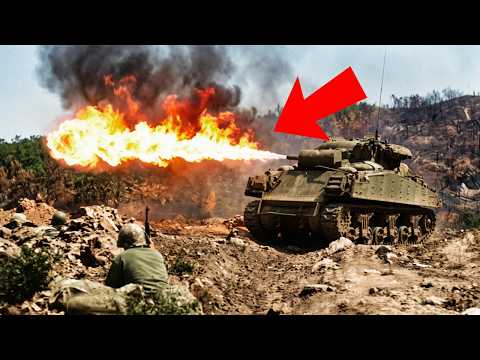
The 14th of March, 1945. Three days, three battalions, one pocket of rock on Iwo Jima, and the Marines could not take it. The men inside that hill had already survived one of the heaviest naval bombardments of the Pacific War. The shells hadn’t reached them. The rifles and grenades hadn’t reached them. So that morning, the Marines brought up a tank they’d had to borrow because there were only eight like it on the entire island. It looked like every other Sherman. It wasn’t. When the battle was over, the Marines would name one weapon as the most valuable on the island. Not the battleships, not the bombers, not the artillery. To understand why, you have to meet the man who buried an army under 11 miles of tunnel.
Iwo Jima is eight square miles of volcanic ash and sulfur, closer to Tokyo than to any American base. In 1945, it was Japanese home soil. Whoever held its two airfields held a waypoint on the road to Japan itself. The Americans were coming. Everyone knew it. The only question left was how the island would be defended.
Every earlier island had been defended the same way. Stop the Marines on the beach and when the beach was lost, charge into American guns until there was no one left. It was brave. It was doctrine. And it had failed every time.
Lieutenant General Tadamichi Kuribayashi threw the doctrine away. He looked at Iwo Jima and understood that the beach could not be held, so he chose not to hold it. He would let the Marines land. He would let them walk inland, and then he would kill them from inside the ground.
His men went underground with picks and drills and began to dig. They cut galleries through rock so hot with volcanic steam that crews could work only a few minutes at a stretch before they had to be pulled out. They hollowed Mount Suribachi into something close to seven stories of tunnel and gun room. On the high ground east of the second airfield, they built a killing ground the Marines would come to call the meat grinder, where a single hill was rebuilt from the inside to hold artillery, and every gun in it was covered by as many as ten machine guns waiting in the rock around it.
By the time the Americans arrived, the island held roughly 11 miles of finished tunnel with far more planned than was ever dug. Pillboxes connected to caves. Caves connected to command rooms. A position knocked out at the surface could be reoccupied an hour later by men who simply walked to it underground. Late in the battle, a 500-pound bomb dropped squarely into a cave mouth near the north end of the island, and the smoke from it blew out of the side of a cliff more than 400 yards away. That was the kind of fortress this was. You could not seal it from the outside. It was all one connected thing breathing under the ground.
Then came the bombardment. For three days, the United States Navy stood off Iwo Jima and fired into it. Battleships, cruisers, weeks of bombing on top of the shellfire. It was one of the heaviest poundings any island of the Pacific ever received. It barely touched him. The bombardment had not failed. It had been aimed at the wrong war. The shells were built to smash things standing on the surface, and Kuribayashi had put nothing on the surface worth smashing. His army was below the shells, waiting, listening to the naval gunfire pass overhead like weather. Getting him out would take something the Navy didn’t have, and it was already on its way.
On the 19th of February, the Marines landed. The first waves came ashore almost unopposed, and for a moment, it looked easy. Then Kuribayashi opened fire from everywhere at once and the beaches became a killing floor. When the first Sherman tanks of the Fifth Tank Battalion clawed up off the sand that afternoon, anti-tank guns firing from hidden rock caught them at once and four tanks took direct hits before anyone could even locate the gun that was killing them.
Kuribayashi had told his men the terms in plain words. There would be no rescue. There would be no surrender. Each man was to kill 10 Americans before he died. 21,000 defenders were dug into that island. When it was over, 216 of them would be taken alive.
That was the problem the Marines woke up to. Not how to win the beach, how to dig out an enemy who had gone into the earth and sworn never to come out.
The Marines already had a weapon for caves. They had carried it up every beach in the Pacific. It was fire. A man could not shoot a bullet around a corner into a tunnel, but he could send burning fuel around that corner, and fire did not need a clean hit to empty a room. The trouble was the machine that delivered it.
The standard infantry flamethrower was the M2-2. A man wore it on his back. Two tanks of thickened fuel, one tank of pressure, and a wand in his hands. Filled, it weighed about 70 pounds. It held roughly four gallons of fuel, enough for eight or nine seconds of flame if he spent it all at once. And it threw that flame no more than 20 yards with thin fuel, perhaps 40 with thickened fuel on a good day.
Twenty yards. Sit with what that meant. To use the one weapon that could clear a bunker, a man had to walk and then crawl to within 20 yards of the very slit the bunker was firing out of. He had to come close enough to a machine gun to burn it while it was shooting at him with 70 pounds of fuel and pressure strapped to his spine.
On the 23rd of February, the same afternoon the flag went up on Mount Suribachi and photographers made Iwo Jima famous forever, Corporal Hershel Williams of the 21st Marines was doing the other work, the work no camera caught. The tanks with the rifle companies could not find a lane through the mines and the concrete. So Williams strapped the fuel tanks onto his back and started crawling. Covered by four riflemen and nothing else. He worked from pillbox to pillbox, went back for more fuel, and came forward again for something close to four hours. He lived. He would wear the Medal of Honor for it, and he would carry the memory of bullets ringing off his own fuel tanks for the rest of a very long life.
Most of the men who did that work were not so lucky. Crawling upright with tanks on your back makes you the tallest, slowest, most obvious target on the field, and the enemy knew exactly what that shape meant. In one Marine battalion, the flamethrower teams were used up almost completely. More than nine in ten of them killed or wounded before the fighting ended. The flame worked. The problem was never the flame. The problem was that the only way to deliver it put a man in the open at arm’s length from the thing trying to kill him with a few seconds of fuel and no armor at all.
The Marines needed a way to put fire at the mouth of a cave without putting a man there first. And 4,000 miles away, a few hundred men had spent the winter building exactly that, almost by hand.
The idea itself was obvious, and it had been obvious for two years. Put the fire behind steel. Give it reach. Give it more than four gallons and more than nine seconds. Build a flamethrower that could never be shot off a man’s back because no man would be carrying it.
The place was Schofield Barracks on Oahu, thousands of miles from any fighting. The men were an odd mix that the war had thrown together. Navy Seabees, the construction sailors who normally built airfields and roads, Army chemical warfare technicians, and Marine tankers who knew the Sherman inside and out. Nobody had ordered a factory to turn these things out. There was no factory. There were these men in a field with welding rod and machine tools and a deadline.
What they did was take the M4A3 Sherman, the standard Marine medium tank, and perform surgery on it. They pulled the 75mm cannon out of the turret. In its place, they mounted a Navy flame gun, the Mark 1. And around the flame gun, they fitted a false tube so that from a distance, the tank still looked like an ordinary gun tank. That disguise mattered. An enemy who could not tell the flame tank from the others could not shoot the flame tank first.
Then they filled it with fire. Where the backpack man carried four gallons, this tank carried 290, 70 times the fuel. Where the backpack threw flame 20 or 40 yards, this tank reached out to about 150. Where the backpack gave eight or nine seconds, this gave the better part of a full minute of continuous flame. Fifty-five to 80 seconds of thickened gasoline that stuck to whatever it hit and kept burning. And because the flame gun sat in the turret, the crew could turn it and aim it like any other tank gun, laying fire wherever the turret pointed. All of it from behind armor plate.
It was rough work, and everyone knew it. One of the men was rigging his ignition out of ordinary telephone wire because the proper parts were still somewhere out on the ocean. Each tank swallowed roughly 1,200 hours of labor. But when they were finished, they had built the weapon that the war on the caves had been asking for, and they had built exactly eight of them. And at least one of the men who built them would not stay in Hawaii. He would follow his work all the way to the worst ground on Iwo Jima and ride it into the line himself.
Fire on tracks was not a brand new idea. The Japanese had met flame armor before. Light flame tanks had burned positions on Saipan and on Tinian. On Peleliu, the Marines had bolted a flame gun onto a thin-skinned amphibious tractor. So, it is not quite right to say that no one on Iwo Jima had ever seen a flame vehicle. What was new, what nobody in those caves had ever faced was this: a full medium tank armored like any Sherman, carrying a flame gun that could reach out 150 yards, aimed from a turret, able to drive up to a cave mouth and put the better part of a minute of fire straight down its throat. Flame tanks were already fighting in Europe by then, but against the Japanese, nothing like this had ever been turned loose. Iwo Jima was the first time.
Four of the eight went to the Fourth Tank Battalion. Four went to the Fifth. They came ashore on the first day and for two days they were held back and used sparingly while the beachhead was still chaos. Then on the 21st of February at the foot of Mount Suribachi, the 28th Marines were grinding into the belt of pillboxes guarding the mountain and the flame tanks went to work for the first time. Wherever the ground let a tank get close, it burned the pillboxes out. That evening, the tanks pulled back to be refueled and rearmed in the dark so that nothing would slow the attack at dawn. The weapon had arrived.
To understand why the flame tank changed this battle, you have to understand what Kuribayashi had done that no bombardment could undo. He had not built a wall. He had built a maze that fought back from every direction at once. His engineers dug positions on the reverse slopes of the hills, the backsides, where naval guns and artillery firing from the front could not reach them. A Marine coming over the crest of a ridge would find himself looking down into fire he could not have seen from below. Fields of fire were deliberately kept short, sometimes 25 yards, so that a defender in a cave saw only a narrow slice of ground, fired into it, and could not himself be flanked by anyone he had not already spotted.
Against that, a tank cannon was often useless. You cannot shoot a hill with a cannon and kill the men living inside it. But you could drive a flame tank up to the mouth of the position. And fire does not travel in a straight line the way a shell does. Fire pours. It finds the opening. It goes in and it fills the space and it takes the air. And men who had sat out three days of naval shelling could not sit through that.
The first proof came in the center of the island on the ground held by the Third Marine Division. A rifle company was stalled at a hill, taking fire from a tunnel on the reverse slope where nothing could reach it. The tankers worked a flame tank around to the back of the hill, put its gun on the tunnel mouth, and burned it out. The enemy who had been firing from it stopped firing from it. The reverse slope, the whole purpose of which was that it could not be touched from the front, had just been touched.
But the flame tank was not magic, and the honest history says so plainly. On the 27th of February, near Hill 362A, a Marine battalion was pinned by a cluster of pillboxes and called for armor. The word that a flame tank was coming ran along the line, and men waited for it the way you wait for a rescue. Then, before it could fire a single shot, a mortar round found it and knocked it out. The rescue that everyone had been waiting for was gone in one blast, and the infantry were left to do the job the hard way.
A few days later, the same ground told the other side of the story. Company C of the Fifth Tank Battalion brought its gun tanks and its flame tanks forward together, and this time they worked. They burned and blasted positions on the steep northern face of Hill 362A and mopped up strong points the infantry had been forced to bypass. One Sherman bogged down in the ash with 30 or 40 Japanese soldiers closing in around it. And the crew fought their way clear with everything they had. That same day, the officer who had sent the flag up Suribachi, Lieutenant Colonel Chandler Johnson, was killed by a shell not far away. The famous photograph and the unphotographed grind of the northern hills were the same battle, a few thousand yards and a few days apart.
If you want to understand the weapons that actually won this island and not only the picture that made it famous, take a second and subscribe because the worst ground on Iwo Jima was still ahead. And it was there that the flame tanks did the thing the Marines never forgot.
On the eastern side of the island, the Fourth Marine Division was fighting through the meat grinder, the linked strong points of Hill 382, the Amphitheater, and Turkey Knob. It was the worst ground most of those men would ever see. Here, the flame tanks earned their keep in small grinding increments.
On the 4th of March, the 24th Marines, working forward behind flame tanks, gained 100 yards in a day and then stopped to detonate more than a ton of explosives against the cave positions they had opened. One hundred yards. That was a good day.
In the Amphitheater, a natural bowl the Japanese had turned into a shooting gallery, the flame tanks proved most useful of all in the ugly patient job of mopping up bypassed positions that would otherwise have come back to life in the Marines’ rear. Even fire had its limits, and the record is honest about that, too. In the meat grinder, a great communications blockhouse on the rise called Turkey Knob shrugged off day after day of point-blank fire from flame tanks and gun tanks alike.
Which brings the story back to that pocket of rock, the place the Marines called Kushman’s Pocket, and to the tank they’d had to borrow. By the middle of March, the Third Division had ground into a pocket of resistance so stubborn that three battalions had failed to clear it in three days. The Third Division had no flame tanks of its own, so it borrowed one. A single flame Sherman sent over from the Fifth Division.
From a distance, it looked like any other gun tank. Up close, where the 75mm cannon should have been, there was only a plain steel tube. On the 13th and 14th of March, that borrowed tank and the gun Shermans with it went at the concrete emplacements one after another. What three days of infantry assault had not done, the flame did in hours.
By then, many of the riflemen in that pocket were replacements. Young men fed into the line to fill the places of the dead. And it was the armor more than anything else that carried them through.
On the far side of the island, the Fourth Division was closing out a pocket of its own where a Japanese general named Sadasue Senda had gathered perhaps 1,500 soldiers and sailors to make a final stand. The ground was mined and the approaches were bad. So the engineers went in first and cleared a road along the coast. And up that road, the flame tanks came. They set themselves on the coast road and fired inland up the draws and gullies where men were hiding in ground that infantry alone could barely enter. On the 15th of March, the attack the flame had made possible gained 200 yards, and by the next morning, the pocket was finished. 1,500 men had held it to the end.
And still, the hardest ground on the island was waiting. At the far north end of the island, Kuribayashi and the last of his army pulled back into a rocky ravine near Kitano Point, a place the Marines simply called the Gorge. It was maybe 700 yards long and a few hundred wide. And it was solid defense from wall to wall. No defenders visible anywhere. Every crevice a firing position. Attacking troops took fire from the flanks and the rear more than from the front. And a single defender in a cave sometimes had a field of fire narrowed to a sliver, 10 degrees or less, which meant you could not see him until you were already in his sights.
There was no clever way through it. There was only a method worked out over weeks of exactly this and repeated now to the very end. First, the armored bulldozer. The ground was too broken for tanks to move. So, a dozer went ahead under fire and clawed a path through the rock. Then, up the path the dozer had cut came the flame tanks. They put their fire into the cave mouths and the crevices, and they burned until the positions went silent. Then, the infantry moved up into the ground the flame had cleared. And behind the infantry came the engineers who packed the emptied caves with explosive and sealed them shut so that no one could reoccupy them from underground.
Bulldozer, flame, infantry, engineers. Over and over, yard by yard, up a ravine where the enemy had chosen to die.
In the Gorge, the flame tanks of the Fifth Division burned through fuel at a rate that tells you how much work they were doing. As much as 10,000 gallons of thickened gasoline in a single day. And the Marines who watched it said the thing that no bombardment had ever earned. This, they said, was the one weapon that finally made the Japanese leave their caves and run.
The naval guns had not done it. The air strikes had not done it. Fire carried in close and poured into the ground did it.
Remember the man from the field in Hawaii, the one who followed his work to the front? He put it in a letter home. His crew, he wrote, had been handed a single pocket to burn out. They cleared it in about six hours on four loads of fuel. It was ground that a whole tank battalion and three infantry companies had been trying to take for five days. The infantry, he said, would rather see one flame tank than a dozen tanks with cannons.
He was not a Marine and not a soldier. He was a construction sailor who had helped build the weapon in a field in Hawaii. And now he was proving it in the worst terrain in the Pacific.
The men on the receiving end of that flame were not fools and they were not cowards. And the way they reacted tells you exactly how much the flame tank mattered. They feared it and they went straight at it. Again and again, when a flame tank came within reach, small groups of Japanese soldiers threw themselves directly at it with explosives strapped to their bodies, trying to kill the tank before it could kill the position. Most of them were cut down by covering Marines or by the tank’s own fire before they arrived. They kept coming anyway. You do not spend men that way against a weapon that does not frighten you.
Higher up the chain, the Japanese command wrestled with the Sherman and could not find an answer. Captured records and later accounts described Kuribayashi’s staff studying the American tanks and concluding that even their 47mm anti-tank gun could not reliably destroy one, and that the only real hope was to attack them at close range with explosives carried by hand. Their own light flame tanks and the armor of Baron Takeichi Nishi, a cavalry officer who had once won Olympic gold on horseback, were mostly dug into the ground and used as fixed pillboxes because there was nothing else useful to do with tanks on an island like this.
It was not fire itself that surprised the men in those caves. They had seen fire on tracks before. What they had never seen was a full medium tank that could stand off at range or roll right up to a cave mouth behind armor and pour nearly a minute of fire into a position that had survived everything the fleet could throw at it. The backpack men they could kill before the flame reached them. This they could not.
But the flame tank did not win Iwo Jima by itself and no honest account claims that it did. There were only eight of them for the entire island. So they were passed from unit to unit and never in enough supply. Infantry attacks stalled while they waited for a flame tank to come free. The volcanic ash bogged them down. Mines and mortars found them, and more than one was knocked out before it could fire a shot. They could not go where the bulldozers had not first cut a path. And when the fire had done its work, it still took riflemen and engineers crawling forward with grenades and demolitions to finish and seal each position by hand. It was the tool that made the method work, never the method itself.
When it was over, the men who had fought the battle sat down to write their reports, and they were not given to exaggeration. Remember the question from the very beginning. Which weapon would they name? The Fourth Tank Battalion set down its answer in plain words. The flame tank, it wrote, was probably the most valuable single weapon employed at Iwo Jima. The commander of the Fifth Marine Division, Major General Keller Rockey, reached the same conclusion from his own ground, calling it the most important single weapon available to this division.
Sit with that for a moment. It was not the battleship offshore that they named and not the artillery and not the fighter bombers overhead. It was eight improvised tanks built by sailors and soldiers and Marines in a field in Hawaii, rated by the men who used them as the most valuable weapon on the island.
The cost of taking Iwo Jima had been almost beyond counting. Nearly 7,000 Americans dead, more than 19,000 wounded, 27 Medals of Honor, the most for any single battle in American history. Of the more than 20,000 defenders, all but a few hundred died in the ground they had dug.
The lesson did not die with the island. When the Americans went ashore on Okinawa a few weeks later, they brought flame Shermans by the dozens, built in the very same program, and an army battalion of them fought there for months on end. The method the Marines had improvised on Iwo Jima, the patient turn of dozer and flame and infantry and engineer, became the standard way to crack a cave. On Okinawa, General Simon Buckner gave it a name that stuck. The blowtorch and the corkscrew. The flame was the blowtorch. The explosives were the corkscrew. Together they took ground that could not be taken any other way.
Popular memory kept the photograph. The flag on Suribachi. Six men and a pole raised on the fifth day of a battle that still had more than 30 days left to run. It is one of the most famous images ever made. And the men in it earned every bit of it. But that photograph was taken while the real work was only beginning. The island was not won on that mountain on the fifth day. It was won yard by yard over the month that followed in the Amphitheater and Kushman’s Pocket and the Gorge by men and machines no photographer ever made famous.
History remembered the flag. The men who were there remembered the flame.
Go back to Kushman’s Pocket to the 14th of March and to that single borrowed tank crawling forward with a steel tube where its cannon should have been. Kuribayashi had built the perfect defense against everything he expected. He had put his army below the reach of the heaviest guns in the United States Navy in 11 miles of tunnel carved out of burning rock. And he had told every man to sell his life for 10. He had planned for the bombardment. He had planned for the assault. He had planned for a battle fought from above and answered from below. What he had not planned for was fire that came in close at eye level and would not stop pouring. He had built his fortress to outlast the war in the sky. It was the war carried up to his door by eight tanks unlike anything his men had ever faced that finally broke it open.
So here is the question worth asking, all these years later: if you had to name the weapon that truly cracked Kuribayashi’s fortress, would you still point to the battleships offshore, or to eight improvised tanks built in a field in Hawaii? Tell us in the comments.
Report this article
Select a reason for reporting:






