On the 30th of August 1999, 450,000 East Timorese walked to polling stations across a half-island the size of the Northern Territory’s top end. Indonesian soldiers watched them from checkpoints along every road. Militia gangs in red and white bandannas sat on truck beds outside the schools where people lined up to vote, sharpening machetes in full view.
The message was clear enough. Vote the wrong way and we’ll be back tonight. 98% of registered voters turned out. 78.5% of them chose independence from Indonesia. The Timorese knew what was coming, they voted anyway.
Within hours of the result being announced on the 4th of September, the militia went to work. East Timor had belonged to Portugal for 400 years until the 1974 revolution in Lisbon collapsed the empire. For about 9 days, East Timor existed as an independent republic under the Fretilin government. Then Indonesia invaded. The 7th of December 1975, Operation Seroja. Indonesian paratroopers landed in Dili and began clearing the city street by street. Australian journalist Roger East was among a group of 50 people lined up on the cliffs outside Dili and forced over the edge.
Over the next 24 years, the Indonesian military carried out one of the worst occupations of the late 20th century. The UN’s own commission later estimated a minimum of 102,000 conflict-related fatalities. Famine and forced displacement reduced whole districts to silence. The East Timorese resistance Falintil fought on from the mountains the entire time, outgunned and outnumbered by a ratio that should have finished them inside 2 years.
Australia knew about all of it. Canberra was one of the only governments on earth that formally recognized Indonesia’s annexation in 1979. The reasons were strategic. Indonesia sat across Australia’s northern approaches. The Timor Gap held oil and gas reserves that both countries wanted to split. The calculation was simple. Keep Jakarta happy, keep the sea lanes stable, pretend the Timorese didn’t exist.
Then Suharto fell and the equation changed. The 1997 Asian financial crisis gutted Indonesia’s economy and dragged the dictator down with it. His successor, President Habibie, inherited a bankrupt state spending a million dollars a day on occupying a territory that had become an international embarrassment. In January 1999, Habibie offered the Timorese a referendum. Stay as an autonomous province or leave. The Australian Prime Minister, John Howard, had pushed the idea in a letter to Habibie suggesting a vote within a decade. Habibie, insulted by the implication that Indonesia was a colonial power, called a snap ballot instead.
The United Nations organized the vote. The mission was called UNAMET. It had about 500 staff and police plus 50 unarmed military liaison officers. It had no combat troops and no armor. Security for the referendum was left entirely in the hands of the Indonesian military, the same military that had armed, trained, and directed the pro-Jakarta militia groups now expected to lose the vote.
Anyone who understood the situation knew exactly what would happen next. The militia groups had been operating since early 1999. They carried names like Aitarak in Dili and Laksa in the south. Indonesian special forces, Kopassus, had built them from scratch. Weapons, training, logistics, and operational tasking all came through the TNI, the Indonesian armed forces. Their purpose was to terrorize independence supporters into silence before the vote and to punish them after it.
In April, militia attacked a Catholic parish in Liquiçá and took the lives of dozens of people who had taken shelter inside. In May, a gang accompanied by Indonesian troops went through the village of Tara hunting suspected independence activists. UNAMET offices were attacked in Maliana. Every week brought fresh reports of disappearances and beatings. Indonesian authorities claimed the violence was spontaneous fighting between rival Timorese factions. Militia leader Eurico Guterres promised a sea of fire if independence won.
The Australians were watching all of this through channels the public didn’t know about. In April 1999, the government put the Darwin-based 1st Brigade on 28-day standby. Weeks later, SASR soldiers and navy clearance divers were covertly inserted into East Timor by submarine. They surveyed military infrastructure around Dili, tracked Indonesian troop deployments in the hinterland, and mapped traffic across the border with West Timor. Divers searched Dili Harbor for mines and examined possible sites for an amphibious landing. Intelligence went back to Canberra in reports that only about 20 people, including the Prime Minister, were cleared to read. The Australian Defense Force was already planning for what the politicians hadn’t yet decided to do.
The vote happened on the 30th of August. The count took 4 days. On the 4th of September, the UN Secretary-General Kofi Annan read the results in New York. 344,580 votes for independence, 94,388 for autonomy. The margin was overwhelming.
The revenge began within hours. Militia and Indonesian soldiers launched what amounted to a scorched-earth operation across the entire territory. 80% of Dili’s infrastructure was destroyed. Buildings were systematically torched. Entire neighborhoods were reduced to ash and corrugated iron. The Red Cross headquarters was burned to the ground. In Suai on the 6th of September, the Laksa militia and Indonesian troops stormed the Ave Maria Church where several hundred people had taken shelter. They turned machetes on civilians to save ammunition. Three priests were among those who perished. Estimates of the casualties ranged from 30 to 200. The exact number will never be known because the Indonesian military transported bodies across the border into West Timor and buried them.
Across the territory, towns were emptied and burned. Aileu, a town of 17,000, was left with only a church and a police station standing. The population was gone. Balibo and Maliana were 70% destroyed. Half a million East Timorese were displaced. Over 200,000 were forced across the border into West Timor and held in camps controlled by the Indonesian military.
The UNAMET mission collapsed. Indonesian forces fired on the UN compound in Dili. Most staff were evacuated by Royal Australian Air Force C-130 Hercules aircraft under an operation code-named Spitfire. SASR soldiers provided protection at the airfield during the evacuation, unarmed, standing between the militia and the aircraft with nothing but their presence. A small group of UNAMET staff refused to leave, barricading themselves inside the compound while the city burned around them.
When a UN delegation arrived in Jakarta on the 8th of September to demand action, President Habibie told them the reports of bloodshed were fantasies and lies. General Wiranto, commander of the Indonesian armed forces, insisted his troops had everything under control. He later expressed his feelings about East Timor by singing the 1975 pop song Feelings at a function for military wives.
An estimated 1,400 civilians lost their lives before and after the referendum. Some counts run higher. The World Bank later estimated that 70% of East Timor’s physical infrastructure had been destroyed.
The United Nations Security Council debated. Diplomats exchanged statements of concern. Resolutions were discussed and redrafted. The machinery of international consensus ground forward at the speed it always does when nobody with a veto wants to commit soldiers to a place with no strategic value to them.
John Howard picked up the phone. Howard called Bill Clinton and asked for American troops. Clinton said no. The United States would provide logistics and intelligence with a carrier able to deter sitting over the horizon, but it wasn’t sending soldiers. Howard later described himself as disappointed and stunned. The one time Australia asked its alliance partner for boots on the ground, Washington demurred. The Americans sent the cruiser USS Mobile Bay to sit in open water at arm’s length while Australian, Canadian, and British ships went into Dili Harbor.
Britain offered a troop from the Special Boat Service. New Zealand committed 1,200 personnel, their largest deployment since Korea. Other nations followed. Thais, Filipinos, South Koreans, and eventually 22 countries in total. But the hard edge of the force, the infantry who’d go in first and set the conditions for everyone else, would be Australian.
Howard went to the UN. On the 15th of September, the Security Council passed resolution 1264 authorizing a multinational force to restore peace and security in East Timor. Indonesia broke and, under pressure from every direction, relented. Habibie announced on the 12th of September that he would accept an international force. The Australians had 5 days official notice. The SASR had been ready for months.
Major General Peter Cosgrove commanded INTERFET. The Australian Deployable Joint Force Headquarters in Sydney provided overall command and control. The main combat element was 3rd Brigade out of Townsville, built around infantry and cavalry. Due to the nature of the operation, they deployed without artillery and heavy weapons. But 105 mm and 155 mm guns and Leopard tanks sat loaded on transports in Darwin Harbor ready to sail within hours if Indonesia escalated. F-111 strike aircraft moved to RAAF Tindal. An additional Hornet squadron deployed to Darwin. The ADF was prepared for the possibility of a full-scale war with its northern neighbor.
30,000 Indonesian troops were stationed in East and West Timor. Kopassus operators who had trained the militia were still on the ground. The TNI had armor, artillery, combat aircraft, and naval assets within range. A single misread situation at a checkpoint, one nervous trigger finger on either side, could have turned a peacekeeping operation into a shooting war between two countries separated by 400 km of open water.
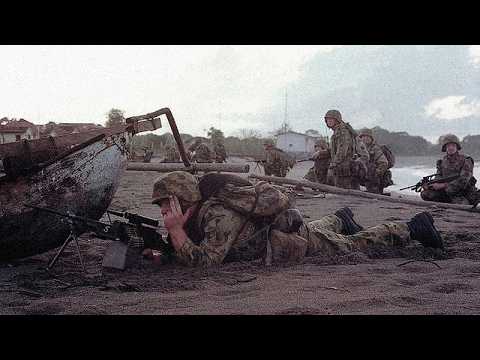
On the 20th of September 1999, INTERFET began landing. The SASR went first. 3 Squadron, along with New Zealand SAS and British SBS personnel, formed the response force designated RESPFOR. They secured Comoro airfield in Dili, then pushed straight into the city in long-range patrol vehicles. The port was the next objective. Lieutenant Colonel Tim McOwan, commanding the SASR element, later described the scene at the port. Piles of what appeared to be burning belongings, human waste on the ground, families in distress, people clearly disturbed and frightened.
C-130 Hercules transports began landing at Comoro the same day. Soldiers from 3rd Battalion, Royal Australian Regiment, 3 RAR, piled out of the aircraft expecting to take fire. The doors opened and they didn’t cop any rounds. The SASR had already cleared the immediate area. Private Matthew Robinson, 18 years old and 12 months in the army, was handed a machine gun and started patrolling into Dili. He saw his first body in a gutter.
3 RAR landed the next day at the port alongside Second Cavalry Regiment with their ASLAV light armored vehicles and Gurkhas from the Second Royal Gurkha Rifles. Two Airfield Defence Squadron secured Comoro permanently, replacing 3 RAR. The force grew daily. New Zealand infantry arrived on the 29th of September.
Cosgrove adopted an approach called the oil spot. Dominate the key ground first, then radiate outward using helicopter mobility to keep the militia off balance. Dili was the first spot. Everything else would follow.
The militia in Dili were used to terrorizing unarmed civilians. They weren’t prepared for what arrived. 3 RAR conducted cordon and search operations through Dili’s streets, door-to-door, compound-to-compound. ASLAVs from Second Cavalry pushed through intersections while infantry cleared buildings on either side. The militia had machetes and a handful of rifles. They assumed foreign troops would behave like UN observers, watching and taking notes while people were dragged away.
The Australians didn’t watch. When a militia member refused to get down, a digger put the barrel of his rifle to the man’s forehead and pushed him to the ground with it. The message traveled faster than any radio signal. The armed gangs who’d spent weeks burning houses and terrorizing families discovered that confronting trained infantry carrying live ammunition felt considerably different from kicking in the door of a church full of refugees. Within days of the initial landing, the militia in Dili either melted away or fled west toward the Indonesian border. The speed of it surprised even Cosgrove’s staff.
The hard work was what came next. INTERFET began expanding west. On the 1st of October, two RAR flew into Balibo and Batugade simultaneously near the western border. Mounted in APCs, they pushed through to Maliana and cleared the Bobonaro Regency. Every town they entered told the same story. Buildings gutted, possessions scattered on the roads, people emerging from the hills and the forests where they’d hidden for weeks, half-starved, carrying nothing.
On the 6th of October, RESPFOR and Gurkhas entered Suai together. The SASR already knew what they’d find there. Intelligence reports had been coming in since the church massacre on the 6th of September, a full month earlier. The Ave Maria Church compound was a forensic site. Shell casings carpeted the floor of Father Francisco’s bedroom. Bullet holes pockmarked the bamboo facade of the cathedral. Dried blood covered the entrance to the church schoolroom. Militia and Indonesian troops had gone through the compound systematically. Evidence of what happened was everywhere, but the bodies had been removed.
Outside Suai that same day, RESPFOR was ambushed. The SASR had taken suspected militia into custody and were escorting about 100 of them toward the West Timor border in a convoy. Near the edge of town, gunfire erupted from the roadside. The militia had laid an ambush for the special forces escort. Two SASR soldiers were wounded. These were the first serious Australian combat casualties since Vietnam. RESPFOR returned fire and cleared the ambush site. The engagement was short and sharp.
The SASR and their New Zealand and British counterparts had been in hundreds of contacts over three decades of deployment to a dozen countries. An ambush by militia with small arms wasn’t going to rattle them, but it changed the tone. The men on the other side of the tree line had rifles and were willing to use them.
Ten days later, the SASR drew blood again. On the 13th of October, a six-man covert patrol under Sergeant Steven Oddie was inserted by Black Hawk near Aidabasalala, 15 km from the West Timor border.
For three days they moved by night and lay up by day. On the morning of the 16th, Lance Corporal Keith Fennell spotted six militia moving along the dry bed of the Moto Mecculee Creek. When the lead scout closed to within 10 m and the two men made eye contact, Fennell opened fire.
What followed was an hour and a half of running contact through dense vegetation. Kopassus had organized over 60 armed militia into six-man hunting teams. Oddie’s men fought through four separate contacts before two Black Hawks arrived to extract them. Five militia were confirmed killed. The Australians took no casualties. Sergeant Oddie received the Medal for Gallantry.
Six days later, the SASR went into the Oecussi enclave. Navy divers swam ashore by night to reconnoitre the beach. By morning, SASR operators had seized Port Makassar. Forty militia were captured immediately. The rest fled west.
The border was the last problem. From camps in West Timor, militia launched cross-border raids. Australian and New Zealand infantry patrolled constantly, tightening the space the militia could operate in. It was grunt work, boots and sweat and constant presence. The kind of soldiering that never makes the evening news, but determines whether a country survives.
By November, contingents from 22 nations were on the ground, over 11,000 personnel at peak. But the Australians carried the operational weight. 5,580 ADF personnel at maximum strength. It was the largest Australian overseas deployment since Vietnam.
On the 28th of February 2000, Cosgrove handed command to UNTAET. On the 20th of May 2002, the Democratic Republic of Timor-Leste declared formal independence. On the 27th of September that year, it joined the United Nations as its 191st member state.
Indonesia never apologized. The Jakarta ad hoc court tried 18 men for the 1999 violence. Twelve were acquitted. The six convicted received light sentences. None served a day in prison. The five officials charged with the Suai church massacre were acquitted by Indonesia’s Supreme Court. Jakarta refused to extradite anyone to the UN-backed courts in Dili.
The Australians who served came home to a country that had largely moved on. There was no victory parade. Veterans who’d been 18 when they stepped off those Hercules were in their 40s before the operation got its own section in the national memory.
Sergeant Marty Ryan, whose photograph carrying a Timorese child became one of the defining images of the operation, spent 25 years not knowing the child’s name. In 2024, a tour operator tracked the boy down. His name was Leandro. Ryan planned to go back to Timor-Leste to shake his hand again, and to bring his own son along to see the country his father had helped bring into existence.
The Australians went in because nobody else would. The whole world had watched East Timor burning on the evening news for two weeks and done nothing. Canberra picked up the phone, assembled a coalition, loaded the Hercs, and sent 5,500 soldiers across 400 km of open water into a situation that could have become a regional war.
Planning was flawed. Logistics were stretched. Preparation time was inadequate. It worked anyway, because the soldiers on the ground did what Australian soldiers have always done when the plan falls apart. They adapted, they patrolled, they held the line, and they brought a country back from the edge.
East Timor is its own country now, which is what 800,000 people voted for at the risk of their lives. The diggers who made that possible didn’t do it for medals or monuments. They did it because the job was there and someone had to do it.
So here’s the question worth asking: when the next small nation is burning and the great powers look away, who picks up the phone then?
Report this article
Select a reason for reporting:






