In the shadowy world of military aviation, few projects have vanished as quietly as the FB-22—a stealth bomber that could have redefined aerial warfare. Imagine an aircraft with the agility of a Raptor and the punch of a heavy bomber, capable of slipping past enemy defenses to deliver devastating strikes. But despite its promise, the FB-22 was erased from history, leaving only whispers and video game fantasies. What happened to this phantom bomber? The answer lies in a tale of ambition, secrecy, and a mystery that still baffles experts today.
Rewind to the early 2000s. The F-22 Raptor was the crown jewel of American air power, a fighter jet so advanced it seemed untouchable. But behind closed doors, Lockheed Martin engineers were already plotting its evolution. They envisioned a variant that could do more than just dominate the skies—it would rain destruction from above with unprecedented stealth. “The FB-22 would have been a near-equal to the B-2 bomber in range, payload, and stealth,” one insider later revealed. This wasn’t just an upgrade; it was a revolution.
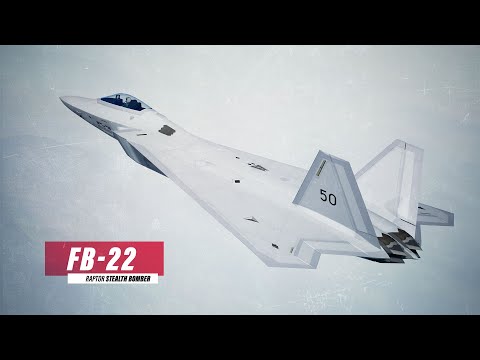
The concept was born from a simple gap: the U.S. military lacked a small, stealthy, and affordable bomber. The B-52s were aging, the B-1s lacked stealth, and only 21 B-2s existed—each costing a fortune. The FB-22 promised to fill that void. By retaining the F-22’s advanced avionics and fuselage, Lockheed Martin hoped to slash costs and win over the Pentagon. Early designs featured a delta wing and twin tails, boosting fuel capacity and weapons load. While a standard F-22 carried eight 250-pound bombs, the FB-22 could haul up to 35 GBU-39s—a staggering increase. With detachable stealth pods, it could switch between maximum firepower and a low radar cross-section on the fly.
Range was another game-changer. The F-22 could strike targets up to 1,000 km away; the FB-22 would extend that to 2,600–3,300 km, potentially more with external tanks. Powered by modified F119 engines without thrust vectoring, it would hit Mach 1.9 at 60,000 feet. “It would have been a near-equal to the B-2 in range, payload, and stealth,” Air Force Magazine noted. The Air Force was intrigued—by 2003, officials suggested procuring 150 FB-22s, with operational status projected for 2018. The price tag? A mere $7 billion, a fraction of a new bomber design.
Yet, by 2006, the FB-22 had vanished. No official cancellation, no public explanation—just silence. Some speculate it was deemed redundant as focus shifted to longer-range bombers; others whisper it was a victim of shifting priorities. But the mystery only deepens when you consider its potential. In today’s contested skies, where stealth and standoff range are paramount, the FB-22’s capabilities seem almost prophetic. Could it have changed the balance in Ukraine or the Pacific? The answer remains locked away, perhaps in the boardrooms of Lockheed Martin, where the concept might still linger, waiting for its moment.
The silence around the FB-22 was not entirely accidental. Inside the Pentagon, a quiet battle was raging between two visions of air power. On one side stood the traditional bomber mafia, who favored long-range, heavy payload aircraft like the B-2 and its successor. On the other, a younger generation of strategists argued for a fleet of smaller, stealthy strike fighters that could be deployed quickly and affordably. “The FB-22 was caught in the crossfire,” a former Lockheed engineer later admitted. “It was too big for the fighter generals and too small for the bomber generals.”
Budget pressures also played a role. The F-35 program was ballooning in cost, and the Air Force was already struggling to justify the F-22’s own price tag. Adding another variant seemed fiscally reckless, even if it promised savings elsewhere. By 2006, the political will had evaporated. The FB-22 was quietly shelved, its blueprints locked away in a classified vault.
But the story did not end there. Whispers persisted that the FB-22’s research had not been wasted. Its stealthy external pods, designed to carry weapons without compromising radar cross-section, reportedly influenced later upgrades to the F-22 fleet. “Those faceted pods you see on modern Raptors? They trace their lineage directly to the FB-22,” one analyst noted. The delta wing concept, too, may have informed subsequent stealth drone designs.
Perhaps the most tantalizing clue came from a 2018 industry conference, where a Lockheed Martin executive was asked about the FB-22. He smiled and said only, “We never throw anything away.” The remark was cryptic, but it hinted that the phantom bomber might not be as dead as everyone thought. Could it be revived as a low-cost, high-capability strike platform for future conflicts? Or had its DNA already been spliced into a classified program?
For now, the FB-22 remains a ghost—a what-if that haunts military planners. Its story is a reminder that in the world of advanced aviation, the line between cancellation and postponement is often blurred. And as the U.S. military pivots toward great-power competition, the lessons of the FB-22 may yet prove invaluable. “The need for a stealthy, affordable strike aircraft hasn’t gone away,” one retired general observed. “If anything, it’s more urgent than ever.”
The retired general’s words hung in the air like a challenge. And as if on cue, the aviation world began to stir. In the years following that conference, a new generation of engineers—many of whom had never heard of the FB-22—started sketching concepts that looked eerily familiar. Tailless deltas. Faceted weapon pods. Stealthy strike platforms sized between a fighter and a bomber. “It was like watching history repeat itself without anyone realizing it,” a defense analyst remarked.
Consider the so-called “Next Generation Air Dominance” program, or NGAD. Publicly, details are scarce. But the few renderings released show an aircraft with a broad, blended wing body and no vertical stabilizers—strikingly similar to the FB-22’s early tailless concepts. “The resemblance is not coincidental,” one industry insider claimed. “Lockheed’s Skunk Works never really stopped thinking about that delta-wing Raptor.”
Then came the rumors from the Pacific. In 2021, a blurry photograph surfaced online, purportedly taken by a commercial satellite over a remote airfield in the western United States. The image showed an aircraft with a familiar Raptor-like nose but a much wider fuselage and a modified wing planform. Analysts argued for weeks. Some dismissed it as a trick of light. Others were convinced. “That’s not an F-22,” one retired test pilot said flatly. “The proportions are wrong. It’s bigger. It’s something else.”
The Pentagon declined to comment, which only fueled speculation. Had the FB-22 been quietly resurrected as a black program? Or was this a different beast entirely—a testbed for technologies that would one day feed into a manned strike aircraft? The truth, as always, remained buried under layers of classification.
What is clear is that the strategic environment has shifted dramatically since 2006. The return of great-power competition with China and Russia has revived interest in long-range strike. Hypersonic weapons, advanced surface-to-air missiles, and dense integrated air defense networks have made the old ways of bombing—low, slow, and unstealthy—increasingly suicidal. “The FB-22 was designed for exactly this kind of fight,” a current Air Force planner admitted off the record. “We’re only now catching up to where that concept was twenty years ago.”
And then there is the question of cost. The B-21 Raider, the Air Force’s new stealth bomber, is projected to cost nearly $700 million per aircraft. Even the F-35, once billed as affordable, now runs over $80 million a copy. The FB-22, by contrast, was pitched at a fraction of those prices—using existing F-22 tooling, engines, and avionics. In an era of tight budgets and rising threats, that kind of value proposition is hard to ignore.
Perhaps that is why the ghost of the FB-22 refuses to die. Every few years, a new rumor surfaces. A line item in a classified budget. A job posting at Skunk Works seeking engineers with “stealth strike experience.” A cryptic tweet from a defense journalist. Each time, the aviation community holds its breath. “We keep waiting for the other shoe to drop,” one forum moderator said. “But maybe it already has, and we just don’t know it yet.”
For now, the FB-22 remains what it has always been: a tantalizing glimpse of a road not taken. A bomber that could have ruled the skies, only to vanish into the fog of bureaucracy and shifting priorities. But in the shadowy world of military aviation, nothing stays buried forever. And somewhere, in a hangar in the desert or a boardroom in Fort Worth, the phantom bomber may yet be waiting for its second chance.
The question now is not whether the FB-22 was real—it was—but whether its spirit has already returned in forms we cannot yet recognize. “Every stealth aircraft flying today owes something to the concepts Lockheed explored in those early 2000s studies,” a historian of aviation technology observed. The delta wing, the faceted pods, the trade-off between internal carriage and external stealth—these ideas did not die; they simply went underground.
And underground is where revolutions often simmer. Consider the rapid progress of autonomous strike platforms and the Air Force’s secretive “loyal wingman” programs. These drones share the FB-22’s core DNA: affordable, stealthy, and designed to penetrate contested airspace without risking a pilot. “The FB-22 was a manned bomber, but its design philosophy was always about cost-effective stealth,” a former program analyst noted. “That’s exactly what we’re building now, just without the cockpit.”
Perhaps the most fitting epilogue came in late 2023, when a declassified budget document from 2005 surfaced online. It listed a line item labeled “F/B-22 Advanced Development” with a funding spike that had never been publicly explained. The document was quickly pulled, but not before eagle-eyed researchers saved a copy. “That wasn’t a cancellation line,” one researcher insisted. “That was a transition. They moved it somewhere else.”
Where? The answer may lie in the Nevada desert, or in the cavernous Skunk Works facility in Palmdale, or in a thousand classified briefings that will not see the light of day for decades. But the lesson of the FB-22 is clear: in military aviation, cancellation is rarely the end. It is often just a change of address.
So the phantom bomber flies on—not in metal, but in influence. Its shadow stretches across the F-35’s weapon bays, the B-21’s curved lines, and the silent drones now patrolling the world’s most dangerous skies. “You don’t need to build an aircraft to learn from it,” the retired general said with a knowing smile. “Sometimes the blueprint is enough.”
And somewhere, in a vault or a hangar or a young engineer’s sketchbook, the FB-22 waits. Not dead. Not forgotten. Just postponed.
So here’s the question for you: If the Pentagon revived the FB-22 tomorrow, would it be a game-changer—or a relic of a bygone era? Share your thoughts in the comments below.
Report this article
Select a reason for reporting:






