The jungle doesn’t care about your rank. It doesn’t care about your briefing, your maps, your call signs, your perfect timing, your confidence. In Vietnam, the jungle is a living thing. Hot breath trapped under a roof of leaves, mud that drinks your boots, vines that grab at your kit like hands that don’t want you to leave. The air tastes like iron and rot. Every step releases the smell of crushed plants and stagnant water. And somewhere deeper in the green, there’s always that faint sickly sweetness you can never quite place until you’ve been here long enough to know what it is. Decay, and that’s why most plans die out here. Not in a firefight, not in an ambush. They die quietly because your timeline slips, your landing zone isn’t there anymore, your radio gets swallowed by canopy, your men get slowed by heat. And the enemy, the enemy doesn’t fight you like an army. The enemy waits like a hunter. This story starts with an operation that should have collapsed into blood and silence, an insertion built on assumptions, a route built on certainty. An extraction built on the kind of confidence that Vietnam exists to punish. It starts with a patrol that disappears.
What’s moving in the dark? Count it, mark it, and come home without being seen. And then the jungle does what it always does. It changes the rules. No warning, no announcement, just a shift in the air like the forest itself inhales. And suddenly the mission isn’t reconnaissance. It’s survival because something is wrong. Not we’re taking fire wrong, not we’ve been spotted wrong, something worse. The kind of wrong you feel before you can explain it. When birds stop calling, when insects dim their song, when even the wind seems to step back as if the jungle is clearing its throat.
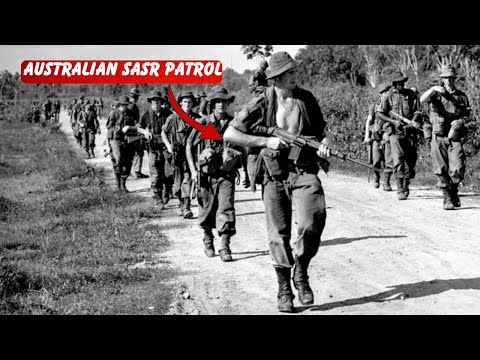
That’s when the men from the Australian SASR, small patrol, five shadows, the kind of soldiers who don’t look heroic so much as inevitable, stop moving. They freeze so completely you’d swear the trees grew them. And the youngest trooper, the one still new enough to feel fear as a separate thing rather than part of the air, sees it. A detail. A tiny violation in the jungle’s pattern. A bent vine that shouldn’t be bent. A patch of ground disturbed and then brushed back to look untouched. A footprint that isn’t quite a footprint because it’s too careful.
Someone has been here. Someone who knows how to hide. And if someone who knows how to hide is hiding, it means they’re not hiding from the Australians. They’re hiding for someone else.
The patrol leader doesn’t speak. He doesn’t have to. He raises two fingers then closes his fist slowly. Hold. The men sink into cover. Leaves press against faces. Sweat crawls down necks. Leeches swell under socks and behind knees like wet coins. Nobody moves to remove them because movement is noise and noise is confession. Minutes stretch. Then another sign. A faint metallic click so soft it could be a beetle hitting a leaf. But the patrol leader’s eyes tighten because beetles don’t click like that. Weapons do.
The Australians don’t react like infantry. They don’t surge forward. They don’t call for support. They don’t break the silence to confirm contact. They do something that looks almost insane to anyone raised on radio and firepower. They do nothing. They let the jungle speak first.
And then it happens. A shadow between trees, a flicker of cloth, a brief glint that might be sweat on a cheek or might be the last mistake a man ever makes. The Australians realize they didn’t stumble onto a random scout. They’ve walked into a shaped space, a prepared space, a place chosen for killing. And their mission, quiet, controlled, calculated, has just become a trap with teeth.
This is the point where most units lose the initiative. This is the point where doctrine collapses into instinct. Pull back, call in, break contact loud. But this is not a normal unit. This is SASR. And in Vietnam, SASR doesn’t fight the jungle. It uses it.
The patrol leader, call him Sergeant Red Mallory, because the men like him always have a nickname that feels too casual for the danger they carry, makes a decision in silence that will save every life under his command. He doesn’t retreat on the obvious line. He doesn’t follow the path they came in on because the path they came in on is exactly where the enemy will look. He changes the plan. Not by calling higher command, by breaking the enemy’s expectation.
He gestures three fingers then a flat palm cutting sideways, not back, sideways off trail into the worst ground. The ground nobody chooses unless they have to. A tangle of bamboo and thorn and mud that smells like swamp water and death. The kind of terrain that punishes every step with sound, every breath with effort. The young trooper’s mind screams, this will slow us down. And that’s the point. Because in this war, speed isn’t always safety. Sometimes speed is how you run straight into a kill zone.
The Australians go low. They move like they’re underwater. They don’t step on branches, they step beside them. They don’t push vines aside, they thread through them. Their rifles are part of their bodies, their bodies part of the bush. And behind them, somewhere out there, the enemy begins to move. Not rushing, tracking, careful. The implication is worse than gunfire. It means the enemy thinks it has time. It means the enemy thinks the Australians are already caught. It means the enemy believes this patrol will die quietly.
The Australians feel it in the air. That subtle pressure of being followed. And then the mission truly breaks. The radio that should be their lifeline, thin, crackling, fragile, fails. Not dramatically, not with sparks, it just dies. A battery soaked, a connection loosened. A jungle problem. Now there’s no quick extraction request, no higher to tell them where to go, no comforting voice in the ear. Only the knowledge that somewhere, miles away, friendly forces will still assume the plan is intact. And that assumption could kill them. Because the extraction point they were supposed to use is now a prediction, and predictions get men ambushed.
The patrol leader makes another decision. He won’t go to the extraction. He’ll build his own. But to do that, he needs ground that can be defended, watched, controlled. Ground that will give the helicopter a chance to get in and out without hovering like a target above a green ocean. He needs something Vietnam rarely gives willingly, a clearing or a river bend or a hard patch of earth where the canopy opens for just long enough.
So they move deeper and the jungle tightens. Hours pass. Sweat dries and becomes salt crust. Water is rationed. Every swallow is measured like ammunition. The men’s eyes stay bright even as their bodies start to dim. Then the first sign that the enemy is close enough to touch. A faint human smell. Not the jungle’s rot, not mud. Human rice, tobacco, unwashed cloth. The Australians freeze again. A small patrol enemy side sliding through the brush like they belong. Close, too close.
The young trooper’s finger tightens on the trigger and Mallory shakes his head once. No, not yet. Because if they fire, the jungle will explode. If they fire, the enemy will know exactly what it has. If they fire, the extraction becomes a firefight. And an extraction firefight in Vietnam is how helicopters become funerals.
So the Australians do the strangest thing. They let the enemy pass. They let them walk by. So close the Australians can hear breathing, can hear the subtle creak of gear, can hear a soft whisper between two men that never becomes a sentence. And when the enemy is past, the Australians move again. But now they move different. Now they move like men who understand something the viewer must understand, too. They are not escaping a trap. They are turning the trap around. Because what the enemy doesn’t know is this. It is now following a ghost, and ghosts choose where you die.
The patrol reaches a shallow creek line, water dark and slow, banks heavy with roots. Mallory pauses scanning. This is where a normal plan would still say, get to the LZ. But there is no normal plan now. He signals again. Two men peel off to the left crawling into cover like animals. Two men peel off to the right. One stays with Mallory. A split, a risk. But it’s not random. It’s geometry, it’s bait. Because if the enemy is tracking, it will commit to the easiest trail, the most obvious line. So Mallory gives it one. He and the youngest trooper move just enough to leave sign, just enough to suggest a direction, just enough to whisper, “They went this way.” Then they stop. They don’t keep going. They wait.
Quiet. So quiet the viewer can hear the wet ticking of insects, the distant pulse of a bird, the slow drip from a leaf to water, and the enemy takes it. Footsteps approach, not loud, but present. Careful men, confident men, men who think they’re behind the Australians now. The Australians on the flanks remain invisible. Mallory watches the space ahead like a man watching a door he knows will open. Then movement. Shadow shapes slide into view. The enemy patrol, several men, weapons carried low, posture relaxed in the way only hunters get when they believe the prey is exhausted. They don’t see the Australians. They see what they expect to see. And expectation is the deadliest weakness in Vietnam.
Mallory raises one hand, holds it. Waits until the enemy steps into the exact space where the bush offers no cover. Then he drops his hand, and the jungle snaps, not a wild firefight, not screaming. A precise, controlled eruption from both flanks, brief, surgical, terrifying. The enemy doesn’t even have time to understand what it stumbled into. It only knows the world has turned wrong. Then silence again, as if nothing happened, as if the jungle swallowed the sound out of shame.
The Australians move instantly, not forward, not toward the bodies, away, because this wasn’t a battle. This was a message, a warning to anyone else tracking them. You are not hunting, you are being led. And somewhere deeper in the jungle, the fear begins, not explained, not narrated from the enemy’s point of view, but implied in the way the forest seems to tense. In the way distant movement suddenly becomes cautious, in the way the night feels heavier.
But the Australians aren’t safe yet, because now the enemy will tighten the net. Now the enemy will assume the Australians are close. Now the enemy will start searching with anger. And anger in the jungle is loud, dangerously loud. Mallory knows this is the most critical window. They need extraction, and they need it soon, but not at the plan site. At a new point, one the enemy cannot predict. So he improvises again. He chooses a place that isn’t perfect. A narrow break in the canopy near the creek, where the trees thin just slightly, where the ground is firm enough for a quick pickup. Where the helicopter can hover low without being swallowed by branches.
But how do you call a helicopter without a radio? You do it the old way. You do it the way men did before the war became wires and signals. You move. You find friendly contact. You bring the message by hand. One trooper, fastest, the kind of man who can move through jungle without leaving a soul behind him, gets the signal. He slips away alone, not heroic, not cinematic, just necessary, and the patrol becomes four. Four men holding a shrinking bubble of safety in a world that wants them dead.
They set in, not a camp, a posture. Fields of fire without clearing brush too much, positions chosen to disappear, no cooking, no smoke, no sound. They drink water like it’s ammunition. They ration movement like it’s life. And the night arrives like a lid closing. The jungle is black, the kind of black that makes you doubt your own hands. The air is alive with insects. Somewhere out there, frogs call and then stop mid-note like someone cut the thread. The Australians listen. They don’t need to see the enemy to know it’s there. They feel it in small absences. In the way the forest stops behaving normally, a twig snaps far out, then another, then a faint shuffle, and the viewer realizes something. The enemy is probing, trying to locate, trying to force contact, trying to make the Australians reveal themselves by fear.
But the Australians don’t take the bait. They remain still. So still that fear has nowhere to go except inward. Minutes stretch until they feel like hours. Then a whisper of movement close too close, a shape passing between two trees. Mallory doesn’t fire. He waits. Because if he fires at a shadow, he announces their position. Instead, he tracks the movement with the patience of a predator. And when the shape moves into a patch where the moonlight breaks through just enough, a single suppressed shot, a soft cough, not loud, not dramatic, just final. The shape falls without a sound. And the jungle returns to silence.
Now the enemy knows something without anyone having to tell it. This isn’t an ordinary patrol. This is a presence, a thing that doesn’t panic. A thing that doesn’t chase, a thing that kills only when it chooses and then vanishes again. And that does something to men. It makes them hesitate. It makes them second-guess. It makes them see threats in every leaf. And in Vietnam, hesitation can be death.
Hours later, when the night is deepest and the air is cold enough to raise gooseflesh under wet uniforms, the runner returns. Not running, not crashing through brush. He appears as if he grew there. And in his hand, a small signal. Extraction is coming, but not where the plan said, where Mallory chose. The mission is no longer controlled by the enemy’s preparation. The mission is now controlled by Australian improvisation.
And now comes the most dangerous part of the entire story, extraction, because extraction is loud. Extraction is rotor wash and noise and visibility. Extraction turns invisible men into targets. Mallory moves the patrol toward the pickup point with a discipline that feels cruel, slow, controlled. No shortcuts, no rushing. They arrive and melt into the edge of the clearing, and they wait, because timing is everything. If the helicopter comes too early, it draws enemy attention before the patrol is ready. If it comes too late, the enemy arrives first. Then the sound begins, faint at first, like distant thunder. A low thump-thump-thump that grows into a vibration in the chest, rotor blades.
The jungle reacts, leaves shiver, birds scatter, insects surge. And the Australians do something that feels like a final insult to the enemy. They don’t pop smoke. They don’t wave. They don’t create a beacon that screams, “Here.” They use the helicopter’s approach like a curtain. Rotor wash tears through the clearing, flattening grass, whipping branches, turning visibility into chaos. And in that chaos, Mallory moves, a hand signal. One, two, three, go. The men sprint, not a panicked run, but a controlled burst from cover to aircraft. Heads low, rifles tight, boots hammering the earth in the only moment they allow noise.
The helicopter hovers just above the ground, door gunners scanning the tree line where shapes may or may not exist. The men climb in fast, practiced, and then the enemy arrives. Not in a perfect formation, not with cinematic clarity, only implied. Movement in the tree line, a sudden tension in the air, a burst of distant muzzle flashes that appear like fireflies at the edge of the clearing. The door gunner opens up short, brutal bursts, not to kill everything, but to make the tree line flinch. The helicopter lifts.
And as it rises, Mallory looks down and sees something that turns his stomach cold. Not a mass of enemy soldiers, not an obvious ambush, something worse. A prepared line, positions that were meant to catch them at the planned extraction point. A kill zone built for a plan that no longer exists. They were seconds, maybe minutes, from flying into a trap they never would have escaped. And the only reason they aren’t dying in it right now is because someone on the ground refused to follow doctrine, refused to trust the original plan, refused to do what the enemy expected.
The helicopter banks away, rotors chewing the night, leaving the clearing to the jungle again. And the Australians vanish back into the myth, alive, exhausted, silent. Back at Nui Dat, under harsh lights and sand and wire, the debrief is clinical. But the story that spreads in whispers is not. It’s a story about a mission that should have failed. A mission that was already being closed like a fist by men who knew the terrain. A mission saved not by bigger guns, not by airstrikes, not by reinforcements, but by a unit that understood the most dangerous truth of Vietnam. Plans are loud. Improvisation is quiet. And quiet is how you live.
Because the Australian SASR didn’t just change the plan. They changed the shape of the battlefield. They turned the enemy’s certainty into confusion. They used restraint as a weapon. They used patience as armor. They used silence like a knife. And if you think that’s the end of the story, if you think the lesson is simply be tougher or move quieter, you’re still thinking like the kind of soldier Vietnam was designed to punish. Because the real question isn’t how they escaped. The real question is what happened next. What did the enemy do after realizing the trap didn’t work? What did it change? What did it build in response? And how many other missions, missions no one talks about, missions that never made headlines, were decided in that same invisible space between plan and improvisation?
The answer, buried in the archives and in the memories of men who never spoke of it, is this: the enemy learned. Not the lesson the Australians wanted to teach, but a darker one. They stopped building traps around routes. They started building them around habits.
Weeks later, another patrol, different men, same jungle, followed a pattern so deeply ingrained it felt like instinct. They moved off trail, went low, went quiet. And the enemy was waiting, not for their plan, but for their style. Because the trap that catches the improviser is the one built for improvisation.
The Australians survived that one too, barely. But the myth cracked, just slightly. And in that crack, a truth emerged that no briefing ever captured.
The jungle doesn’t punish certainty. It punishes predictability. And the moment you believe you’ve outsmarted it, you’ve already become the thing it’s hunting.
So here’s the question that matters, the one that echoes through every green darkness: when your best instincts become your enemy’s blueprint, how do you move when even your silence has a signature?
Report this article
Select a reason for reporting:






