You think you know the mansions of the stars? Think again. Behind the manicured hedges and gilded gates of Hollywood’s elite lies a shadow world of secret tunnels, hidden rooms, and bizarre obsessions that Tinseltown fought tooth and nail to keep out of the tabloids. These weren’t just homes—they were fortresses of secrecy, each one guarding a story so strange it could only belong to a legend.
From Charlie Chaplin’s discreet wine cellar to Howard Hughes’s paranoid labyrinth, the truth is far stranger than any screenplay. And after the stars were gone, the walls began to talk.
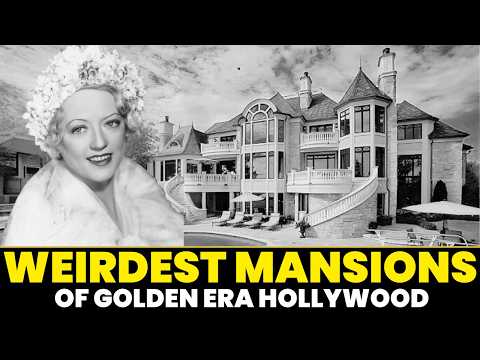
Take Charlie Chaplin, the genius who made the world laugh. His Beverly Hills home was modest by celebrity standards—but it harbored a hidden tunnel that reportedly led to a secret wine cellar. Chaplin used it to dodge reporters or host private parties away from prying eyes. Even more curious: a miniature stage on the grounds where he rehearsed comedic bits before filming. Despite his global fame, he kept the original 1920s decor, a quiet nod to his humble beginnings. The house became his haven during the McCarthy era, a place to retreat as political tensions boiled over. Today, it’s privately owned, but the lore remains.
Then there’s Gloria Swanson, whose Beverly Hills mansion, Casa del Sol, was as dramatic as the star herself. Spanish Moorish arches, exotic collectibles, even a private chapel—it was a spectacle. But behind the glamour, a hidden passageway led to a small, out-of-sight room, perfect for secret meetings or a quiet escape. Swanson’s lavish parties were legendary, but as her star faded in the 1930s, the estate became a financial burden. Eventually, it was torn down, erasing the physical remains of her lavish hideaway. Yet film fans still whisper about it, a symbol of her larger-than-life image.
Errol Flynn’s Mulholland Farm was the ultimate playground for the swashbuckler. A secret passage to a hidden bedroom, a two-way mirror to observe visitors unnoticed, a pistol range, and a private bar—it was Flynn’s untamed spirit in architectural form. But as his career waned and health declined, the estate fell into neglect, mirroring his own downward spiral. It was eventually demolished, but the legend of its mysterious tunnels and raucous parties endures.
Not every star opted for a mansion. Mae West chose a modest apartment in the Ravenswood building, but inside, it was anything but plain. She decorated almost entirely in white, with a seashell-shaped bed and souvenirs from her career. Rumors of ghosts and strange happenings have circulated for years, with some residents claiming to sense her presence. Whether true or not, her apartment remains a symbol of her fiercely independent nature—she did things on her own terms.
John Barrymore’s Bella Vista was a Gothic masterpiece with a grand library stuffed with rare books, some hidden in secret compartments. A private stage for Shakespearean rehearsals, and exotic pets—a monkey and a parrot—roaming freely. But financial pressures and declining health forced him to give it up, a devastating blow. Bella Vista was eventually demolished, erasing a unique monument to his bright yet troubled legacy.
And then there’s Hedy Lamarr, the screen siren with a secret genius. Her Hollywood home included a private workshop where she tinkered with inventions, including the frequency-hopping concept that paved the way for Wi-Fi and Bluetooth. Few knew about her high-level problem-solving skills, and she rarely brought visitors into her workshop. The home no longer stands, but its memory resonates with fans who marvel at how she balanced stardom and science.
Howard Hughes’s Beverly Hills estate was a maze mirroring his brilliant but troubled mind. Hidden rooms, secret passageways, a private airstrip—Hughes engineered his own seclusion. As his mental health declined, the estate became a self-imposed prison. After his death, it was sold and demolished, ending its shadowy hold on the neighborhood. The tales of his paranoia and secrecy linger, reminding us that genius often comes with a steep price.
These are just a few of the 21 strange celebrity homes that Hollywood tried to hide. Each one holds a story of ambition, eccentricity, and the lengths stars will go to protect their private worlds. But the secrets don’t end here—far from it. The walls of Tinseltown have many more whispers to share.
Consider Dolores Del Río, whose 1920s Los Angeles home was designed by the forward-thinking architect Richard Neutra. The sleek, minimalist structure stood in bold contrast to the ornate mansions favored by Hollywood’s elite, its large windows and open floor plans a clean, modern statement. Inside, Del Río displayed art and artifacts from her Mexican homeland, crafting a personal oasis that celebrated her roots. Fellow creatives like Diego Rivera and Frida Kahlo visited often, finding it a refreshing escape from the usual Hollywood style. When her American career slowed in the 1940s, she returned to Mexico—but the house remains a testament to how an artist can meld cultural heritage with cutting-edge design.
James Dean’s final home was a small bungalow in Sherman Oaks, a far cry from the high-speed life he lived on screen. He kept his Porsche 550 Spyder in the garage—the car that would later become tragically famous—and spent quiet hours sketching, reading scripts, or experimenting with bongos. Friends recalled him retreating there to escape studio demands, a place where he could simply be himself. The bungalow’s modesty underscores the stark difference between the mythic James Dean and the real young man who once sought peace within those walls.
Then there’s Jayne Mansfield’s Pink Palace, impossible to miss with its bubblegum paint and flamboyant design. A heart-shaped swimming pool bore the mosaic “I love you, Jaynie,” and the bold use of pink covered carpets, walls, and ceilings alike. Her husband Mickey Hargitay added a fountain she would sometimes fill with pink champagne for her famous gatherings. The house hinted at her deeper need to stand out in a Hollywood scene that often compared her to Marilyn Monroe—she never settled for blending in. Though torn down in the early 2000s, its wild, over-the-top style remains a vivid reminder of a woman who embraced every opportunity to be different.
Buster Keaton’s old Beverly Hills estate felt like a living tribute to silent films. The 20-room mansion was stuffed with surprises—a Roman-style pool, a trout stream, an aviary—and Keaton added his own touches, including a hidden bar that could transform into a private screening room. But money troubles and a rough divorce cost him the property, foreshadowing the broader struggles he faced when talkies took over and his career slid. The estate became a bittersweet reminder of how swiftly Hollywood’s favor could evaporate, even for a brilliant performer.
Few homes matched the sheer scale of Marion Davies’s Ocean House, a Santa Monica palace with over 100 rooms, 55 bathrooms, and 37 fireplaces. The centerpiece was a 110-foot pool flanked by marble statues, and Davies hosted legends like Winston Churchill and Charlie Chaplin at parties still talked about today. Yet behind the sparkle lay a quieter truth: the estate signaled how much she relied on William Randolph Hearst, whose strong will sometimes overshadowed her own ambitions. When his financial troubles hit in the 1930s, the grand estate was broken up, and the main house met the wrecking ball.
Rudolph Valentino’s Falcon Lair felt like a grand fortress, complete with sprawling gardens, arched doorways, and a sweeping staircase recalling Medieval Europe. He poured money and passion into it but barely had a chance to enjoy it—just months after moving in, he died unexpectedly at 31. Whispers circulated that Valentino himself thought the home was cursed, a rumor that only grew after his passing. New owners reported eerie sounds and strange figures, and though the estate was finally demolished in the early 2000s, its story carries on as a ghostly tribute to Hollywood’s first major heartthrob.
Mary Pickford’s Pickfair was a kingdom of its own, a 42-room estate she shared with Douglas Fairbanks, hosting names like Albert Einstein, Charlie Chaplin, and Amelia Earhart. But after their divorce in the 1930s, Mary withdrew from the world, rarely leaving her luxurious sanctuary, drifting through its lavish rooms haunted by memories of her past fame. In the 1990s, owner Pia Zadora had it demolished, citing termite damage and even potential hauntings—a decision that sparked anger among film historians who saw it as the destruction of a treasured piece of Hollywood heritage.
Douglas Fairbanks, the swashbuckling star of The Thief of Baghdad, had a second estate in Santa Monica called Fairbanks Ranch—a lush retreat with landscaped gardens, a private lake, and a charming boathouse. An avid sportsman, he installed a modern gym and tennis court, hosting spirited matches that drew Hollywood’s brightest. But the most memorable feature was a hidden tunnel linking the main house to the boathouse, used either to dodge reporters or to stage dramatic entrances for guests. When his marriage to Pickford ended and his popularity waned, Fairbanks found refuge here, spending more time away from the public eye. The property was eventually sold and subdivided, but the legend of that hidden tunnel and private lake captures the mix of showmanship and seclusion that defined his later years.
Then there’s Alla Nazimova’s Garden of Allah, a colorful enclave on Sunset Boulevard that offered a safe haven for Hollywood’s more unconventional minds. The Russian-born actress and producer bought the mansion in the 1910s and transformed it into an open-minded retreat, adding guest villas and an eye-catching swimming pool shaped to evoke the Black Sea. Artists, writers, and actors like F. Scott Fitzgerald, Greta Garbo, and Errol Flynn found respite there, drawn by the relaxed atmosphere and Nazimova’s avant-garde outlook. Rumor has it she hosted private gatherings that defied the conservative norms of the time, giving attendees a place to break free. Money woes forced her to sell in the 1920s, and the property eventually became a hotel before being demolished in the 1950s to make room for a strip mall. Today, little hints at the creativity that once buzzed there—yet the memory lives on as a bold reminder that Hollywood wasn’t just about blockbusters.
No list of secretive celebrity homes would be complete without William Randolph Hearst’s San Simeon, often called Hearst Castle. Built from the 1910s onward, it sprawled over the hills of California’s Central Coast with 165 rooms, extensive gardens, and two huge swimming pools—one famously decorated with real gold tiles. Hearst spared no expense, shipping in authentic European ceilings, tapestries, and sculptures, while a private zoo roamed the grounds with zebras and other exotic creatures. He threw lavish parties for stars like Charlie Chaplin and Clark Gable, but behind the glitz was a man who liked to call the shots. His longtime companion Marion Davies often had to balance his extravagant tastes with her own ambitions. Financial strains in the 1930s forced him to sell off much of his priceless art, but he kept the estate. Today it operates as a state historical monument, a testament to one man’s drive for power and beauty—and a reminder that even the mightiest fortunes face tough times.
And then there’s Jean Harlow’s house in Beverly Hills—elegant but carrying a load of chilling stories. Modest compared to some star homes, it became infamous after the sudden death of her husband, Paul Bern. The circumstances sparked endless debates, stirring rumors and attracting curious onlookers. Tragically, Harlow herself died at just 26, deepening the idea that something eerie was tied to the property. Over time, new owners insisted they heard strange sounds and felt unsettling vibes, adding to the house’s haunted reputation. Yet Jean’s softer side was also on display—she surrounded herself with books and keepsakes that hinted at private interests the wider world never knew. The home still stands quietly, reminding passersby of a star who shone brightly and faded far too soon.
Harold Lloyd’s Greenacres was a shining example of fun and ambition in 1920s Hollywood. The 44-room mansion boasted a 50-foot-long living room, several fountains, and manicured gardens, but Lloyd poured the same creativity into it as his silent comedies. He designed a private zoo, a nine-hole golf course, and even a secret room to store his film collectibles. Every nook reflected his relentless drive for success—but as silent films gave way to talkies, maintaining the vast property became harder. By the 1970s, much of the estate had been sold off to manage costs, though the main residence still stands as a historic landmark. It’s a glimpse into a time when daring screen heroes could design equally daring homes, and a reminder that fortunes can quickly turn.
Clark Gable, the King of Hollywood, found peace away from the studio lights at a secluded ranch in Encino. Tucked amid farmland and rolling hills, the property didn’t boast a grand facade, but it had expansive fields and well-kept stables reflecting his fondness for the outdoors. He often rode horses on the trails and entertained close friends with casual barbecues rather than lavish affairs. A modest cottage on the grounds served as a personal retreat where he practiced lines or unwound with a good book. Following the death of his wife Carole Lombard, the ranch became a refuge for his grief—locals recall glimpses of him strolling at dusk, finding solace in its tranquility. Though development has changed Encino, the legend of Gable’s hidden ranch lives on.
Finally, Cary Grant’s Beverly Hills hideaway told a different story than his dapper onscreen image suggested. Nestled behind tall hedges and understated gates, it wasn’t a palatial mansion so much as a private haven. He prized his peace and valued a sense of humor in the decor—visitors noted tasteful interiors accented by playful touches hinting at the wit behind his refined persona. Winding paths and a lush garden provided the setting for small gatherings far more relaxed than high-society events. He preferred hosting a handful of guests for quiet evenings or screening his latest film in a makeshift viewing area. Rumors even swirled of a hidden alcove behind the library shelves—a quick route to the study or perhaps just a whimsical nod to Hollywood intrigue. Though Grant eventually relocated, the house continued to be whispered about, its unassuming exterior belying the star power it once sheltered.
These 21 strange celebrity homes reveal a side of Hollywood rarely seen—a world where genius and paranoia, glamour and grief, all shared the same address. The walls may have come down, but the stories refuse to fade.
So the next time you drive past a quiet Beverly Hills estate or a modest bungalow tucked behind tall hedges, remember: the most ordinary facade can hide the most extraordinary secrets. A wine cellar here, a hidden tunnel there—these were the private worlds of legends who spent their lives performing for us, yet fiercely guarded the one stage no audience ever saw.
Hollywood tried to hide these homes, but the walls always talk. Chaplin’s tunnel, Hughes’s labyrinth, Lamarr’s workshop—each one a fingerprint of a personality too big for any screenplay.
Which of these secret celebrity homes shocked you the most—and whose hidden world would you most want to step inside if those walls could let you in? Tell us in the comments below.
Report this article
Select a reason for reporting:






