Scarlett O’Hara had bipolar disorder. The straight man from America’s funniest comedy duo was hiding seizures between takes. And the biggest sex symbol of the 1940s spent her final years unable to remember her own name—because nobody in Hollywood recognized what was happening to her until it was far too late.
The studio system sold perfection. Every star was healthy, beautiful, and in complete control. That was the product. And when reality didn’t match the product, the studios covered it up, buried it, and kept the cameras rolling.
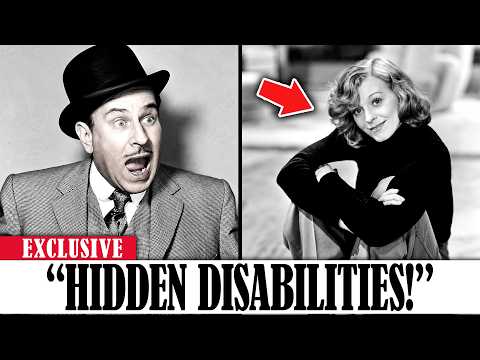
These are 14 golden age stars who were secretly living with conditions that Hollywood never wanted you to know about.
Number 14: Peter Lorre. He became a star by playing a child killer in Fritz Lang’s M in 1931. The performance was so convincing that it defined his career and trapped him inside it. For the rest of his life, Hollywood cast him as the creepy little man, the villain, the weirdo. What casting directors didn’t know—and what Lorre hid for years—was that the anxiety he carried wasn’t an act. Lorre suffered from severe chronic anxiety that made public appearances and social interactions genuinely difficult. To cope, he became dependent on morphine, originally prescribed for pain after an appendectomy. The addiction lasted decades.
Number 13: Gail Russell. She was strikingly beautiful and genuinely talented. Paramount signed her as a teenager, and by 21 she was starring opposite John Wayne. She was also terrified of the camera. Russell suffered from paralyzing stage fright that went far beyond nerves. She physically trembled before scenes. She couldn’t eat on shooting days. To get through takes, she began drinking—and by her early 20s, she was a full-blown alcoholic. Paramount knew about the anxiety and the drinking but kept casting her because she photographed beautifully. By the early 1950s, the drinking had taken over her career and her life. She was found dead in her apartment in August 1961 at age 36, surrounded by empty bottles.
Number 12: Bud Abbott. He was the straight man in Abbott and Costello, the most popular comedy duo in America during World War II. His timing was impeccable. What the audience never saw was what happened between shows. Abbott suffered from epilepsy for his entire adult life. Beginning around 1926, he lived in constant fear that a seizure would strike during a performance—or worse, during filming when a disruption would cost the studio money and expose his condition. To manage the seizures, Abbott drank heavily. The alcohol suppressed the episodes but created a second problem that was almost as destructive. His drinking strained his relationship with Costello and contributed to the partnership’s eventual collapse. He hid the epilepsy from the public for over 40 years.
Number 11: Margaret Sullavan. She was one of the finest actresses of the 1930s and 1940s, starring opposite James Stewart and earning an Academy Award nomination. What nobody outside her inner circle knew was that she was progressively losing her hearing. For an actress, hearing loss was a career death sentence. She kept it hidden as long as she could, relying on lip reading and careful positioning. But the strain of maintaining the secret, combined with personal losses, pushed her into severe depression. On New Year’s Day 1960, she was found dead of an overdose of barbiturates at age 48.
Number 10: Clara Bow. She was the original It Girl, the defining star of the Roaring Twenties. But behind the performance, she was barely holding together. Bow suffered from what doctors then called nervous breakdowns—likely severe anxiety disorder compounded by insomnia and possible PTSD from a nightmarish childhood. Her mother, institutionalized with epilepsy and mental illness, once held a knife to Clara’s throat while she slept. By the early 1930s, her anxiety had become unmanageable. Paramount quietly dropped her when the breakdowns became too frequent to hide. She retired at 26 and spent the rest of her life in near-total seclusion.
Number 9: Mary Pickford. She co-founded United Artists, won an Academy Award, and was arguably the most powerful woman in Hollywood history. But after she retired from acting in 1933, something shifted. She retreated into her mansion, Pickfair, and gradually stopped leaving. By the 1950s, she was essentially agoraphobic. She conducted business from inside the house and rarely ventured out. The woman who had helped build Hollywood spent her final three decades locked inside the empire she’d created.
Number 8: Charles Laughton. He won the Academy Award for Best Actor in 1934 and delivered unforgettable performances in The Hunchback of Notre Dame and Mutiny on the Bounty. He was also haunted by depression so severe that it shaped every aspect of his life. Laughton’s self-loathing was legendary among those who knew him. He despised his own appearance, particularly his weight, and carried a shame about his personal life that compounded everything. Director Billy Wilder said that getting a performance out of Laughton was like pulling teeth from a frightened child. The brilliance was always there. So was the anguish.
Number 7: Veronica Lake. Her career collapse after the war has been well documented. What’s less well-known is what happened to her mind. In the 1960s, after her career was over and she was working odd jobs to survive, Lake was diagnosed with schizophrenia. The diagnosis explained behavior friends had noticed for years: erratic mood shifts, paranoia, and episodes where she seemed disconnected from reality. She died in 1973 at age 50, having spent her final decade dealing with a condition the public never knew about.
Number 6: Gene Tierney. Her breakdown has been discussed for decades, but the cause remains one of the cruelest stories in golden age history. In 1943, while pregnant, Tierney attended a USO event where a female fan mentioned she’d broken quarantine from a rubella ward to meet the actress. Tierney contracted the disease. Her daughter was born with severe disabilities. The guilt shattered Tierney. She fell into a depression so severe that by the mid-1950s she could no longer work. She was hospitalized and underwent 27 rounds of electroconvulsive therapy. The treatments erased portions of her memory.
Number 5: Frances Farmer. She had the talent to be one of the biggest stars in Hollywood. She also had a disposition that made the studio system want to destroy her—and eventually it did. After a series of arrests and public incidents in the early 1940s, Farmer was committed to Western State Hospital in Washington. She spent years in and out of institutions. The conditions were brutal: overcrowding, physical restraint, and treatments that amounted to punishment rather than care. Whether Farmer suffered from a genuine psychiatric condition or was simply a difficult woman institutionalized by a system that couldn’t tolerate defiance has been debated for decades.
Number 4: Judy Garland. Her mental health crisis didn’t come from nowhere. It was manufactured almost chemically by the studio that employed her. MGM signed Garland at 13 and immediately put her on a regimen of amphetamines to suppress her appetite and keep her energy up during 18-hour shooting days. When the amphetamines kept her awake, the studio gave her barbiturates to sleep. This cycle, created by MGM’s own medical staff, produced a lifelong dependency that destroyed her mental and physical health. She died at 47.
Number 3: Montgomery Clift. He was one of the most gifted actors of his generation, nominated for four Academy Awards before he turned 40. On May 12, 1956, Clift drove his car into a telephone pole. The crash shattered his jaw and caused severe facial lacerations. What was less visible was the neurological damage. Clift suffered a traumatic brain injury that affected his cognitive function for the rest of his life. His memory faltered, his concentration fractured. He self-medicated with painkillers and alcohol. Elizabeth Taylor said his life after the accident was the longest suicide in Hollywood history.
Number 2: Vivien Leigh. She won two Academy Awards, playing Scarlett O’Hara and Blanche DuBois. She was married to Laurence Olivier. From the outside, her life looked flawless. From the inside, it was a war. Leigh suffered from bipolar disorder for most of her adult life. The manic phases brought insomnia, hyperactivity, and reckless behavior. The depressive phases brought paralysis and withdrawal. The treatments available at the time were crude—she underwent electroconvulsive therapy multiple times. Between episodes, she continued to deliver brilliant performances. Her Oscar-winning turn in A Streetcar Named Desire is perhaps the most haunting example. Olivier had to accompany her to Hollywood to keep watch and make sure the manic episodes didn’t disrupt production.
Number 1: Rita Hayworth. She was the love goddess of the 1940s. Her image was taped to the nuclear bomb dropped on Bikini Atoll. By the late 1960s, something was wrong. She was forgetting lines, getting lost in familiar places. The press assumed she was drinking. For over a decade, Rita Hayworth was dismissed as a fading star with a drinking problem. She didn’t have a drinking problem. She had Alzheimer’s disease—and nobody recognized it because in the 1970s Alzheimer’s was barely a household word. The diagnosis didn’t come until 1981. She died in 1987 at age 68, having spent her final years unable to recognize the people who loved her.
The Golden Age didn’t just hide scandals and affairs. It hid the suffering of the people inside it. The anxiety, the seizures, the depression, the deterioration—all of it was tucked behind the glamour because the product had to stay perfect. But the people inside the product were never perfect. They were human.
The system that refused to acknowledge that fact left a trail of damage that stretched far beyond the studio gates. And it didn’t end when the cameras stopped rolling.
Look at the pattern. Lorre’s morphine. Russell’s bottles. Abbott’s hidden seizures. Garland’s amphetamine cycle. Hayworth’s undiagnosed Alzheimer’s. Each one was a condition that could have been treated—if anyone had been allowed to name it out loud. Instead, the studios chose silence, and the silence became the disease.
Some of these stars found moments of peace. Clara Bow, far from Hollywood, lived quietly on her Nevada ranch. Frances Farmer rebuilt a life in local television. Gene Tierney recovered enough to work again, though she never forgot the fan at the party. But peace, for most of them, only arrived after the spotlight moved on.
The product had to stay perfect. The people inside it did not survive that demand.
So here’s the question worth asking today—when we scroll past the polished images of our own era, the filtered faces and curated lives, do we recognize the same silence? Or are we still buying the product, and still refusing to see the human behind it?
What do you think—has Hollywood really changed, or just found better filters? Tell us in the comments.
Report this article
Select a reason for reporting:






