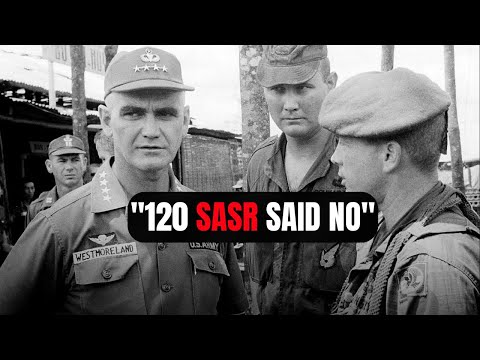
Saigon, August 17, 1967. The red phone on General William Westmoreland’s desk rang at 2:47 AM, and what he heard in the next 90 seconds would trigger the biggest diplomatic crisis between allies in the entire Vietnam War.
An Australian patrol had crossed into Cambodia without authorization, without orders, without permission from MACV, without clearance from the State Department, without approval from anyone. They’d penetrated 15 kilometers into technically neutral territory, engaged enemy forces, destroyed a major supply depot, and extracted back across the border before American command even knew they’d left South Vietnam.
Westmoreland’s hand shook as he held the receiver. This wasn’t just a violation of operational protocol. This was an international incident that could collapse the entire Allied command structure.
The Australians had committed an act that on paper could be considered an invasion of a neutral country. And they’d done it so smoothly, so professionally, so devastatingly effectively that the enemy didn’t even know which unit had hit them.
But that phone call was just the beginning. What Westmoreland didn’t know yet was that this wasn’t an isolated incident. The Australians had been running unauthorized cross-border operations for 8 months. 8 months of ghost raids into Cambodia and Laos, hitting targets that American forces weren’t allowed to touch, gathering intelligence that was changing the entire strategic picture, and doing it all in complete secrecy from their own supposed allies.
How did 120 Australian soldiers decide they knew better than the entire American command structure? Why did they risk court-martial, international scandal, and diplomatic catastrophe? And what did they discover across those borders that was so important they were willing to defy direct orders to get it?
Today you’re going to hear the classified truth about the most alarming, most controversial, and most successful unauthorized military operations of the Vietnam War. You’re about to discover why American generals were simultaneously furious and desperate to cover up what the Australians had done.
Do not click away because this story will shake everything you thought you knew about command control and who really made the decisions in Vietnam.
The crisis actually began 6 months earlier in a plywood briefing room at Nui Dat, where Australian Major Brian Cooper sat across from his American liaison officer, Captain James Harrington, and delivered news that made Harrington’s jaw literally drop open.
“We’ve identified a major NVA logistics hub 12 km inside Cambodia,” Cooper said calmly, pointing to coordinates on a map that made Harrington’s stomach clench. “Brigade-level supply depot, probable division headquarters, and a training facility for sappers who have been hitting Saigon. We’re planning to take it out next week.”
Harrington stared at the map, then at Cooper, then back at the map. “Major, those coordinates are in Cambodia. You can’t operate in Cambodia. That’s explicit orders from MACV. The Cambodian border is absolutely off limits to combat operations. Political reasons, strategic reasons. We’ve got standing orders that anyone who crosses that border without authorization faces court-martial.”
Cooper nodded like Harrington was talking about the weather. “Right. That’s why we’re not asking for authorization. We’re informing you after we’ve made the decision. The target is too valuable. The intelligence is solid. And waiting for permission that will never come means that depot keeps supplying the people killing our blokes.”
“You can’t,” Harrington said, and his voice had an edge of desperation. “Now, this isn’t bravado. This isn’t cowboy stuff. This is strategic policy. Cambodia is neutral. We cross that border, we give the North Vietnamese a propaganda victory. We risk expanding the war. We create an international incident that could bring China deeper into the conflict. The Pentagon has warned this scenario a hundred times. The answer is always no.”
“Then it’s a good thing we’re not asking the Pentagon,” Cooper replied. “We’re Australian. We operate under our own command structure, and our command has decided that dead NVA in Cambodia is better than dead Australians in South Vietnam. The math is simple.”
Harrington stood up. And for a moment, Cooper thought the American might actually take a swing at him. “If you do this, I have to report it. I have to tell MACV. And they will shut you down. They’ll ground your helicopters, cut your supply lines, revoke your operational authority. You’ll be confined to base.”
Cooper stood too, and his voice went quiet in a way that was somehow more threatening than shouting. “Then you’d better decide whether you want to report a hypothetical future operation or explain to your command why you didn’t tell them about intelligence on a division-level enemy facility. Because either way, that depot is getting hit. The only question is whether American command wants to know about it before or after.”
The two officers stared at each other for a long moment. Then Harrington sat back down, pulled out a notepad, and said something that would haunt him for decades. “Tell me about the intelligence. Everything. Because if this goes sideways, I need to be able to justify why I didn’t stop you.”
What neither man knew was that the Australian decision to operate without permission wasn’t impulsive. It was the result of four months of watching American forces hamstrung by political restrictions while enemy sanctuaries across the border operated with complete impunity.
The Australian SAS had been running reconnaissance along the Cambodian border since December 1966. And what they discovered was enraging. Massive enemy base areas, sometimes just two or three kilometers across the border, functioned as staging grounds for attacks into South Vietnam. NVA units would cross into Cambodia after operations, rest, refit, and then cross back to hit Allied forces again.
The Americans knew about these sanctuaries. They had signals intelligence, aerial reconnaissance, agent reports, all confirming that the enemy was using Cambodia as a shield. But Washington had decided that respecting Cambodian neutrality was more important than tactical advantage. The political calculus said that violating that neutrality would damage America’s international standing, potentially bring more countries into the conflict on the communist side, and create complications that outweighed any military benefit.
To the Australian commanders, this logic was insane. You don’t let the enemy have a safe haven just because a map says it’s someone else’s country. Wars aren’t won by following peacetime rules. The enemy certainly wasn’t respecting Cambodian neutrality. They were using it as a weapon, a shield they could hide behind while killing Allied soldiers with impunity.
Brigadier Stuart Graham, commanding the Australian task force, made the decision at the command level. If American political constraints prevented them from addressing the border sanctuaries, the Australians would address them without American approval. The risk of diplomatic blowback was real, but the risk of continuing to let enemy forces operate from untouchable bases was, in Graham’s assessment, greater.
He couldn’t order the operations officially. That would create a paper trail, would implicate the Australian government, would turn tactical necessity into a strategic crisis. But he could make clear to his SAS squadron commanders that he wouldn’t ask questions about where certain intelligence came from or how certain enemy facilities happened to be destroyed. He could create what intelligence services call plausible deniability.
The SAS squadron commanders understood perfectly. They began planning cross-border operations with a level of secrecy that excluded even most of their own task force. These weren’t missions that appeared on operational schedules or in daily briefings. They were ghost operations launched from concealed patrol bases, inserted by helicopters whose flight plans showed completely different destinations, executed by men who understood that if they were captured there would be no rescue, no acknowledgement, no support.
February 23rd, 1967, the first unauthorized cross-border raid launched from a classified patrol base in the Long Hai Hills. Call sign Phoenix. Six Australian SAS operators under Sergeant Michael “Boxer” Malone inserted 8 kilometers inside Cambodia at 2:00 AM during a moonless night.
The insertion itself violated a dozen regulations. The helicopter crew had filed a flight plan showing a routine supply run to a fire support base. Instead, they’d flown nap-of-the-earth across the border, following terrain contours to avoid radar, landed for 23 seconds in a small clearing, and extracted before anyone could react.
Phoenix patrol moved through Cambodian jungle with the same ghost tactics they used in South Vietnam, but with an added layer of paranoia. If they were detected, if they made contact, the diplomatic consequences could be catastrophic. They carried no identification, no documents, nothing that could definitively prove they were Australian military. Their weapons were sterile, serial numbers removed. Their uniforms had no insignia, no patches, no flags. If something went wrong, they would be ghosts in truth, disavowed and abandoned.
For 37 hours, they observed a confirmed NVA supply route, noting that massive convoys moved with complete confidence, no security precautions, no fear of interdiction. Why would they be afraid? They were in Cambodia, off limits, untouchable. Phoenix counted 87 trucks in a single night carrying ammunition, rice, medical supplies, weapons. A logistical artery feeding the entire war effort in South Vietnam’s II Corps region.
At 4:30 AM on the third night, they planted demolition charges on a critical bridge spanning a river too deep to ford. 12 pounds of C4 explosive, radio-detonated, positioned on structural supports. Then they extracted, moving four kilometers in six hours, slow and silent, to an emergency pickup zone.
The bridge detonated at 1600 hours when a convoy of 14 trucks was crossing. The explosion dropped the bridge into the river, took seven trucks with it, and created a supply choke point that would take the NVA three weeks to repair. Phoenix patrol was back in South Vietnam before the enemy even began investigating what happened.
The after-action report went into a classified file that listed the operation as a long-range reconnaissance patrol in Phuoc Tuy Province. The bridge destruction was attributed to unknown causes, possibly internal sabotage or structural failure. Nobody asked questions, but the results spoke for themselves. Enemy activity in the sector supplied by that route dropped 40% over the next month. Tactical intelligence indicated confusion and supply shortages. And most importantly, no diplomatic incident occurred because officially nothing had happened.
The success of Phoenix emboldened the Australian command. Over the next six months, SAS patrols ran 17 cross-border operations into Cambodia and four into Laos. Every single one violated standing orders. Every single one was conducted in absolute secrecy from MACV, and every single one produced results that conventional operations inside South Vietnam couldn’t match.
The targets were carefully selected for maximum impact and minimum political exposure. Supply caches far from population centers, isolated training camps, communications facilities in deep jungle. Nothing that would generate civilian casualties. Nothing that could be easily traced. Nothing that would force Cambodia to officially acknowledge that their territory was being used as a battleground.
The Australian tactics were surgical. Small teams, quick strikes, immediate withdrawal. No sustained combat, no occupation of ground, no attempts to hold territory. They would hit a target and vanish, leaving the enemy to wonder what had happened and the Cambodian government to remain blissfully ignorant that foreign military forces were operating on their soil.
But the intelligence gathered was the real prize. By operating across the border, Australian patrols mapped the entire enemy logistics network. They identified base areas that supported specific NVA divisions, documented the routes used to infiltrate forces into South Vietnam, photographed facilities that signals intelligence had only guessed about.
This intelligence was sanitized, the source obscured, and fed into the Allied intelligence network as if it came from agents or aerial reconnaissance. American commanders used this intelligence to plan operations, to position forces, to anticipate enemy movements. They never knew it came from unauthorized cross-border raids.
The Australian SAS were fighting a shadow war that their own allies didn’t know existed. But secrets that big can’t stay hidden forever.
April 14th, 1967, an Australian patrol called Sign Dingo ran into trouble 11 kilometers inside Cambodia. They’d been observing a suspected divisional headquarters, had gotten too close during exfiltration, and triggered a contact with an NVA security patrol. The firefight lasted 90 seconds. Three NVA killed. Dingo patrol withdrawing under fire. One Australian trooper hit in the leg.
They made it to the emergency extraction point, called for dust-off, and that’s when the situation spiraled out of control. The American helicopter pilots who responded to the emergency extraction call looked at their GPS coordinates and realized immediately that they were being asked to fly into Cambodia.
Radio chatter erupted. “Dingo, confirm your grid. You’re showing across the border.”
“Confirmed. We need immediate extraction. One wounded.”
“Negative. Dingo. We cannot cross the border. You need to move to an alternate LZ inside South Vietnam.”
“Negative. We have enemy pursuit. No time. Need extraction now.”
The helicopter pilot, Warrant Officer Carl Jensen, had a split-second decision. Leave Australian soldiers to die or be captured because of a political boundary, or cross that boundary and face court-martial for violating explicit orders. Jensen chose to be a soldier first and a politician never. “Inbound your location. Mark smoke.”
The extraction went down under fire. The helicopter taking hits. Wounded Australian pulled aboard along with his team. Enemy forces converging on the LZ. Jensen’s door gunner poured suppressive fire as they lifted off, and the whole thing was chaos, noise, blood, and desperation.
They made it out, but the radio traffic had been monitored. The coordinates had been logged, and within three hours, questions were being asked at MACV headquarters. How did an Australian patrol end up in Cambodia? Why were they operating in an area that was explicitly off limits? Who authorized this operation?
The investigation that followed put the entire Australian command structure at risk. American intelligence officers demanded answers. They wanted operations logs, patrol routes, authorization chains. The Australians stonewalled beautifully. The patrol had gotten disoriented during a pursuit. GPS-era maps were inaccurate in that region. Honest mistake during the fog of combat. Nobody meant to cross any borders.
The Americans didn’t believe a word of it. But they also couldn’t prove anything. And more importantly, they discovered something during the investigation that changed the entire calculus. The intelligence that Dingo patrol had gathered during their unauthorized observation included photographs of a North Vietnamese major general at the suspected headquarters. A confirmed divisional commander, one of the most wanted enemy officers, documented in a location that officially didn’t exist.
The Americans suddenly faced a dilemma. If they pushed the investigation, if they formally accused the Australians of unauthorized cross-border operations, they’d have to explain why they weren’t doing anything about a divisional headquarters just across the border. They’d have to acknowledge that political restrictions were letting high-value enemy targets operate with impunity. They’d have to admit that the Australians had found something the Americans knew was there but weren’t willing to touch.
The investigation quietly died. Dingo patrol’s navigation error was noted in their file. Jensen received a private reprimand for crossing the border and a private commendation for courage under fire. And absolutely nothing changed, because the Australians went right back to running unauthorized operations with the unspoken understanding that American command would look the other way as long as the results were valuable and the political exposure was minimal.
That unspoken arrangement lasted until August 1967, when an operation code-named Firebreak changed everything.
This wasn’t a ghost patrol. Thirty SAS operators hit a regimental logistics base 15 km inside Cambodia—ammunition, medical stocks, a sapper training camp, and a suspected POW cage. Three prisoners came out alive: two Americans, one South Vietnamese.
“Good day, lads. Time to go home,” one operator said, cutting the bamboo open. The base burned behind them, visible for ten kilometers.
Then came Westmoreland’s fury, the shouting match with Graham, and the quiet burial of the truth. The official story: the prisoners escaped and were recovered near the border. The raid never happened.
But the operators carried it anyway—the gray zone, the silence, the weight of doing what needed doing. Fifty-seven years on, we still argue whether they were heroes or insubordinates.
Maybe they were both. Maybe that’s the point.
So tell me—if you were the one in that jungle, would you have crossed the line?
Report this article
Select a reason for reporting:






