The magnifying lamp cast a warm glow over the Victorian wedding portrait, but Morgan’s eyes were fixed on the mirror in the background. She had bought the photograph for $30 at an estate auction, drawn by its unusual composition: a bride standing alone, her expression unreadable, her hands hidden behind her back. Now, under high magnification, she noticed something strange in the tarnished reflection—a glint of metal. Her breath caught. It was a key.
Morgan’s pulse quickened as she adjusted the focus. The key was ornate, Victorian, the kind that might open a jewelry box or a small safe. Why would a bride hide a key during her wedding portrait? Why risk having it captured in the mirror’s reflection? This wasn’t an accident. The bride had deliberately positioned herself to hide something from the camera while hoping the mirror might preserve evidence of what she carried.
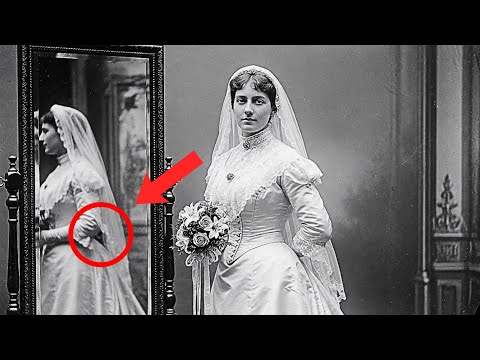
She spent the rest of the evening creating high-resolution scans, enhancing the reflection until the key’s decorative scrollwork was unmistakable. By midnight, she had confirmed her suspicion: the key was from the late 1880s, and it was no random artifact. It was a clue.
The next morning, Morgan drove to the auction house in the South End. Thomas, the elderly appraiser, remembered the photograph. “That came from the Caldwell estate liquidation,” he said. “Old family, been in Boston since before the revolution.” He gave her the name of the granddaughter, Patricia Caldwell, who had sold the contents of her mother’s attic.
Patricia’s voice was hoarse when Morgan called. “I don’t know anything about individual photographs,” she said. “That portrait was just part of a massive collection.” But when Morgan mentioned the date, 1889, Patricia paused. “That would be around the time my great-great-grandmother got married. Her name was Eleanor Whitmore.”
Eleanor Whitmore. The name echoed in Morgan’s mind as she hung up. She opened her laptop and began searching historical records, starting with Boston marriage certificates from 1889.
At the Boston Public Library, a librarian named Sarah helped her pull microfilm records. “Whitmore,” Sarah said. “That’s an old Boston name, connected to textile mills.” Morgan’s attention sharpened. “Large ones. The Whitmore mills operated in several locations around Massachusetts in the late 1800s, employed hundreds of workers, mostly immigrants.”
They found the marriage announcement: October 12th, 1889. Eleanor Catherine Whitmore married James Harrison. The newspaper described Eleanor as the only daughter of Gerald Whitmore, prominent industrialist and philanthropist. The wedding took place at Trinity Church with a reception at the Whitmore family estate in Beacon Hill. The groom was identified as a businessman of good standing with connections to banking.
But as Sarah scrolled through 1890 and 1891, the tone of the articles shifted. In March 1890, a small news item reported labor disputes at one of Whitmore’s mills. In June, there was mention of an investigation into working conditions. By October 1891, the headlines were explicit: “Whitmore Mills Under Scrutiny, Workers Allege Fraud.”
Morgan leaned forward, her heart racing. “Can you print all of these?”
The articles painted a disturbing picture. Workers, primarily Irish and Italian immigrants, had complained about systematic wage theft, hours worked but not paid, deductions for supplies that were never provided, falsified time records. What started as complaints escalated into a formal investigation by the Massachusetts Bureau of Labor Statistics. Then, in December 1891, came the breakthrough: “Industrialist Gerald Whitmore Indicted on Multiple Counts of Fraud. Documentary Evidence Surfaces.”
Anonymous sources had provided investigators with ledgers, correspondence, and financial records proving that Whitmore had been systematically defrauding his workers for at least five years. The evidence was so comprehensive that Whitmore’s lawyers couldn’t dismiss it. He was arrested, tried, and sentenced to eight years in prison.
“Anonymous sources,” Morgan whispered. She thought of the key in Eleanor’s hand, hidden behind her back on her wedding day in 1889, two years before the investigation began. She showed Sarah the enhanced photograph. “What if Eleanor Whitmore was the anonymous source? What if she spent years collecting evidence against her own father?”
Sarah’s eyes widened. “That would explain why the evidence was so thorough. She would have had access to everything—his office, his personal papers, his business records.” She paused. “But why hide a key in a wedding photograph?”
“Maybe it was the only proof she could preserve,” Morgan said. “If anyone ever questioned where the evidence came from, this photograph would show she had the means. That key opened something—probably a safe or a strong box where she kept the documents before turning them over.”
“But she was getting married that day,” Sarah said quietly. “To a man her father approved of. Why would she go through with it if she was planning to betray him?”
That was the question Morgan needed to answer. She returned to her studio with copies of dozens of newspaper articles and began constructing a timeline. Eleanor Whitmore married James Harrison in October 1889. The labor complaints began in March 1890, five months after the wedding. The formal investigation started in June 1890. Gerald Whitmore was indicted in December 1891, more than two years after Eleanor’s marriage. If Eleanor had been collecting evidence, she’d done it methodically over an extended period.
But the question remained: why had she gone through with the marriage? Morgan needed to know more about James Harrison. She searched for his name in conjunction with Eleanor’s and found almost no social announcements featuring the couple together. After 1890, James Harrison’s name disappeared from Boston society pages entirely. She widened her search and found an obituary from 1923: “James Harrison, deceased at age 62, long-time resident of Portland, Maine.” The notice mentioned no children and listed Eleanor as his widow, but noted that she had remained in Boston. They’d lived separately for over 30 years.
Morgan felt a chill. This wasn’t the story of a happy marriage. She searched for property records and found that James had purchased a modest house in Portland in 1891, the same year Gerald Whitmore was indicted. Eleanor had remained in a townhouse in Boston’s Back Bay, property that had been transferred to her name alone in 1892.
Her phone rang. It was Thomas from the auction house. “I found something you need to see,” he said. “I was going through the Caldwell estate paperwork and discovered that Patricia sold a trunk of personal items to a collector in Cambridge. He specializes in Victorian era correspondence and documents. If there were any letters or diaries that belonged to Eleanor, he’d have them.”
The collector’s name was Raymond, and he agreed to meet Morgan the following afternoon at his home, a converted carriage house in Cambridge filled floor to ceiling with wooden filing cabinets and archival boxes. “Eleanor Whitmore,” he said, his eyes lighting up. “Yes, I purchased a trunk from that estate. Mostly clothing and personal effects, but there were several bundles of letters.” He disappeared into his archive and returned with a leather portfolio. “I haven’t had time to properly catalog everything yet, but I remember these because of the dates—1880s and 1890s—and the handwriting was remarkable.”
Morgan’s hands trembled as she opened the portfolio. Inside were dozens of letters, all written in elegant Victorian script. She carefully unfolded one dated August 1889, two months before Eleanor’s wedding. “My dearest Clara,” it began, “Father has made his intentions clear. I am to marry James Harrison regardless of my own wishes. He believes the connection to Harrison’s banking family will prove advantageous to his business interests. I have no say in the matter. My only consolation is that James, while not the man I would have chosen, is at least kind and has privately assured me that our marriage need only be one of appearance.”
Morgan looked up at Raymond. “Can I photograph these?” “Take whatever time you need.”
She spent three hours documenting every letter, her understanding of Eleanor’s story deepening with each one. The picture that emerged was of a woman trapped by her father’s ambitions but refusing to be powerless. Eleanor had known for months before her wedding that she was being used as a pawn, but rather than simply accepting her fate, she’d made a plan.
One letter, dated September 1889, just weeks before the wedding, was particularly revealing. “Dearest Clara, I have made a decision that may seem incomprehensible, but I believe it is the only moral path available to me. I have spent the past year observing father’s business practices, and what I have witnessed sickens me. The workers in his mills, good people who came to this country seeking honest work, are being robbed systematically. Father alters their time cards, inflates charges for materials, and pockets the difference. I have seen the ledgers. I have read his correspondence with his accountant, where they discuss these adjustments with casual cruelty. I know I cannot confront him directly. He would dismiss me, perhaps even destroy the evidence. So, I have been copying documents in secret, keeping records of his frauds. I have a key to his personal safe. He does not know I made a duplicate years ago, and I have been removing papers one by one, photographing them and returning them before he notices. The wedding approaches and I will go through with it. James knows the truth about father’s character, though not yet about my investigations. He has agreed that our marriage will be one of mutual protection and independence. Once I am married and established in my own household, I will be able to act without father’s direct control. I am working with a lawyer who specializes in labor rights, a man father would never associate with, and when the time is right, when I have gathered sufficient evidence, I will deliver everything to the authorities. This wedding photograph next week will be my only record that I possess the means. I will hold the key where father cannot see it, but where the mirror will capture its reflection. If anything happens to me, if father discovers what I have done and seeks to silence me, at least there will be proof that I had access to his secrets.”
Morgan sat back, overwhelmed. Eleanor hadn’t just been a reluctant bride—she’d been a deliberate spy, using her wedding day itself as a moment to document her access to evidence. The key in the photograph wasn’t hidden carelessly. It was positioned precisely so that only the mirror would reveal it, creating a permanent record that could protect her if her father discovered her betrayal.
The remaining letters detailed Eleanor’s methodical collection of evidence over the next two years. She documented meetings with her lawyer, a man named Samuel Chen, who was building a case against her father with the material she provided. She described the fear of being caught, the strain of maintaining appearances while secretly undermining her father’s empire, and the growing horror as she uncovered the full extent of his crimes.
In a letter from November 1891, just before her father’s indictment, Eleanor wrote: “It is finished. Samuel delivered all the documents to the Bureau of Labor Statistics yesterday. I watched from my window as father was taken from his office this morning. He looked smaller than I remembered, diminished. Part of me feels the guilt of a daughter who has betrayed her father, but the greater part knows that what I have done was necessary. Those workers—Antonio with his three children, Bridget who sends money to her mother in Ireland, Luca who dreams of saving enough to open a shop—they deserved justice more than my father deserved protection. James has been informed of my role. He plans to move to Maine to establish a business there away from the scandal. We have agreed to maintain the appearance of marriage while living separately. It is not conventional, but it is honest. I will remain in Boston to face whatever consequences come. Though Samuel assures me that as the source of evidence rather than a conspirator, I should be protected.”
Morgan photographed the final letters, which detailed the aftermath. Gerald Whitmore’s trial, his conviction, and Eleanor’s quiet retreat from public life. There were no more society page appearances, no more galas or fundraising events. Eleanor had effectively disappeared from Boston’s social scene, living modestly and, according to the last few letters, dedicating herself to supporting organizations that helped immigrant workers.
Raymond watched Morgan work with quiet interest. “You found something significant, haven’t you?” “I found an extraordinary woman,” Morgan said softly, “one who used her wedding day to create evidence of her own courage.”
Morgan knew she needed more than Eleanor’s letters to complete the story. She needed to understand the impact of what Eleanor had done, to find the workers whose lives had been affected by her actions. The newspaper articles from 1891 had mentioned specific complaints and testimonies, and she spent the next week tracking down immigration records, census data, and union documents from the period.
At the Massachusetts Historical Society, she found transcripts from the trial of Gerald Whitmore. The testimony was heartbreaking. A man named Antonio Rossi described working 14-hour days at Whitmore Mills, only to discover his wages had been systematically reduced through fraudulent charges. “They say I owe for thread, for needles, for machine maintenance,” he testified, “but I never received these things. When I complain, the foreman tells me I will be dismissed and my family will starve.”
Bridget O’Sullivan, an Irish immigrant, testified about time cards that were altered to show fewer hours than she’d actually worked. “I mark my hours carefully in my own book,” she said. “Every day I write the time I arrive and the time I leave. The cards Mr. Whitmore’s clerks keep never match my records. Sometimes they show five or six hours less in a week. That is food for my children’s mouths.”
There were dozens more testimonies, all describing the same patterns of theft and deception. And throughout the trial transcripts, references to documentary evidence provided by anonymous sources appeared repeatedly. Gerald Whitmore’s own ledgers, his correspondence with accountants, his instructions to foremen—all of it had been preserved and presented to the court.
Morgan found records showing that after Whitmore’s conviction, the Massachusetts legislature passed new laws requiring independent auditing of factory payrolls and establishing penalties for wage theft. The reforms were directly attributed to the evidence presented in the Whitmore case. One newspaper editorial from 1892 called it “a watershed moment in labor rights made possible by the courage of those who brought forth the truth.”
But who had brought forth that truth? The public never knew it was Eleanor.
Morgan wanted to know what happened to those workers after the trial. She spent days in immigration archives and city directories tracing names. Antonio Rossi had used his recovered wages to open a small grocery store in the North End, which remained in his family for three generations. Bridget O’Sullivan had saved enough to bring her mother and siblings from Ireland, and her son eventually became a labor organizer who helped found one of Boston’s first trade unions. These were real lives changed by Eleanor’s actions. Families that escaped poverty, children who received education, futures that became possible because one woman had refused to be complicit in her father’s crimes.
At the North End Historical Society, Morgan met with a genealogist named Maria who specialized in Italian-American family histories. “The Rossi family?” Maria said. “Oh, yes, they’re well documented. Antonio’s grocery store was a community landmark for decades. His granddaughter still lives in Boston, actually. Teaches history at Northeastern University.”
Morgan’s heart raced. “Would she be willing to talk to me?”
Two days later, Morgan sat in Professor Isabella Rossi’s office at Northeastern, surrounded by books on immigration history. When she showed Isabella the enhanced photograph and Eleanor’s letters, the historian went very still. “You’re telling me the daughter of the man who was stealing from my great-grandfather is the one who saved him?”
Isabella helped Morgan trace the other families. Michael O’Sullivan, a union representative in Worcester, wept when he learned the truth. “My great-grandmother called it providence,” he said. “She never imagined it was a real person who’d risked everything.”
Together they built a quiet exhibit at the old Rossi grocery building. Patricia donated the actual key—the one from the photograph—and it rested in a case beside Eleanor’s portrait, her hidden courage finally seen.
Morgan returned to her studio, where dozens of other Victorian photographs waited. Each one might hold its own secret, its own moment of truth, waiting for someone to care enough to look.
So tell me—what would you have done, standing in Eleanor’s shoes with that key hidden behind your back?
Report this article
Select a reason for reporting:






