The crisp October morning in Chicago brought an unexpected crowd to the Riverside estate sale. Among the curious buyers browsing through decades of accumulated treasures, antique dealer Sophia Martinez moved with practiced efficiency. Her trained eye quickly separated valuable pieces from mere clutter as she navigated through the sprawling Tudor-style mansion.
The Williamson family had lived in this house for nearly a century before the last heir, elderly Margaret Williamson, passed away without children. Now, strangers rifled through their personal belongings, each item tagged with a price that reduced a lifetime of memories to mere dollars and cents.
In the mansion’s wood-paneled library, Sophia discovered a collection of framed photographs arranged on an antique mahogany desk. Most were typical family portraits from various decades—graduation photos, wedding pictures, holiday gatherings. But one particular frame caught her attention. Its ornate silver border was tarnished with age.
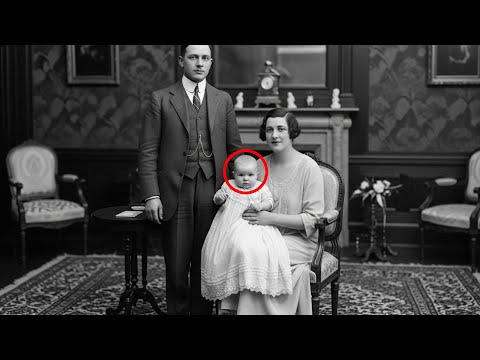
The photograph, clearly from the 1920s based on the clothing and photographic style, showed a young couple posed in what appeared to be their living room. The man wore a three-piece suit with a pocket watch chain, his hair slicked back in the fashion of the era. The woman, dressed in a drop-waist dress typical of the flapper period, sat gracefully beside him, a gentle smile playing on her lips. Between them, cradled in the woman’s arms, was an infant who couldn’t have been more than six months old.
At first glance, the portrait embodied the prosperity and happiness of the Roaring Twenties. A successful couple with their precious child posed in their comfortable home. The lighting was professional, suggesting this was a formal portrait session rather than a casual family snapshot. But as Sophia examined the photograph more closely, something about the baby’s expression made her pause.
While the parents smiled warmly at the camera, radiating contentment and pride, the infant’s eyes held something entirely different. Even at such a young age, there was an unmistakable intensity in that tiny face—not the blank, innocent gaze typical of babies, but something that seemed almost aware, almost fearful.
Sophia purchased the photograph for $25, unable to shake the feeling that those small eyes were trying to tell her something important.
Back in her antique shop in Lincoln Park, Sophia carefully removed the photograph from its frame to examine it more thoroughly. Her years of experience had taught her that the most valuable information about old photographs often lay hidden on the back—photographer’s stamps, dates, names, or notes that provided crucial context.
The back of the photograph revealed exactly what she had hoped to find: an embossed stamp reading Henrik Kowalski Photography Studio, Chicago, Illinois, along with a date written in elegant script, October 15th, 1920. Below that, in different handwriting, were three names: Robert, Catherine, and baby Thomas Williamson.
Sophia’s pulse quickened. She recognized the Kowalski name. Henrik Kowalski had been one of Chicago’s most prestigious portrait photographers during the 1920s, known for capturing the wealthy elite of the city. His work was highly sought after by collectors, but more importantly, Kowalski had been famous for his meticulous record-keeping. If his studio archives still existed, they might contain valuable information about this particular session.
She spent the next two hours searching online databases and historical records. What she discovered made the photograph even more intriguing. Robert Williamson had been a successful banker in 1920, part of Chicago’s financial elite. Catherine Williamson, née Hartford, came from old money. Her family had made their fortune in railroad investments during the late 1800s.
But it was information about baby Thomas that stopped Sophia cold. According to a Chicago Tribune obituary she found in the newspaper archives, Thomas Williamson had died in November 1920, just one month after this photograph was taken. The cause of death was listed as sudden infant death syndrome, though the medical understanding of SIDS in 1920 was primitive at best.
Sophia stared at the photograph again, focusing on the baby’s eyes. Now that she knew Thomas would be dead within weeks of this portrait being taken, his expression seemed even more haunting. Was it possible that somehow, in that mysterious way that sometimes occurred with old photographs, the camera had captured something that the human eye couldn’t see?
She reached for her phone to call Dr. Elizabeth Chen, a photography historian at Northwestern University who specialized in early 20th-century portraiture. If anyone could help her understand the technical aspects of what she was seeing, it would be Dr. Chen.
“I have a 1920 Kowalski portrait that’s unusual,” Sophia explained. “The baby’s expression doesn’t match the parents’ mood at all. It’s almost as if the child is seeing something the adults can’t.”
“Bring it in tomorrow morning,” Dr. Chen replied, her voice immediately interested. “Kowalski was known for capturing things other photographers missed. His portraits often revealed more than his subjects intended to show.”
Dr. Elizabeth Chen’s office at Northwestern University resembled a museum of photographic history. Vintage cameras from different eras lined the shelves, and the walls displayed examples of significant portrait photography spanning nearly two centuries. When Sophia arrived the following morning, Dr. Chen was already preparing her examination equipment.
“Henrik Kowalski,” Dr. Chen mused as she carefully placed the photograph under her specialized lighting. “He was an interesting figure in Chicago’s photography scene. Immigrated from Poland in 1910, built a reputation for portraits that seemed to capture people’s inner essence rather than just their appearance.”
Through her magnifying equipment, Dr. Chen studied every detail of the image. “The technical quality is exceptional, even by Kowalski’s standards. Look at the depth of field, the way he’s captured the texture of the mother’s dress, the intricate details of the baby’s christening gown.”
Sophia watched as Dr. Chen focused intently on the baby’s face. “What’s unusual about the infant’s expression?”
“Several things. First, babies this young—probably four to six months old—typically have very limited facial expressions. They might smile reflexively, cry, or sleep. But this child appears to be focusing on something specific outside the camera’s range.” Dr. Chen adjusted her equipment to get a clearer view. “Look at the direction of his gaze. He’s not looking at his parents, not at the photographer, but towards something to the left of the camera setup.”
“Could it be a sound that caught his attention?”
“Possibly, but notice his facial expression. This isn’t curiosity or a startle response. If I had to describe it, I’d say it looks like weariness—even fear.”
Dr. Chen continued her examination, paying special attention to the lighting and shadows in the photograph. “There’s something else interesting here. Kowalski was famous for his use of natural light. But in this portrait, there are multiple light sources. See these shadow patterns? They suggest there was strong lighting coming from that same direction the baby is looking toward.”
“What kind of lighting?”
“Hard to say definitively, but it’s not consistent with the soft natural light Kowalski typically preferred. It’s almost as if something bright—perhaps reflected light or an additional lamp—was positioned in that area during the shoot.”
Dr. Chen leaned back in her chair, removing her glasses in a gesture Sophia was beginning to recognize as significant. “Sophia, in my experience, when babies this young show such a specific, focused expression, they’re usually reacting to something immediate in their environment. The question is, what was in that room that we can’t see in the photograph?”
“The baby died a month later,” Sophia revealed quietly. “Sudden infant death syndrome, according to the records.”
Dr. Chen’s expression grew more serious. “That changes things. In 1920, SIDS wasn’t well understood, and many infant deaths that might have had other causes were attributed to it. Combined with this child’s expression…” She paused, studying the photograph again. “I think we need to research this family more thoroughly.”
Sophia spent the following days immersed in research at the Chicago History Museum. The Williamson family records painted a picture of typical wealthy Chicagoans of the 1920s—charity events, business dealings, society page mentions. But as she dug deeper into newspaper archives and public records, a more complex story began to emerge.
Robert Williamson, she discovered, had not been merely a banker. He had been involved in several controversial financial deals during 1919 and 1920, including investments that were later investigated for fraud. While never formally charged, his name had appeared in connection with schemes that had cost several families their life savings.
More troubling were the personal details she uncovered. Catherine Williamson had been hospitalized twice during 1920 for what the medical records euphemistically called “nervous exhaustion,” a common diagnosis for women suffering from what would now be recognized as severe depression or anxiety.
But it was a small item in the Chicago Tribune Society section from November 1920 that made Sophia’s blood run cold: “Following the tragic loss of their infant son Thomas, Mr. and Mrs. Robert Williamson have announced their intention to travel abroad indefinitely. Mrs. Williamson’s physician has recommended a change of climate for her health.”
Sophia found more clues in the Cook County property records. The Williamsons had sold their house on North Lake Shore Drive in December 1920—just two months after the portrait was taken and one month after baby Thomas’s death. The sale was handled quickly and quietly, with the house selling for significantly less than its assessed value.
At the Chicago Public Library’s genealogy section, Sophia discovered something even more disturbing. Thomas Williamson had not been the couple’s first child to die young. Catherine had given birth to a daughter, Mary, in 1918. According to the death certificate, Mary had died at eight months old—also attributed to sudden infant death syndrome.
Two babies, both dead before their first birthdays. Both deaths attributed to the same mysterious cause that doctors in 1920 barely understood.
Sophia stared at the photograph again, focusing on baby Thomas’s worried expression. Had this child somehow sensed that he was in danger?
Sophia’s research led her to one more crucial discovery: the Williamson house on North Lake Shore Drive was still standing, converted into luxury condominiums in the 1980s. The current owner of the former Williamson unit was Dr. Amanda Foster, a pediatrician who had purchased the condo specifically because of its historical significance.
Sophia called Dr. Foster, explaining her research into the photograph and the Williamson family’s tragic history. “I’d love to see where this portrait was taken,” Sophia said. “Sometimes seeing the actual space can provide clues about what was happening when a photograph was made.”
“Of course,” Dr. Foster replied. “Though I should warn you, there are some unusual things about this apartment that might interest you given what you’re investigating.”
Dr. Foster led Sophia through the renovated space, pointing out original architectural details. In what had been the nursery, she showed Sophia preserved wallpaper with tiny dark stains—fingerprints at crib height. “These tested positive for laudanum when I had them analyzed,” Dr. Foster said. “I think Robert Williamson was systematically poisoning his children.”
She retrieved a hidden diary entry from Catherine, dated October 10th, 1920, which described Robert giving Thomas “medicine” that made the baby drowsy, and Catherine’s fear that Robert saw their children as obstacles.
Armed with this evidence, Sophia contacted Detective Maria Santos of the Chicago Police Department’s cold case unit. Detective Santos listened intently, then searched modern databases. “Robert Williamson remarried in 1925 to a wealthy widow with two young children,” she said. “Both children died within two years—the son in 1926, the daughter in 1927. Their deaths were attributed to pneumonia and wasting sickness.”
Sophia’s heart sank. “He did it again,” she whispered.
“It certainly appears that way,” Detective Santos said. “By 1930, Robert Williamson had inherited substantial wealth from his second wife and moved to California, where he lived comfortably until his death in 1954.”
As word of Sophia’s discovery spread, she received a call from Dr. Patricia Williamson, a retired psychiatrist and Catherine’s great-great-niece. Dr. Williamson brought Catherine’s complete diary, which revealed Catherine’s growing certainty that Robert had murdered their children. The entry from October 15th, 1920, the day of the portrait session, described Robert’s cold calculation and Thomas’s distress whenever his father approached.
Six months later, Dr. Chen organized a symposium at Northwestern University titled Photography as Historical Evidence: The Case of the 1920 Williamson Portrait. Sophia presented her findings to an audience of historians and criminologists. “This photograph teaches us that truth has a way of preserving itself,” she concluded. “Baby Thomas couldn’t speak, but his eyes told a story that survived for over a century.”
Afterward, Dr. Patricia Williamson handed Sophia Catherine’s final letter, written before her death in 1965. With trembling hands, Sophia read: “To whoever finds this truth: My babies were murdered by their father, Robert Williamson, and I was powerless to save them. If you are reading this, then Thomas’s eyes finally spoke their truth. Please remember that he was loved, that he was innocent, and that his brief life mattered.”
The portrait found its permanent home in the Chicago History Museum, displayed with the full story of the Williamson family tragedy. Visitors often remarked on the baby’s unusual expression, and now finally they could understand what those young eyes had been trying to say all along.
What other silent testimonies might be hiding in plain sight, waiting for someone to finally listen?
Report this article
Select a reason for reporting:






