Late in the evening of August 30, 1918, Lieutenant General John Monash stood before General Sir Henry Rawlinson, outlining a plan that would have made most commanders laugh him out of the room. A hill called Mont St Quentin, one mile north of Péronne. Three battalions in the front line. Seventy officers and 1,250 men in total. Rawlinson turned to gentle sarcasm. “So you think you will take Mont St Quentin with three battalions. What presumption!” He paused, then added, “Anyhow, I don’t think I should stop you. So go ahead and try.” And with that, he wished Monash good luck.
Here is what three battalions could and could not do. Rawlinson commanded the Fourth Army. Monash led the Australian Corps, one of its formations. Rawlinson had known this hill since the Somme in 1916. Private Francis Brewer of the 20th Battalion, a former journalist who returned to inspect the ground and officers’ reports after the battle, recorded that Rawlinson had once described the position as impregnable. The official historian, Charles Bean, recounts the meeting more harshly than Monash did. In Bean’s version, Rawlinson laughs at Monash’s audacity and says clearly that he does not expect success. Then he lets him go ahead anyway.
These three battalions are small and tired before they begin. The 2nd Division began moving on August 25, bussed from reserve at Allonville, and from the drop-off point, the hill was still about 25 kilometers on foot. All the way, the Germans left their mark behind. Wells were poisoned, roads mined, railway sleepers removed to make the line useless.
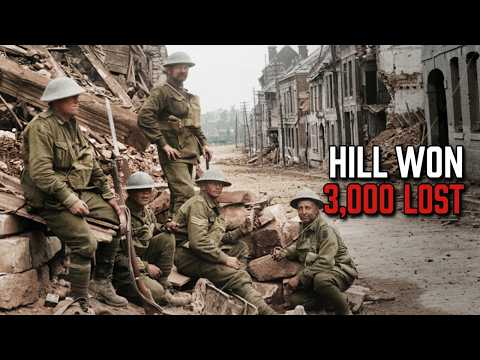
And now, why this hill? The Australian Corps had spent three weeks as the spearhead of the British Army. On August 8, it broke the German line at Amiens. Then, three weeks of pushing east. Every battle costs men no one replaces. In August, the average strength of an Australian Corps battalion was 653 soldiers. A battalion is supposed to have about a thousand men. Monash himself provides this figure in a letter written a week after the battle. Historian Peter Stanley counts the 21st Battalion of the 6th Brigade at 421 soldiers.
On the 26th, Monash was told that the Fourth Army had done its part. Wait for events elsewhere. No need to hurry the German withdrawal. Stay in contact with the enemy, which means pressure without costly battles. The big attacks now belonged to the Third Army in the north and the First Army in the south. Monash also received advice from the Commander-in-Chief, Field Marshal Haig, to act with the utmost boldness. He read a set of orders as a rule, and another as a statement. Guess which is which?
Before him lay a river. Monash describes the Somme as a belt of marshes and canals, and the only way across is a bridge. The Germans know this. When they withdraw, they destroy every bridge. Monash says in his book that every single bridge is regularly and methodically smashed. At a place called Brie, there are eight separate bridges along one road, and destroying the smallest one cripples the entire route. Infantry can cross by wading or swimming at night if no one shoots at them. But guns, tanks, and wagons cannot.
On the other side lies the hill. Monash is a civil engineer by profession and he looks at ground like an engineer. Mont St Quentin is a simple rise, 100 meters high, not a prominent landmark from the west. From the road, it is easy to underestimate. Stand on top and you can see the river extensions and every approach in every direction. The slopes are almost bare of any cover. Barbed wire stretches across them row after row, remnants of the 1916 battles. With gaps cut by the French and Germans as they came and went. Monash admits that an expert eye would describe it as completely impregnable to infantry without tanks.
It lies one mile north of the town of Péronne. Whoever controls the hill controls the northern and western approaches to the town, and whoever controls the town controls the gateway in the river line the Germans plan to stand behind. Once the hill is taken, the entire Somme defense collapses. So Monash’s task is simple in saying and difficult in execution. He must seize it before the Germans are ready to defend it.
In the late afternoon of August 29, he gathers his division commanders in a cluster of empty cottages near Broyard the Germans had just left. Lambert of the 32nd, Hobbs of the 5th, Rosenthal of the 2nd, and Gellibrand of the 3rd. His notes are brief. The 32nd Division, a British division serving under Monash, will hold the river south of Péronne and feign every intention of crossing to distract the Germans in the wrong direction. The 5th Division will attempt to storm the Péronne bridges. The 2nd Division will establish a bridgehead at Halle or cross behind the 3rd with Mont St Quentin as its ultimate objective. Each division uses only one brigade until it gains a foothold. And whichever division crosses first, the other has priority use of the same crossings.
Monash explains his reasoning in his own book without any embarrassment. He wants this achievement, as he puts it, to be purely Australian. He explains that corps commanders are jealous of their boundaries. And he has learned not to rely on a neighbor with his own problems. So the 2nd Division moves. Its reserve brigade is the 5th, led by Brigadier Edward Martin.
On August 30, the 5th Brigade crosses the river at Feuillères, passes through the 3rd Division’s area, and fights its way through the part of Cléry still held by the Germans. The trenches beyond are still fortified as well. Monash writes that after superb fighting, the brigade reaches its objective with seven machine guns, 120 prisoners, and only light casualties. It is a good job. Nothing the brigade does afterward will be this easy.
On the German side, the high command recognizes the value of Mont St Quentin. Ludendorff says that Monash, facing a crisis, takes one of his best remaining reserve divisions and sends it forward to hold the hill at all costs. The 2nd Prussian Guard. Two of its regiments, the Empress Augusta and Kaiser Alexander, are as famous in Germany as the Grenadier and Coldstream Guards are in Britain. Alongside them, a motley mix. Prussians, Bavarians, Saxons, and Württembergers are captured side by side these days, gathered from pioneer battalions, labor units, mine-thrower companies, and anything else Ludendorff could find.
In Péronne itself, the German command calls for volunteers and builds a garrison of hand-picked men to man the old ramparts with dozens of machine guns at the best observation points. The 5th Brigade will enter all that with a few hundred men per battalion in the dark. Artillery provides no support. There are no tanks because the Tank Corps has run out of crews. And there are hardly any heavy guns either because the roads are so destroyed that only a few light heavy guns can advance. The field guns that arrive suffer from a shortage of shells because ammunition depots have not kept up with the advance. The surviving barrage map for the second day of fighting shows three small target areas and no more. The guns are limited to just two rounds per gun per minute. Half of what they could fire. At Hamel in July, the creeping barrage alone fired 132,000 field rounds in 90 minutes. Later reports describe the Mont St Quentin barrage as weak and intermittent. Monash describes the entire four days as a pure infantry battle. Battalion reports confirm his words.
One more number matters here. A survey of the hill after the battle showed the Germans had twice the usual number of machine guns fortified in it. Rawlinson laughed at this plan, and he had good reason based on those numbers.
Five in the morning, August 31. The weather is gloomy and still dark. The men have had their ration of rum. The 5th Brigade has three battalions in the front line. The 17th, 19th, and 20th, and one behind them. The center battalion targets the highest point of the hill. The left battalion at Feuillaucourt, a destroyed village from which a flanking attack on the hill is supposed to launch. The right battalion extends the line toward the Péronne road. Orders were issued in haste, most by telephone. If we divide the brigade’s strength among its four battalions, each averages about 330 men, a third of a full battalion.
They advance making as much noise as possible. Monash says the two battalions on the right did this deliberately. It is a trick, and it works. They shout and yell as they leave the trenches to deceive the Germans into thinking a much larger force is coming. A soldier of the 20th Battalion, Percy Morris, wrote that the men set off like a pack of noisy, yapping hounds. German outposts positioned in the dark hear them and surrender. A nest of seven machine guns is attacked and captured without losing a single man. One captured German tells his captors that it was all over in an instant.
On the right, the noise is no longer effective. The right battalion runs into machine-gun fire from the ruins of a sugar refinery at a place called St Denis. On the main road between Péronne and the hill, the position is strong and holds. That ruin remains defiant for days. The left battalion manages to enter Feuillaucourt. The center battalion reaches the hill. The ground they cross is awful. Barbed wire is a thousand yards away. Morris’s unit gets caught in it, and by the time they crawl through, their boots are shredded, their trousers and tunics torn to pieces. Machine guns open fire from the flanks. Lieutenant Goddard of the 20th Battalion watches his men calculate the gaps between the fire, one after another, to jump into a trench leading forward. He later writes that a number of good comrades lost their lives. Battalion reports describe the fire from surviving German positions as choking, intense, and continuous.
By seven o’clock, the center battalion has broken into the ruins of the village of Mont St Quentin and crossed the main road from Péronne to Bouchavesnes. They are on the hill. They are also, as Monash describes them, scattered and exhausted, and a counterattack arrives at the worst possible moment. So the battalion withdraws across the road. It fortifies in a trench system west of it, and there it repels five successive counterattacks, one after another. Monash records the brigade’s casualties for the day as 380 men out of nearly 1,300. The Germans are not all in the same state. Brigadier Martin later writes that enemy resistance was initially weak, then became extremely strong. Some Germans are done with the war. In the days before the attack on the northern flank, Private Mark Lowndes of the 20th Division found two of them dead with their throats cut, and decided they preferred death to facing the Australians in battle. A captured sergeant major tells Morris that it was just a capitalist war, and that he does not know what the Germans are fighting for. Others are the Prussian Guard who do not yield the slope.
It is eight o’clock. Monash telephones Rawlinson and tells him that his men have a foothold on Mont St Quentin. He writes that Rawlinson was at first completely incredulous. Then he became generous in his reaction. He tells Monash that this event is likely to have a most critical influence on the immediate future course of the war. And he hopes they can hold what they have gained.
Monash holds the hill, or part of it. He now has a problem his plan only solved on paper. The 5th Brigade is nearly two miles ahead of the corps line. Its flanks are in the air. They are exhausted with hundreds of their men down. If the Germans can hit them with force, it will all be for nothing. Behind them is a river with bridges the Germans have bombarded all day. So he returns to the item he wrote in his own notes on the 29th. Whichever division crosses first gives priority to the others. At eight-thirty, he asks General Hobbs to move the 5th Division’s reserve, the 14th Brigade led by Brigadier Stewart, toward the Omiecourt crossing. Get them across the river that day. Go through the ground the 5th Brigade has won. Attack southeast of Péronne itself. It is a dangerous demand. There is no time to gather commanders together. And the roads are bad. Monash admits in writing that there was a real risk of confusion and even conflicting authority with troops of one division passing through ground controlled by another. But he writes the line that explains the next three days. But the only alternative was to do nothing and attempt nothing. That would have been the worst kind of military leadership, and it was an occasion where risks had to be taken.
The march is 7 miles long. A traditional staff officer would give it 3 hours. The 14th Brigade takes more than 10 hours over shell-torn ground at the bend of the river. The Omiecourt crossing turns out to be under German artillery fire all day, so the brigade heads for a newer bridge at Boscourt. It arrives at the same time as the 7th Brigade led by Brigadier Wisdom, sent by the 2nd Division to the same bridge for the same reason. Wisdom’s men make way, and the 14th Brigade crosses first. The hastily issued orders nearly crammed two brigades onto a single footbridge in the dark, and no one had planned for that. The men who pay the price are not silent.
Late in the afternoon of August 31, Brigadier Hobbs of the 5th Division comes to Monash and confirms with great seriousness the pressure on his troops. He repeats his commanders’ anxious demands. Hobbs is an artilleryman by trade, the first artillery commander of the 1st Australian Division in 1914, a man his officers follow because he looks after them. His men have just finished four days of grueling pursuit, and they are about to set off on a long march over rough terrain, then three days of fierce fighting. Monash listens, then refuses his request. He decides that speed matters more than rest, and admits he had to harden his heart to insist. Hobbs agrees, and his division follows. Monash later says Hobbs led them to undying glory, and the field records confirm it. They also say Hobbs had asked for it.
Monash understands the cost too. On the afternoon of the 31st, he tells Brigadier Gellibrand that casualties no longer matter. Bean records this remark, and historian Catherine Smith quotes it. She asks the reader to think about what that means for the men on the ground. That evening, the answer already lay in a trench at the foot of the hill.
Meanwhile, to the north, the 3rd Division fights its own battle in ‘Bush of Esmond,’ and Private George Cartwright of the 33rd Battalion wins the Victoria Cross there that morning at ‘Rod Wood.’ Two companies are pinned down by a machine gun at the edge of the wood. Cartwright stands up, walks toward it, and fires his rifle from the shoulder. He hits the first gunner. A second German takes over the gun, and he kills him too. A third tries, and he kills him as well. Then he throws a bomb at the position, rushes in, and captures the gun and nine Germans. His citation reads: “The line rushed forward behind him, cheering loudly.” He is 23 years old. Born in South Kensington, London, he lived until 1978.
In the last days of August, Lieutenant Percy Smith of the 24th Battalion is organizing his men at the foot of the hill at dusk. A sergeant tells him there are wounded in a trench on the left, and none of the stretcher-bearers have reached them. Smith goes there. A 9.2-inch shell has landed inside the trench. He describes the scene: “The carnage was awful.” Dead, wounded, and dying lay together, and when the living realized these were Australians who had come to help, they began to moan and cry. One man begged him to cut off his arm. Smith tried with a pocket knife but could not. In the dark, he found a brass ‘A’ on a tunic sleeve, the Gallipoli badge, and the man wearing it was Sergeant Victor Jolly, the company’s quartermaster. Smith described him as “a decent man.” Jolly volunteered on March 13, 1915. There were pictures of his mother in his pocket.
Behind the hill that night, Major Donald Coates of the 6th Field Ambulance works inside a tunnel. He writes that they worked all night, and the wounds were severe, fractures of limbs, head and abdominal injuries from German 5.9 shells. The tunnel entrances were hit, and several stretcher-bearers were killed. No senior officer slept in that part of the front. The last meetings ended very late in the early hours of September 1. Orders were for execution at dawn.
It is the turn of the 6th Brigade. Its commander is Brigadier James Robertson. He has four battalions, the 21st, 22nd, 23rd, and 24th. Each is understrength. The 21st Battalion numbers 421 soldiers. Lieutenant Colonel Brazenor of the 23rd Battalion will later report that the task was carried out under almost insurmountable difficulties. They were ordered to take over positions from the 5th Brigade and advance across the summit with almost no time for planning. The first attempt fails. The brigade advances early on September 1. As Robertson’s report states, German machine guns opened fire as soon as the men rose, scattering our formations. The advance should have been made in successive rushes. Reconnaissance was poor. Lieutenant Walter Clayton of the 23rd Battalion writes of trenches at the foot of the hill reported empty but which were not. Fifteen minutes before zero hour, two bombing patrols went out to clear nearby German strong points in front of the 23rd Battalion. Both failed. The battalion cannot even reach its start trench.
Private Robert McTier of the leading company jumps out of the trench alone in broad daylight. He rushes past the barricade and kills the machine-gun crew, eight men, with his pistol and bombs, and throws their gun over the parapet. Twenty yards away, he jumps into a second position. Its six men surrender. A third gun turns on him, firing along the flank of the advancing troops. He climbs out into the open, reaches behind it, and bombs the crew from the rear. Before he can get down into that trench, another machine gun kills him at close range. In the three positions he rushed, 15 dead Germans were found, and 30 more were captured. He is 28 years old. He is from Tatara, Victoria, where he worked on his father’s property.
At one o’clock, the guns open fire. It is a half-hour bombardment, and the men crouch in trenches and shell holes as the barrage falls. At one-thirty, the infantry advance again. The 6th Brigade takes the village of Mont St Quentin and clears it street by street. In one cellar, Private Morris of the 20th Battalion finds a German doctor hiding and takes from him a tin of coffee, and his mates gather around thinking it is rum. The fighting in the village is close and savage. Monash describes September 1 as a day crowded with great events and bloody hand-to-hand fighting. He writes that few prisoners were taken, because the work was with the bayonet at every yard of the advance, and the field was full of enemy dead everywhere.
In the midst of it, there are two more Victoria Crosses. Sergeant Albert Lowerson of the 21st Battalion is 22 years old. He is a gold miner from Myrtleford, Victoria. Throughout the early attack, he moves under machine-gun fire, directing and encouraging his men forward. On reaching the objective, he finds the left attacking force has failed. A strong point, equipped with 12 machine guns, is holding up the attack. Lowerson gathers seven men into a storming party and sends them from both sides. A party of three is killed immediately. He rushes the strong point himself and bombs it. He captures the position with its twelve machine guns and 30 prisoners. A bullet pierces his right thigh. He refuses to leave the line until the prisoners are sent back and the position secured. Then he refuses to leave the battalion until his wounds force him out two days later. He lived until 1945.
Lieutenant Edgar Towner is 28 years old, a cattleman from a station near Blackall, Queensland. He commands four Vickers guns of the 2nd Machine Gun Battalion on a 1,500-yard front. Early on, one German machine gun is cutting down the infantry. Towner goes out alone, kills the gun crew with his pistol, and turns the gun on its owners. Then he places his guns behind a small wood full of Germans, and 25 of them surrender after being surrounded. A bullet pierces his helmet and grazes his scalp. He keeps fighting and refuses to go back for treatment. Later, when the infantry withdraw and one gun is left behind, he carries it back across the open and puts it back into action. He is finally evacuated, utterly exhausted, after 30 hours since being wounded.
By the end of the afternoon, the 6th Brigade has passed the crest. Their attack has pushed the line 600 yards beyond the summit. The hill that the 5th Brigade reached at seven the previous morning and could not hold now belongs to Australia. This channel was created to tell the details of the Australian war in this depth, with the names of those involved. If this is the history you want more of, subscribe to the channel for all new content. The men on this hill deserved at least that.
Here Monash makes a fair statement. He writes: “It is difficult to apportion the credit between the 5th and 6th Brigades.” “The 6th reached the summit, but it only completed what the 5th had so splendidly begun the day before.” He adds: “No one will grudge either of them their share of credit.”
So the headline number does need adjusting. Three battalions seized the first part of Mont St Quentin in the dark and held a foothold. The 6th Brigade took the rest on the afternoon of the second day. Everything so far had been on the northern side of the hill. The hill was only half of Monash’s plan, and the other half lay to the south.
Péronne lies below it behind the old ramparts and the moat. The 5th Division under Hobbs had been trying to force its way across the river but could not. The main bridges were unreachable from the south and under fire. So the 14th Brigade, which had taken 10 hours to cover 7 miles, advanced through Cléry on the right of the 6th Brigade. It was the reserve brigade of the 5th Division, and it had been in reserve on every important occasion since August 8. As one company commander who distinguished himself that day later expressed it: “We had been trying to find a fight with the other side for 3 weeks.” That day, we got what we were looking for and made the best of it.
The attack goes in at six in the morning. The 53rd and 54th Battalions break through several belts of barbed wire under machine-gun fire from front and flanks, and it seems nothing can move. But the two battalions keep going. By the end of the day, the 14th Brigade controls the western half of Péronne. Three more Victoria Crosses are awarded in this battle.
Private William Currey of the 53rd Battalion is 22 years old, a wireworker from Leichhardt, Sydney. The battalion is suffering heavily from a 77 mm field gun firing over open sights at close range. Currey rushes it amid machine-gun fire from the flanks and captures it single-handedly, killing the entire crew. Later, he works around a strong point of 30 men and two machine guns with a Lewis gun, then rushes it alone. After that, he volunteers to carry a withdrawal order to an isolated company, crossing the open under fire three times, his gas mask torn and he is gassed, yet he succeeds in delivering the order.
Two corporals of the 54th Battalion win the award in the same battle. Alexander Buckley and another man rush a machine-gun nest, kill four of the crew, and capture 22 others. Arthur Hall rushes another position alone, kills four, and captures nine men and two machine guns. Then Buckley’s company reaches the moat, and the only remaining footbridge is covered by another machine-gun nest. While the position is engaged from the flank, Buckley tries to cross and rush it. He is killed there. His citation says he knew it meant almost certain death.
On the morning of the 2nd, Hall carries a severely wounded man of his platoon through heavy shellfire, hands him to stretcher-bearers, and returns straight to his post. By the end of that day, only one officer in his company remains unwounded.
On September 2, the last of the eight awards goes to a New Zealand-born undertaker living in Adelaide. Corporal Lawrence Weathers of the 43rd Battalion, 28 years old, is with a bombing party advancing north of Péronne. After an hour of fighting in a trench full of Germans, he advances alone with bombs and kills their senior officer, then goes back for more bombs, and goes again with three men. He stands on the parapet and throws bombs inside, then signals his mates to advance. The rest surrender. His citation records the capture of 100 soldiers and the seizure of three machine guns. Weathers dies of his wounds on September 29 during the fighting for the Hindenburg Line. He never knew he had been awarded the Victoria Cross. The London Gazette published it on December 24.
Eight Victoria Crosses in three days for one hill and one town. And the battle was not over on the second day. The 7th Brigade, with its 25th, 26th, and 27th Battalions, continues fighting throughout the second day against the Prussian Guard and the rest of the gathered forces. One company receives orders to clear a single trench defended by 30 machine guns. Lieutenant Colonel Davis of the 25th Battalion reports that the barrage was light and his battle turned into pure infantry fighting. Brigadier Wisdom complains that his artillery observer reached a position two hours after it was captured. He adds dryly that a battalion commander should be excused if he ordered him to leave. An English battalion, the Royal Sussex, arrives to relieve the 7th Brigade. So it was not a purely Australian achievement.
By the evening of September 3, Péronne and most of the surrounding heights are in Australian hands. A small suburb called Flamicourt holds out for one more day. After that, German resistance begins to fade.
Let us gather the accounts. Monash’s own book counts 35 battalions engaged over the four days. Three divisions of the Australian Corps fighting side by side. Nearly 2,000 prisoners by his estimate, most from elite Prussian regiments. The 2nd Division’s own report, as cited by historian Catherine Smith, counts more than 1,500 prisoners, 265 machine guns, and 15,141 acres captured. Smith, citing Bean, records about 3,000 casualties among nearly 17,000 men in the three divisions. One in six. Three battalions did not take Mont St Quentin. Three divisions did. 35 battalions spread across the hill and the town and the Bouchavesnes spur.
Rawlinson’s subsequent message to Monash deserves to be read in full. “I am full of admiration for the gallantry and surpassing audacity of the 2nd Division in winning this important fortress, and I congratulate them with all my heart.” Signed Rawlinson. Monash writes that Rawlinson described it more than once as the greatest individual feat of the war.
And now the candid part, which works against Monash. Catherine Smith returned to unit diaries in a research paper hosted by the Australian War Memorial and asks a difficult question. Was it necessary? On August 26, the Fourth Army was ordered to wait while the armies on either side advanced. She argues that with time, attacks from north and south would have left the hill prominent, and the Germans would likely have withdrawn to the Hindenburg Line on their own. There was no order to take it. There was a general who wanted it, and a higher commander who allowed him to try.
The records are not kind about how it was executed. Machine-gun companies were sometimes not told where their battalions were going. Wisdom complained that his commanders barely had time to get their companies to the start line. Signallers died laying cables. Stretcher-bearers could not move fast enough over these distances, so surrendered Germans were forced to carry Australian wounded. A lieutenant at the foot of the hill did not know who was on his right flank or if there was anyone at all. The 38th Battalion of the 3rd Division on the northern flank had been marching and fighting for 84 hours without rest when it took Cléry. Smith, quoting Bean’s diary, notes a feeling that there might soon be no Dominion army left. Monash writes that he found it necessary to apply severe pressure on the troops.
There is a gap in the records worth knowing. Battalion and brigade reports are full of complaints about the guns. The barrage was thin, light, and of little help, and the infantry soon outran it. When Rosenthal reported to Monash, he omitted those complaints. His only concerns were lack of staff and broken communications. Smith suggests he may have thought the battle a one-off event or that complaints would not be taken into account. By then, Monash and Rawlinson were looking toward the Hindenburg Line.
The other view is Monash’s own. He writes that if we had delayed a day or two, the capture of Péronne would have cost twice as much. Smith and Monash can both be right about that. The numbers are not everything in this, though. Some of the three thousand have names we know. McTier, Buckley, and Weathers never returned home. Afterward, the battalions formed in 1914 were broken up and their men sent to other battalions. Stretcher-bearers, signallers, runners, bombers, and clerks crawled to the front line as infantry. The experienced men who could have brought them through were used up in the taking of the position.
What did the Germans lose? The river line they wanted to hold and a hill that dominated both extensions of the Somme. Monash describes the loss of Mont St Quentin as a decisive factor in their retreat to the Hindenburg Line. Smith believes they would have retreated there anyway. Whichever was right, the Germans did retreat. And even after the fighting ended, the bill kept arriving. The great lattice railway bridge at Péronne was destroyed beyond repair. Monash’s engineers estimated two months to rebuild it. A temporary crossing would take a month. A new 6-mile link from Bray to Péronne station could be built in two weeks. Without a railway, every shell and ration for the next advance was carried on trucks wearing out on broken roads. The hill was taken, and the bridges were still to be built.
Monash sets out his own order of reasons for this victory. First and foremost, the magnificent courage of the men who took part. Second, the speed with which the plans were put into execution. Third, the absolute audacity of the attempt. A commander known for meticulous planning ranks audacity third, and the unit records support him.
And there is a final irony. Rawlinson’s joke is the most memorable line of the whole battle, and Monash is the one who tells it against Rawlinson in his book. The commander who wanted a purely Australian achievement made the Englishman the setup for his punchline.
Let us return to midday on the 30th. A commander tells a gently sarcastic army commander what he plans to do. “What presumption?” says Rawlinson. “Go ahead and try.” They tried. It cost the 5th Brigade 380 men in one day, and it took five counterattacks to learn what the center battalion was made of. It cost the 6th Brigade at dawn and then at noon. It cost a soldier from Tatara who advanced alone, a farmer from the Goulburn Valley, and a corporal of the 43rd Battalion who never learned of his cross. It cost a company quartermaster sergeant with a Gallipoli badge on his sleeve and his mother’s picture in his pocket.
If someone in your family served on the Western Front, or at Gallipoli, or on the Kokoda Track, or in Vietnam, or with SAS, in any unit, tell me about them. Names, units, a letter home. “Three battalions,” the headline says. Someone should remember the 30th. What is the one story from your family’s war that deserves to be told?
Report this article
Select a reason for reporting:






