The air in the restoration lab of the Charleston Heritage Museum was thick with the smell of chemicals and aging paper. Sarah Williams adjusted her magnifying lamp, her gloved hands steady as she placed an 1862 photograph under the scanner. It was her third week cataloging the Whitfield estate collection, and most items were ordinary—faded family portraits, land deeds, ledgers documenting cotton production. But this photograph was different. It showed the Whitfield family posed on their plantation veranda: James Whitfield stood tall in a Confederate officer’s uniform, his wife Katherine seated beside him in a wide, ornate skirt, their three children arranged like porcelain dolls. The image quality was exceptional for its era, sharp and well-preserved despite its age.
Sarah had processed dozens of similar photos—wealthy Southern families documenting their wealth, status, and narrative of history. She began the high-resolution scan, watching the progress bar crawl across her screen. The museum’s digitization project aimed to make the collection accessible to researchers and descendants seeking their family histories. As the scan completed, Sarah zoomed in to check the quality, examining faces first, then clothing details, then the architectural elements of the veranda. Her cursor drifted toward the background, where columns of the plantation house cast dark shadows. She stopped. There, barely visible in the gloom behind the family, stood several figures. Servants. Enslaved people, present in the frame but pushed to the edges. Their faces were deliberately obscured by shadow and distance.
Sarah leaned closer to her screen, increasing the magnification. One woman stood slightly apart from the others, her face partially visible. Then Sarah saw it. Her breath caught. The woman’s hands, folded at her waist, were not simply resting. They were positioned in a deliberate gesture, fingers intertwined in a pattern that seemed purposeful and intentional. Sarah’s pulse quickened. She had seen something similar before, in her research on communication methods in the Underground Railroad. But she needed to be sure.
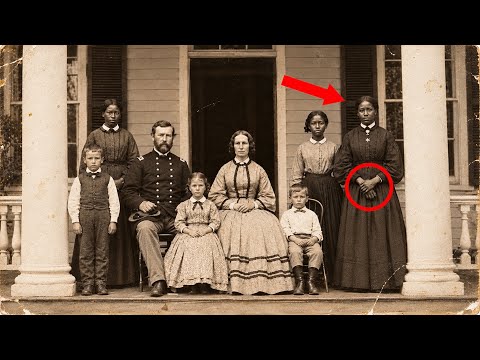
She spent the next two hours cross-referencing historical databases on her second monitor, pulling up academic papers on coded communication among enslaved people, studies of quilt patterns used as maps, and documentation of hand signals used by conductors on the Underground Railroad. The woman’s hand position matched descriptions she found in a 1932 oral history interview with a freedman named Jacob Harris, who had escaped from South Carolina in 1863. The signal meant “safe house” or “friend”—a message that could be captured in photographs, hidden in plain sight while slaveholders remained oblivious.
Sarah printed several reference images and returned to the photograph, comparing them carefully. The match was unmistakable. This woman had deliberately positioned her hands to communicate something to those who understood the language. Her colleague, Marcus Chen, an archivist specializing in African American history, stopped by her workstation. “Still working on the Whitfield collection?” he asked, setting down his coffee. Sarah turned her screen toward him without a word. Marcus leaned in, his expression shifting from casual interest to intense focus. “Is that what I think it is?” he asked quietly. “I think so,” Sarah replied. “But there’s more.”
She zoomed in further on the woman’s dress, pointing to the collar. Barely visible on the dark fabric was a small pin, no larger than a button. The high-resolution scan revealed intricate details: tiny symbols etched into the metal surface, including what appeared to be a star. “The North Star,” Marcus whispered. “The Underground Railroad symbol.” They sat in silence for a moment, the implications settling over them. This wasn’t just a family portrait. It was evidence of resistance, of courage—a woman who had risked everything to leave a message that would endure for over 160 years.
“We need to know who she was,” Sarah said. Marcus nodded. The Whitfield estate records should contain inventories of enslaved families—lists that recorded names, ages, and assigned tasks. The thought made Sarah’s stomach turn, but she knew these dehumanizing documents might be their only way to identify the woman in the photograph. “Let’s start there,” she agreed. “I want to examine every inch of this image. If she left one message, maybe there are others.”
Three archival boxes of Whitfield estate papers were arranged meticulously on the large research table in the climate-controlled basement. Sarah and Marcus spread the documents out, scanning for any mention of the woman. The inventory from 1862, compiled just months before the photograph was taken, listed 18 enslaved individuals at the main house. The document provided names, approximate ages, assigned roles, and assessed monetary values. Sarah’s hands trembled slightly as she read the list. “Here,” Marcus said, pointing to an entry near the bottom. “Eliza, age approximately 35, house servant and seamstress, valued at $900.” Nine hundred dollars. A human life reduced to a price tag.
Sarah photographed the page with her phone, then continued searching through the papers. She found Eliza’s name mentioned in other contexts: a receipt for fabric purchased for sewing, a note in Katherine Whitfield’s diary about dress alterations, a medical expense record from 1859 when Eliza was treated for fever. But nothing revealed Eliza’s true self beyond her role in the household. “We need more than this,” Sarah said, frustration creeping into her voice. “These records don’t tell us anything about her as a person.” Marcus was already searching on his laptop. “The Avery Research Center might have oral histories from this area,” he said. “And there are Freedmen’s Bureau records from the post-war period. If Eliza survived to emancipation, she might have registered, applied for assistance, or searched for family members.”
Sarah returned to her computer and pulled up the photograph again, studying Eliza’s partially visible face with new focus. The woman’s features were strong, her gaze not directly at the camera but angled slightly to the left, as if watching something beyond the frame. Her expression was carefully neutral—the mask enslaved people were forced to wear before their enslavers—but knowing now about the hand signal, Sarah could see something else in that face. Determination. Perhaps even defiance. “She’s part of the Underground Railroad,” Sarah said aloud, her certainty growing. “She has to be. This wasn’t just a random gesture. She knew exactly what she was doing.”
The next morning, Dr. Patricia Johnson, director of the Avery Research Center for African American History and Culture, welcomed Sarah and Marcus into her office. The walls were adorned with photographs, documents, and artifacts chronicling the African American experience in the Lowcountry. Dr. Johnson, a distinguished historian in her seventies, listened intently as Sarah explained their discovery. “The Whitfield plantation,” Dr. Johnson said thoughtfully, pulling a book from her shelf. “Oh, I know this plantation. It’s on Edisto Island, correct?” Sarah nodded. The island had been a hotbed of Underground Railroad activity, though it was not widely documented. “Many people don’t realize how extensive the network was in South Carolina,” Dr. Johnson continued. “We tend to focus on the Northern routes, but there were active networks throughout the South, helping people escape to Union-held areas or to ports where they could board ships heading north—or even to the Bahamas.”
She opened the book to a page marked with a hand-drawn map of the Lowcountry, annotated with faded ink. “This map was drawn in 1935 by a historian who interviewed elderly former slaves,” Dr. Johnson explained. “They identified safe houses, meeting points, and river crossings. Look here.” She traced a line on the map. “There were at least three known safe houses on Edisto Island, run by free Black families and sympathetic whites—mostly Quakers. The Whitfield plantation is right in this corridor.” Sarah felt a chill run down her spine. So Eliza might have been a conductor, helping people escape from the very plantation she was enslaved on.
Dr. Johnson smiled. “Well, that’s possible. House servants had more freedom of movement than field workers, and greater access to information. They heard conversations, read letters left lying around, knew when slave catchers were in the area or when the master was away. A seamstress had reason to travel between the main house and slave quarters, to visit other plantations for work. Perfect cover for Underground Railroad activities.” Marcus leaned forward. “Do you have any records of conductors who operated in this area during the war years?” Dr. Johnson turned to her file cabinet. “Well, we have some oral histories, but names are often incomplete or changed. People used code names, false identities. After the war, many were afraid to speak openly about their involvement, fearing retaliation even decades later. But let me check our database.”
She typed for several minutes, scrolling through records. Then she stopped, reading something on her screen. “There’s a reference here in a 1938 WPA interview with a woman named Ruth, born enslaved on Edisto Island in 1857. She mentioned a woman called Aunt Eliza, who was a seamstress and who would sing certain songs when it was safe to move. The interviewer didn’t understand the significance and simply recorded it as folklore.” Dr. Johnson printed the interview transcript, and Sarah read it eagerly. Ruth’s testimony, recorded when she was 81, painted a vivid picture of life on Edisto Island during the Civil War years. The interviewer was more interested in plantation life and folk customs, but woven through the narrative were fragments of something more important.
Ruth told the interviewer: “Aunt Eliza was a smart woman. She could sew anything, make a dress from scraps, fix any tear, but she had another talent. She knew things, heard things. When the patrollers came, she would sing ‘Wade in the Water.’ When it was safe, she’d hum ‘Follow the Drinking Gourd.’ We all knew what it meant, but the white folks just thought she liked to sing while she worked.” The transcript continued with Ruth describing how people would sometimes disappear from the plantation at night, and how Aunt Eliza always knew when someone was planning to run. She never said anything directly, but she would leave signs—a quilt hung a certain way, a candle in a window, a mark on a tree. Signals for those who understood.
Sarah looked at Dr. Johnson. “That has to be her. The timeline matches, the location, the work as a seamstress.” Dr. Johnson nodded slowly. “It’s strong evidence, but we need to find more direct links. Ruth’s testimony gives us context, but we need to trace what happened to Eliza after this photograph was taken. Did she survive the war? Was she emancipated? Did she leave any descendants who might have family stories?” Marcus was already searching Freedmen’s Bureau records on his laptop. “I’m checking the registration records for Charleston County between 1865 and 1868. There are thousands of entries. Let me filter by name and approximate age.”
Minutes passed in tense silence as he scrolled through digital documents. Then he stopped. “I found something. Eliza Freeman registered in Charleston in April 1865. Age listed as approximately 38, former slave from Edisto Island. Occupation listed as seamstress.” The room fell silent. Freeman—the surname chosen by thousands of formerly enslaved people to signify their new status. Sarah felt a surge of emotion. “She survived. She lived to see freedom.” “Does the record show anything else?” she asked. Marcus continued reading. “She registered two children with her: a daughter named Hannah, age 12, and a son named Isaac, age 8. And there’s an address, or at least a general location. Radcliffe Street, near the waterfront.”
Dr. Johnson stood up, re-energized. “Radcliffe Street was in a neighborhood where many freedpeople settled after the war. Some of those families may still have descendants in Charleston. They might have stories, family Bibles, photographs, documents.” Finding those descendants took three weeks of methodical research. Marcus contacted churches in Charleston’s historic Black neighborhoods, reached out to genealogy groups, and posted inquiries on ancestry forums. Sarah continued examining the photograph, discovering additional details she had initially missed: faint marks on the veranda floorboards that might have been symbols, the particular way Eliza’s collar was folded—perhaps hiding something—and the angle of her head that kept her face partially shadowed but ensured her hands remained visible.
The breakthrough came from a woman named Dorothy Burnett, a retired schoolteacher who belonged to the Gullah Heritage Society. She responded to Marcus’s inquiry with cautious interest. Her great-great-grandmother was named Hannah Freeman, born enslaved on Edisto Island, daughter of a woman named Eliza who was a seamstress. Dorothy had family stories passed down through generations, though some details had faded or become mixed over time. Sarah and Marcus met Dorothy at her home in the East Side neighborhood, a modest house filled with family photographs spanning generations. Dorothy, 73, with silver hair and sharp, intelligent eyes, welcomed them with sweet tea and homemade cake.
“My grandmother used to tell me stories about Eliza,” Dorothy said, settling into her chair. “She called her Grandma Eliza the Brave. She said she helped people find their way to freedom during slavery times.” Sarah showed Dorothy the photograph on her tablet, zooming in on Eliza’s face. Dorothy stared at the image for a long moment, her eyes filling with tears. “That’s her,” she whispered. “I’ve always wondered what she looked like. My grandmother said she was strong, that her face didn’t show fear, even when she should have been afraid.” She touched the screen gently, tracing Eliza’s features with her finger.
Marcus asked gently, “Can you tell us what your grandmother said about Eliza’s activities?” Dorothy nodded, gathering herself. “Grandma said Eliza was part of a network that helped people escape. She would get information from the big house, pass messages, hide people in her quarters when the patrollers came looking. And once the war started, she helped Union soldiers who had escaped from Confederate prisons, guiding them to Union lines. It was dangerous work. If she’d been caught, she would have been sold or worse.” Sarah showed Dorothy the hand signal in the photograph, explaining its meaning. Dorothy’s eyes widened. “So she left a sign. She made sure the truth would survive somehow.”
She stood and walked to a corner cabinet, bringing out an old wooden box. “I have something to show you. It’s been in the family since Eliza’s time.” Dorothy carefully opened the box, revealing its contents wrapped in faded cloth. Inside was a small, leather-bound diary. Its pages were yellowed and fragile with age. “Hannah, Eliza’s daughter, kept this,” Dorothy explained. “She learned to read and write after emancipation, at one of the schools the missionaries established. She wanted to record her mother’s story before it was lost.” Sarah’s hands trembled as she received the diary, handling it with the care of an expert conservator. The first page bore a dedication in careful, formal handwriting: “The Life and Courage of My Mother, Eliza Freeman, as Told to Me and Witnessed by Her Daughter Hannah Freeman, Written in Charleston, South Carolina, 1877.”
Marcus set up his phone to photograph each page as Sarah carefully turned them. Hannah’s account began with her earliest memories of life on the Whitfield plantation, describing the daily routines, the fear that permeated every moment, the careful masks enslaved people wore. Then the narrative shifted to Eliza’s secret activities. Hannah wrote: “A free Black man named Samuel, who worked on the Charleston docks, approached my mother. He asked if she was willing to help people seeking freedom. She said yes without hesitation, though she knew the danger. She began leaving signs, passing information, hiding people in the cellar beneath the sewing room, where the white family never went.”
Hannah documented specific escapes Eliza facilitated: a family of four guided to a safe house three miles north, a young man provided with a map and supplies to reach Union lines, a woman and her children hidden for a week while slave catchers searched the area. Hannah recorded at least 15 escapes Eliza assisted between 1860 and 1865. Then Sarah reached an entry dated August 1862, and her breath caught. Hannah wrote that a traveling photographer had come to take a portrait of the Whitfield family. “My mother saw an opportunity. She knew the photograph would endure, would survive even when she did not. She wore the North Star pin hidden in the shadows where only the discerning would see. And she positioned her hands in the signal Samuel had taught her, the sign that meant safe house, meant friend. She told me later that she wanted to leave proof, a message that would outlive them all, that would let people know the truth someday.”
Eliza had known exactly what she was doing. The photograph was not an incidental documentation but a deliberate testimony, a message planted in the historical record like a time capsule waiting to be discovered. The diary revealed far more than Eliza’s Underground Railroad activities. It documented a wider network of resistance than historical records had indicated. Eliza worked with at least a dozen other conductors, including several house servants on neighboring plantations, a white Quaker family who ran a store in Charleston, and free Black sailors who smuggled freedom seekers onto ships bound for the North.
Hannah described how Eliza used her sewing work to pass messages, stitching coded patterns into quilts and clothing, using specific colors of thread and stitch patterns to convey information about routes, timing, and dangers. She also detailed how Eliza would travel to Charleston for supplies for the Whitfield family, using those trips to coordinate with other network members. The diary also revealed the psychological toll. Hannah wrote of nights when her mother woke screaming from nightmares, of the constant fear of discovery, of the guilt Eliza felt when she couldn’t help everyone who needed her.
One passage described an incident in 1863 when a young man Eliza had helped was recaptured and brutally beaten, left as an example to others. Eliza blamed herself for months, though Hannah insisted her mother never stopped helping others despite the trauma. Sarah and Marcus spent hours in Dorothy’s living room, photographing every page, taking notes, asking Dorothy to share more family stories. Dorothy told them about Eliza’s life after emancipation, how she worked as a seamstress in Charleston, saved money to buy a small house, helped establish one of the first Black schools in the city, and lived to see her grandchildren born free.
“She died in 1891,” Dorothy said. “Hannah wrote that she was peaceful at the end, proud of what she had accomplished. Her last words were: ‘I kept them safe. That’s what matters.'” Dorothy wiped her tears. “For generations, we’ve told these stories at family gatherings, passed them down. But most people outside the family didn’t believe us. They’d say we were exaggerating, making ourselves seem more important than we were. Now you have the proof. You have her own message, left for the world to find.”
Sarah looked at the photograph again, seeing it now with entirely new understanding. It was not just a historical artifact but evidence of extraordinary courage, of a woman who risked everything to help others and was clever enough to document her resistance in a way that would endure for over 160 years. The Charleston Heritage Museum held a press conference six weeks after Sarah’s initial discovery. The exhibition hall was packed with journalists, historians, community members, and Dorothy’s family. The enlarged photograph dominated one wall, with detailed annotations highlighting Eliza’s hand signal, the North Star pin, and other subtle messages Sarah had discovered through meticulous analysis.
Display cases held Hannah’s diary, carefully preserved and open to key passages, alongside contemporary documents about the Underground Railroad in South Carolina. Dr. Johnson spoke first, providing historical context about Underground Railroad operations in the Lowcountry, acknowledging how much of this history had been ignored or minimized in traditional narratives. Marcus presented the archival research, and Sarah traced Eliza’s life from slavery through emancipation to her work as a teacher and community leader. Then Sarah took the podium, the restored photograph displayed on the screen behind her.
“When I first looked at this photograph, I thought I was looking at another document of slavery, another image of a wealthy white family with enslaved people marginalized,” Sarah began. “I didn’t expect to find evidence of resistance, of courage, of a woman who used this very image as an act of defiance.” She explained the discovery process in detail, how enhanced imaging revealed details invisible to the naked eye, how cross-referencing with historical records and oral histories built a comprehensive picture of Eliza’s activities. “Eliza Freeman was not just a victim to be defined by her enslavement. She was a conductor on the Underground Railroad, a strategist, a hero who saved lives at great risk to her own. And she was clever enough to leave us this message, knowing that someday, with the right technology and enough attention, someone would see what she had hidden in plain sight.”
Dorothy took the podium, her voice strong despite her emotion. “My family and I have told Eliza’s story for generations. We were told we were exaggerating, making up stories to feel important. Today, the evidence proves what we always knew: our grandmother was a hero. She deserves to be remembered and honored, not just by our family but by everyone who values freedom and justice.” The room erupted in applause. Sarah watched as Dorothy’s children and grandchildren gathered around the enlarged photograph, some crying, some laughing, all touching the image of their ancestor with reverence and pride.
Journalists approached with questions. Historians requested access to the diary and documents for further research. A local filmmaker asked Dorothy about participating in a documentary about Eliza’s life. Three months later, Sarah stood in the newly opened exhibition at the Charleston Heritage Museum titled “Hidden in Plain Sight: Eliza Freeman and the Underground Railroad in South Carolina.” The exhibit went far beyond the original photograph. Working with Dr. Johnson and local historians, they had uncovered additional evidence of the network Eliza was part of: property records showing safe houses, ship manifests documenting the arrival of freedom seekers at Northern ports, letters from formerly enslaved people describing their escapes.
Other families came forward with their own stories, passed down through generations, of ancestors who participated in resistance activities. The exhibit honored them all, correcting a historical record that had long minimized or ignored the role of Black people and their courage during slavery. Schools brought students to see the displays, learning history that had been absent from their textbooks. Dorothy visited the exhibit regularly, often finding herself surrounded by visitors asking questions about Eliza. She became a sought-after speaker, sharing her family’s oral history with audiences who finally understood its significance.
Her grandchildren, who had initially been skeptical of the old family stories, now spoke about their ancestor with pride, researching other aspects of their family history. Sarah continued her work on the Whitfield collection, discovering three more photographs of enslaved individuals who had positioned themselves or objects in ways that now seemed clearly intentional. Each discovery opened new questions, new research, new opportunities to restore forgotten voices to the historical record.
Sarah stood before the enlarged photograph, studying Eliza’s face once more, that careful, neutral expression that hid so much determination and courage. The hand signal was now clear to every visitor, highlighted with subtle lighting and detailed explanations. Children traced the position of Eliza’s fingers with their own hands, learning the sign that once meant safe house, meant friend, keeping that knowledge alive for a new generation.
“She wanted to be seen,” a young girl said to her mother, standing near Sarah. “She knew someone would look closely someday and find her message.” The mother smiled, reading the exhibit text aloud. “And now everyone knows her name and what she did.” Sarah thought about all the other photographs preserved in archives and museums, waiting to be examined with new technologies and new perspectives. How many other messages had been hidden by people who refused to let their stories be erased? How many other acts of courage and resistance were still waiting to be discovered, hidden in images that historians had glanced at and dismissed?
The photograph was no longer just an old picture of a wealthy white family on their plantation veranda. It was Eliza Freeman’s testimony, her proof of existence and resistance, her gift to the future. It had taken 162 years for someone to see what she had left behind, but her message had survived. Her courage had survived. Her name would not be forgotten.
Sarah stepped back from the display, her gaze drifting to the museum’s east wing, where rows of unexamined boxes waited in climate-controlled silence. Each one held fragments of lives deemed unimportant by the historians who first catalogued them.
She thought of the girl tracing Eliza’s fingers in the air, and of Dorothy’s trembling voice on the podium. “History isn’t what was written down,” Sarah murmured to Marcus, who had come to stand beside her. “It’s what survived despite every effort to erase it.”
Marcus nodded, his eyes on Eliza’s steady, shadowed face. “Then we keep looking. Box by box, image by image.”
The exhibit lights hummed softly, holding Eliza’s signal in their glow—a message from 1862, still speaking.
How many other silent witnesses are waiting in our archives, hoping someone will finally look closely enough to see them?
Report this article
Select a reason for reporting:






