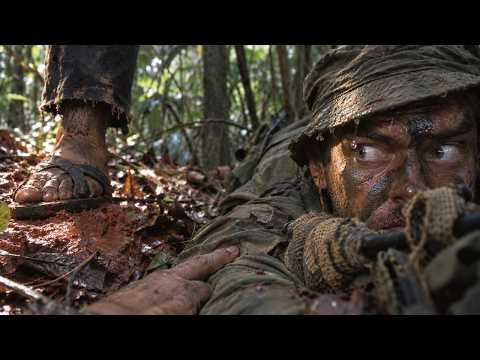
The rubber sole landed on the wet leaves without a sound, inches from the muzzle of an Australian rifle. The man behind it didn’t blink. He didn’t breathe. He waited until the heel lifted, leaving a perfect imprint of a worn truck tire in the red laterite soil—a footprint as clear as a signature.
The man who left it carried a rice sack and a rifle slung muzzle-down against the rain. He wasn’t looking for anything. He’d walked this path before, maybe many times, and now he was passing within five meters of five Australians who had been hiding in the scrub since before dawn.
This was a recon patrol from the Special Air Service, operating deep in the secret zone the maps called the “Hot Plate.” Five men, five days of rations, and a mission written in a single paragraph: find the courier route, map it, and return. No ambush. No harassment. If they were seen, the mission had already failed.
Nearly thirty years later, an American military historian named Thorne holds a photographed page from a 1969 complaint filed by a US long-range recon team. The sentence he keeps returning to describes the Australian patrol’s behavior as a refusal to engage a located enemy. The word below it is harsher. It’s the only version of the incident in the records he can access.
He requests the matching Australian file. The reply: no such document exists in available records. He has one side of an argument written in anger from twenty kilometers away.
On the trail, the problem had arrived much earlier than anyone expected. The patrol found the path within four hours of landing—used, and used in both directions. Fresh tracks, water still seeping into the deep prints. Everything that moved on this path had passed that morning and would move again.
The patrol commander chose to stay. Five men in an L-shape under bamboo, three meters from the trail’s edge, leaves unscraped because scraping leaves a mark. Claymores placed, wires run back out of training more than intent. From that moment, the patrol committed to ground they hadn’t chosen, with no rehearsed withdrawal route, inside the inspection circle of anything using the path.
What approached the next afternoon announced itself before it was seen. Woodsmoke drifted first in the heat. The sour-sweet smell of nuoc mam sauce followed. Then the sound the signaller later called the most familiar he heard in that country: the dry clatter of a loaded bicycle chain, repeated across a dozen bikes, with the squeak of rubber-covered grips and the slap of sandals on clay.
The patrol commander placed two fingers on the arm of the man beside him. Pressed. Held. Released. The message had been agreed upon at the hill in Nui Dat and held no ambiguity: Let them pass.
No one touches the detonator. No one moves a weapon. If one of them steps on you, take it.
With that single two-finger movement, five claymores buried under leaves became useless weight. Twenty-two kilograms of explosives carried in and now carried out unused. The patrol itself became closer to an instrument than a fighting force.
The first porters drew abreast of the hide seconds later. The signaller, lying with his AN/PRC-64 under his chest to muffle any sound, could see the frayed edge of a trouser leg, the broken strap of a sandal, the peeled paint on a bicycle frame. He could also see the mud on the man’s ankles, dried in a band—proof of a stream crossing, proof of a direction.
The man was carrying more than he should. In recon patrols, weight discipline was absolute. The difference between moving quiet and moving loud often depended on a few extra kilograms carried by a tired man at the end of the third day.
Forty meters up the trail, where the path forked at a junction the lead scout could see clearly, a small bush had been partially cut and bent toward the northeast, fixed there with a strip of bark. Not an accident. The scout noted it the way scouts note things—without deciding what it meant—and went back to counting feet.
The American complaint describes the incident almost correctly, but the reason is entirely wrong. The reason was never written anywhere the Americans could read it.
The Australian squadron interrogation report, later studied by historian David Horner, records the patrol’s tasks: determine the route, the pattern, the composition of traffic. Engage only in self-defense. Those instructions didn’t come from the patrol commander lying among the fallen leaves. They came from the squadron, where the standing requirement under Major Red Beasley was that a recon patrol returns with a route, not a body count.
What the US team called a refusal to fight had been issued in substance before the patrol ever left the hill at Nui Dat.
None of this helps a man lying motionless for too long. A leech had attached to the scout’s wrist at night and swollen to the size of a thumb joint. He left it there because salt and a lit cigarette required movement, and movement was the only thing that would end this. Sweat ran from his hairline into his open right eye. He kept it open and let it burn, because closing it would move his lashes, and the man in sandals was close enough to hear leaves rustle.
The scout shifted his weight by a degree, enough to reach the taped strip at his rifle’s sling swivel. With a flat carpenter’s pencil, he marked each porter carrying a rifle, each belt-fed weapon, each bicycle with square, heavy loads. Four marks in the bottom column—long green tubes on carrying frames. Mortars. They weren’t going to a transit camp.
The column stopped. A man sat against the bamboo three meters away, his cracked heels white between the toes. The scout exhaled into his sleeve for twenty-two minutes.
At 2100 they slipped out, cloth boots leaving no tread. At the junction, the lead scout knelt before a bent bush—the network’s own marker, tilted northeast. They weren’t searching anymore. They were tracking.
At dawn on the third day, they found seven cut steps, a bamboo handrail. Then the cleared killing ground, the weapon pits, eleven bicycles. The signaller raised the URC-10. Forty seconds of coordinates. The rest is in the records.
Thorne struck the word refusal and wrote: They were refusing to spend the trail.
So what does the next patrol follow when the enemy stops moving anything through the path at all?
Report this article
Select a reason for reporting:






