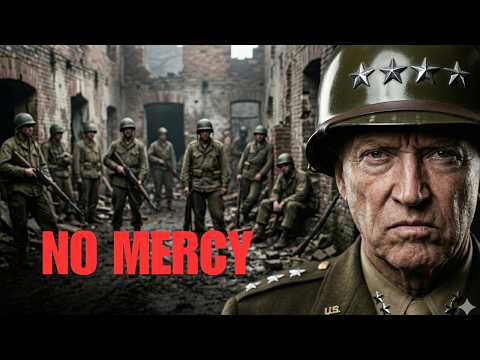
April 29th, 1945. A cold, gray morning in Bavaria, Germany. The sky was the color of dirty iron. The war in Europe was only days away from its bitter, violent end. The Third Reich was in ashes. The American army was racing across the German countryside, hunting down the last pockets of resistance.
Among those fast-moving American units was the 45th Infantry Division. They were known as the Thunderbirds. They were mostly farm boys from Oklahoma and kids from the crowded streets of New York. They were not green recruits. They were not easily shocked. They had been fighting constantly for over 500 days. They had stormed the bloody beaches of Sicily. They had survived the artillery nightmare of Anzio in Italy. They had frozen in the winter forests of France. They had seen their friends blown apart. They had killed German soldiers up close. They had seen entire cities reduced to smoking craters. They believed they understood the absolute limits of human cruelty. They thought they had seen everything a man could do to another man in the name of war. They were dead wrong.
On this frozen April morning, the men of the 45th Infantry Division were about to cross a line that would change them forever. They were about to discover a place called Dachau.
At 0900 hours, Lieutenant Colonel Felix Sparks was riding in the passenger seat of his muddy Jeep. Sparks was a legendary commander. He was leading the Third Battalion of the 157th Infantry Regiment. He was only 27 years old, but his eyes looked like they belonged to a man of 50. He was exhausted. His men were exhausted. Their green uniforms were caked in dried blood and brown mud. They just wanted the shooting to stop. They wanted to go home and forget the horror of Europe.
The radio in Sparks’ Jeep cracked with static. The orders from division headquarters were simple. Proceed to a location on the outskirts of Munich. Secure a facility marked on the map as a concentration camp.
In April 1945, the average American infantryman had absolutely no concept of the Holocaust. The rumors of death camps were just whispers. The men of the 45th expected to find a standard prisoner-of-war camp. They expected to find captured American or British pilots. Or maybe a few barbed-wire fences, some hungry political prisoners, and a handful of German guards. They expected a routine, organized military surrender. They expected to collect the enemy’s weapons, hand out some chocolate bars, and move on. They did not expect to walk into the very center of human evil.
As the long column of Sherman tanks and troop transport trucks rumbled down the narrow Bavarian roads, the atmosphere began to change. The landscape grew unnervingly quiet. The birds stopped singing. The local German civilians had locked themselves inside their farmhouses.
And then, the smell hit them. It started when they were still miles away from the camp. It was completely unlike the smell of a battlefield. It was heavy. It was sickeningly sweet. It clung to the backs of their throats and burned their noses. A young American scout driving the lead Jeep slammed on his brakes. He leaped out of his vehicle, fell to his hands and knees on the muddy road, and violently threw up. A grizzled tank commander popped his heavy steel hatch to get some fresh air. He gagged immediately.
The stench was getting thicker by the mile. A terrible, heavy silence fell over the entire Thunderbird battalion. The joking stopped. The complaining stopped. The men reached into their pockets and pulled out olive drab handkerchiefs. They tied the fabric tightly over their mouths and noses. They checked the bolts of their M1 Garand rifles. They began to realize they were not driving toward a military target. They were driving toward a slaughterhouse.
The column rounded a bend in the road near a small, quiet railway siding. Sparks motioned for the convoy to stop. Sitting on the tracks was a long, silent freight train. It was attached to a black, lifeless locomotive. There was no steam. There was no noise. There were 39 wooden boxcars sitting stationary on the rusty rails. The wooden sliding doors of several cars were cracked open just a few inches. The stench coming from the train was physically paralyzing.
Sparks stepped out of his Jeep. He drew his heavy .45 caliber service pistol. He motioned for his men to unmount and secure the train. Dozens of battle-hardened American soldiers stepped off their trucks. Their boots crunched loudly on the gravel. They walked slowly toward the wooden cars.
A 19-year-old private from Oklahoma walked up to the very first boxcar. He reached out with a trembling hand and pushed the heavy wooden door open. The young soldier looked inside. He dropped his rifle. He took three steps backward. His legs completely betrayed him. He collapsed into the dirt and began to weep uncontrollably.
Sparks ran toward the open boxcar. He looked inside. The veteran commander totally froze. The car was not carrying military supplies. It was not carrying captured soldiers. It was filled from the floor to the ceiling with human corpses. They were completely naked. They were skeletal. They looked like bundles of dry sticks covered in gray, translucent skin. Their eyes were wide open and hollow. Their mouths were locked in silent, agonizing shrieks. They were piled on top of each other in a massive, tangled web of broken arms and legs.
Sparks could not speak. He walked mechanically down the length of the train. He looked into the second car. It was the same. A mountain of starved human beings. He looked into the third car. More bodies. And so it continued. 39 cars. Over 2,000 dead men, women, and children crammed into rolling wooden coffins.
The Americans would later learn the terrible history of this train. Weeks earlier, the SS guards had packed thousands of prisoners into the cars at Buchenwald to transport them to Dachau. But the German rail lines were destroyed by Allied bombing. The train was delayed. Instead of letting the prisoners out, the SS guards simply locked the doors. They left them inside the pitch-black cars for 3 weeks without a single drop of water. They let them slowly, agonizingly freeze and starve to death.
Sparks looked down at the gravel tracks. The gray stones were stained with frozen blood and human feces. He looked closer at the victims inside the train. Some of the dead faced the wooden walls. Their fingers were broken. Their fingernails were completely torn out. They had tried to claw their way through the solid wood in their final moments of suffocating panic.
The sheer scale of the atrocity short-circuited the minds of the American soldiers. The threshold of disciplined military conduct began to snap. These were the Thunderbirds. They were professional soldiers. But professionalism requires an enemy who plays by the rules of war. The men who guarded this train had abandoned humanity entirely.
Around the train, total psychological breakdown took hold of the battalion. Grown men who had survived D-Day without shedding a tear were now sobbing openly against the steel hulls of their Sherman tanks. Some threw their helmets into the mud and screamed curses at the empty gray sky. Others vomited until their stomachs convulsed empty.
A combat medic named William Walsh walked slowly down the edge of the tracks. He was desperately looking for anyone who could be saved. Deep inside one of the cars, he spotted a tiny movement. One man out of thousands was still breathing. The man was a walking skeleton. He consisted of nothing but bones and thin skin. He looked up at the American medic. The dying man forced a weak, pathetic smile. He tried to speak, but no sound came out. A second later, his eyes rolled back and he died.
Walsh stood up. The tears stopped running down his face. A terrifying, cold blankness washed over his eyes. The sadness was instantly replaced by a pure, blinding, unadulterated rage. He gripped his rifle. It was not just Walsh. It was every single American soldier standing in the railway yard at Dachau. The psychological transformation was instantaneous and terrifying. They were no longer the liberating army of the United States. They were a heavily armed mob of executioners. The Geneva Convention ceased to exist. The rules of engagement were forgotten. Empathy for the German uniform was permanently erased.
Sparks felt the terrifying shift in his men. He knew he was losing control of the battalion, and a dark part of his soul did not care. He chambered a round in his pistol. He ordered his men to push forward. They left the nightmare train behind and advanced toward the towering brick walls of the main Dachau compound. They did not move with tactical caution. They moved with a reckless, burning desire for violence.
They reached the outer perimeter of the camp. The massive wooden double doors of the exterior wall loomed in front of them. The Americans did not knock. They kicked the doors off their iron hinges. The soldiers swarmed into the initial concrete courtyard. Instantly, they spotted a small reinforced concrete guardhouse near the railway entrance. Inside the guardhouse were four SS officers. They were the men responsible for the security of the train. They were young, arrogant, and immaculate. Their gray and black uniforms were perfectly pressed. Their black leather boots were polished to a mirror shine. They looked completely absurd surrounded by tens of thousands of rotting corpses.
The four SS guards watched the Americans storm the courtyard. They did not look afraid. They looked annoyed. The German propaganda machine had told them the Americans were soft, undisciplined, and eager to follow the rules. The SS men assumed this was a routine capture. They assumed they would be formally arrested, taken to a quiet POW camp in France, fed hot meals, and eventually sent home safely after the war.
The lead SS guard smirked. He unbuckled his pistol belt, stepped out of the concrete guardhouse, and slowly raised his hands in a gesture of proud, confident surrender. He opened his mouth to introduce himself by his official rank. He never got the chance to speak.
The American soldiers who had just stared into the 39 boxcars of hell were looking straight down the sights of their M1 Garand rifles. The Oklahoma farm boys placed their fingers on the cold steel triggers. The arrogant SS officer standing in the courtyard smiled for the last time.
The explosive crack of the M1 Garand rifle shattered the heavy, sickening silence of the Dachau courtyard. It was deafening. The bullet struck the smiling SS officer squarely in the center of his face. His arrogant grin vanished in a violent spray of red. His knees buckled instantly, and he collapsed backward into the filthy mud. His polished black boots pointing up at the gray sky. He never even got the chance to say his name.
His three comrades standing in the concrete guardhouse screamed. The illusion of a civilized surrender evaporated in a fraction of a second. They dropped to their knees, throwing their hands into the air, begging for the protection of the Geneva Convention. But the American boys of the 45th Infantry Division were no longer listening.
A young corporal from New York raised his Thompson submachine gun. He pulled the heavy trigger and held it down. A devastating burst of heavy .45 caliber rounds ripped through the freezing air. The three remaining SS guards were essentially cut in half. They folded into the dirt beside their commander. Their immaculate, tailored gray uniforms were instantly soaked in dark blood.
Dozens of battle-hardened American soldiers watched the four men die. Nobody shouted an order to fire. Nobody reprimanded the shooters. Lieutenant Colonel Felix Sparks, the commanding officer of the battalion, stood only feet away. He watched the blood pool into the frozen ruts of the road. Any other day, in any other European town, he would have court-martialed the men on the spot for executing surrendered prisoners. But Sparks had just looked inside the 39 boxcars of the death train. He had seen the 2,000 starved, mangled corpses. He looked at the bodies of the SS men bleeding out in the mud. He said absolutely nothing. He turned his back on them. He chambered a fresh round in his own heavy pistol and kept walking toward the inner gates.
The unwritten law was established. The Thunderbirds were not taking prisoners today. They were dealing in death.
The American battalion pushed deeper into the sprawling, terrifying complex of Dachau. They moved like a pack of wolves. Every shadow was a target. Every locked door was kicked off its iron hinges.
They finally reached the coal yard, an enormous staging area beneath tall black smokestacks. The air was thick with fine, greasy ash drifting down like dirty snow. It was human ash.
Suddenly, roughly 50 elite Waffen SS soldiers emerged from a nearby hospital building. They were combat veterans recovering from wounds, and even facing furious Americans, many stood upright, chests out, sneering at the filthy infantrymen. They still believed the Americans were soft.
First Lieutenant Jack Bushyhead, a stoic Native American officer from Oklahoma, said nothing. He simply set up a heavy .30 caliber machine gun facing the line of prisoners and racked the bolt. The metallic clack echoed off the brick walls.
An arrogant SS officer lowered his hands and took a defiant step from the wall, opening his mouth to demand his rights under the Geneva Convention. A terrified young private screamed, “They’re trying to escape! They’re escaping!”
Bushyhead did not hesitate. He squeezed the trigger. The machine gun roared, and a stream of heavy bullets ripped across the coal yard. The perimeter riflemen opened fire too, emptying clip after clip into the writhing pile of bodies.
Sparks sprinted into the deadly line of fire, kicking the red-hot barrel skyward and physically striking down his own men’s rifles. “Cease fire! Cease fire!” he screamed. Slowly, the gunfire stuttered to a halt.
Seventeen elite German soldiers lay dead at the base of the bullet-scarred wall. Dozens more bled in the coal dirt. Bushyhead took his hands off the smoking grips, said nothing, and spat a dark wad of tobacco onto the frozen ground.
Sparks had stopped a total massacre, but the damage was irreversible. The liberators had crossed an undeniable line into outright murder.
Word of the bloodbath raced up the Allied chain of command. The next morning, clean-cut military lawyers arrived in spotless uniforms, carrying leather briefcases. They had not smelled the death train. They saw only a horrific violation of the Geneva Convention.
The Howard Report recommended that the shooters, including Bushyhead, be court-martialed. The damning file landed on the desk of General George S. Patton, a man who had himself vomited at the sight of a liberated camp.
Patton read the names of the broken Oklahoma farm boys. He stared at the photographs of the 39 boxcars. Then he threw the entire report into a metal trash can and struck a match. “Not a single American soldier under my command will ever be punished for killing an SS guard at Dachau,” he told the stunned lawyers.
The investigation was closed forever. The Thunderbirds went home to their farms and offices, carrying the dark secret in silence for the rest of their lives.
They had violated the sacred laws of civilized war. But they had also destroyed monsters who believed themselves above the law of God. They learned that the line between disciplined soldier and ruthless executioner is practically invisible.
So tell me — was Patton right to burn the evidence and let his broken heroes walk free? Or should the men of the 45th have faced a tribunal for what happened in that coal yard? Let me know your honest thoughts in the comments below.
Report this article
Select a reason for reporting:






