The desert sun beat down on the Golan Heights as Syrian crews scrambled into their machines—machines that had no business being there. These were not modern Soviet tanks fresh from the factory. They were German World War II relics, captured decades earlier and sold to Syria, now facing off against Israel’s finest. The irony was not lost on the men inside: they were about to fight the Jewish state using tanks built by the Nazis.
After World War II, Europe was littered with abandoned German armor. Czechoslovakia, France, Spain, and Romania, eager to offload surplus weapons, found a willing buyer in Syria. Starting in 1949, Syria acquired dozens of these tanks, including the Stug III and Panzer IV variants. They were pushed into service almost immediately, becoming a bizarre but integral part of Syria’s armored corps.
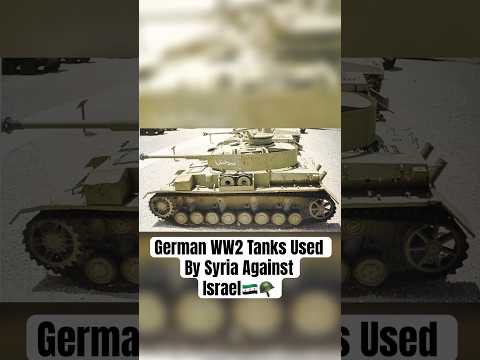
The Syrians didn’t just use the Stug—they also fielded Jagdpanzers, tank destroyers designed to hunt armor. Captured Israeli photos from the Six-Day War show these German beasts, now bearing Syrian markings, lined up against Israeli Centurions and Pattons. For the Israeli crews, it was a surreal sight: the same tanks their parents had fought in Europe, now aiming at them in the Middle East.
These tanks saw action in the War over Water in the mid-1960s, the Six-Day War in 1967, and even the Yom Kippur War in 1973. By then, they were hopelessly outclassed, but desperation has a way of making old weapons useful. “I can’t imagine it was a good time,” one historian notes dryly. Indeed, for the Syrian tankers, it was often a death sentence.
Yet the story of these German tanks in Syrian service is more than a footnote. It’s a testament to how war reshapes tools and alliances, turning yesterday’s enemies into today’s weapons. And as the Yom Kippur War loomed, these relics would face their final test.
The crews knew the odds were grim. A Stug III’s short 75mm gun could barely scratch the frontal armor of a Centurion at range, while the Israeli gunners could punch through the old German steel with ease. Syrian commanders understood this too, which is why the relics were often dug into hull-down positions on the slopes, hoping to ambush advancing armor rather than duel it head-on.
In the War over Water, these tanks were used less as spearheads and more as mobile artillery, shelling Israeli water infrastructure and defensive works. It was inglorious work for machines that had once spearheaded the Blitzkrieg, but it kept them in the fight.
By 1967, the situation had grown desperate. On the Golan, Syrian crews manned their Jagdpanzers in prepared emplacements, watching the dust clouds of Israeli columns approach. Some of the old tank destroyers scored hits that day—brief, violent successes before Israeli return fire turned them into burning wrecks.
Captured photographs tell the rest of the story. Rows of abandoned Stugs and Panzer IVs sit in Israeli assembly areas, their Syrian markings still visible, some with their tracks blown off, others seemingly intact but simply left behind in the chaos of retreat.
What the Israelis found inside those hulls was telling. Ammunition racks held a bizarre mix of old German stock and whatever the Syrians could scrounge—shells sometimes decades old, their reliability a gamble every time the breech closed. Spare parts were cannibalized from wrecks, and maintenance was a constant, losing battle against time and sand.
Yet the Syrians pressed on. By 1973, the surviving German tanks were a shadow of a shadow, but they still rolled out of their revetments on the Golan when the Yom Kippur War began. For the men who crewed them, the question was never whether the machines were obsolete—it was whether they would survive the first exchange.
The answer, for many, was no. On October 6, 1973, Syrian armored brigades surged across the ceasefire lines, and among the lead elements were a handful of these German relics, engines straining, tracks rattling over the rocky basalt. Israeli tank commanders, peering through their optics, recognized the boxy silhouettes immediately—and for a moment, some of them hesitated, unsure whether they were seeing ghosts or targets.
The hesitation lasted only seconds. Centurion gunners, drilled to perfection, found their ranges and fired. The old German steel, never designed to withstand modern high-velocity rounds, offered little resistance. Stugs brewed up one after another, their ammunition cooking off in spectacular fashion.
Yet not every encounter went the Israelis’ way. In the confusion of the first night, a few Syrian Jagdpanzers slipped into ambush positions along the wadis, and when Israeli armor advanced in the darkness, they opened fire. One crew reportedly knocked out a Patton before being silenced—a brief, bitter victory for a machine that had no business winning anything in 1973.
By the second day, the survivors were scattered, abandoned, or burning. The German tanks that had crossed into Israel were largely gone, their wreckage littering the slopes alongside the more modern Soviet T-55s and T-62s that Syria had fielded in far greater numbers.
But the story didn’t end on the Golan. Some of the old tanks remained in rear areas, held in reserve or used for training. A few even lingered in depots, forgotten, their Syrian markings fading under the sun. For the men who had crewed them, the war was over—but the machines, somehow, endured.
What happened to those last survivors is a question that leads in unexpected directions. Some were captured and shipped to museums. Others were scrapped. And a few, remarkably, may have found their way into the hands of yet another army, in yet another conflict, far from the deserts they had come to call home.
In the decades that followed, the survivors became relics of a different kind. Israeli engineers examined the captured hulls with professional curiosity, then parked them in storage yards or donated them to museums. A handful of Stugs and Panzer IVs ended up as gate guardians on military bases, their Syrian markings painted over in Israeli olive drab.
Some, however, took stranger paths. Reports from Lebanon in the 1980s hinted that a few German-made hulls, sold yet again as scrap, were pressed into service by militias desperate for armored vehicles. Whether any actually fought again is uncertain—but the possibility alone is haunting.
Today, a few of these tanks sit in museums, carefully restored, their Syrian service a footnote in their placards. Visitors stare at the boxy silhouettes and struggle to reconcile them with the desert battlefields they once roamed.
The German tank destroyers of the Syrian army were never meant to last. They were obsolete before they arrived, outmatched before they fired, and forgotten soon after they burned. Yet their story endures—a reminder that wars recycle everything, even the ghosts of old enemies.
What other forgotten weapons are still out there, waiting for one last battle?
Report this article
Select a reason for reporting:






