Staff Sergeant Colton had seen the after-action report slide across his desk before. He had read the dry, clinical language of combat for eleven months in Uruzgan province, the stark numbers of engagements, casualties, and ammunition expended. But this one was different. This one made no tactical sense.
The report detailed a 19-hour firefight that had begun at 03:17 local time. A four-vehicle Australian patrol, ambushed during a routine resupply run. Standard Taliban tactics: disable the lead and rear vehicles, then concentrate fire on the trapped middle. Colton had seen this exact scenario fourteen times. The average American casualty rate in such ambushes was 31%. The average engagement time before extraction or reinforcement was 47 minutes.
The Australians had no extraction available for 19 hours. They should have been overrun within two.
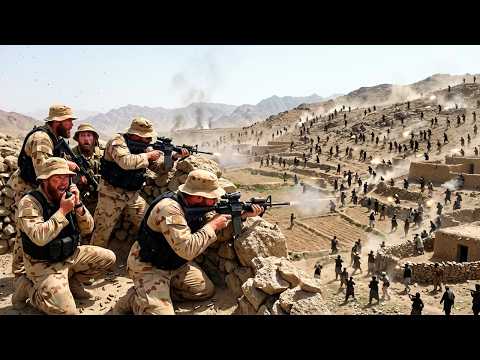
But something in the first minutes of contact had shifted the entire tactical equation. And Colton, reading the timeline reconstructed from radio intercepts and helmet camera footage, could not identify what that something was. The physics of the ambush should have been fatal. Three directions of concentrated fire, elevated positions on two sides, a numerical advantage of roughly five to one.
American doctrine in such scenarios emphasized immediate suppressive fire, aggressive movement to break contact, and a rapid call for close air support. The Australians had done none of these things. Their initial response, according to the timeline, was four seconds of total silence.
Four seconds in a three-sided ambush is not tactical discipline. It is suicide. Colton had drilled his own teams to return fire within 1.2 seconds of contact. Every second of delay in a near ambush increased casualty probability by approximately 8%. Four seconds should have meant 32% additional casualties before a single Australian round was fired.
Instead, those four seconds had produced something the Taliban fighters had never encountered. The Australian patrol had used the silence to identify exact firing positions. Not approximate sectors, not general directions. Exact positions marked mentally by each operator, cross-referenced against the others through a communication system that Colton would later learn required no radios at all.
This was the first mechanism that made no sense to American training. The SASR operated on what they called silent contact protocol. A doctrine developed not in simulation centers or tactical classrooms, but in the scrubland of Western Australia during selection. Candidates at Bindoon learned to track each other’s positions through peripheral vision and micro-movements, maintaining constant spatial awareness of their patrol members without verbal or electronic communication.
The skill was tested during navigation phases, where candidates covered 40 km at night in pairs, forbidden from speaking or using lights. Those who lost track of their partner failed. Those who maintained awareness learned something that could not be taught in any classroom.
Colton would later interview one of the operators from that night. The man explained it simply. “In the first four seconds, I knew where my 36 mates were, where the fire was coming from, and what my arc of responsibility was. No one told me. We all just knew.”
This was not bravado. This was the product of 18 months of reinforcement training following a 21-day selection that eliminated 87% of candidates. But spatial awareness alone does not explain surviving a 5-to-1 ambush.
The second mechanism was ammunition discipline. And this is where Colton’s confusion deepened into something approaching disbelief. American special operations doctrine emphasized fire superiority. When ambushed, the immediate response was maximum sustainable rate of fire to suppress enemy positions while maneuvering elements broke contact or flanked.
A typical American operator in a 19-hour engagement of this intensity would expend between 300 and 500 rounds of primary ammunition, plus grenades, plus crew-served weapons. The Australians had averaged 41 rounds per man. Some had fired fewer than 30.
The mathematics seemed impossible until Colton understood the underlying philosophy. SASR trained for extended operations in environments where resupply was not merely difficult, but non-existent. Their historical deployments—Vietnam, East Timor, the remote valleys of Uruzgan—had taught a simple lesson. Ammunition spent is ammunition gone. There would be no helicopter bringing more. Every round had to count not just tactically, but strategically, calculated against the unknown duration of the engagement.
This created a firing discipline that American operators found almost alien. Where teams would fire three-round bursts to suppress a suspected position, the Australians fired single aimed shots at confirmed targets. Where Americans used volume to create psychological pressure on the enemy, Australians used precision to create actual casualties. The result, over 19 hours, was a kill ratio that no American unit had achieved in Uruzgan. Approximately 1.5 confirmed enemy killed per operator.
The third mechanism was positional rotation. And this Colton did not learn about until six months after the engagement, when a classified Australian tactical brief was shared with coalition partners. Standard defensive doctrine teaches that once a perimeter is established, operators hold their positions to maintain overlapping fields of fire. Moving during contact risks friendly fire incidents, gaps in coverage, and loss of situational awareness.
The Australians had violated this doctrine continuously for 19 hours, rotating positions every 40 to 90 minutes according to a pattern that Colton initially assumed was random. It was not random. Each rotation was calculated to achieve three objectives simultaneously: prevent enemy pattern recognition of defensive positions, allow each operator brief recovery periods in lower-threat sectors, and continuously refresh mental alertness by forcing spatial reorientation.
The rotation schedule had been developed during jungle training phases in Tully, Queensland, where patrols practiced extended ambush positions for 72 hours or more. The human body, they had learned, could maintain peak alertness in a static position for approximately 45 minutes. After that, degradation was inevitable. By rotating, the Australians kept every operator at peak performance throughout the engagement.
The Taliban fighters, Colton later learned from interrogation reports, had been genuinely confused by the defensive pattern. They had identified what they believed were weak points in the Australian perimeter, had concentrated forces for assault on those points, and had found the weak points suddenly reinforced with fresh defenders while their previous strong points had become the new targets. Three separate assault attempts had been broken not through superior firepower, but through positional unpredictability.
But perhaps the most significant factor was not tactical at all. It was metabolic. When the American quick reaction force reached the compound 19 hours after initial contact, they found the Australians in a state that Colton’s medic described as impossible. Heart rates averaging 62 beats per minute. Cortisol levels, when later tested, showed patterns consistent with moderate stress rather than sustained combat. Two operators were eating field rations. One was conducting maintenance on his weapon. They looked, the medic noted in his report, like they had been on a training exercise rather than fighting for their lives against 200 enemy fighters.
This physiological control was the product of selection brutality that Colton had heard rumors about but never fully understood. The SASR interrogation phase, he would later learn, subjected candidates to 36 hours of continuous psychological pressure specifically designed to teach stress regulation under conditions of helplessness. Candidates who could not control their physiological responses, who could not lower their heart rates through breathing techniques, who could not maintain cognitive function while exhausted and afraid, were removed.
What remained were men whose nervous systems had been trained to treat combat as a manageable problem rather than an existential crisis. Colton had experienced combat stress himself. He knew what it did to fine motor control, to decision-making speed, to ammunition expenditure. The average American operator under sustained fire increased their rate of fire by approximately 40% compared to training conditions. A well-documented phenomenon driven by cortisol and adrenaline. The Australians showed no such increase. Their firing rates during the 19th hour of contact were statistically identical to their rates during the first hour.
The tactical implications were profound. An operator who maintains physiological control conserves ammunition, makes better decisions, and presents a calmer target picture to the enemy. Multiply that across 37 men over 19 hours, and the aggregate advantage becomes decisive. The Taliban had been fighting opponents who did not behave like opponents, who did not panic when flanked, who did not increase fire when pressed, who did not make the mistakes that pressure was supposed to create.
This was what Colton could not explain to his own command when they asked him to assess the engagement. The Australian advantages were not technological. Their equipment was, if anything, simpler and older than American standard issue. The advantages were not numerical. They had been outnumbered five to one. The advantages were not positional. They had been caught in a near-perfect ambush configuration.
The advantages were human. And human advantages of this type could not be requisitioned, could not be purchased, could not be installed through a training update or doctrinal revision. They were the product of a selection and training pipeline that took 18 months and eliminated almost nine of every ten candidates who attempted it.
What Colton witnessed in that after-action report was not superior tactics. It was superior operators. Men whose capabilities had been forged through a process his own military system was not structured to replicate. The question that would occupy him for months afterward was not whether the Australian method was better. The evidence answered that. The question was whether understanding the method could help him bring more of his own people home.
The compound engagement was not an anomaly. It was a demonstration of principles that the SASR had been refining since Vietnam. And the specific moment when those principles became visible—when Colton first understood he was watching something fundamentally different—came not during the firefight itself, but in the hours before it began.
Those hours began at Firebase Anaconda, 0317, under a moon Colton had argued against. Wombat 6 glanced at the lunar calendar and shrugged. “We’ll work with it.” The patrol carried one radio, a store-bought GPS, and two men without ceramic plates. “We might need to run 17 km tonight. Try that with 9 kg of ceramic on your chest.”
They moved through a hostile village timed to the 40-minute window when the dogs slept deepest. “Three months of watching,” Wombat 6 said. “Dogs here sleep heaviest between 0200 and 0240.” They passed within four meters of three sleeping gunmen without altering pace. Colton’s heart rate read 147. The Australian beside him logged 63—identical to the pre-mission brief.
Then came the hide: 18 hours, 600 meters from the compound, 43-degree heat, 50 ml of water every 40 minutes. A child wandered within nine meters and stared through the corporal three times. The boy never saw him. Not hidden—unrecognizable.
When the ambush finally came, 200 fighters from three directions, the commander’s voice stayed flat: “Hold all air assets.” Civilians in the compounds. Twelve operators flanked to a shepherd ridgeline no map showed, and six shots in nine seconds silenced the command element. Seventy-four enemy casualties. Three minor Australian wounds. The medic treated eleven villagers while the bullets flew.
Colton’s final assessment ran three sentences. They showed us what was possible. We chose not to learn, and they paid for our education with parts of themselves they never got back.
In Swanbourne, a plaque civilians never see bears only a number and three words: They held always.
So here is the question that still keeps Colton awake: if the price of that kind of excellence is 78% of your men coming home broken, was it brilliance—or was it a debt we quietly agreed to let them pay for us?
Report this article
Select a reason for reporting:






