Inside the Smithsonian’s aviation collection, there is an old leather flying glove. Its left thumb is torn open by a machine-gun bullet. It belonged to a German pilot with 275 aerial victories—the third-highest score in human history. In Russia, he was shot down seven times and always came back, once with a broken back. Then, in the spring of 1944, he was sent home to defend Germany against the Americans. He added only two more victories. Within weeks, a squadron of six-ton American fighters chased him down, shot his thumb, and dropped him from the sky.
His name was Günter Rall, and he was no lucky beginner. By May 1944, he was a major commanding a fighter group with hundreds of combat missions behind him. So look at the numbers again—they don’t match. 275 victories, almost all on the Eastern Front. In the West, over his own country, he barely added to his score before he was hanging from a parachute with blood pouring from his left glove. There are two lazy explanations. The first is that his Eastern score was fake, that the Russians were easy and the numbers inflated. The second is that the Americans simply had the better plane. Both contain some truth. But neither explains what actually happened on May 12, 1944.
To get there, we have to go back to the moment Rall should have stopped flying for good. He didn’t start as a pilot. He began in the infantry, then moved to the Luftwaffe in 1938. His first victory came on May 18, 1940, over France—a Curtiss Hawk flown by a Czech sergeant serving with the French. The Czech bailed out. Rall’s plane came back damaged, and he later said that fight showed him how dangerous the profession really was. Keep that in mind. This was not a man who thought he was invincible.
After the Channel, the Balkans, and Crete, his unit, Jagdgeschwader 52, headed east to the Soviet Union in June 1941. There his score began to climb fast. And there, too, on November 28, 1941, everything almost ended. That day he shot down his 36th enemy aircraft, a Soviet I-16. Then he made the mistake that kills fighter pilots: he relaxed for a moment. His plane was hit. With a damaged engine, he tried to steer his Messerschmitt toward safety, and by the time he came down, darkness had fallen. He crash-landed, lost consciousness, and was pulled from the wreckage by a German tank crew. The damage was worse than it looked. His back was broken in three places. His right leg was paralyzed. There were no X-ray machines in the chaos of the winter retreat, and when a doctor in Romania finally saw the images, Rall later recalled the verdict was brutally direct: flying? Forget it.
In a Vienna hospital, the doctor who came to examine him was a young woman named Hertha Schön. This is a detail worth knowing about her. After the Anschluss in 1938, Hertha had quietly helped Jewish friends escape to London. They married in 1943. And he flew again. Against all medical opinion, nearly a year after the crash, he returned to the front. The man whose career was supposed to be over was about to become one of the most dangerous fighter pilots on earth.
So what made him so good? It wasn’t a magic plane. It was a skill most fighter pilots never truly mastered: deflection shooting. Here’s the problem it solves. Against a good pilot, the target is rarely flying straight away from you. He’s crossing in front of you, turning, climbing, or sliding sideways. Aim where he is now, and your bullets will arrive where he was. You have to aim at empty sky, at the place the enemy will be when your bullets get there. Misjudge it, and you miss by a wingspan. Most pilots solved this by sneaking up close behind the target and firing from zero range. Rall could hit from an angle. When asked about it later, his explanation was very simple: “After years at the front, you just have an instinct for the right lead.”
The Eastern Front rewarded that instinct. Most of the air war there was fought at low to medium altitude, close to ground battles, from airfields just behind the front line. In the middle of that chaos, the individual mattered enormously. A pilot with sharp eyes, a light and nimble Messerschmitt 109, and a perfect sense of lead could knock down target after target. To be fair, these are wartime claims, and historians disagree about Eastern Front results. But Rall was not hunting helpless targets. He faced many excellent Soviet pilots and was shot down seven times in the East. The accounts of that front simply gave a skilled hunter a huge number of opportunities.
By April 1943, he had taken command of a group in JG 52, the unit that produced the top three fighter pilots in history. Through Kursk and the long retreat, his tally passed 200, then 250. Then the Luftwaffe pulled him back, because by early 1944 Germany’s most urgent emergency was no longer in Russia. It was directly overhead. American four-engine bombers were coming in daylight, hundreds at a time, deep into Germany. And now long-range American fighters were escorting them all the way. The German pilots trying to stop them were getting younger and less experienced. Many were shot down before their tenth mission. The Luftwaffe’s response was to bring experienced leaders home.
On April 19, 1944, Günter Rall took command of II. Gruppe of Jagdgeschwader 11 at Hohsum near Celle in northern Germany. But look at the mission they gave him. His group flew high-altitude Messerschmitt 109s, including the G-5 with a pressurized cockpit. Their job was not the bombers. The heavier, better-armed Focke-Wulf 190s would chase the bombers. Rall’s 109s were supposed to climb above everything and engage the American escorts so the 190s could get through.
So the greatest hunter of the Eastern Front was now assigned to fight the bodyguards. And the bodyguards he was about to meet were flying the strangest-looking fighter of the war.
Put a P-47 Thunderbolt next to a Messerschmitt 109 and it looks like a joke. The 109 is thin and small, built around a light airframe and a powerful engine. The Thunderbolt is enormous, with a fat fuselage, a huge round nose, and broad wings. Loaded for combat, it weighed nearly twice as much as the German fighter. Its pilots called it the “Jug.” But that shape was no accident. It was the solution to one specific problem.
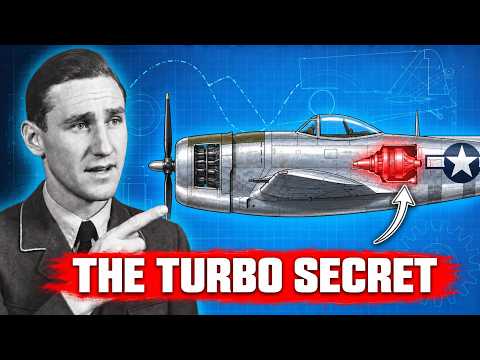
At 30,000 feet, the air is thin. Piston engines begin to choke there because not enough oxygen reaches the cylinders. A fighter that looks brilliant at 10,000 feet can look half-dead at 30,000. So Republic built the P-47 around a giant radial engine, the Pratt & Whitney R-2800, generating about 2,000 horsepower, then added a turbosupercharger in the rear of the fuselage. Exhaust gas spun a turbine that pumped air back into the engine through ducts running along much of the aircraft. That is a major reason the fuselage is so thick. The plane was designed around a breathing machine. Then they gave it eight .50-caliber machine guns. One second’s burst threw a storm of heavy bullets at anything in front of it.
Every one of those decisions had a price. All that weight meant the P-47 did not climb like a 109. And at low altitudes, it did not want to maneuver with one either. Put an average Thunderbolt pilot in a slow, low turning fight against an experienced Messerschmitt pilot, and that is exactly the fight the German wanted. It is the kind of fight Rall had spent years winning. But weight does something else. Point a heavy object at the ground and it accelerates like a falling anvil. In a dive, the Thunderbolt gained speed faster than a 109 and kept it. And the 109 had a hidden weakness here. As speed rose, its controls grew heavy. So turning or pulling out of a dive became a physical fight with the stick. Light controls at normal speed, heavy controls exactly when you need to escape quickly. One fighter built around agility, the other built around power, altitude, and momentum. As one account describes this delicate fight, no Bf 109 could catch a P-47 in a dive.
But the plane was only half the story. The other half was the man who decided how to fly it. And here is the strangest coincidence in this entire story. In the autumn of 1941, while Rall was fighting on the Eastern Front, an American officer named Hubert Zemke was also in the Soviet Union. America had not yet entered the war. Zemke was sent to teach Soviet pilots how to fly American-built P-40 fighters arriving through Lend-Lease. He was in Russia the same autumn Rall broke his back there. Zemke had worked on tests of the new P-47 himself. In September 1942, he took command of the 56th Fighter Group, the first group to fly the Thunderbolt, and took it to England. His pilots described him as strict but fair, a man who stuck to the rules. One of them, Robert Rankin, remembered that Zemke kept a photo of every pilot on his office wall and knew each one by name.
This is what Zemke understood about the Jug. Do not get into a turning fight with a Messerschmitt. Gain altitude, dive at the enemy, fire, and use the speed from that dive to climb back out of reach. Dive, fire, reset. Use the plane’s weight as a weapon instead of apologizing for it. By August 1943, the 56th had become the leading air-superiority group in Eighth Fighter Command. Under Zemke, the group would shoot down more than 500 German aircraft. People began calling it “Zemke’s Wolfpack.”
So the Jug’s reputation as a clumsy plane was only partly true. Comparing turning rates, the P-47 looked like a big, slow target, and if dragged down into a turning fight, it could be. But that was not the fight the 56th trained to accept. At its own altitude, attacking from above, the Thunderbolt’s supposed weaknesses became strengths. Weight was speed. Size was engine. Bulk was what allowed it to absorb damage and keep flying. And Zemke was not finished. Until 1944, American fighters were tied closely to the bombers. Stay with the formation, drive off the attackers. That sounds logical, but it gave the Germans the chance to choose the time and place of every battle. Zemke’s idea was to go hunting. Fighters would gather at a prominent landmark ahead of the bombers’ path, then split into squadrons and spread across a 180-degree arc, searching for German formations before they reached the bombers. This tactic became known as the “Zemke Fan,” and the Eighth Air Force later adopted a modified version of it. But notice the hidden cost. Spreading the group into small squadrons meant those squadrons were miles apart. A flight of four planes could suddenly find itself alone against an entire German formation. The only thing keeping the group together was the radio.
The first real test of the Zemke Fan came on May 12, 1944, and it was set to collide with Günter Rall. That date mattered for a reason far bigger than just pilots. That morning, Mission 353 of the Eighth Air Force sent out 886 bombers and 735 fighters. Their targets were synthetic fuel plants: Leuna near Merseburg, Böhlen, Zeitz, Lützkendorf, and Brüx. Germany had almost no oil of its own. It depended on imports, mostly from Romania, and on plants that turned coal into fuel. Every tank, every truck, every fighter in the Luftwaffe depended on those plants. May 12 was the opening blow of a sustained campaign against them. Albert Speer, Hitler’s armaments minister, later claimed in his memoirs that the technological war was decided that day.
So the Luftwaffe threw everything it had. About 470 German aircraft took off to meet the raid. Rall’s group was among those launched that morning. He met 25 Messerschmitts from Hohsum and headed southwest toward the bombers’ path. German accounts describe them dropping from about 35,000 feet to about 26,000, which meant Rall had the one thing every fighter pilot wants at the start of a battle: altitude.
Meanwhile, ahead of the bombers, Zemke was flying his new Fan tactic. His flight had started with four Thunderbolts, but one aborted and turned back. So when the German formation appeared, Zemke had only three planes—three P-47s beneath a group of Messerschmitts led by a man with 273 confirmed victories. Zemke did what the book says. He ordered his tiny formation into a defensive circle, what pilots call a Lufbery. Each plane follows the one ahead in a loop, so that anyone diving behind one Thunderbolt finds the next plane turning in behind his tail. This tactic works against the average pilot. But think about how a Lufbery looks to Günter Rall. Every plane in that circle is turning constantly. Every one of them crosses the firing line at an angle. It is a ring of deflection shots. It is the very skill he had spent years perfecting on the Eastern Front.
Rall dived and shot down one of Zemke’s wingmen. Then he turned and did it again. Within moments, the commander of the most successful American fighter group in Europe found himself alone, surrounded by German fighters. On the back of one of his gun-camera photos, Zemke later admitted it in his own handwriting. He had lost two of his wingmen. Now Zemke did what his plane was built for. He rolled, pushed the speed to the limit, and pointed the Thunderbolt almost vertically into a fast, spiraling dive. Some accounts suggest Rall chased him. Either way, the Jug pulled away from the Messerschmitt like a heavy box falling from a height.
So in the first minutes, the old hunter had done everything right. And here, precisely, the story changes, because his victory had just created his problem. First, he was alone too. His wingman had withdrawn, reportedly because of an engine problem. The man who was supposed to guard his tail was gone. Second, Zemke was not really alone. He had a radio. Miles away, a pilot from the 61st Fighter Squadron named Robert Rankin—a trained musician who had spent months as a wingman and had barely fired a shot—was having the day of his life. He had already shot down German fighters when he heard his commander calling for help. According to Rankin’s memory, Zemke reported he was south of Koblenz, circling over what he described as the entire German air force. Rankin and his wingman turned toward the call. This is the hidden half of the Zemke Fan strategy. It scatters formations to search for the enemy, then the radio gathers them the moment one of them is in trouble. It does not create isolated formations; it creates a network.
Rall was alone and trying to withdraw. He performed a Split-S, rolling his plane inverted and diving down, a classic way to trade altitude for speed and escape a fight. Over Russia, against most opponents, that meant survival. But when he came out of the maneuver, he found himself surrounded by four P-47s from Zemke’s group. Now think about his options, because this situation sums up the whole nickname in a single moment. He cannot climb to escape because he has already spent his altitude. He cannot out-dive them because the dive is the one thing the Thunderbolt does better than anything else in the sky. The only thing left is to maneuver and turn at low altitude, hoping someone makes a mistake. And that is exactly what he tried to do, fighting close to the ground.
But four planes can do something one plane cannot. While Rall turns away from one, another has already aimed its guns, and each carries eight heavy machine guns. The bullets punched through his engine, his radiator, and his fuselage, and one hit his left hand—the hand that controls the throttle. The bullet tore the glove, the glove that is in the museum today, and took his thumb with it. The damage to the radiator was a death sentence. A liquid-cooled engine that loses its coolant does not last long. The Messerschmitt was coming apart, its windscreen icing over. So, with his left hand damaged, Rall reached with his right to clear the ice so he could see, and then he got out of the plane. He bailed out at low altitude. He landed in a field where local farmers found him, and after the raid ended, they called an ambulance for him. In the same battle in which Zemke survived, Rall did not.
So who shot him down? This is the part people like to simplify and beautify. The simple story is that Zemke turned and avenged his wingman, or that it was Rankin, because Rankin’s day became famous. He shot down five Messerschmitts in that battle, becoming the first P-47 pilot in the European theater to achieve “ace in a day.” One of those victories, according to his records, was when he saved his commander’s tail. He received the Distinguished Service Cross for it. But in his own oral history, Rankin stated clearly that he did not shoot down Günter Rall. Someone from his squadron did. That is as close as the records can get. No one can tell you with certainty which American fired the bullet that took his thumb. And frankly, that ambiguity is the real answer. Rall was not defeated by one famous rival in a duel. He was defeated by a group. Three Thunderbolts drew him in, a commander who could dive out of danger, a radio call that brought help from miles away, and four planes he could not outrun or outclimb. The squadron does not need a hero. It needs numbers, discipline, and a way to communicate.
Now step back and look at what May 12 cost both sides, because it was not a pure American victory either. The Eighth Air Force lost 46 bombers that day. Hundreds of American airmen were killed or captured. In the fighting around Zemke’s squadron, the Americans lost two Thunderbolts and two Mustangs against four Messerschmitts. For a few minutes, the old hunter showed how dangerous he still was. But the Germans could afford it far less. The 11th Group alone lost 11 Bf 109s that day. Across the Luftwaffe’s defenses, 28 German pilots were killed and 26 more wounded. Yet the bombers reached the fuel plants. Leuna was bombed again and again over the following months.
Here is the part that answers the headline. On the Eastern Front, Rall’s skill could decide a battle because it was often a struggle of individuals against individuals. But over Germany in 1944, he was thrown into a different kind of war. The Americans had more planes, more fuel, more pilots graduating from training, plus radios and tactics to mass them. An American squadron could lose two men and call in an entire wing. When the Luftwaffe lost a pilot like Rall, it could not replace him at all. That is why the numbers do not match between East and West. He had not forgotten how to fly. He had become a brilliant individual inside a system that was being crushed by a larger system.
What happened to him afterward is almost revealing of the facts. His thumb could not be saved. It became badly infected, and he did not leave the hospital until November 1944. He later said that long period away from service probably saved his life, and you can see why. The summer and autumn of 1944 were the season of the oil campaign and the invasion of France. Experienced German fighter leaders were being wiped out faster than they could be replaced. Perhaps the P-47s that hit him took him out of the battle before that season finished him. When he returned, he took command of the school that trained German fighter leaders. And here it gets strange. There was a unit that flew captured enemy aircraft to show German pilots what they were facing. Rall flew with it. Spitfire, Mustang, Lightning, Thunderbolt. He finally sat inside the machine that had beaten him. He was amazed by the quality and comfort of American fighters, and he always considered the Mustang the best of them all.
In February 1945, he took command of Jagdgeschwader 300. He flew the Me 262 jet but never saw combat in it. With fuel almost gone, his inexperienced pilots flew whenever he could find a little of it. He flew his last mission, number 621, at the end of April, then was captured by the Americans in Bavaria. He was shot down eight times, wounded three times, and was now a prisoner of the nation whose pilots had cost him his thumb.
And what about Zemke? He too did not finish the war in the air. In August 1944, he left the Wolfpack to take command of the 479th Fighter Group, the least experienced group in the Eighth Air Force. On October 30, 1944, while leading a mission over Germany, he flew into violent weather no one had predicted. The wing of his P-51 tore off. The weather did what Rall and the rest of the Luftwaffe could not. Zemke bailed out and was captured. He became the highest-ranking Allied officer at Stalag Luft I on the Baltic coast, responsible for thousands of Allied airmen. When the Soviet army finally arrived, the man who had once taught Soviet pilots to fly P-40s found himself dealing with the Soviets again. And so the two men, the hunter and the squadron leader, ended the war as prisoners.
For decades, Rall did not even know whose squadron he had faced. After the war, he worked as a salesman. Then West Germany built a new air force, and he joined it in 1956. He trained in the United States. He became the project officer for the F-104 Starfighter, overseeing the modifications that produced the German F-104G. From 1971 to 1974, he served as Inspector of the Air Force, chief of the new air force. Then he became Germany’s military representative to NATO, an alliance built around the country that had shot him down. Even that ended abruptly. In 1975, after a controversial visit to apartheid South Africa, his superiors said they had not known about it, and the defense minister forced him to retire.
Two years later, in 1977, Rall attended a reunion of American fighter pilots. He was still curious about the battle in which he lost his thumb, and he asked about it. That is when he learned who he had been fighting: Zemke’s Wolfpack. Instead of bitterness, a friendship grew. Rall became close to Hub Zemke and Bob Rankin, the man who had flown to rescue Zemke that day. In the years that followed, he traveled to the United States repeatedly, often speaking alongside American pilots who had once tried to kill him. In 1996, he took part in the “Gathering of Eagles” at the National Air and Space Museum. Günter Rall died on October 4, 2009, at the age of 91. Not bad for a man who was once told to forget flying. And the glove ended up at the Smithsonian.
So go back to that glove, because it means something different now. At first, it looked like the story of a famous fighter pilot who finally met a better enemy. It is not. Look at what Rall actually did that day. He attacked from high altitude. He used the deflection skill that had made him lethal for years. He shot down two of Zemke’s pilots and nearly hit Zemke himself. As an individual, he was still every bit as good as his reputation says. He could not escape because what was chasing him was not an individual. It was a plane built to win the moment he tried to dive away. It was a commander who built his tactics around that plane’s weight instead of its weaknesses. It was a radio call that turned three Thunderbolts into a full squadron. And behind all that was a nation that could lose two pilots and 46 bombers and come back the next day.
The torn thumb is not proof that a great hunter became careless. It is what happens when the best lone hunter of one war meets a pack from another. And the strangest part is how it ended. The pack that took his thumb in 1944 became, decades later, the circle of friends he crossed an ocean to see.
So here is the question for you: if a single ace like Rall could not survive against a system built on numbers, radios, and teamwork, does the age of the lone hero in war—or in anything else—ever truly end? Tell us what you think in the comments.
Report this article
Select a reason for reporting:






