The air in the bunker was thick with tension, a palpable force that seemed to press down on the three men seated around the map table. Outside, the Normandy sun beat down on the concrete walls, but inside, a cold war of wills was brewing. Adolf Hitler, his face pale with rage, slammed his fist onto the table, rattling the markers that represented the crumbling German front. “You have failed me!” he roared, his eyes boring into Field Marshal Erwin Rommel, the Desert Fox, who sat rigid, his jaw clenched.
It was June 16, 1944, ten days after the Allies had stormed the beaches of Normandy, and the Führer had summoned his two top commanders in the West—Rommel and Field Marshal Gerd von Rundstedt—to this bunker in Margival, near Soissons. The meeting was supposed to be a strategy session, but it quickly devolved into a bitter blame game. Hitler, furious at the stalemate, had traveled from his Alpine retreat to demand answers. “The Allies must be pushed back into the sea within 48 hours!” he had decreed, but that window had long passed, and the Germans were now locked in a battle of attrition they could not win.
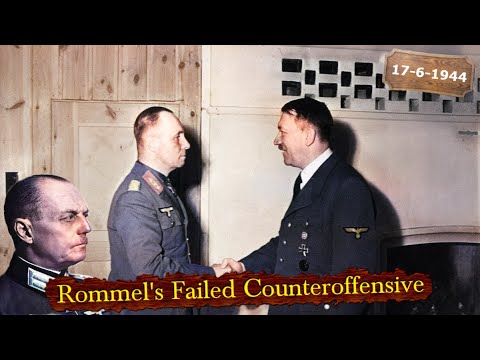
Rommel, his face weathered from years of desert warfare, exchanged a glance with Rundstedt, who sat stony-faced, avoiding direct confrontation. The older marshal had already ceded the floor to Rommel, knowing the Desert Fox’s bluntness might be their only hope—or their doom. Rommel took a deep breath. He had prepared for this. “Mein Führer,” he began, his voice steady but laced with urgency, “the situation is dire. We are outnumbered on land, in the air, and at sea. The enemy lands two to three divisions a week. Our counter-attacks are futile against their naval artillery and air superiority.” He paused, letting the words sink in. Hitler’s eyes narrowed, but Rommel pressed on, detailing the abysmal disparity in forces, the relentless Allied bombing that made movement impossible, and the futility of holding the coastal fortresses.
He proposed a radical plan: a fighting withdrawal behind the Seine and the Loire rivers, abandoning the coast to lure the Allies away from their naval cover, then massing for a powerful counter-attack. “We must regroup and strike where they least expect it,” Rommel argued, his voice rising. “But we need freedom of action! I cannot wait for permission from Berlin for every move while the enemy consolidates!” Hitler’s face flushed. “Abandon territory? Never!” he bellowed. “The V-1 rockets will crush London’s morale! We must hold every inch!” The debate raged, the air crackling with frustration.
Rommel, undeterred, shifted to the lack of Luftwaffe support. “The enemy rules the skies. My troops cannot move without being strafed. And the High Command brands my reports as exaggerated!” He demanded that officials visit the front to see the truth. Hitler, momentarily taken aback, promised new fighters would soon dominate the air. But Rommel countered, “Then trust us as we trust you. Stop dismissing our assessments!” The tension spiked, and just as Hitler was about to retort, a warning shattered the confrontation: Allied bombers were approaching. The meeting was abruptly halted, and the three men hurried to the bunker’s shelter.
In the cramped shelter, the formalities dissolved. Rommel, seizing the moment, spoke candidly. “The war is lost, mein Führer. We must negotiate a peace.” Hitler’s eyes blazed with fury. “Negotiation is impossible! The Allies demand unconditional surrender. We must fight with fanatical resistance!” He ordered Rommel to focus solely on stopping the invasion, not politics. The words hung in the air, a stark divide between reality and delusion. As the all-clear sounded, the meeting ended without resolution. Rommel and Rundstedt agreed to meet Hitler again in two days, but fate intervened: a rogue V-1 rocket forced Hitler’s departure, and the planned follow-up was postponed.
The confrontation at Margival marked the last time Hitler ventured outside Germany’s original borders. It was a meeting of minds so opposed that no common ground could be found. Rommel’s tactical brilliance clashed with Hitler’s stubborn fanaticism, setting the stage for the final, desperate days of the Normandy campaign. As Rommel left the bunker, he knew the die was cast. The Desert Fox had warned of the abyss, but the Führer refused to see. What would have happened if Rommel’s plan had been heeded? The question lingers, a haunting what-if of history.
Rommel stepped out of the bunker into the pale afternoon light, the drone of the departed Allied bombers still echoing in his ears. Rundstedt followed close behind, his face a mask of weary resignation. “He will not listen,” Rundstedt muttered, lighting a cigarette with trembling hands. “He has never listened, and he never will. We are commanded by a man who inhabits a different world.” Rommel said nothing, his eyes fixed on the horizon where, somewhere beyond the rolling French countryside, his men were dying for a cause he no longer believed in.
The two marshals walked in silence toward their staff cars, the gravel crunching beneath their boots. It was Rommel who finally broke the quiet. “Gerd, I have tried everything. I have shown him the maps, the figures, the reports. He sees only what he wishes to see.” Rundstedt exhaled a long plume of smoke. “And yet you will return to your headquarters and continue to fight. As will I. Because what else is there?” The question hung between them, unanswered and unanswerable.
Before they parted, Rommel grasped Rundstedt’s arm. “If we cannot change his mind, then we must consider what comes after. Germany cannot survive another year of this.” Rundstedt’s eyes flickered with something—fear, perhaps, or a warning. “Speak carefully, Erwin. Walls have ears, and the Gestapo has many.” Rommel released him and climbed into his car, the weight of unsaid words pressing down on him as the vehicle pulled away.
Back at his headquarters at La Roche-Guyon, Rommel pored over the situation maps late into the night. The situation was worse than he had admitted even to Hitler. The Americans had finally broken out of the Cotentin Peninsula and were driving hard toward Cherbourg. The city, which Hitler had ordered held at all costs, was doomed. Rommel had known it the moment the Führer had made his proclamation. “At all costs” was the phrase of a man who had never stood on a beachhead under naval bombardment.
His chief of staff, Hans Speidel, entered the room with a fresh dispatch. The news was grim: the 7th Corps had been shattered, and the British were massing for a push toward Caen. Rommel read the report twice, then set it down slowly. “Speidel, we are watching the end of an army. Not through cowardice or poor leadership, but through the arithmetic of material.” He tapped the map where the Allied supply lines converged. “They have more of everything. More men, more tanks, more fuel, more planes. And we have promises of wonder weapons that never arrive.”
Speidel, a man who would later play his own part in the conspiracy against Hitler, met Rommel’s gaze. “Herr Feldmarschall, there are those in Berlin who share your assessment. Who believe the time has come to act.” Rommel turned from the map, his expression unreadable. “Act how? You speak in riddles, Hans.” But he knew precisely what Speidel meant. The whispers had grown louder in recent weeks—men of conscience, men of rank, men who saw the abyss and refused to leap into it blindly.
Rommel walked to the window and stared out at the darkened countryside. Somewhere beyond those fields, the enemy was preparing for the next phase of the battle. And somewhere in Berlin, a madman was planning fresh atrocities and fresh demands. “I have given my life to this army,” Rommel said quietly, almost to himself. “I have served with honor. But honor and obedience are not the same thing. Not anymore.”
He turned back to Speidel, his voice firmer now. “Arrange a meeting with the gentlemen you speak of. But discreetly. If we are to do anything, we must do it before the front collapses entirely.” Speidel nodded and slipped out of the room, leaving Rommel alone with his maps and his thoughts. The Desert Fox had finally stopped looking for a way to win the war. Now he was looking for a way to end it.
The next morning brought word that Cherbourg’s garrison commander had signaled his intention to fight to the last man—a decision that would cost thousands of lives for a port the Allies would render useless within weeks. Rommel read the message and crumpled it in his fist. “Fanaticism,” he spat. “They call it fanaticism. I call it murder dressed in uniform.” He summoned his operations officer. “Begin planning the withdrawal of all mobile forces from the coastal sectors. If Berlin will not give me freedom of action, I will take it where I can.”
The officer hesitated. “Herr Feldmarschall, that is in direct contradiction to the Führer’s orders.” Rommel’s eyes hardened. “The Führer is not here. I am. And I will not sacrifice another division to his fantasies. Carry out the order.” The officer saluted and withdrew. Rommel watched him go, knowing that each such order was a step further down a road from which there might be no return.
By the end of the month, the confrontation at Margival had faded into memory, but its consequences rippled outward. Rundstedt was dismissed on July 2nd, accused of defeatism—a charge that stung the old marshal but surprised no one. Rommel, protected by his fame and the moral weight he carried with the German people, was spared the same fate. But the Gestapo files on him grew thicker by the day.
On July 17th, Rommel was driving back from the front when Allied fighters strafed his car. The Desert Fox was thrown from the vehicle, his skull fractured in three places. He would survive the attack, but he would never return to command. The conspiracy he had cautiously embraced would unfold without him—and fail. Within months, he would be dead, forced to take poison to protect his family from the retribution of a regime he had finally dared to oppose.
But that was still to come. For now, in the summer of 1944, the battle of Normandy raged on, and the question that Rommel had posed to Hitler in the bunker—whether to fight on or seek peace—remained unanswered. The Führer had chosen fanatical resistance. The Desert Fox had chosen to act. And the world waited to see which choice would prevail.
Rommel’s plan to fall back behind the Seine and Loire was never tested, but the logic was sound: trade space for time, lure the Allies from their naval guns, and mass for a decisive counter-strike. Whether it could have succeeded against overwhelming air power remains one of history’s great what-ifs.
As for the conspiracy, it flickered and died without him. The bomb plot of July 20th failed, and the Gestapo’s net closed around the Desert Fox. “Tell the Führer I will be dead within fifteen minutes,” he reportedly said before swallowing the cyanide capsule, a final act of obedience to save his family from the gallows.
The war ground on for another ten brutal months. Normandy became the graveyard of the Wehrmacht, and Hitler’s fanatical resistance consumed Germany in fire and ruin.
But the question Rommel posed in that bunker—fight on or seek peace—still echoes through history. What would you have chosen, if you stood in his boots that day? Share your thoughts below.
Report this article
Select a reason for reporting:






