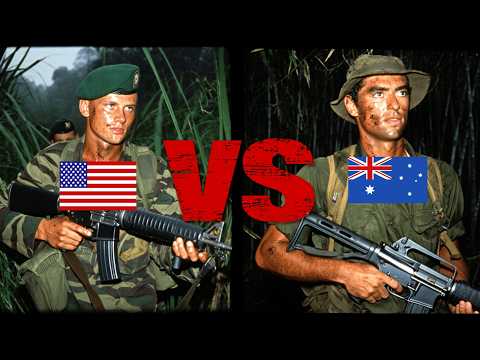
Two men in a creek bed, water to their shins. Neither one is moving. The first is American, Green Beret, 26 years old. He’s from a town in North Carolina with one traffic light and a Baptist church on every corner. He’s carrying a CAR-15, four magazines, a Browning pistol, and a Bowie knife he bought in Saigon for $3. He’s been in country for 5 months. He has killed 11 men. He does not know their names.
The second is Australian, Special Air Service Regiment, 28, from a cattle station outside Longreach, Queensland. He hasn’t spoken in 4 hours. He’s carrying a shortened L1A1 self-loading rifle, a Browning 9-mm and an Owen gun he liberated from an ARVN supply depot because he liked the balance. He’s been in country for 12 months. He does not talk about his kills.
The creek smells like rust and rock. Something moves upstream. A branch, maybe. The American raises his rifle. The Australian puts one finger on his wrist, holds it there, doesn’t look at him, doesn’t need to. The message is clear. Don’t.
30 seconds pass. A monitor lizard slides off a submerged log and disappears into brown water. The branch was the lizard’s tail. The American exhales. The Australian doesn’t. He stopped reacting to false signals about 9 months ago. His nervous system has been recalibrated by the jungle. He processes threat data the way a crocodile processes movement across the surface of a river, calmly, constantly, without urgency until urgency is required.
This is Phuoc Tuy Province, 1968. The wet season hasn’t broken yet, but you can taste it. The air is so thick with moisture, it feels like breathing through a warm cloth. Everything is green and everything is rotting and the distinction between the two is almost impossible to determine. Insects the size of rifle cartridges crawl across every surface. The canopy overhead is so dense that at noon the light on the jungle floor is the color of weak tea.
Somewhere north of this creek bed, a company of Viet Cong main force soldiers are moving supplies along a trail the Americans don’t know exists. The Australian knows it exists. He’s been watching it for 3 days.
This is the war most people think they understand. Vietnam. America’s war. One with the helicopters and the napalm and Creedence Clearwater Revival on the soundtrack. And that’s not wrong. The United States sent over 2.7 million personnel to Vietnam between 1955 and 1975. They fought the largest air campaign in human history. They dropped more bomb tonnage on Southeast Asia than was dropped by all sides in World War II combined. They lost over 58,000 killed. They changed the definition of warfare, of protest, of trauma, of what a country owes the people it sends to fight.
But there’s another war inside that war, a quieter one. Fought in smaller numbers with different methods on different terms. And if you measure that war not by scale but by efficiency, not by how many men you sent but by what each man accomplished, the answer to who was deadlier is not the answer most people expect.
The Australian SAS operated in Vietnam from 1966 to 1971. At peak strength, there were never more than around 150 SAS operators in country at any given time. They worked in five-man patrols. They carried everything on their backs. They stayed in the jungle for days, sometimes weeks, moving through terrain that would break a conventional infantry platoon in 48 hours. They did not call for extraction when things got hard. They did not call for fire support unless the alternative was annihilation. And they achieved something that remains one of the most remarkable kill efficiency records in modern special operations history.
But we’re getting ahead of the story. Stay in the creek bed. Stay with these two men because the next 11 hours will tell you more about the difference between American and Australian special operations in Vietnam than any lecture ever could.
The American’s name is Staff Sergeant Dean Kowalski. He’s been assigned as a liaison to the Australian SAS patrol as part of an intelligence sharing operation that neither command is particularly enthusiastic about. He arrived at the Australian base at Nui Dat four days ago and the first thing he noticed was the quiet. American bases in Vietnam are loud. Generators, music, helicopters cycling on pads, men shouting. The energy of a nation that fights wars the way it builds cities, big, fast, and with total confidence in its own machinery.
Nui Dat was different. The SAS compound was separated from the main task force area by a wire perimeter and a culture gap wider than the South China Sea. The tents were orderly. Gear was laid out with obsessive precision. Men moved with economy. Nobody was playing cards. Nobody was blasting the Stones from a transistor radio. The loudest sound was a wetstone on a blade.
Kowalski had done two tours with 5th Special Forces Group. He’d run operations with Montagnard tribesmen in the Central Highlands. He’d survived an ambush on the Cambodian border that killed four of his teammates. He was not a man who impressed easily, but something about the Australian compound put a wire in his spine. It felt like walking into a predator’s den. Everyone was calm. Everyone was watching.
He met the patrol commander on the afternoon of his second day, Sergeant David Hadley, 28, lean in a way that suggested the jungle had boiled every unnecessary ounce of his frame and kept only what was useful. Skin the color of tanned leather, eyes that tracked movement with a mechanical precision that Kowalski recognized because he’d seen it in exactly three other men in his career, and two of them were dead. Hadley shook his hand, one firm pump, no smile, no small talk. “We leave at 0400 day after tomorrow. You carry what we carry. You eat what we eat. You walk where I walk. You do not fire unless I fire first. Clear?”
Kowalski nodded. Hadley studied him for another second, then turned and walked away. That was the entire briefing.
The patrol crosses the wire at 0400, and Kowalski walks third in the file, placing his boots where Brennan placed his. He counts the steps. He counts the stops. He counts the times the jungle goes silent and every man becomes stone.
By the second night he has stopped counting. He has learned to sleep with his eyes open, to read the insect chorus like a radio signal, to trust the hand that touches his forearm in the dark.
At the extraction point Hadley looks at him once, a flat appraisal that lasts two seconds. “You’ll do,” he says. It is the longest sentence Kowalski hears from him all week.
He writes his report three weeks later. Five pages, classified for thirty years. One line survives the redactions: The Australians have solved the jungle.
Was the deadliest soldier in Vietnam the one with the most firepower, or the one you never saw?
Report this article
Select a reason for reporting:






