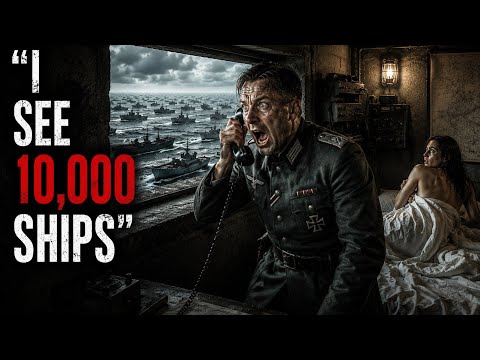
At 5:20 on the morning of June 6, 1944, a 32-year-old German major pressed naval binoculars to his face and watched the horizon move. Not one ship. Not a dozen. The entire line where sea met sky was solid with gray steel, stretching from edge to edge of his vision. His first coherent thought was not about his guns or his men. It was simpler and worse: Germany had lost. And he was watching the proof of it arrive at seven knots.
His name was Werner Pluskat. For about ninety seconds that morning, he was probably the only German officer in France who understood exactly what was about to happen. This is the story of that morning from his side of the water — a story about waiting, which is most of what war actually is.
He came from Mecklenburg, from the kind of respectable, unremarkable background that produced tens of thousands of German officers in that generation. He joined the army in the 1930s and went into the artillery — a thinking man’s branch. Artillery officers did mathematics. They calculated air density and powder temperature and barrel wear. Their job was to put a shell on a spot they usually could not see, using numbers passed to them by someone who could.
He went east in 1941 with everyone else. The Russian campaign taught the German artillery lessons it never forgot — mostly about scale. In the east you learned there was always more enemy than you had shells. You learned to ration fire. You learned what happened to a battery still setting up when the counterbattery fire arrived. If you were lucky, you learned all this and lived. And eventually you were pulled out and sent somewhere quieter to help rebuild a division that had been chewed to pieces.
That is how Pluskat ended up in Normandy. The 352nd Infantry Division was assembled in late 1943 out of the wreckage of units destroyed in Russia, padded out with teenagers, older men, cooks and drivers combed out of rear-area jobs and handed rifles. Around that skeleton of Eastern veterans, the Germans built a new division and sent it to France to train, to fatten up, and to hold a piece of coast.
Pluskat got the first battalion of the division’s artillery regiment. Four batteries. Around twenty guns, mostly 105-mm field howitzers, dug in behind the coast and connected by buried telephone cable to observation posts on the cliffs. On paper, his guns covered roughly twenty miles of shoreline. In practice, everything he had could be brought down on one particular crescent of sand between the villages of Vierville and Colleville — a beach the Germans thought of as an obvious place to land, and that the Americans in their planning documents had started calling Omaha.
He set up his main observation post near Sainte-Honorine-des-Pertes on the high ground east of the beach. If you have ever stood on those bluffs, you know why he chose it. The land there does not slope down to the sea. It stops. There is a drop of 150 feet or so, then sand, then water. From the top, you can see for miles in both directions. Whoever held that ground held the beach. That was the entire idea.
By 1944, the Atlantic Wall had been under construction for nearly two years and had swallowed something like seventeen million cubic meters of concrete. Propaganda newsreels showed it as an unbroken chain of steel and gray fortress running from the Arctic Circle to the Spanish border. Soldiers who actually lived in it had a different view. Along the narrow part of the Channel around Calais, it was real and frightening. Elsewhere, it thinned out into strong points with gaps between them, and behind the gaps, very little.
Then Rommel arrived.
In late 1943, Hitler sent Erwin Rommel to inspect the coastal defenses of Northwest Europe, and Rommel took one look and was appalled. He had spent two years in North Africa being bombed by aircraft he could not stop, and he had come to a conclusion that put him at odds with almost every other senior German commander in France.
Rommel believed there would be no mobile battle. He believed that if the Allies got ashore and stayed ashore for even a few days, Allied air power would make it impossible to move German reserves anywhere useful, and the war in the west would be finished. Therefore, everything had to be forward. Everything had to be on the beach. The invasion had to be destroyed in the water and on the sand in the first hours, or it would not be destroyed at all.
Von Rundstedt, the old field marshal in overall command in the west, thought this was nonsense and said so. His view was the classical one: let them land, find out where the main effort is, hold the armor back, then hit them with a concentrated counterstroke and drive them into the sea. Hitler, being Hitler, split the difference in the worst possible way. Rommel got to fortify the coast. Von Rundstedt got to keep some reserves back. And control of the panzer divisions was divided so thoroughly that on the day it mattered, nobody could move the tanks without permission from a man who was asleep and whom nobody dared wake.
For the soldiers on the coast, Rommel’s arrival meant work — endless, backbreaking work. Through the winter and spring of 1944, they poured concrete, laid wire, and buried mines by the million. They planted the beaches with obstacles designed to rip the bottom out of landing craft at high tide: angled stakes with mines lashed to the tips, steel hedgehogs, concrete tetrahedra, welded ramps. They flooded low-lying fields inland to drown paratroopers. They staked open pasture with poles to wreck gliders, and the soldiers nicknamed those poles Rommel’s asparagus, because soldiers name everything.
Pluskat’s men worked on the gun positions. They cut the pits deeper, roofed them, camouflaged them, ran and re-ran the telephone lines that were the nervous system of the whole arrangement. Everything the artillery could do depended on those wires. A gun that cannot be told where to shoot is scrap metal with a crew standing around it.
And around them, quietly, the Allies were taking the wall apart from the air. Not the bunkers — the bunkers were nearly impossible to hit. Bridges, railway yards, marshalling points, and above all, radar. In the weeks before June, the coastal radar network was systematically flattened, and by the first week of June the German early warning picture along that coast was a series of holes with a few blind stations in between.
The men lived a strange life. Half of it was hard labor, and the other half was boredom of a quality that has to be experienced to be understood. They were young, most of them, or too old, and a surprising number were not German at all. The static divisions along that coast were stiffened with Ost battalions — men from the Soviet Union who had been captured and had chosen a German uniform over starving in a prison camp. Their enthusiasm for dying on a French beach for the Reich was, understandably, limited.
They ate badly. They drank the local cider. They got to know the villages. They watched the sea. And every few weeks the alarm went off and everyone ran to their positions and nothing happened.
That is the part people forget. By the spring of 1944, the invasion had been announced roughly a hundred times. Every rumor, every unusual radio pattern, every stretch of good weather produced a warning, and the warnings produced alerts, and the alerts produced nothing at all. There is a specific psychological effect this creates in an army, and it is not vigilance. It is fatigue. Somewhere in the back of the mind of every man on that coast was a small voice that said, It is another false alarm. It is always another false alarm.
And then the weather turned, and the men who read the sky for a living made a reasonable judgment. No amphibious operation could sail into that chop. They gave it days. They were reasonable. They were also wrong.
The Allies had the North Atlantic — stations in Greenland, ships at sea, patrols flying west — and could see the gap coming. The Germans, stripped of their weather ships and Atlantic stations, could not. A Scottish meteorologist named James Stagg told Eisenhower there would be a window on the 6th. The Allies saw it. The Germans did not.
So Rommel drove home to Germany for his wife’s birthday, shoes bought in Paris on the seat beside him. Senior officers were summoned to a map exercise in Rennes whose subject, with a bleakness you could not put in fiction, was an Allied airborne landing in Normandy. Naval patrols were canceled. Leave was granted. The commander responsible for defeating the invasion on the beaches was, at the moment it hit the beaches, several hundred miles away buying time with his family.
Only one organization stayed sharp, and its warning went nowhere. German intelligence had spent months listening to the BBC read nonsense lines to the French Resistance — a pair drawn from Verlaine they believed would signal the invasion. The first line went out at the start of June. The second went out on the evening of the 5th. Fifteenth Army, up around Calais, went to full alert. Seventh Army, which held Normandy, did not. The intelligence was real. It reached the wrong desks, or the right desks at the wrong moment, and the alert stopped at a boundary line on a map.
So the coast slept the way soldiers sleep on a bad night, half in and half out, listening to the wind.
Just after midnight, the sound started. At first it was nothing much — a drone off to the northeast, the sort of noise men had learned to ignore because Allied bombers crossed that coast most nights on their way to Germany. Then it did not go away. Then it thickened. Anti-aircraft batteries opened up, searchlights began working, and the noise kept coming until it was no longer a sound in the sky but a pressure in the ground, a rolling mechanical grinding of hundreds and hundreds of engines.
Then aircraft came in low over the Cotentin and over the Orne, and men fell out of them.
The airborne landings that night were, in strict military terms, a mess. Cloud and flak scattered the transport formations. Pathfinders landed off target. Paratroopers came down across a huge area — in flooded fields, in orchards, in villages, in trees, sometimes straight into the middle of German positions. Whole sticks landed miles from where they should have been. Men spent the night wandering French hedgerows, clicking toy crickets at shadows and hoping the shadows clicked back.
And that chaos, entirely by accident, did something no plan could have done. It made the German picture unreadable. Reports flooded in from everywhere at once. Paratroopers here, paratroopers there, paratroopers twenty miles inland, paratroopers in places where no sane commander would drop them. Some of the reports were of real soldiers. Some were of dummies — rubber parachutists dropped in decoy operations, rigged with small charges that sounded like a firefight, pulling German troops out into the dark to hunt an enemy that did not exist. Somewhere in that noise the real drop zones were hidden, and no one at any German headquarters could yet say what was happening.
Was it a raid? A supply drop to the Resistance on an enormous scale? A diversion to pull reserves away from the real landing, which everyone knew would come at Calais?
That last question mattered, and the Germans were not stupid for asking it. For over a year the Allies had been running one of the most elaborate deceptions in the history of warfare: an entirely fictional army group in southeast England, complete with invented divisions, fake radio traffic, dummy landing craft, and George Patton at the top of it — a commander the Germans took extremely seriously. Everything German intelligence believed about the coming invasion pointed at the Pas de Calais. The shortest crossing. The shortest route to the Ruhr. It made sense. It had been made to make sense.
So when the reports came in from Normandy, the trained instinct of the German High Command was not to shout invasion. It was to say, Careful. This is the feint.
Around one in the morning, Pluskat’s telephone rang. He was at his battalion headquarters at Etretat, a few miles inland, and by his own account the voice on the other end was his regimental commander, telling him parachute troops were landing and to get his batteries to a state of readiness. He asked, reasonably enough, whether this was the real thing. The answer he got was the answer everybody got that night. Nobody knew.
He gave the orders. Crews to the guns. Then he did something that tells you what he actually believed: he stayed put and waited for someone to tell him more.
A second call came, sharper this time. Get to your observation post on the coast.
He went out into the dark, took his car, and drove for the cliff. He brought his dog with him — a German Shepherd called Harris, who went most places with him. That detail has always stuck with me more than any other in this story. A man drives to the edge of a continent in the middle of the night to find out whether the world is ending, and he takes his dog, because it is what he does every day, and because there is nothing else to do with your hands.
The road down to the coast was blacked out. He could hear flak somewhere behind him. When he reached the bunker he came in through the entrance at the back, down into the concrete, and joined two other men who would spend the next few hours with him: a captain from one of his batteries, and a young lieutenant. Three of them in a box of reinforced concrete cut into a cliff, with a slit facing the sea.
And then, nothing.
This is the part of the night that never makes it into the films, and it is the part I find hardest to shake. For close to four hours, Werner Pluskat stood at that slit and looked at empty water. He had a telephone and a periscope and a pair of high-powered naval binoculars, and he used all three over and over. He scanned left. He scanned right. He listened to the aircraft noise moving inland and the anti-aircraft fire chasing it. Every so often he called back to regiment and asked if there was anything, and every so often regiment called him and asked the same question in reverse, and the answer was always the same.
Nothing on the water. Nothing at all.
Think about what that does to a man who is fairly sure something is coming. Because the sea was not empty. Somewhere out there beyond his horizon in the dark, nearly seven thousand vessels were forming up into lanes swept through the German minefields. Minesweepers had been working within sight of that coast for hours. Transports were lying to twelve miles out, and men were already going down the scramble nets into landing craft pitching in a heavy swell, being sick, waiting. He could not see any of it. The night and the distance held it, and then the sea mist held it, and the whole time it was getting closer.
Around four o’clock, the airborne noise died away. There was a lull. Some of the men on that coast decided the emergency was over.
Then the sky started to lighten, and the coast of Normandy stopped being dark, and Werner Pluskat put his binoculars up one more time.
What he described afterwards is one of the few genuinely unforgettable images to come out of that war, and it comes from the losing side. At first he thought the mist was playing tricks. There were shapes at the edge of the gray — indistinct, too many of them, arranged too regularly to be weather. He adjusted the focus. The shapes hardened. Ships. And having found one, his eye found the next, and the next, and then the horizon simply filled in, the way a photograph develops. He swung the binoculars slowly to the left. Ships. He kept going. More ships. He swung right, all the way to the limit of what the slit would let him see. Ships. There was no end to them in either direction.
The bay in front of him — the same water he had stared at every morning since March — had been occupied overnight by a fleet so large it did not look like a fleet. It looked like a change in the geography.
He is supposed to have said to the men in the bunker with him that this was it. That it had come. Then he picked up the telephone and reported the largest naval force ever assembled, and nobody believed him.
This is the detail that always gets me, because it is so utterly human. He called his regimental headquarters. He said there were thousands of ships off the coast. The officer on the other end — sitting inland in a building where the windows showed nothing but fields — essentially told him to calm down and count again. The Allies did not have that many ships. Nobody had that many ships.
There is a version of the exchange in which someone at the other end asks him, with heavy sarcasm, which way this vast armada is heading. His answer, in every version, is the same, and it is one of the great flatlines of the war.
“Straight at me.”
He put the phone down. And for a few more minutes, the strangest thing of all happened. Nothing. The ships sat there. The light came up. He could see them properly now — individual hulls, the big ones lying broadside on. He could see landing craft moving between them like insects. And there was no sound at all except the sea, because the whole enormous machine out there was still winding up.
Then aircraft came over the coast in numbers he had never seen in daylight, and bombs started coming down inland, and a few moments after that the battleships opened fire.
There is no useful way to describe naval gunfire to someone who has not stood near it. So here is the arithmetic instead. The heavy ships supporting that stretch of coast carried guns of twelve, fourteen, and fifteen inches. A single shell from the largest of them weighs about as much as a small car. It arrives at supersonic speed. The shell gets there before the noise does, and men who survived it always describe the same sequence in the wrong order. First the world blows up. Then you hear it coming.
Pluskat was looking straight down the barrels when the first salvos left the ships. He saw the flashes ripple along the line of the fleet. He had perhaps thirty seconds of knowing exactly what was about to happen to him and no way at all to stop it.
The bluff came apart. The bombardment walked along the high ground, ripping the top off the cliff, throwing up earth, filling the air with pulverized chalk and concrete dust. Inside the observation post the shock was transmitted through the rock itself. Dust came down from the roof. The lights went. Men were knocked off their feet. Something struck near enough to crack the structure and destroy the optics he had been using two minutes earlier.
He got out. He came up out of the post into an open landscape being systematically demolished, ran for his car, and drove inland along a road that was being shelled and strafed, and he made it — which, given the circumstances, is astonishing. When he reached his headquarters he found the buildings hit and men digging.
That is the end of Werner Pluskat’s personal view of D-Day. He saw the fleet, he reported it, he was blown out of his hole, and after that he was just another officer trying to run a battalion in a battle that had already gone past him. But his guns were still in it. And what happened on the beach below over the next four hours is the reason his division is remembered.
Because here is the thing about Omaha. On four of the five beaches that morning, the German defense broke fast. On Omaha, it did not.
Several accidents came together. The first was intelligence. Allied planners believed that particular beach was held by a static division of second-rate troops — older men, foreigners, a thin crust with nothing behind it. What they did not know, or knew too late and could not get into the plan, was that the 352nd had moved forward. A field division. Eastern Front veterans in the cadre. Real artillery, dug in, registered, with observers who had been pre-plotting every square meter of that sand for months.
The second was the ground. Omaha is not a flat beach. It is a shallow crescent about six miles long, backed almost the whole way by bluffs 150 feet high. There are only five places where the land opens up enough to get a vehicle off the beach — five valleys the Americans called draws — and the Germans had built a strong point on each side of every one of them. Concrete casemates with their embrasures facing sideways along the beach rather than out to sea, so the guns inside were hidden from the ships and could rake the sand lengthwise. Mortar pits with the ranges already worked out. Machine guns sighted to cross their fire. Wire, mines, and an anti-tank ditch. If you had asked the German staff to design a killing ground and given them two years and unlimited concrete, they would have built Omaha.
The third accident was the weather. That break in the storm was real, but it was not calm. The swell that morning ran four to six feet, and it wrecked the American plan piece by piece before a single soldier reached the sand.
The amphibious tanks went first. Two battalions of Shermans had been fitted with canvas screens and propellers so they could swim ashore and be waiting when the infantry arrived. In front of one sector they were launched three miles out into that sea. The screens collapsed. Twenty-seven of thirty-two went to the bottom, some of them with their crews. The infantry that landed in front of the eastern half of Omaha arrived with almost no armor at all.
Then the bombing missed. Heavy bombers had been sent to smash the beach defenses, but they were bombing through cloud and delayed their release by a few seconds to avoid hitting the landing craft. A few seconds at that altitude is a mile on the ground. Thirteen thousand bombs went into the fields behind the bluffs and cratered a lot of French pasture. The strong points were untouched.
Then the current pushed the landing craft east. Units came ashore hundreds of yards from where they were supposed to be, in front of the wrong strong points, mixed together, without their engineers, without their demolition teams, without their commanders. And the naval bombardment stopped because the boats were coming in.
So at half past six in the morning, the ramps went down in front of Omaha Beach, and the men who walked off them were walking into a defensive system that was essentially intact, held by troops who were better than anyone had told them, across three hundred yards of open sand at low tide, with no armor and no cover and no smoke.
The Germans in the bunkers waited until the ramps dropped. That was the whole trick. Machine guns registered on the waterline. Mortars registered on the shingle. Artillery observers on the bluffs with telephones in their hands calling correction after correction onto guns four miles inland.
The first wave in some sectors ceased to exist as a fighting formation within ten minutes. There were companies that lost most of their officers before anyone got off the sand. Men drowned in the surf under the weight of their equipment. Men crawled forward using the beach obstacles for cover, which meant sheltering behind steel with mines wired to it. The tide was coming in at a foot every eight minutes, so the wounded who could not move had to be dragged or they went under. And a lot of them could not be dragged.
One position on those bluffs shows you what the beach looked like from the other end of the guns. It was a strong point above the eastern end of Omaha, a cluster of trenches and concrete overlooking the exit road. Inside it that morning were two men whose day is worth holding on to for a second.
One was a young lieutenant, a forward observer from Pluskat’s own regiment, sitting with a telephone and a set of pre-plotted reference points, calling the fire of guns he could not see onto boats and men he could. This is what artillery actually is. Not the gunners sweating at the breech four miles back, but one man with a phone and a view, turning a landscape into coordinates.
The other was his radio operator, a soldier of twenty-one behind a machine gun, who spent that morning firing down a fixed line into the surf, and who wrote about it decades later in a book that made him briefly notorious and permanently unpopular with a lot of people. Historians argue about his numbers. They argue about how much of the killing at that end of the beach was his and how much belonged to the mortars and the guns and the other positions. What nobody argues about is the shape of it. Two men and a telephone and a machine gun on high ground above a beach with no cover on it, for something like three hours. The lieutenant was killed that day somewhere in the collapse of the position. The gunner walked away and spent the rest of his life carrying it.
From the German side, through the vision slits, it looked like a victory. The reports going back up the chain from the strong points that morning were confident. The landing was pinned. The beach was covered in destroyed equipment and immobile men. The 352nd’s commander, a competent and unsentimental officer named Dietrich Kraiss, was told before nine o’clock that the assault in his sector had been stopped in the water, and he believed it. He began releasing his reserves toward other threats.
That report was one of the more consequential mistakes of the day, and it was not really anyone’s fault. From a hole in a cliff, an army lying still on a beach looks like an army that has been defeated. It is very hard to tell the difference between men who have stopped because they are beaten and men who have stopped because they are working out what to do next.
They were working out what to do next.
What happened on Omaha over the following two hours was not a plan. The plan was gone. It was small groups of men — junior officers, sergeants, rangers, individual privates — deciding independently and almost simultaneously that staying on the beach was death and that the only direction that made sense was up. An assistant division commander walked the shingle under fire telling men that the ones staying there were going to die there. A regimental colonel said much the same thing in blunter words. They cut wire with tubes of explosive. They climbed the bluffs between the strong points where the Germans had less coverage. And they came at the concrete from behind and from the flanks with grenades and satchel charges and flamethrowers.
And out at sea, a group of destroyer captains ran out of patience. Watching the beach through their glasses and unable to raise the shore fire control parties, several American and British destroyers turned in and closed the coast until they were in water barely deeper than their own draft, some of them scraping bottom. From a few hundred yards out they put five-inch guns directly onto the embrasures of the strong points over open sights, firing at targets they could see with their own eyes. It was not in anybody’s plan. It may have been the single most useful thing that happened that morning.
The German defense began to come apart from the inside, and it came apart for the most boring reason in war. Ammunition. They had been firing at maximum rate since dawn. Resupply had to come forward along roads that Allied aircraft owned completely in daylight, and it did not come. Telephone cable was cut in a hundred places by the naval shelling, which meant observers could no longer talk to the guns. The strong points that were still holding were now isolated, unable to see the whole beach, running low, and being attacked from a direction their guns did not face.
By early afternoon, Kraiss knew the truth. He sent word up to corps headquarters that his division could not hold, that his reserves were used up, and that he needed fresh troops immediately. There were none. The armor that might have made a difference was still waiting on a decision from a headquarters that had been arguing about it since dawn. And by the time the panzers moved, Allied fighter-bombers were waiting for them on every road in Normandy.
The 352nd Infantry Division fought hard enough that day to be remembered, and it was destroyed doing it. It took around twelve hundred casualties in the first day. Within weeks of continuous fighting in the hedgerows, the division had effectively ceased to exist as a formation. Kraiss himself was mortally wounded in August at Saint-Lô.
By nightfall on the 6th, the Americans on Omaha had a foothold. A shallow one, a mile or two deep in places, held by exhausted men among their own dead, with none of the objectives on the first-day map taken. By any measure of the plan, it was a failure. It did not matter. They were ashore, and they were never going to be pushed off, and every hour after that the machine behind them poured more men and more vehicles and more supplies onto that sand than the entire German army in Normandy could be sent in a week.
Werner Pluskat survived all of it. He kept his battalion going through the fighting inland, and at some point in the collapse of that summer he was captured, and he came out of the war alive — which a great many of the men who had been on that coast with him did not.
And then, fifteen years later, he became famous.
In the late 1950s, an Irish-American journalist named Cornelius Ryan set out to write the story of the 6th of June from every angle, and he did something almost nobody had done. He interviewed the Germans. Hundreds of them. He advertised in newspapers, tracked down survivors, and sat in living rooms in a defeated country asking men what they had seen. When The Longest Day came out in 1959, it sold in enormous numbers, and among all the material Ryan gathered, one German scene stood out and stayed in people’s heads: the artillery major at the cliff, the binoculars, the horizon full of ships, the disbelieving voice on the telephone, and the flat reply about which way they were heading.
When the book was filmed in 1962, the scene went in more or less intact. And Pluskat’s astonished face became the way the world pictured the German experience of D-Day. Not a fanatic. Not a monster. A professional soldier looking at something enormous and understanding, before his own commanders did, that it was finished.
Which is where the trouble starts.
Because in the decades afterwards, as German historians and researchers went back over the 352nd Division and interviewed its surviving veterans, some of those veterans said flatly that the story was wrong. That Pluskat had not been at that observation post that morning at all. That other officers had manned it. That the account he gave Ryan had been improved, or borrowed, or placed on a cliff he was not standing on. The arguments get technical and they get bitter. There are disputes about which post he could have been at, about what could actually be seen from where, about times that do not quite line up, about who was where when the shooting started. There are researchers who consider the whole thing largely invented. And there are others who think the core of it is sound and the criticism is score-settling among old men who did not like each other.
I am not going to pretend to settle it here. And honestly, anyone who tells you it is settled is selling you something.
What I will say is this. Whether or not one particular major was standing at one particular slit at 05:20 that morning, some German was. Someone on that coast put a pair of binoculars up in the gray light and saw the sea fill with the industrial output of two continents. Someone made that phone call. Someone was told he was seeing things. That moment happened.
And the reason it lodged in the world’s memory through Pluskat’s version of it is that it captures something true about how that war ended: that it was not decided by a single heroic charge. It was decided long before, by shipyards and factories and convoys. And on the 6th of June 1944, the result of all that was simply delivered to the coast of France and made visible all at once to a man who had four hours of empty water to prepare himself and was not prepared at all.
He is supposed to have said, driving away from that cliff through the shellfire, that this was the end. He was right. It took another eleven months and it cost more lives after that morning than before it. But standing in the dust of his own observation post with the horizon still full of ships, he had already seen how it finished.
So here is the question I keep coming back to: if a single man can see the end of an empire through a pair of binoculars — and no one back at headquarters will believe him — what does that tell us about the stories we choose to remember, and the ones we quietly let go?
Report this article
Select a reason for reporting:






