In the early hours of August 6, 1945, a lone B-29 Superfortress named Enola Gay lifted off from the island of Tinian, carrying a weapon that would alter the course of human history. The world was still reeling from the brutal battles of World War II. Europe had been liberated, but the Pacific theater raged on. Japan, though crippled, refused to surrender. Allied leaders feared an invasion of the Japanese home islands would cost millions of lives. Then came a secret mission that promised to end the war in a single stroke.
Aboard the Enola Gay, twelve men prepared for a mission shrouded in secrecy. Their commander, Colonel Paul Tibbets, had handpicked each crew member. Among them were navigator Dutch Van Kirk, bombardier Tom Ferebee, and tail gunner Bob Caron. None knew the full magnitude of what they carried—a five-ton atomic bomb code-named Little Boy. As the plane droned toward Japan, the crew exchanged nervous glances. The fate of the world rested on their shoulders.
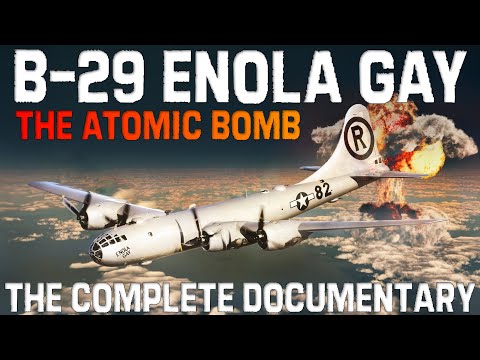
At 8:15 AM local time, the bomb bay doors opened. The Enola Gay shuddered as Little Boy fell away. Forty-three seconds later, a blinding flash lit the sky over Hiroshima. A mushroom cloud rose 50,000 feet into the air. The city below vanished under a boiling inferno. In that instant, tens of thousands of lives were extinguished. The crew stared in awe and horror. “My God, what have we done?” whispered one. But there was no time for reflection. Tibbets banked the plane sharply and raced away from the blast.
The shockwaves rattled the aircraft, but Enola Gay held together. As they turned back for one last look, the crew saw a scene of unimaginable destruction. The city was gone, replaced by a churning cauldron of fire and smoke. Tail gunner Bob Caron later described it as “a pot of boiling oil.” The mission was a success, but the human toll was staggering. Back on Tinian, the crew was hailed as heroes. Yet each man carried the weight of what they had witnessed.
Three days later, a second bomb fell on Nagasaki. Japan surrendered. World War II was over. The Enola Gay and its crew had changed the world forever, ushering in the atomic age. But the debate over the bomb’s morality would rage for decades. For the men who flew that fateful mission, the memory of Hiroshima never faded. They had followed orders, ended a war, and unleashed a power that would haunt humanity for generations.
The news of Hiroshima reached Washington within hours. President Truman, aboard the USS Augusta, received the coded message and declared it “the greatest thing in history.” Yet even as he spoke, the Japanese war council remained deadlocked. Three days later, Nagasaki vanished under a second mushroom cloud. On August 15, Emperor Hirohito’s voice crackled across the radio waves—Japan would surrender.
For the men of the 509th Composite Group, the war was finally over. But peace brought no easy answers. Back on Tinian, Paul Tibbets sat alone in his quarters, staring at the wall. He had trained for this mission for a year, had planned every detail, and had flown the plane himself. He felt no regret—only a strange, hollow calm. “I was eager to do it,” he later said. “I wanted to end the war.”
Dutch Van Kirk, the navigator, found himself haunted by a different memory. He kept replaying the moment the bomb fell—the bright flash, the silence on the radio, the long flight home. “We were at war,” he said decades later. “You do what you have to do. But you never forget.” Tom Ferebee, the bombardier who had pressed the release, rarely spoke of Hiroshima at all. When asked, he would simply say, “I did my job.”
Bob Caron, the tail gunner who had watched the fireball rise, became one of the most outspoken members of the crew. He carried a photograph of the mushroom cloud in his wallet for years. “People ask if I’m proud,” he said. “I’m not proud. I’m not ashamed. I’m just a man who was there.” The crew scattered after the war—some to civilian life, some to military careers. Tibbets became a brigadier general and never apologized for his role.
In Hiroshima, survivors—the hibakusha—began the slow, agonizing work of rebuilding. Thousands died in the weeks that followed from burns, radiation sickness, and infections. By the end of 1945, the death toll had climbed past 140,000. The city had been erased, but its people refused to vanish. They planted trees where buildings had stood and prayed for a world without nuclear weapons.
The Enola Gay itself became a relic of another age. For years it sat in a hangar, forgotten by most. Then, in 1995, the Smithsonian Institution announced plans to display the forward fuselage at the National Air and Space Museum. The exhibit was meant to mark the fiftieth anniversary of the war’s end. Instead, it ignited a firestorm of controversy that would split the nation once again.
Veterans and historians argued that the exhibit was too apologetic, while peace activists demanded that the human cost be front and center. The Smithsonian eventually scaled back its plans, displaying the Enola Gay with minimal context. “You can’t separate the plane from the bomb,” one curator lamented. The controversy revealed that Hiroshima was still an open wound in the American conscience.
Paul Tibbets, by then in his eighties, was asked to comment on the exhibit. He refused to apologize. “I was a soldier,” he said. “I was given a mission. I carried it out.” He died in 2007, still convinced that the bombing had saved lives—both American and Japanese. His mother’s name, Enola Gay, would forever be linked to the most destructive single weapon ever used in war.
In Hiroshima today, the Aioi Bridge still stands, rebuilt after the war. Nearby, the Genbaku Dome—one of the few structures left standing near the hypocenter—has been preserved as a memorial. Every August 6, a bell tolls at 8:15 AM. The city falls silent. Some pray for the dead. Others pray for peace. All remember.
The crew of the Enola Gay never reunited. They scattered across the country, carrying their memories in silence. Dutch Van Kirk lived to be 93, the last surviving member. In his final interview, he was asked if he would do it all again. He paused for a long moment. “Yes,” he said quietly. “It ended the war. It saved more lives than it took.” Then he added, almost to himself, “But I still see the flash.”
The atomic age was born over Hiroshima, and the world has never been the same. The Enola Gay sits in a museum now, a silent witness to a moment when humanity glimpsed its own power—and its own capacity for destruction. The debate over whether that power was used wisely will never fully end. But the men who flew that mission, and the people who survived the blast, share one thing: they know the cost of ending a war.
What do you think—was the bombing of Hiroshima justified, or should the world have found another way?
Report this article
Select a reason for reporting:






