The darkness was absolute, broken only by the soft splash of boots in the border stream. One by one, Australian infantrymen crossed into Thailand, their weapons held high above the water. On the far bank, they moved silently, following trails used by communist fighters since the war against the Japanese. Behind them lay the Malay states of Perlis and Kedah, where Australian battalions had rotated along the border for years. Ahead were camps, food caches, and men who had refused every surrender offer.
The war they were fighting had been declared over four years earlier. On July 31, 1960, the Malayan government announced the end of the Emergency after twelve years. Speeches were made in Kuala Lumpur, amnesty was offered to anyone still armed in the jungle, and a national day of thanksgiving was held. The insurgency had been reduced to a few hundred survivors on the Thai border, and Malaya wanted to repeal its emergency laws and end its war.
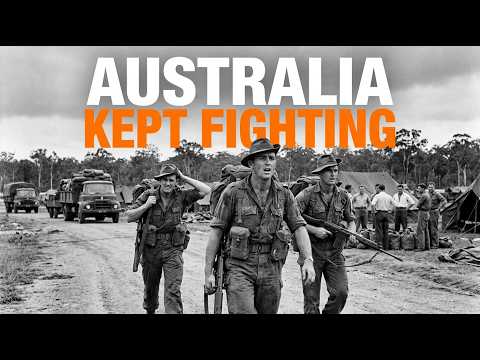
Yet Australian infantry continued to patrol the jungle for four more years. The 1st, 2nd, and 3rd Battalions of the Royal Australian Regiment rotated through the country until 1964, accompanied by artillery, engineers, and signals, continuing the same work they had done before the Emergency was declared. The Royal Australian Air Force kept flying strikes against the Malayan National Liberation Army until early 1966. Some units crossed into Thai territory, lived in the jungle for weeks, and returned with the same patrol reports they had been writing since 1955.
At home, all of it was recorded as peacetime service. Those records stood for thirty-five years. The men who patrolled the border jungle after the Emergency ended returned to a country that logged their service as ordinary peacetime duty, with all the benefits that implied. The record was corrected in 1995 when the operations were reclassified as warlike service. The youngest of them was nearing sixty by then.
But the hardest morning of the entire campaign had come much earlier, on a water pipeline in Perak on June 22, 1956. Five Australians were walking along the pipe, returning to their patrol base along the line that carried water from the Songai Pernam reservoir to the town of Songai Siput in the hills of Perak, northeast of Ipoh. Their battalion had been in the mainland for months and had seen hardly a single fighter.
Four hundred meters from the reservoir, a mine was buried under the track. The men who planted it were dug in above the line with Thompson and Sten guns, waiting for the patrol to reach it. The war had begun in 1948 when the Malayan Communist Party sent its fighters back into the jungle they had used against the Japanese occupation. They called themselves the Malayan National Liberation Army and attacked the rubber plantations and tin mines that funded the colony.
Britain ran the counter-insurgency under emergency regulations rather than declaring war. The choice of words came partly from London insurance firms whose policies covered losses during civil disturbances and excluded losses caused by war. The strange legal status of everything that followed began with that accounting decision. Australia sent its forces in 1955, seven years after the campaign began. The 2nd Battalion of the Royal Australian Regiment (2 RAR) arrived in September and October and settled on Penang Island off the west coast.
These troops came under British command within the 28th Commonwealth Brigade, sharing a battle structure with British battalions, Gurkha rifles, and Malay Regiment soldiers. Everything the Australians did in Malaya was subject to British command according to British operational plans in a war Britain had been fighting for nearly a decade before they arrived. The Air Force had been there five years longer.
Lincoln bombers of No. 1 Squadron and Dakota transports of No. 38 Squadron had deployed to Singapore in 1950, launching air strikes on the jungle and dropping supplies to units operating beyond the road. Bombing the jungle canopy from high altitude had little effect on the men living beneath it, and aircrews knew that better than the planners, though the sorties maintained pressure and kept the camps moving. By 1958, the Lincolns had left, and Australian air support remained at Butterworth on the Malayan mainland, continuing for years after the infantry returned.
By the time the infantry arrived, the course of the campaign had already been set. Half a million rural Chinese Malaysians had been moved from the jungle fringes into fenced settlements under the Briggs Plan, isolating the fighters from the villages that fed them. What remained of the insurgents depended on a supply network of couriers, sympathizers, and small farmers who passed rice and medicine into the trees at night.
Killing the fighters was nearly impossible. Starving them was a slow, tedious, but effective process. That was the task assigned to the infantry.
On January 1, 1956, the 2nd Battalion crossed from Penang to the mainland and began operations in Perak. The state was the heart of the insurgency, with limestone hills, farmland, and forests running to the main mountain range where the group had its best organization and deepest bases. The battalion was the first Australian unit to pass through the jungle training center at Canungra in Queensland since World War II, and the training they learned there was designed for this ground. Their task within the brigade was to keep the fighters away from food.
Weapons and engineers came with them. The 105th Field Battery of the Royal Australian Artillery arrived in Penang in October 1955 with eight 25-pounder guns, replaced later by the 100th and then the 101st Field Battery beginning in October 1959. The 4th Platoon of the Royal Australian Engineers arrived in late 1955 to build bridges and roads, and from July 1956 took on the task of clearing mines around the Butterworth air base. Two more platoons took over the task. On September 12, 1955, six nurses of the Royal Australian Army Nursing Corps landed at Penang, the first Australian women to serve in the campaign. They worked in the island’s military hospital, treating the sick and wounded from all units of the brigade, most suffering from fever rather than gunshot wounds. The Australian nurses remained in Malaya until 1963.
Operation Shark North began in late April 1956 in Perak. The plan was to cut off the food supply, to stop the flow of rice, canned fish, and medicine from the settlements, and force the fighters to move, surrender, or starve. The 2nd Battalion spent that operation on roads and at settlement gates instead of pushing deep into the jungle. A soldier’s day passed in searches, as workers left for the rubber fields in the morning carrying baskets, bicycles, trucks and all they held, and returned at dusk.
The worst task on the schedule was collecting the latrine buckets. Families leaving the settlement in the morning carried their waste with them, and rice, ammunition, and medical supplies could be moved inside. The Australians had to stir the contents of every bucket with a stick and look through it before it left the gate. They did this in tropical heat at a checkpoint, standing in front of the people whose buckets were under their control, hundreds of times a week. No one at Canungra had trained for that.
Everything else was ambush. A section would go out, position itself beside a road or supply trail, and stay there for days without moving, cooking, or even speaking softly. The monsoon rains came every afternoon, soaking equipment that never dried before the next rain. Leeches came out of boot openings, and had to be burned with a cigarette because pulling them left the head in the wound. The 2nd Battalion spent more than a month on the mainland before any soldier in the battalion could target a fighter. When that wait finally ended, it ended badly.
The equipment was designed for service in the country, not for military parades. Forward scouts carried the Owen gun, an Australian design with a top-mounted magazine, superior in its resistance to mud and water to any other weapon in the brigade. The rest of the section carried Lee-Enfields until the semi-automatic rifle arrived at the end of the decade. Even trackers from Sarawak worked with the Australian platoons, reading the signs of bent stems and footprints on ground that seemed virgin to a man from Wagga. The patrol moved slowly enough that covering 400 meters in an hour was considered good progress.
It was the morning of June 22. A platoon of one of the companies had established a patrol base near the Songai Pempam reservoir, and Corporal John Norman Allan took four men along the pipeline track. The pipe ran from the reservoir toward Songai Siput in a straight path through the scrub and secondary growth, the fastest route through that area in either direction. The fighters had discovered that long before the Australians, and had spent the morning positioning themselves on the bank overlooking it.
The mine exploded under the track when the patrol was 400 meters from the reservoir. Thompson and Sten guns opened fire from the high bank at close range, targeting five men spread along the exposed section of the pipeline, with no cover on either side. Corporal Allan was killed as he tried to cross the track to reach the bank. Private Geoffrey Clyde Fritz was hit, fell, and kept firing his Owen gun toward the ambush position until he died of his wounds. The two men had walked the same ground hours earlier in the opposite direction.
Two other patrols were close enough to hear the shooting and attacked from the flanks. One swung around the ambush positions and climbed to higher ground above them to fire, and Private Cedric Charles Ingra was killed while making that move. The fighters withdrew from the contact and retreated into the scrub, leaving two of their own on the ground. A later sweep found abandoned weapons and blood trails stretching along the hills, meaning they carried more of their wounded with them. A company came out of the pipeline with three men lost and three more wounded.
Three days later, the Canberra Times published an account from a survivor describing a section commander trapped and ordered to move around the flank of the fighters firing from a high bank, in light so dim under the trees that he could not see five meters ahead. That report is still on record today, seventy years later. In terms of Australian casualties, this operation was the heaviest of the entire nine years. Contacts remained rare after that. The Australian battalions in Malaya never fought a battle larger than the pipeline, and many infantrymen finished their entire tour without firing at a human being.
The campaign was measured in kilometers walked, settlements searched, and hours spent lying motionless on muddy ground. It produced a gradual attrition through deprivation, a food shortage that reached no camp, a halt in mail routes, and a growing quiet in the area month after month until the police could manage it alone.
In October 1957, the 3rd Battalion replaced the 2nd. The new battalion first trained in Johor, in the south of the peninsula, then moved north to patrol in Perak and Kedah. By then, the insurgency had lost control of the populated areas, and the remaining units lived deep in the jungle, suffering from shortages of food, ammunition, and recruits. Fighters who came in under surrender terms brought information with them, and that information turned random patrols into results. In July 1958, one such captive gave testimony, and the 3rd Battalion used what he disclosed to find and destroy several camps in their area. The same pattern repeated on November 20 of that year when the battalion attacked another camp deep in the region. Among the dead was a man who had taken part in the ambush that killed Sir Henry Gurney, the British High Commissioner, on the mountain road to Fraser’s Hill in October 1951. That crime was the heaviest blow the British administration suffered during twelve years, and it took seven of them to catch one of its perpetrators.
In April 1959, Britain declared Perak safe. The state that held the strongest branches of the party, the deepest jungle bases, and the longest list of casualties came out of the Emergency, and restrictions on its people were lifted. The announcement followed four years of brigade operations by British, Gurkha, Malay, and Australian units rotating over the same hills. Of all the Australians did in Malaya, this was the clearest evidence of the value of their patrols.
The 1st Battalion took command from the 3rd in September 1959, and by then the shooting had faded markedly. What remained of the Malayan National Liberation Army moved north to the mountain forest belt along the Thai border, where Malay forces could not legally follow. The party leadership sat inside that belt, rebuilding its ranks and recruiting from Chinese communities on the Thai side, waiting for a better decade. The government in Kuala Lumpur looked at the map, decided the war was settled, and set a date to announce it.
On July 31, 1960, the Emergency ended. Twelve years of emergency regulations were repealed, detention powers ended, and the country held a military parade. British units began to withdraw and return home because the campaign they had been sent to fight was officially and legally over. The Australians of the 28th Commonwealth Brigade stayed in the same positions, under the same command, tasked with the same patrols in the same forest.
The reason was simple. The men in the border areas did not benefit from the amnesty. They were still armed, still crossing south to impose taxes and recruit in the northern states. And so the rotation continued as if nothing had been announced. The 1st Battalion continued operating in the border areas, and the 2nd Battalion returned for a second tour beginning in October 1961, patrolling in Perlis and Kedah, where the trails ran across the border into Thailand without a fence, a post, or any mark on the ground. A section of the battalion could have stayed in another country for two days before anyone discovered it was there.
Brigadier Frank Hassett commanded the Commonwealth Brigade during part of that period. Ten years earlier, Hassett had led the 3rd Battalion up Maryang San in Korea, in what is still considered one of the finest Australian battalion operations of the century against Chinese infantry entrenched on a hill above him. In 1961, he was running a multinational brigade in a country where the war had officially stopped, approving patrol programs for jungle sweeps against an enemy whose government no longer recognized as an enemy. The papers on his desk were called “internal security.”
When the 2nd Battalion crossed the border, patrols entered Thai territory after pushing infiltrating groups south and handed over the pursuit to whoever was waiting on the Malay side of the line. These crossings were made under border arrangements between Kuala Lumpur and Bangkok, and were not announced in Australia at the time. The 2nd Battalion also entered Thailand to take part in organized SEATO exercises during its second tour, then sailed home in August 1963, having spent two separate tours in a war that existed only during one of them.
Australian ground operations in Malaya ended in 1964, nine years after the 2nd Battalion arrived on the shores of Penang, and four years after the Emergency was declared over. The Air Force stayed longer. Canberra bombers and Sabre fighters, flying from Butterworth, continued to fly against what remained of the guerrilla organization until early 1966, when the Australian Army was fully immersed in Borneo and beginning to build up its presence in Vietnam. News of Malaya faded from the records as everyone looked elsewhere.
Two Australian soldiers died in Malaya after the Emergency ended, and both are listed on the honor roll. Private Brian Howard Farrell drowned on August 24, 1960. Lieutenant David John Brian died of an accidental gunshot wound on March 5, 1964. Neither died in battle, and the records confirm that clearly. That is how those four years were logged: a drowning, an accident, and battalions walking the same hills for four years to make sure nothing worse was recorded, which brings us back to the files in Canberra.
Since the Emergency had been declared over in 1960, every hour Australian soldiers spent in Malaya from August of that year onward was recorded as peacetime service. A soldier positioned in an ambush on the Thai border in 1962 carried the same service classification as a soldier doing guard duty at a depot outside Brisbane. He received the same conditions, leave, and entitlements afterward. The soldiers were aware of the difference, and so were their officers, and that difference remained in the records unchanged for three and a half decades.
Then the change came in 1995. A review of Australian operations in Southeast Asia concluded that the work done after the Emergency ended was warlike in nature, and the classification was rewritten to match. The change covered soldiers in their late fifties and sixties, some of whom had been arguing the point since the day they were discharged, and it altered the value of their service on paper for the rest of their lives. Thirty-five years is a long time to wait for a clerk to agree with what you were doing in Kedah.
No official ceremonies were held, and no one in Australia noticed. What the decision did was close a loop that had been open since a Malay minister stood in Kuala Lumpur and announced to a crowd that the fighting was over. The Australians listened, packed their bags, and went back to the forest for more years, because someone had to guard the border. In 1995, their country finally documented the truth of those four years, leaving the survivors with the hard task of explaining to their grandchildren how they managed to fight in a war that ended before they arrived.
So here is the question for you: when a government declares a war over but sends its soldiers back into the jungle anyway, what should history call those silent years—peacetime duty, or a war the records refused to name?
Report this article
Select a reason for reporting:






