The rain fell like stones on a tin roof, a relentless drumbeat that drowned out the world. In the blackness of a New Guinea night, the earth was nothing but thick, clinging mud that grabbed at every step. Crocodiles slid silently through the dark water near the shore, waiting for anything to fall in. The air was heavy with the stench of rotting leaves and salt. Giant palm trees groaned and thrashed in the wind, their fronds swaying like angry green arms.
And then, through the storm, came the grinding screech of steel landing craft ramming the beach. This was the moment that would freeze American generals in disbelief—the battle that would force them to say words no one in Allied command ever expected to hear.
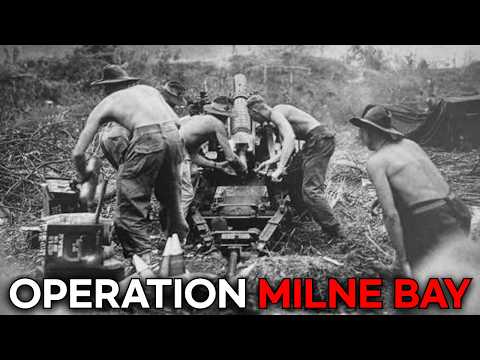
Some 2,800 hardened Japanese marines leaped from those boats into the churning dark surf. They were elite special naval landing forces, and their mission was clear: seize three small dirt airstrips the Allies had carved out of the swamp. If the Japanese took those strips, their planes could bomb Port Moresby, the key Allied base a few hundred miles to the west. If Port Moresby fell, the supply line between Australia and America would be cut in half. And if that line snapped, the entire Pacific could fall under Japanese control—and the war might be lost forever.
Standing in the mud to stop them were about 8,800 Australian defenders. But there was a problem that worried every planner. Nearly half of these men had never fired a shot in anger. They were part-time soldiers, young boys pulled straight from farms, bakeries, and shops just months earlier. Many had never even slept outdoors in the rain, let alone fought the most feared army in the world.
In Australia, some people had a cruel nickname for them: “chocolate soldiers.” The bitter joke was that these boys would melt the moment the fighting got hot, like a chocolate bar left in the summer sun. Most military planners expected them to panic, throw down their rifles, and run into the jungle.
And frankly, who could blame them? By mid-1942, the Japanese Imperial Army had not lost a single battle anywhere on earth. In just ten months, Japan had crushed the British in Malaya in seventy days. They had forced 85,000 British troops to surrender at Singapore. They had beaten the Americans and Filipinos at Bataan and driven thousands of starving prisoners on a brutal death march. They had taken the fortress island of Corregidor. Every time, the result was the same: Japan won, and Allied armies collapsed like houses of cards.
The smartest military experts agreed on one terrifying point: no Western soldier could beat the Japanese in the jungle. The Japanese moved like ghosts through the trees, struck with terrifying force, and never surrendered. Fear spread through every Allied camp like a disease. Even the American generals sitting in Port Moresby—men who had watched their own soldiers be slaughtered in the Philippines—believed it. They carried that shock with them every day, and it shaped everything they thought was possible in this war.
Now meet the man supposed to stop this juggernaut. His name was Major General Cyril Clowes. He looked nothing like a hero from the movies. He wore round spectacles. He spoke in a quiet, gentle voice barely above a whisper. He was an artillery officer, meaning his entire career had been spent working with big guns far behind the front lines, making calculations and estimating distances instead of charging into enemy fire. He had never fought in the jungle. He had never led men through deep swamp water, or under torrential rain, or among poisonous snakes.
The senior Allied commanders in their safe, dry offices in Port Moresby had no faith in him. The American officers serving under General Douglas MacArthur looked at the map, shook their heads, and secretly expected a total disaster. Some were already planning how to pull the men out before they were all killed, convinced that Milne Bay would be just another shameful defeat.
But Clowes saw something on that map that every other expert missed. He studied the ground around the bay with extreme care, tracing the coastline with his finger, and noticed a crucial fact that changed everything. The flat land between the towering Owen Stanley Mountains and the ocean was extremely narrow. In some places, it was only 200 yards wide—about the length of two football fields end to end.
The Japanese army loved to slip through open jungle and attack from the flanks. That was their favorite trick, and it had worked perfectly everywhere in Asia. But here at Milne Bay, there was no room for that trick at all. The mountains closed off one side like a giant green wall. The deep ocean blocked the other with heavy waves. Dense, muddy swamp full of crocodiles and tangled roots filled everything in between.
Clowes realized something simple but powerful. The terrible terrain didn’t help the Japanese here—it helped him. He could pack his soldiers tightly into that narrow strip of ground and point every rifle straight at the narrow passage like a hunter aiming a shotgun down a hallway. The Japanese would have no choice but to come at him head-on through the deep mud in a straight line, and he would be waiting with everything he had.
This quiet man with round glasses had found the one key every other general overlooked, and he was about to change the entire course of the war.
Clowes wasted no time building his trap in the mud. He strung his men along the only muddy track that ran between the ocean and the mountains, behind an old church called KB Mission and a dirt strip known as Gili Gili airstrip. Then he made a bold decision that stunned the other senior officers and set them arguing loudly in their tents.
Clowes placed his strongest, most experienced fighters—the famous 18th Brigade of battle-hardened veterans—in the center of the line where the fighting would be fiercest. But on the open flanks, the positions most exposed to the first attack, he put the inexperienced militia boys of the 7th and 61st Battalions. The generals in their clean, dry headquarters considered this a reckless, fatal mistake. They were certain these boys would scatter and run the moment the shooting started.
But Clowes trusted his plan and his men. He arranged his soldiers in tight rows across the narrow 200-yard gap, leaving the enemy no room to slip around the sides. His weapons and supplies were desperately limited, but he used every single piece with precision. He had two sets of 25-pounder artillery guns hidden among the palm trees, aimed straight at the beach approaches the Japanese would use. He had no tanks to shield his men. He had almost no sharp barbed wire to slow the attack. Field telephone lines ran directly through deep pools of muddy water, and the dampness caused them to fail almost every hour, leaving commanders confused about what was happening at the front.
But Clowes had one enormous advantage hidden in the grey storm clouds overhead. Two Australian air squadrons, Nos. 75 and 76, were based right on the muddy airstrip the Japanese wanted to seize. Their P-40 Kittyhawk fighters were fueled and loaded with bombs, ready to take off straight from the wet dirt runway. These daring pilots planned to fly just 50 feet above the ground, roaring through torrential rain to strafe the enemy from above while the soldiers fought in the mud below.
The first real test came in pitch darkness between the night of August 25 and the morning of August 26. About 1,200 elite Japanese troops rushed from their landing craft and leaped into the dark, heaving sea. But the torrential rain and thick fog played a cruel trick on the Japanese boat commanders. They could not see the shore clearly, and they put their men down on completely the wrong beach, miles from the airstrips they needed to capture.
To reach the Australian lines, the confused Japanese soldiers had to wade through horrifying mangrove swamps where the black, stinking water rose to their waists. Cold, sticky mud clung to their legs and boots with every exhausting step. Tangled tree roots grabbed at their knees and threw them face-first into the dark water. Sharp coral cut open their feet and hands. By the time they finally reached the Australian positions hours later, the Japanese soldiers were utterly exhausted, soaked, and packed tightly into the narrow passage—exactly as Clowes had hoped and planned.
At headquarters in Port Moresby, the senior commanders began to panic. When they heard the Japanese were on the island, they sent frantic radio messages to Clowes demanding he pull his men back and retreat. They wanted a slow, careful withdrawal to save lives. But Clowes flatly refused to run. He knew that retreating would give the Japanese the room they needed to spread out and use their favorite flanking tricks. He had one strong supporter who believed in the plan as much as he did. His name was Brigadier John Field.
Field did not hide in a safe tent far from the battle like so many senior officers. He walked straight out into the pouring rain and stood in the muddy trenches beside the frightened teenage militia boys. He checked their rifles to make sure they were clean, patted their trembling shoulders, and looked calmly into their scared eyes as bullets cracked through the trees above their heads. When the nervous commanders radioed from headquarters to ask if the lines were collapsing, Field sent back a short, firm message that would become famous throughout the army. He told them: “These boys will not break.”
Then the real nightmare began in the dark. Japanese soldiers screamed their terrifying battle cries and charged straight through the trees with long knives fixed to their rifles. It was the same ferocious, overwhelming attack that had shattered every other Allied army across Asia. But the boys of the 61st Battalion did not run.
Their hands shook violently and their hearts pounded, but they kept their fingers tight on the trigger. They fired into the black jungle again and again until the metal barrels grew hot under the cold rain. The line held firm. The Japanese charge broke in the mud and stopped dead. It shattered against a wall of bullets and stubborn courage no one expected from farm boys.
The savage fighting dragged on for days in the worst conditions imaginable. More than 76 centimeters of rain fell in a single week, turning the whole forest into a dark brown soup of filthy water and rotting plants that smelled of death. Soldiers’ boots grew soft and literally fell apart in the constant wet, forcing many men to walk barefoot on sharp rocks and broken coral. Mosquitoes bit them day and night, spreading malaria to nearly 30 of every 100 men. Yet no one surrendered.
In the sky, Kittyhawk fighters screamed between the treetops, so low that the Australians on the ground felt the hot wind from their spinning propellers wash over their soaked helmets. The boys in the mud had survived the first brutal blow, and the trap was about to snap shut for good.
The final numbers from Milne Bay told a story no one in the world could believe. After 12 days of vicious fighting, from August 25 to September 7, everything changed forever. The Australians killed roughly 625 Japanese soldiers in the swamp. The surviving Japanese, shattered and humiliated, had to be rescued by fast Australian warships sneaking in under cover of darkness. On the Australian side, 167 brave men gave their lives, and 491 more were badly wounded.
These numbers are heartbreaking, and they must be honored. But compared to any other battle in the Pacific, they represent something close to a miracle. It was the first time in the entire war that a complete Japanese fighting force was defeated and forced to flee a land battle. The long, terrifying streak of Japanese victories was broken, and it would never return.
Now, this is the moment you have been waiting for. When the battle reports crackled over the radio into the big Allied headquarters in Port Moresby, the American generals could not believe the words printed before them. They were the same officers who had watched their brave soldiers be crushed at Bataan just months earlier. They had truly believed, deep in their hearts, that the Japanese were superhuman fighters who could not be beaten in the jungle.
But now, a mixed group of Australian soldiers—including the farm boys everyone at home had mocked as useless—had done what no American, British, or Dutch army could do in ten full months of war. Shock spread through the American command like fire through dry grass. The words these stunned American generals spoke became famous instantly and changed the entire course of the Pacific War in a single moment. They looked at each other in utter disbelief and said:
“If the Australians can beat the Japanese in the jungle, so can we.”
That sentence was like a warm, bright light switched on in a room of pure terror. Suddenly, the Japanese were no longer invincible monsters. They were men—and men bleed and lose. These American generals had spent months drowning in defeat and despair, and the Australian soldiers at Milne Bay threw them a lifeline of pure courage.
Far away, on the island of Guadalcanal, young American Marines heard the shocking news as they sheltered in their waterlogged trenches, fighting the same Japanese army. They breathed a sigh of relief and smiled for the first time in weeks. The heavy cloud of fear that had hung over every Allied soldier in the Pacific suddenly lifted, replaced by a firm belief that victory was truly possible.
Milne Bay proved to the whole world that the mighty Japanese army was not made of magic or superhuman power. They were just men, and they could be stopped. The American generals who spoke those famous words of hope watched their soldiers fight with renewed fire, inspired directly by what the Australians did in that terrible swamp. The way the Pacific War was fought changed completely after those twelve grueling days in the mud.
Before the battle, military commanders tried to fight using old-fashioned rules borrowed from the dry, open battlefields of Europe. Those stale plans failed again and again in the thick, wet jungles of Asia. But General Clowes laid out a completely new blueprint for jungle warfare right there in the swamp. Other Allied generals studied what happened at Milne Bay carefully and quickly copied his clever ideas. They stopped trying to spread their defensive lines too thin across vast stretches of forest. Instead, they learned to force the enemy into narrow corridors trapped between mountains, swamps, and oceans, where big numbers meant nothing at all. They learned to send fighter planes screaming over the treetops to smash enemy attacks before they could even begin. They learned that respecting the mud, the rain, and the dense green jungle mattered far more than following old rules written for entirely different wars on entirely different continents.
Milne Bay became the master plan the Allies would use across the Pacific to win the war one muddy island at a time, all the way to final victory in 1945.
You might think Major General Cyril Clowes became a shining global hero, covered in glittering medals and celebrated in huge military parades. But real life can be very cruel and unfair, especially in the military. Just weeks after achieving the most important Allied land victory of that year, senior commanders sitting in safe headquarters far from the battlefield removed Clowes from his post. These powerful generals did not like his quiet calm or his complete disregard for their frantic radio orders to retreat in the middle of the battle. They felt embarrassed that a gentle, soft-spoken man with round glasses had understood the muddy battlefield far better than they did. Instead of giving him the loud cheers, bright lights, and public recognition he deserved, they ignored him and tried to take credit for his historic victory themselves.
Cyril Clowes did not complain publicly or scream about the injustice. When the war finally ended, he quietly packed his bags, left the army, and lived the rest of his life in complete peace and silence. He was largely forgotten in the history books that should have immortalized his name on every page.
Yet the real lesson of Milne Bay is still alive today, and it is far greater than any metal, parade, or dusty history book on a shelf. People often assume that winning a huge battle requires the newest, shiniest machines, massive armored tanks, or secret super weapons no one has ever seen. But at Milne Bay, the tools of victory were waterlogged telephone wire, simple bolt-action rifles, dark brown mud, and endless torrential rain. The real miracle did not come from fancy military equipment or advanced technology. It came from pure human courage, quick thinking, and an unbreakable heart. It came from young farm boys mocked as weak amateurs, led by a quiet artillery officer who looked at a narrow muddy track and saw a brilliant trap where others saw only certain death.
Real strength is not about having the biggest muscles, the loudest voice, or the most expensive equipment. That can be bought. It is about facing a terrifying problem head-on, finding a smart solution, and having the courage to stand firm against the odds when the whole world expects you to turn and run.
This powerful story speaks to every one of us today. Whenever we face something in life that seems too big to handle, too scary, or impossible to overcome, we often stare at our biggest problems and convince ourselves they are unstoppable giants that will crush us no matter how hard we try. But Milne Bay teaches us that the feeling of invincibility is just a trick of the mind, a story we tell ourselves because we are afraid. The unbeatable bully or the impossible challenge only stays that way until it meets the right group of determined people who absolutely refuse to give up, standing side by side in the right place at the right time.
Those stunned American generals did not speak their famous words just because they admired a good battle. They said them because they desperately needed hope during the darkest days of the war when everything seemed lost. The future looked completely bleak. But the brave Australian soldiers who stood tall in that rainy, crocodile-filled swamp gave the free world a decisive proof that things had finally changed, and that a better tomorrow was now possible. And that is exactly what the American generals saw when they watched the Australians fight at Milne Bay. They saw proof that the impossible was possible, and the echo of their words rang across the Pacific, changing the course of history forever.
So now I ask you: when life drags you into your own muddy swamp, will you melt like a chocolate soldier—or will you stand firm and prove the world wrong?
Report this article
Select a reason for reporting:






