In the mid-1970s, the skies over Europe were on the brink of a revolution. The United States had just unveiled the F-15 Eagle, a fighter so advanced it seemed to belong to another era. The Soviet Union was racing to catch up with its own fourth-generation designs. And France, determined not to be left behind, was quietly hatching a plan that would produce one of the most impressive—and ultimately tragic—fighters never to enter service.
This is the story of the Mirage 4000, a jet that could have changed the balance of power in the air, but instead became a footnote in aviation history.
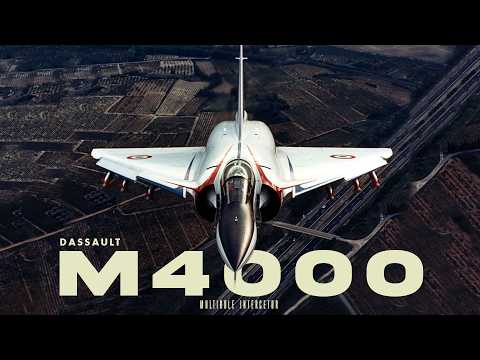
By 1975, the French government had issued a formal request for a new lightweight fighter, which would become the Mirage 2000. But Dassault, never one to rest on its laurels, had already begun sketching a far more ambitious machine—a twin-engine, high-performance air dominance platform that could go toe-to-toe with the F-15. This was the Mirage 4000.
Using the Mirage 2000 as a starting point, Dassault’s engineers envisioned a larger airframe with a redesigned wing, canards, and a cutting-edge carbon-fiber composite fin. Most importantly, it would have two engines, giving it the power and redundancy needed for high-speed intercepts and long-range strikes. On paper, it was a monster: Mach 2.2 top speed, a service ceiling of 65,600 feet, and a combat range of up to 1,500 kilometers.
But there was a problem. The Mirage 4000 was a private venture, largely self-funded by Dassault. The company hoped to attract export customers, particularly from the Middle East, or convince the French government to adopt it as a complement to the smaller Mirage 2000. Saudi Arabia showed early interest, and even Iran, under the Shah, expressed curiosity. But the Iranian Revolution killed any hope of a deal, and the Saudis were temporarily distracted by the offer of F-15s from the United States.
Still, Dassault pressed on. A demonstrator was built, and on March 9, 1979, it took to the skies for the first time. The results were stunning. On its sixth flight, it hit Mach 2. It climbed to 50,000 feet at Mach 2 in under four minutes, and reportedly achieved an initial climb rate of 60,000 feet per minute. Here was a fighter that could outrun and outclimb almost anything in the sky.
The Mirage 4000 was not just fast; it was also remarkably agile for its size. The addition of canards—small forward wings near the cockpit—transformed its handling, especially at low speeds. While the classic delta wing of earlier Mirages had a reputation for high landing speeds and poor energy retention, the 4000’s redesigned wing and canards gave it a level of agility that surprised even its test pilots. It could turn with the best of them, and its twin engines provided the thrust to sustain maneuvers that would leave older fighters gasping.
Internally, the demonstrator was fitted with the Thomson-CSF RDM radar, the same set used on the Mirage 2000. But Dassault had bigger plans: if the aircraft entered production, it would receive a more powerful radar and a comprehensive suite of electronic warfare systems. With 11 hardpoints—comparable to the F-15 and Su-27—it could carry an impressive array of weapons: air-to-air missiles, laser-guided bombs, anti-ship missiles, and even anti-runway munitions. It was a true multirole platform, capable of switching from air superiority to ground attack in a single sortie.
Yet for all its promise, the Mirage 4000 faced an uphill battle. The French government, while impressed by its performance, had already committed to the Mirage 2000 as its primary lightweight fighter. The larger 4000 was seen as a luxury—a costly machine that duplicated capabilities that the Air Force believed it could do without. And with no firm export orders, Dassault could not justify the expense of developing and integrating a full weapons system.
Then, in 1985, came a decisive blow. France withdrew from the collaborative European Fighter Aircraft program over disagreements about design leadership and naval requirements. In response, the French government redirected its efforts toward a domestic project: the ACX, which would eventually become the Rafale. The Rafale was everything the Mirage 4000 was not: a fully funded, state-backed program with a clear future.
Dassault suddenly found itself in an awkward position. It had two advanced fighter concepts—the Mirage 4000 and the Rafale—competing for the same limited resources. The French Defense Ministry, under André Giraud, made its preference clear: it wanted the Rafale. The Mirage 4000, despite its impressive flight test results, was left without a sponsor.
Still, there was a glimmer of hope. In 1987, the Saudis expressed renewed interest in the Mirage 4000. They had already purchased 62 F-15s, but the aircraft were downgraded export models, and the acquisition process had been fraught with political complications. Diversifying their air force with a French fighter seemed attractive. Rumors circulated that the Saudis were considering an order for 100 Mirage 4000s.
But the deal never materialized. The Mirage 4000 was still a demonstrator, with no production-ready internal systems. Developing and integrating those systems would take years and significant investment—money that Dassault did not have without a confirmed customer. The F-15, while expensive, was combat-proven and available immediately. And crucially, the French government’s lack of enthusiasm for the Mirage 4000 may have undermined the sales pitch. If France itself did not want the aircraft, why should Saudi Arabia?
By the late 1980s, the writing was on the wall. The Rafale A demonstrator flew in 1986, and it quickly became the focus of Dassault’s efforts. The Mirage 4000, despite its promise, was quietly shelved. Only one prototype was ever built, and it never received the upgrades or weapons integration that would have made it a true combat aircraft.
The Saudi negotiations, however, deserve a closer look, because they reveal just how close the Mirage 4000 came to survival. According to sources within Dassault, the Saudi delegation that visited in 1987 was genuinely impressed by the aircraft’s performance figures. The twin-engine configuration, the eleven hardpoints, the Mach 2.2 dash speed—all of it appealed to a kingdom eager to field a fighter that could match the F-15 without the political strings attached to American hardware.
But the timing was disastrous. The Tornado deal had just been signed, committing the Saudis to 72 British strike aircraft. Their air force was already juggling three separate supply chains—American, British, and now potentially French. The Mirage 4000 would have been a fourth, and the logistics alone were enough to give the Saudi planners pause.
More importantly, Dassault could not offer a firm delivery schedule. The demonstrator had flown, but the production aircraft existed only on paper. The radar, the electronic warfare suite, the weapons integration—none of it had been funded. What Dassault was selling was a promise, and the Saudis had learned to be wary of promises.
There is another dimension to the story that is often overlooked: the role of the French Defense Ministry in actively steering the Saudis away from the Mirage 4000. According to later accounts, French officials made it clear that the Rafale was the future of French military aviation. The Mirage 4000, they suggested, was a private venture without government backing—a risky proposition for any foreign buyer.
Whether this was a deliberate strategy to protect the Rafale program or simply bureaucratic indifference, the effect was the same. The Saudis walked away, and with them went the last realistic chance of a production order.
By 1988, the Mirage 4000 demonstrator had been flown extensively—over 300 sorties, according to Dassault’s records—but it had never been fitted with a functional weapons system. It remained a testbed, a proof of concept, a machine that could show off its speed and agility but could not fight.
Yet even in retirement, the aircraft continued to serve a purpose. Its flight test data, particularly the aerodynamic behavior of the canards and the composite fin structure, fed directly into the Rafale’s design. The Rafale’s canards, in fact, owe a direct debt to the lessons learned from the Mirage 4000’s flight test program.
And the story might have ended there, a quiet footnote in the annals of aviation history. But in the early 1990s, something unexpected happened. With the Rafale still years from operational service and the Mirage 2000 aging, the French Air Force found itself facing a capability gap. For a brief moment, there was talk of resurrecting the Mirage 4000 as an interim solution.
The idea was floated in defense circles: build a small batch of Mirage 4000s, equip them with the Mirage 2000-5’s radar and weapons, and use them as a stopgap until the Rafale arrived. It was a pragmatic proposal, and it might have worked.
But it was not to be. The French government, committed to the Rafale, refused to divert funds. Dassault, now fully focused on its new flagship, had no interest in reopening a closed chapter. The Mirage 4000 remained grounded, a silent monument to what might have been.
Today, the sole prototype sits in a museum in France, its sleek lines and twin engines a reminder of an alternate path. Visitors often pause before it, struck by its size and its aggressive stance. It looks like a fighter that should have fought, that should have flown in formation with the F-15s and Su-27s it was designed to challenge.
But history is not written by what might have been. The Mirage 4000 was a victim of timing, politics, and the relentless march of technological progress. It was too expensive for the French government, too risky for export customers, and too late to compete with the Rafale’s promise of a fully integrated, state-backed future.
Yet the Mirage 4000’s legacy is not one of failure. Its greatest contribution was invisible to the casual observer: it taught Dassault how to build a twin-engine, canard-equipped fighter with composite structures—knowledge that directly shaped the Rafale.
When the Rafale entered service in the 2000s, it carried forward the 4000’s aerodynamic DNA. The canards that give the Rafale its exceptional agility, the composite materials that save weight, the systems architecture that integrates sensors and weapons—all of it traces back to the lessons of that lone prototype.
In a way, the Mirage 4000 never truly died. It simply changed its name. The Rafale is, in part, the Mirage 4000’s revenge.
But the question remains: what if France had ordered it? What if the Saudis had signed on the dotted line? Would the Rafale still exist, or would Dassault’s line have split into two competing branches?
History offers no answers, only possibilities. The Mirage 4000 remains a tantalizing glimpse of an alternate timeline—a fighter that could have dominated the skies but instead became a teacher for the one that did.
So here’s the question for you: Was the Mirage 4000’s cancellation a tragic loss, or was it the necessary sacrifice that gave us the Rafale? Share your thoughts in the comments below.
Report this article
Select a reason for reporting:






