The morning fog clung to the American prison camp in Manila like a secret. Inside a canvas tent, a young Japanese nurse sat motionless, her fingers trembling as she pressed a fresh bandage against her arm. She had been told that capture meant shame, starvation—death. Yet here, an American medic handed her a steaming bowl of soup. The scent of coffee filled the air. The clatter of metal trays echoed across the yard. These women had sworn to die before surrender. Now they were being fed, given books, even letters home. The ultimate shock: the enemy cared for them while their own country starved.
It was no lie, no trick. It was a reality that defied every belief they held.
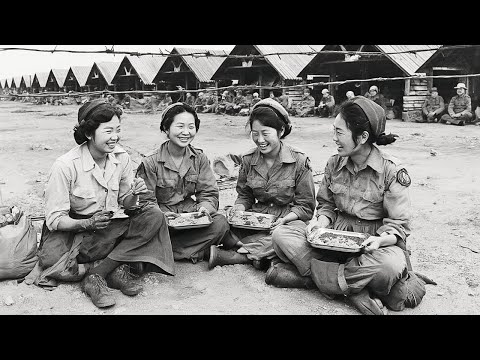
August 18, 1945. The humid air blanketed the ground outside Manila as a column of exhausted women trudged through the gates of an American-run POW camp. Their clothes were torn, their bodies thin from weeks of hiding, their minds braced for humiliation. Each had been raised under the iron code of Bushido—the warrior’s law that drilled into them that surrender was not merely shameful, it was worse than death. Japanese training manuals warned that Allied troops would rape, starve, or execute captured women. Mothers whispered the same warnings into their daughters’ ears.
In those first heavy minutes, the camp’s silence pressed down like a bad omen. But instead of kicks from boots, they heard the clang of metal pots and the scrape of ladles against steel. The smell of boiled beef and onions drifted across the yard. One nurse, barely twenty, later wrote in her diary: “I thought I was hallucinating. I had prepared for bullets, but they gave me bread instead.”
The contrast was vivid and cruel. At that very hour, their homeland was reeling under ash and famine. Allied air raids had left Tokyo and Osaka in smoldering ruins. In rural provinces, families subsisted on millet and roots. Reports from Japan in late 1944 indicated civilians were consuming fewer than 2,000 calories per week—less than many American POWs received in a single day.
Yet here, in enemy hands, tables laden with food seemed from another world.
Military numbers add weight to this paradox. By war’s end, between 35,000 and 50,000 Japanese soldiers—and a smaller but significant number of women—were in American captivity. They were never supposed to exist. They had been indoctrinated that surrender was unthinkable. For the Japanese, the fact of survival itself was a scandal, but survival mixed with blankets, cigarettes, and medical care felt like a fantasy bordering on betrayal.
Eyewitnesses confirmed that astonishment. An American medic stationed in the Philippines recalled: “They looked at me as if I were a ghost.” One girl kept asking if the food was poisoned. When he tasted it in front of her, she finally ate—and then wept.
The first morning’s routine etched itself into memory. The sound of spoons scraping metal, the weight of cotton blankets on exhausted limbs, the faint smell of antiseptic in the infirmary. For women accustomed to expecting degradation, these sensory details carried more power than any speech.
The paradox became undeniable. Captivity was not punishment—it was refuge. This was not propaganda; it was reality. And that reality began to shake the stories they had carried since childhood. Years of training collided with the facts of a single day, and the contradiction was impossible to ignore.
But the shock of first impressions was only the beginning. What they saw next—quiet, unforced acts of kindness—would burrow deeper into the myths they had believed.
The second day of captivity began not with shouted orders in a foreign tongue, but with the clatter of a metal bucket and the hiss of coffee pouring into tin cups. A nurse sat in the corner of the mess tent, watching an American soldier place a steaming mug between her trembling hands. She had been told Americans were savages—men who laughed while they tortured prisoners. Instead, this soldier gave her something warm to drink and turned his face away, as if granting her privacy.
That small mercy cut deeper than violence ever could.
Moments like these became the quiet turning points. A sergeant paused during roll call to light a cigarette for a prisoner. A medic knelt to tie a woman’s bootlace because her hands were bandaged. One Japanese woman recalled years later: “They wrapped the bandage so gently that I wanted to cry. I thought of my lost brother in Burma and wondered if someone had shown him the same.”
The gestures seemed ordinary to the Americans, yet they tore down walls of propaganda with each repetition. Here lay the paradox: acts so small carried the weight of revelation for those trained to see only cruelty.
Statistics confirm the scale of this irony. By late 1945, American camps across the Pacific held tens of thousands of Japanese POWs. Each received rations in line with the Geneva Convention—three meals a day averaging 3,500 calories, nearly double what the average Japanese citizen consumed at home. The enemy they had been told would starve them was now feeding them better than their own nation could.
Yet trust was not instant. Some prisoners hesitated, suspecting poison in the soup or hidden motives behind the blankets. The clang of the ladle, the steam rising from a pot of beans, even the faint sweetness of cornbread—all of it felt more like a trap than a gift. Only after repeated offerings, food left untouched and then replaced, did suspicion begin to fade.
The camp’s sounds carried their own meaning. Boots crunching on gravel, the low laughter of guards playing cards, the distant harmonica drifting at dusk. To women who had expected shouts and beatings, these sounds of ordinary life suggested something stranger: normalcy.
One American officer summed up the policy bluntly in his report. “We keep them alive because it helps us win the war faster. A fed prisoner works, talks, and doesn’t return to fight. That is victory by other means.” For the prisoners, this strategy was indistinguishable from compassion. The motive mattered little. The experience was what seared itself into memory.
Each cigarette, each clean bandage, each untouched plate was another crack in the armor of ideology. What began as survival was becoming a slow education, one small kindness at a time.
But daily mercies alone could not explain what unfolded next. Beyond food and shelter, these women encountered something they had never imagined behind barbed wire: the ordinary rhythms of rest, learning, and even leisure.
By the third week of captivity, the shock of survival had settled into routine. What began as disbelief became habit. Wake at dawn, line up for roll call, then file into the mess hall where steam rose from vats of oatmeal and coffee. Prisoners were given spoons instead of scraps, metal trays instead of bare hands. For women who had expected punishment, the ordinariness of meals felt like a quiet miracle.
One woman who had served as a nurse in Bataan later wrote: “The bread was soft. I had not touched soft bread since before the war. I pressed it with my fingers and thought I was dreaming.” Her words capture how ordinary comforts carry disproportionate power. A slice of bread or the weight of a wool blanket became proof that everything they had been taught about the enemy was not just wrong, but inverted.
The camp itself was a modest grid of wooden barracks, wire fences, and gravel paths. Yet within its bounds, a strange paradox unfolded. Prisoners lived with more stability than civilians in the bombed cities of Japan. Straw mats on the floor replaced cold ground. Cotton sheets replaced worn rags. Buckets of disinfectant, sharp and clean-smelling, replaced the stench of infection. Even the sounds were different. No air-raid sirens. No drone of engines overhead. Just the tread of guards’ boots and the clang of the dinner bell.
Statistics lay bare the scale of this assistance. An official U.S. Army report noted that Japanese POWs received between 3,000 and 3,500 calories daily—beans, rice, bread, coffee, sometimes meat or fruit. Meanwhile, Allied estimates put the average Japanese civilian at fewer than 2,000 calories per week in 1944. The contrast was obscene. Soldiers and nurses who had come as enemies were fed in captivity with a generosity their families in Tokyo or Kyoto could only dream of.
Beyond food, the camps offered small projects. Some prisoners were given vegetable seeds and allowed to plant gardens, where the smell of turned soil reminded them of farms left behind. Others took up cleaning, laundry, or work in the clinic. These tasks were voluntary—a way to fill the endless hours. A few even requested books, and American officers, moved by surprise, supplied English-language primers and hymnals.
Eyewitness accounts bring this unexpected atmosphere to life. One Japanese woman remembered hearing laughter through the thin barracks walls as prisoners tried to pronounce English words, stumbling over “apple” and “book.” Another recalled her astonishment when guards allowed them to listen to a phonograph, the scratch of jazz records and horns and drums echoing at night—music utterly foreign yet strangely soothing.
This was the heart of the paradox. Captivity, expected to be a living death, had become a fragile version of safety. “We lived as if in a dream,” one diary entry read. “The enemy gave us medicine. They let us bathe. I had forgotten what it felt like to be clean.”
Yet every act of kindness cast its shadow. With each blanket draped over their shoulders, they remembered a relative or brother shivering in the ruins of Nagoya. With each bowl of rice set before them, they imagined their mothers clawing through ash for roots. Kindness carried the taste of guilt as much as comfort.
Still, the pattern of merciful routine continued. Days blurred together until life behind barbed wire seemed to resemble something more dangerous than “comfort.” But the full horror of the truth would not strike them until they saw the numbers written in black and white—statistics of hunger, death, and survival—and the contrast between captivity and home became unbearable.
The numbers stripped illusions bare. By August 1945, the United States held 35,000 to 50,000 Japanese prisoners across the Pacific. Their survival rate was astonishing: over 95% lived to return home. In savage contrast, Allied prisoners in Japanese camps faced a death rate approaching one in three. An American intelligence officer summarized the comparison with chilling brevity: “Our camps produce workers. Theirs produce corpses.”
For the women behind the wire, the statistics cut like a blade. To live under enemy care meant outliving comrades who had stayed loyal to the Emperor. One young nurse confessed: “When I ate, I felt I was betraying my family. Every spoonful tasted of shame—but also of survival.”
The gifts were never pure mercy. American commanders knew that feeding prisoners brought cooperation, information, labor. Humanitarian treatment was strategy and ethics at once—a weapon of abundance wielded with quiet precision.
If their teachers, fathers, and officers had lied about the enemy’s cruelty, what else was false? The question gnawed at them.
Then the gates opened in late 1945. The women walked toward trucks bound for gray transport ships, salt spray stinging their faces. For months they had lived with blankets and bread. Now they faced a homeland reduced to rubble. Tokyo was blackened, Osaka smoldering, Nagoya flattened. Nearly nine million Japanese were homeless.
One nurse remembered her first sight of Yokohama: “I saw children with bellies swollen from hunger. I had eaten three meals a day in camp. Shame devoured me.”
Rice production had collapsed below half of prewar levels. Civilian rations fell to roughly 1,600 calories a day. The mirror was unbearable: the enemy had fed them while their own people starved.
Reception at home was no less contradictory. Some families wept with relief; others turned cold, seeing only disgrace. “We were not welcomed as survivors, but as ghosts,” one woman wrote bitterly.
Yet the memory of unexpected kindness refused to fade. For some it lived in the taste of coffee; for others, in the harmonica drifting at dusk. One former prisoner admitted decades later: “I could not hate the Americans after what I lived. They treated us better than our own army treated its women.”
They entered captivity expecting humiliation. They left carrying memories of milk, soap, and sometimes smiles. History counts tanks, planes, and atomic bombs—but it must also count abundance. America’s greatest weapon was never its bombs, but its capacity to feed even those who had sworn to die before surrender.
So tell us: knowing what these women endured and discovered, could you forgive the enemy who showed you mercy?
Report this article
Select a reason for reporting:






