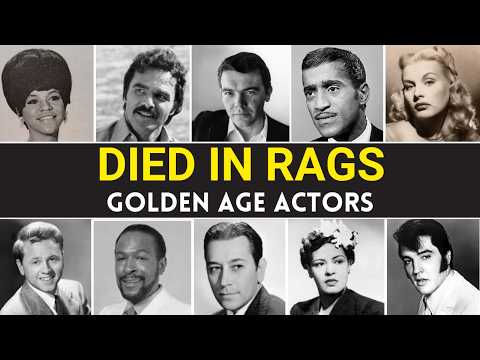
The applause fades. The spotlights dim. And the fortunes that once seemed endless vanish into thin air. Hollywood’s Golden Age gave us legends—actors and singers who dazzled millions, commanded astronomical salaries, and lived like royalty. Yet behind the glamour, a darker story unfolded. Many of these icons died broke, buried under a mountain of debt, their once-glittering careers ending in financial ruin.
In this second part of our series, we uncover the shocking financial downfalls of stars like George Raft, Marvin Gaye, Elvis Presley, and more. These are tales of extravagance, betrayal, and tragedy—proof that fame and fortune can be as fleeting as a standing ovation.
George Raft was the quintessential gangster on screen, but off screen, his life was a masterclass in self-destruction. The actor, famous for Scarface and Some Like It Hot, earned a fortune but burned through it with reckless abandon. Gambling debts, shady business deals, and a legendary generosity that bordered on foolishness left him bankrupt by 1966. He turned down iconic roles in The Maltese Falcon and Casablanca—decisions that cost him millions and boosted Humphrey Bogart’s career instead. When Raft died in 1980, he was broke, a shadow of the star who once ruled the screen.
Marvin Gaye’s velvet voice made him a legend, but his financial life was a mess. Most of his earnings went to alimony and back taxes. He owed $600,000 to his ex-wife and had to surrender royalties from his album Here, My Dear just to settle the debt. To cope, he turned to drugs and alcohol, which only deepened his troubles. On April 1, 1984, in a violent argument, his own father shot him dead. Gaye died penniless, one day before his 45th birthday.
Elvis Presley, the King of Rock and Roll, earned an estimated $100 million to $1 billion over his career. Yet when he died in 1977 at just 42, he had only $5 million in the bank—and owed double that to the IRS. Years of extravagant spending and drug addiction had drained his fortune. His ex-wife Priscilla and father Vernon were left to pay the massive tax bill. Priscilla turned Graceland into a tourist empire, eventually rebuilding the estate to $100 million. But tragically, his daughter Lisa Marie Presley died in 2023 $4 million in debt, more than half owed to the IRS.
Bobby Driscoll was one of the most famous child actors of the 1940s, earning $1,750 a week at his peak and winning an Academy Award at 12. But puberty, acne, and typecasting ended his career abruptly at 16. He fell into drug addiction, was arrested multiple times, and by 1968 was living in an abandoned East Village tenement. He was found dead at 31, surrounded by empty beer bottles—a heartbreaking end for a boy who once lit up the screen.
Burt Reynolds was a box-office titan in the 1970s, but mismanaged finances and a costly divorce from Loni Anderson left him bankrupt in 1996, with $10 million in debts against $6.65 million in assets. He sold his beloved South Florida ranch and later admitted to reckless spending and trusting the wrong people. Though he stabilized somewhat later, he died in 2018 having experienced a dramatic fall from Hollywood royalty.
These stories are just the beginning. The golden glow of fame often hides a darker truth—one where the curtain never falls on financial ruin.
Anita Ekberg was the Swedish bombshell who defined an era of glamour. Her role in Fellini’s La Dolce Vita made her a global sex symbol, and she commanded hefty salaries while living a life of luxury. But her fortune slipped through her fingers. She lost her wealth to unscrupulous individuals, suffered a devastating house fire, and faced mounting medical expenses. By the time of her death in 2011 at 83, she was living in poverty in Italy, applying to the very foundation named after Fellini for financial assistance. The star who once shone so brightly died broken and alone.
Sammy Davis Jr., the ultimate showman, earned millions annually at his peak. But his love for the finer things—lavish parties, luxury goods, and high-stakes gambling—drained his wealth. He accumulated $7 million in unpaid taxes to the IRS. When he died of cancer in 1990, he was flat broke. Royalties from his films, TV appearances, and records were directed straight to the IRS to clear his debts.
Mickey Rooney’s career spanned nine decades, and he was once one of Hollywood’s highest-paid stars. But alcoholism, prescription drug addiction, and eight marriages left him financially devastated. He filed for bankruptcy in 1962 and, in 2014, testified before Congress that family members were exploiting and abusing him. When he died at 93, his multi-million-dollar estate had dwindled to just $18,000—not even enough to cover his funeral.
Meatloaf’s Bat Out of Hell sold 43 million copies, making him a rock icon. But behind the scenes, his empire crumbled. He declared bankruptcy in 1983, faced 45 lawsuits totaling $80 million, and lost his home and publishing rights. Unpaid royalties from Sony were estimated at $5 million. Yet, in a remarkable comeback, Bat Out of Hell II revitalized his career. By his death in 2022, he had amassed a net worth of $40 million—a rare tale of financial redemption.
Billie Holiday’s voice revolutionized jazz, but her life was marked by trauma. Sexually assaulted at 10 and forced into prostitution at 14, she found herself drawn to abusive men who exploited her financially. Her drug arrests cost her the cabaret card she needed to perform in New York, and unscrupulous managers embezzled her earnings. When she died in 1959, her bank account held just $750—a pittance compared to the millions her music had generated.
Florence Ballard, founding member of The Supremes, earned an estimated $100,000 annually at her peak. But as Diana Ross rose to prominence, Ballard was sidelined, and in 1967 she was expelled from the group she had founded. Legal battles with Motown drained her resources, and by 1971 she was on welfare, her home foreclosed. She died in 1976 at just 32, leaving behind three daughters and barely enough money to cover her funeral.
Joe Louis, the legendary Brown Bomber, earned $4.6 million in the ring—equivalent to $60 million today. But his generosity was legendary, and his business ventures failed. The IRS charged him $1.2 million in back taxes, even during his military service. He continued fighting past his prime, worked as a casino greeter, and battled cocaine addiction. When he died in 1981, he was living on a $300 monthly pension, unable to afford his own funeral. President Reagan intervened to bury him at Arlington with full honors.
These are the cautionary tales of Hollywood’s Golden Age—stories of unimaginable wealth lost to extravagance, betrayal, and tragedy. But the list doesn’t end here. There are more stars whose fortunes vanished, whose final years were spent in poverty and obscurity. Their stories serve as a stark reminder that fame is fleeting, and fortune can disappear overnight.
Take Buster Keaton, the stone-faced genius of silent comedy. At his peak in the 1920s, he commanded complete creative control and earned a staggering $3,000 a week—plus a percentage of his films’ profits. He built a custom mansion, owned a fleet of luxury cars, and employed a full staff. But when sound arrived, his world collapsed. MGM stripped him of his independence, his marriage fell apart, and his drinking spiraled out of control.
By the 1930s, Keaton was reduced to writing gags for other comedians, his fortune gone. He was declared bankrupt in 1933, with debts so severe he lost his home and his beloved film collection. Though he eventually found steady work and a happy second marriage, the millions he had earned were never recovered. When he died in 1966, his estate was modest—a quiet end for a man who had once been one of the most powerful artists in Hollywood.
Then there’s the tragic case of Frances Farmer, a brilliant actress whose career was destroyed by a combination of studio politics, alcoholism, and mental illness. She was institutionalized against her will, subjected to brutal treatments, and when she returned to Hollywood, the industry had forgotten her. She worked as a hotel clerk, a dishwasher, and a secretary. When she died of esophageal cancer in 1970 at 56, she had almost nothing to her name.
Veronica Lake, the peek-a-boo blonde who captivated wartime audiences, fared little better. Her films for Paramount made millions, but her marriages, drinking, and a disastrous business partnership with her mother drained her accounts. By the late 1960s, she was living in a single room in a women’s hotel in New York, working as a bartender. She died in 1973 at 50, her estate valued at under $1,000.
And who could forget the sad fate of ‘Fatty’ Arbuckle? Once one of the highest-paid comedians in Hollywood, earning $1 million a year, his career was destroyed by a scandal he was ultimately acquitted of. Blacklisted and bankrupted by legal fees, he spent his final years performing in small clubs under an assumed name. He died in 1933 at 46, his fortune and reputation both in ruins.
The pattern is chilling. Whether through gambling, bad investments, divorce, taxes, addiction, or simple generosity, these stars all discovered the same bitter truth: Hollywood’s money is never truly yours. It belongs to the studios, the lawyers, the taxman, and the hangers-on who circle every fortune like vultures.
But the stories don’t end with the Golden Age. The same forces that ruined these legends are still at work today, claiming new victims among the famous and successful. The names change, but the tragedy remains the same.
And so the reel keeps spinning, generation after generation. The same forces that ruined Raft, Gaye, and Presley are still claiming victims today—athletes, pop stars, child actors, all caught in the same trap. Fame arrives like a tidal wave, but the money that follows is rarely built to last.
The lesson, if there is one, is simple and brutal: a fortune is only as strong as the hands that hold it. Talent can fill a stadium, but it can’t balance a checkbook. Hollywood’s brightest lights have always burned fast—and too often, they burn out broke.
Their stories linger not as gossip, but as warnings. The applause fades. The spotlights dim. And the fortune that once seemed endless vanishes into thin air.
So the next time you see a star shining at the top, remember the ones who fell—and ask yourself: who will be the next to discover that the golden age was never really golden at all?
Which of these tragic downfalls shocked you the most—and do you think today’s stars are any better prepared for the fall? Share your thoughts in the comments below.
Report this article
Select a reason for reporting:






