He was born into a world of fading empires and personal tragedy, a sickly child in a modest Austrian apartment. No one could have predicted that the baby boy named Adolf would one day plunge the world into darkness. But the seeds of his future were sown early, in a childhood marked by loss, rebellion, and a desperate need for recognition.
In 1889, Alois Hitler, a strict customs official, and his young wife Clara welcomed their fourth child, Adolf. The family had already suffered devastating blows: three of Clara’s previous children had died in infancy or early childhood. Adolf, too, was frail, and Clara doted on him, while Alois showed little interest in child-rearing, preferring the tavern or his beekeeping. The family moved frequently, eventually settling in Linz, Austria, where Adolf’s rebellious nature began to take root.
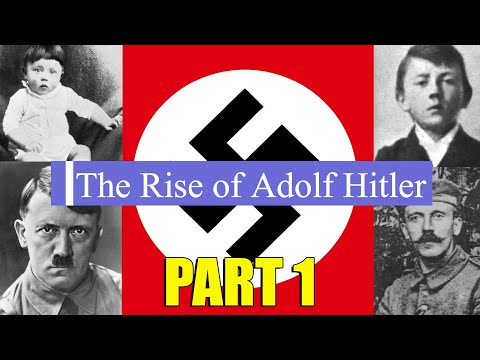
Alois was a volatile man, quick to anger, and he often took his fury out on his children. Adolf’s older brother, Alois Jr., fled home after a particularly violent confrontation, vowing never to return. That left Adolf as the primary target of his father’s wrath. “The relationship between Adolf and his father would deteriorate dramatically,” and the boy grew to resent the man who tried to force him into a civil service career. Adolf was determined to do the opposite of anything his father expected.
At school, Adolf was popular and achieved good grades, but his behavior worsened over time. When he was ten, his younger brother Edmund died of measles, a loss that devastated him. He began talking to himself and spent long hours at Edmund’s grave. High school brought bullying, and his behavior spiraled further. At sixteen, he dropped out without qualifications.
Hitler had always loved art, and at eighteen he moved to Vienna to pursue his dream. But the Vienna Academy of Fine Arts rejected him—twice. The director advised him to try architecture, but without a high school diploma, that path was closed. “I have never seen anyone so frustrated with grief as Adolf Hitler,” the family doctor later said after Clara’s death from breast cancer in 1907. Hitler was shattered.
He returned to Vienna, homeless and selling paintings on the streets. The city was a hotbed of anti-Semitism and far-right propaganda, and these ideas began to shape his worldview. In 1913, he moved to Munich to avoid Austrian military service, but was later conscripted—only to be deemed unfit. When World War I broke out in 1914, Hitler eagerly volunteered for the Bavarian army.
He served as a dispatch runner on the Western Front, surviving battles that decimated his regiment. “Hitler escaped unscathed and was promoted to corporal,” decorated for bravery with the Iron Cross Second Class and later First Class—a rare honor for his rank. Fellow soldiers found him odd but likeable; he never complained and preferred discussing art and history over women.
In 1916, he was wounded by an artillery barrage and sent home, where he was disgusted by anti-war sentiment. He returned to the front in 1917. In October 1918, a British chlorine gas attack temporarily blinded him, and he was hospitalized. There, he learned of Germany’s surrender.
The news hit him like a thunderbolt. Like many Germans, he believed the undefeated army had been “stabbed in the back” by civilians, Jews, and Marxists. These wartime experiences, which he called “the greatest of all experiences,” would become the foundation of an ideology that would soon unleash unimaginable horror upon the world.
But the war had done more than shatter his illusions—it had given him a home. For the first time in his life, Adolf Hitler had belonged to something larger than himself: a regiment, a cause, a brotherhood of soldiers who asked no questions about his past and expected only obedience and courage. Now that structure was gone, and the silence of the hospital ward pressed in on him like a weight.
The army that had been his family was dissolving into revolution. In the streets of Munich, red flags flew over the barracks, and soldiers’ councils replaced officers. Hitler, still weak from the gas, watched in disbelief as the world he had known crumbled around him. “I could not understand what was happening,” he would later recall. The kaiser had abdicated, the armistice had been signed, and Germany was now a republic—a word that tasted like ashes in his mouth.
He remained in the army as long as he could, clinging to the only order he knew. Assigned to a reserve battalion in Munich, he was given the task of monitoring political groups—a job that would prove fateful. Among the dozens of tiny factions vying for power in the chaotic city, one caught his attention: a small, obscure party that called itself the German Workers’ Party.
In September 1919, Hitler attended one of its meetings in a beer hall, sent as an observer. He listened as a speaker proposed that Bavaria break away from Germany—and something in him snapped. He rose to his feet and spoke with a fury that surprised even himself, tearing into the speaker’s arguments with a passion that silenced the room. “I spoke for fifteen minutes,” he later wrote, “and the words simply flowed from my mouth.”
The party’s founder, Anton Drexler, pressed a pamphlet into his hands and urged him to return. Hitler hesitated only briefly. Here, in this shabby gathering of dreamers and malcontents, he sensed an opportunity. He joined the party as member number 555—a number inflated by the leadership to make the group seem larger than it was.
Within months, he had discovered his true gift: public speaking. The beer halls of Munich became his stage, and the crowds grew larger with each meeting. He learned to read the mood of a room, to build his arguments to a fever pitch, to make his listeners feel the same rage and humiliation that burned inside him. “The power which has always started the greatest religious and political avalanches in history,” he would later declare, “has been from time immemorial the magic of the spoken word.”
By early 1920, the party had a new name—the National Socialist German Workers’ Party—and a new symbol: a black swastika on a white circle against a red background. Hitler had designed it himself, and he understood its power instinctively. A flag, he wrote, had to be more than a flag; it had to be a program, a promise, a weapon.
He was no longer a nameless veteran drifting through the chaos of a defeated nation. He was becoming something else entirely—a voice for the bitterness and resentment that festered in the hearts of millions. And he was just getting started.
The party grew faster than anyone had expected. Veterans, students, shopkeepers, and disillusioned workers crowded into Munich’s beer halls to hear the former corporal speak. “He was not a speaker,” one early follower remembered, “he was a storm.” Hitler rehearsed his gestures in private, practicing the raised hand, the clenched fist, the long silence before a punchline. He studied the crowds the way a hunter studies his prey.
In the summer of 1921, he made his move. A revolt within the party leadership threatened to sideline him, and he responded by offering his resignation—knowing full well that without him, the movement would collapse. The gamble worked. Drexler and the others begged him to stay, and he returned on his own terms: absolute authority as chairman, with the power to appoint his own deputies.
Among those deputies was a quiet, bespectacled man named Dietrich Eckart, a poet and journalist who saw in Hitler a messiah for a broken nation. Eckart introduced him to Munich’s wealthy conservatives, to army officers, and to the salons of the far right. “Follow Hitler,” Eckart reportedly told his circle. “He will dance, but it is I who will call the tune.” It was a miscalculation Eckart would not live long enough to regret—he died of a heart attack in 1923, convinced he had found the savior of Germany.
The year 1923 brought crisis. France occupied the Ruhr to seize reparations, and Germany’s currency collapsed into worthless paper. A loaf of bread cost billions of marks. The government in Berlin seemed paralyzed, and in Bavaria, separatist plots brewed in every tavern. Hitler saw his moment approaching.
He had built the party into a paramilitary force. The Sturmabteilung—the SA—marched through Munich in brown shirts, brawling with communists in the streets and intimidating anyone who dared to speak against them. Hitler now commanded thousands of men who answered to him alone. He was no longer an observer of history; he was preparing to seize it.
In November 1923, he gathered his followers in the Bürgerbräukeller, a cavernous beer hall where Bavarian officials were holding a rally. “The national revolution has begun!” he shouted, firing a pistol into the ceiling. He demanded the support of the Bavarian leaders, promising them roles in a new German government. For a few hours, it seemed the putsch might succeed.
But the momentum faltered. The army refused to join, and by morning the coup was collapsing. Hitler marched his followers through the streets toward the War Ministry, where police blocked their path. A shot rang out. Then another. Sixteen Nazis fell dead in the snow, and Hitler threw himself to the ground, dislocating his shoulder.
The putsch was over in minutes. Hitler was arrested, tried for treason, and sentenced to five years in Landsberg Prison—though he would serve less than one. But in the courtroom, he had been given a stage, and he used it brilliantly. “I alone bear the responsibility,” he declared, “but I am not a criminal.” The judges, sympathetic to his cause, allowed him to speak for hours, and his words were printed in newspapers across Germany.
In prison, he was treated like a guest. He had a comfortable cell, received visitors, and was permitted to write. And write he did—dictating a sprawling manuscript to his loyal secretary, Rudolf Hess, a book that would become the blueprint for everything that followed.
The book was Mein Kampf—My Struggle. In its pages, Hitler poured out his hatreds and his vision: the superiority of the Aryan race, the need for Lebensraum in the East, and the extermination of the Jews. “The Jew is the cause of our ruin,” he wrote, and millions would one day pay for those words.
When he was released in December 1924, the party was in ruins. He had been banned from public speaking, and his followers had scattered. But Hitler was patient. He rebuilt the movement quietly, brick by brick, and he learned from his mistakes. “We shall have to hold our noses and enter the Reichstag,” he told his followers, “but we will use democracy to destroy democracy.”
The Great Depression came in 1929, and with it, the final piece of the puzzle. Millions of desperate Germans turned to the man who promised them bread, work, and pride. In 1933, Adolf Hitler was appointed Chancellor of Germany—legally, through the ballot box, not a coup. “We have done it,” he whispered to a confidant that night. “We are in power.”
The sickly child of Braunau had become the master of a nation. The artist who was rejected by Vienna would now remake the world in his image—and the world would never be the same.
What do you think—was Hitler’s rise inevitable, or could history have taken a different turn if just one thing had changed?
Report this article
Select a reason for reporting:






