November 20th, 1943. Bhutaritari Island. A scrap of coral in the middle of the Pacific. A soldier of the 165th Infantry presses himself into the bottom of his foxhole and listens. Out in the black, a voice calls in clear American English. “Medic, medic, send a medic out here.” A wounded man begging for help a few yards away. Every instinct the soldier has screams at him to go. He doesn’t move. He doesn’t make a sound—because he has learned the cruelest rule in the Pacific War.
What was really out there in the dark? And why were the men whose whole job was to answer that cry the ones who learned to fear it most?
To understand what that soldier knew, you have to understand the war he was fighting. The war in the Pacific was not the war most Americans had trained for. In Europe, the front was a line you could point to on a map. In the jungles and coral of the Pacific, the front was wherever you happened to be standing when the sun went down.
And when the sun went down, the Japanese came. Imperial Japanese Army doctrine treated the night as a weapon. A War Department intelligence bulletin from May 1943 put it plainly: Japanese soldiers were trained to create fear. They used shrieks, threats, and ruses to make Americans reveal their positions by firing blindly into the dark—or to lure them out of cover entirely.
On New Guinea, they propped a dead Allied soldier upright near the lines and waited for a rescue party to come and die for him. They shook bushes. They fired captured rifles. They called out in whatever English they had managed to learn. “Marine, you die.”
This was not a battle line. It was a hundred small murders in the dark, every single night, for as long as the island held out. A man could survive the landing, survive the assault, survive the artillery—and then die at 2 a.m. because he answered a whisper.
The American military had to invent an answer. And the answer it arrived at was brutal in its simplicity. Nobody leaves the hole. Not for anything. Not for anyone.
The rule had no name on any official document. The men simply called it gospel. Private First Class Eugene Sledge, a mortarman with King Company, 3rd Battalion, 5th Marines, 1st Marine Division, wrote it down after the war exactly as he had lived it: “Anybody who moved out of his hole at night without telling the men around him, anybody who failed to answer a challenge instantly with the right password, could expect to get shot. Not might—could expect to.”
It worked like this. Two men to a foxhole. One slept, one watched. Never both asleep, never both awake—straight through until dawn. Sledge called it a creed of faith and trust. You could depend on your buddy, and he could depend on you. Your life was in the hands of the man beside you, and his was in yours.
Then came the password. And here the Americans found a crack in the enemy they could exploit. The Japanese language has no separate sound for the English letters L and R. A native speaker who learned English as an adult often could not tell them apart—let alone pronounce them cleanly under stress. So the Marines built their passwords around the letter L. The word the stories always come back to is a mouthful: Lalapalooza. A challenge rang out in the dark, and if the answer came back with the Rs and Ls tangled together, the man who had spoken was already a target.
The cost of getting it wrong ran in both directions. One night on Peleliu, a helmeted figure loomed over Sledge’s gun pit. He asked for the password. Silence. He asked again, his finger tightening on the trigger. The figure finally stammered it out. “Sledgehammer.” It was Jay Deacon, one of his closest friends in the company, crawling over in the dark for a drink of water. Sledge wrote that if his finger had applied the last ounce of pressure, Jay would have died instantly. That was the margin—one syllable, one heartbeat of hesitation.
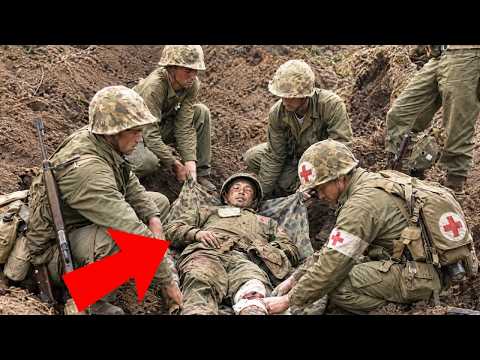
And moving through all of this, crawling between the holes, were the men the whole system was built to protect—and the enemy was most determined to kill. The corpsman. A United States Navy hospital corpsman was not a Marine. He was a sailor attached to the Fleet Marine Force, and he carried bandages, morphine, and blood plasma instead of a rifle. His job was the single most human job on the battlefield: when a man went down screaming, the corpsman went to him.
Which is precisely why, in the Pacific, the corpsman learned to take the Red Cross off.
At Guadalcanal, the Red Crosses painted on corpsmen’s helmets and sewn onto their armbands did exactly the opposite of what the law intended. Japanese snipers used them as aiming marks. Kill the corpsman, and every man he might have saved bled out. Kill the corpsman, and the Marines who loved him might do something desperate to reach his body.
So the crosses came off. Corpsmen scraped the paint from their helmets, stripped the brassards from their sleeves, and dressed exactly like the riflemen they served beside. They traded the symbol of mercy for a .45 caliber pistol—not to attack with, but to stay alive. Pharmacist’s Mate Second Class Stanley Dabrowski, who landed on Iwo Jima, remembered being told to carry a sidearm for one reason only: protection. The markings that were meant to shield him had become a death sentence, and he knew it.
Which brought every corpsman face to face with the cruelest arithmetic of the Pacific War. A voice in the dark cries, “Corpsman!” Maybe it is a Marine, gut-shot and terrified, counting on the one man trained to come. Maybe it is a Japanese soldier who learned the word, lying in wait with a rifle already zeroed on the sound. The corpsman cannot know—and if he guesses wrong, he dies. And so does the next man who comes looking for him.
On Iwo Jima, the surgeon of 1st Battalion, 24th Marines, and his veteran corpsmen lived by a rule born from that arithmetic. If someone calls for help in the dark, you do not run to him. You call for riflemen to cover you first—because the enemy marksman is zeroed on the wounded man, waiting for exactly the person whose instinct is to rush in.
Think about what that asks of a human being. To hear a man scream for help—and to wait.
Some men could not wait. Some men went anyway, and the record of what happened to them is written in the same after-action reports that counted the dead. A corpsman who broke cover on Peleliu to reach a crying voice was found at dawn with a bullet through his chest and no wounded man anywhere near him. The voice had been bait. The trap had worked exactly as designed.
And yet the corpsmen kept going. Again and again, they went.
February 28th, 1945. Iwo Jima. Pharmacist’s Mate First Class John Willis of 3rd Battalion, 27th Marines, knelt in a shell hole giving plasma to a wounded man while Japanese grenades rolled in on him. He threw them back. One, two, eight grenades he picked up and hurled away without stopping the flow of plasma. The ninth exploded in his hand.
Three days later, the 3rd of March, Pharmacist’s Mate Third Class Jack Williams, 3rd Battalion, 28th Marines, crawled to two fallen Marines under fire and shielded one with his own body while he worked. He was hit as he worked. He bandaged his own wounds, finished with his patient, and was shot dead by a sniper as he moved to the next man. He was 20 years old.
And there was Pharmacist’s Mate First Class Francis Pierce of 2nd Battalion, 24th Marines, who on Iwo Jima took the enemy’s own method and turned it inside out. When his litter bearers were pinned, Pierce stood up deliberately in the open. He made himself the target so the Japanese guns would track him instead of the wounded men. And he stood there, drawing their fire, until the stretchers got clear. The bait this time was a corpsman who chose it.
On Okinawa, on the 2nd of May, a hospital apprentice first class named Robert Bush knelt over a wounded Marine officer on an exposed ridge, holding a bottle of blood plasma up with one hand. Then the Japanese counterattacked straight at him. Bush would not stop the plasma. With his free hand, he drew his pistol and emptied it, then grabbed the officer’s carbine and kept firing, killing the enemy soldiers coming over the rise, refusing to lower the bottle that was keeping his patient alive. He was hit again and again. He lost an eye. He held the line over a single wounded man alone—and the officer lived. Robert Bush was 18 years old, the youngest sailor to receive the Medal of Honor in the Second World War.
The Japanese understood exactly what they were doing. Their infiltration teams on Iwo Jima moved so silently the Marines gave them a name: the Prowling Wolves. They crept to the lip of a foxhole in total darkness and rolled a grenade down into it. Night was their battlefield, and they had been training for it since before the war began.
No captured order has ever surfaced instructing them to cry Corpsman or to shoot the men wearing the Red Cross. The intent was simply written over and over in who the Americans found dead at dawn: the medics, the radiomen, the officers, the machine gunners—the men a unit could least afford to lose.
But the soldier in the dark was a man, not a monster. And the honest storyteller has to say so. The first enemy dead Eugene Sledge ever examined up close on Peleliu was a Japanese medical corpsman. His medical chest lay open beside him, the bandages and instruments arranged neatly in their compartments. He had been killed doing the same thing Robert Bush and Jack Williams did: crawling to the wounded. Two men, two uniforms, one impulse. The war made them kill each other for it.
Now the hard part—the honest part. Dig into the records, and some of the legend gives way. There was never a printed order that read, Do not answer the call for a medic. No typed command, no signature at the bottom of a page. The rule was gospel—unwritten, passed foxhole to foxhole in a whisper, learned by every man who lived long enough to learn it. And that famous password, Lalapalooza, the one in every retelling? You will not find it in an after-action report tied to a date and a unit. What you will find, written plainly by a man who was there, is Sledge’s own line: the password always contained the letter L. The legend is a little neater than the record. The truth underneath it is real enough.
And the rule that worked also cost men who were genuinely wounded. Americans crying out in the dark for real could not always be reached until the sun came up. On Guam, on Bougainville, on the black beaches of Iwo Jima, wounded men lay out in the open through the night because no one could move to them and live. Some were still alive at dawn. Some were not. The same discipline that defeated the infiltrators also condemned the men it could not save, and the fear ate at the living.
On New Georgia, the soldiers of the 43rd Infantry Division were so shattered by night after night of noise and knives and English voices in the dark that the division logged nearly 2,000 psychiatric casualties—more than 15 percent of its fighting strength—from an enemy who often was not even there.
The Marines had a single word for these men. Not sailor, not medic. Doc. They said it the way you say the name of someone who has already saved your life once and might have to again before dark. A corpsman was Navy on paper and Marine in every way that counted. And the Marines guarded him like the most valuable thing in the platoon, because he was.
The price is written in the numbers. On Iwo Jima alone, in 36 days, 332 Navy corpsmen were killed. In one battalion, more than two out of every three corpsmen were cut down. Of the seven hospital corpsmen who earned the Medal of Honor in the entire Second World War, four earned it on that one small island of black volcanic ash.
So here at last is the answer to the question from that foxhole. The man trained to answer the cry for help was the one who had the most reason to fear it—because the enemy had learned that the surest way to kill the healer was to call for him in a dead man’s voice. And the thing that made a corpsman a corpsman was never his training, or his medical bag, or the plasma in his pack. It was that when a man screamed for help in the dark, something in him pulled toward the sound—against all reason, against the rule, against the near certainty of a rifle already zeroed in.
In the Pacific night, the safest thing a man could do was stay in his hole and let the voice call. The corpsmen are remembered precisely because so many of them could not.
So tell us—if you were in that foxhole, and the voice out there sounded like a man you knew, would you have stayed down?
Report this article
Select a reason for reporting:






