October 23rd, 1942. El Alamein, Egypt. The British Eighth Army stared across forty miles of desert at an impossible wall. Half a million landmines. Machine-gun nests every few hundred yards. Barbed wire stretching to the horizon. Behind it all, Rommel’s undefeated Afrika Korps waited. This is the story of how Australia’s 9th Division changed everything about fighting Germany in World War II.
The British had tried to break through before. Every single time they failed. In the last year and a half, 80,000 British soldiers had been killed, wounded, or captured trying to push Rommel back. 80,000 men. That’s more people than live in many cities. Each attack followed the same plan: artillery fire for hours, then thousands of soldiers walking forward in straight lines across open ground. The Germans would wait until they got close, then open fire. Men fell like wheat cut down by a scythe.
Back in London, Prime Minister Winston Churchill needed a victory. He needed it desperately. If Rommel broke through at El Alamein, he would capture the Suez Canal, cutting off Britain’s supply line to India and the oil fields of the Middle East. Without oil, British ships couldn’t sail, planes couldn’t fly, tanks couldn’t move. Churchill told his new commander, General Bernard Montgomery, to win or else.
The problem was that Montgomery only knew one way to fight—the same way that had already failed so many times. His staff officers spread maps across tables, moved little flags, calculated shells and men and timing. On paper, it looked perfect. But when they ran practice attacks in the empty desert, nothing worked right. The timing was always wrong. The soldiers couldn’t move fast enough through the sand. After eighteen months of trying to break Rommel’s line, the British still had no answer.
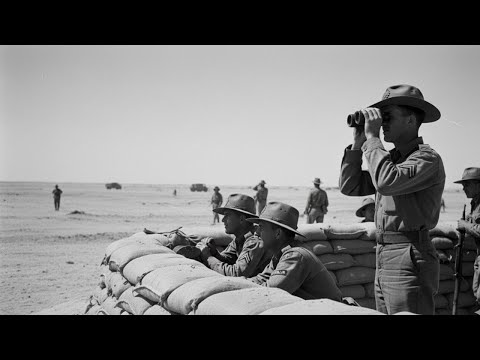
Then Montgomery met Major General Leslie Morshead. Morshead commanded Australia’s 9th Division—20,000 men who had sailed across the Indian Ocean to fight in North Africa. The British officers didn’t think much of the Australians. They called them undisciplined colonials. The Australians didn’t salute properly. They argued with their officers. They wore their uniforms however they wanted. Some British generals thought they looked more like pirates than soldiers.
But the Australians had something the British didn’t have. They had survived the siege of Tobruk. For eight months in 1941, Rommel had surrounded the port city and tried to capture it. 20,000 Australians held him off. They couldn’t fight the way the British army taught. They didn’t have enough men for big frontal attacks. They didn’t have enough ammunition to waste. So they learned a different way. They learned to fight at night, when the Germans couldn’t see them coming. They learned to move in small groups, quiet as shadows. They learned to hit hard and disappear before the enemy could hit back. They learned to stay alive when every rule said they should die.
Montgomery’s planning staff didn’t care about Tobruk. They had their textbooks and their battle plans. They insisted on the traditional approach: artillery bombardment, then massed infantry assault, then tanks pushing through. That’s how the British army had fought for a hundred years. That’s how they would fight at El Alamein.
When Morshead tried to explain what his division had learned, British staff officers cut him off. One told him directly that Australian tactics were too irregular. Another said they lacked the decisive punch needed for a real battle. The British army didn’t need advice from colonials who couldn’t even march in straight lines.
Montgomery himself wasn’t sure what to think. His staff officers had been clear in their opinions. But Montgomery had also seen conventional British tactics fail again and again in the desert. The textbook methods weren’t working. Maybe it was time to consider something different, no matter how irregular it seemed.
That night, Morshead sat with Montgomery and explained his idea. Forget the big breakthrough. Forget sending thousands of men charging across open ground. Instead, attack at night with small units. Move forward two hundred yards, destroy one German position, then stop and dig in. Wait until the next night, then do it again. Keep doing it night after night, grinding down the German defenses piece by piece. Morshead called it crumbling—like crumbling a wall bit by bit instead of trying to smash through it all at once. It would take longer. It wouldn’t look glorious. But the men would live, and the Germans would die.
Montgomery listened in silence. Everything Morshead said went against every lesson taught at British military academies. But Montgomery had seen those lessons fail over and over in the desert sand. Maybe, just maybe, it was time to let the undisciplined colonials show everyone a better way to kill Germans.
The technical details were simple but precise. Each attack would start at exactly 10:00 at night—not 9:59, not 10:01. The artillery would fire for three hours, every eight minutes the shells landing two hundred yards farther ahead. That timing gave the infantry just enough room to move up behind the explosions without getting hit by their own guns. Small groups of twenty to thirty men, boots wrapped in cloth, would destroy one position completely, then dig in and wait for daylight.
In September 1942, six weeks before the battle, the Australians practiced in empty desert. Montgomery sent observers. The British officers brought notebooks and measured everything. When the Australians attacked at night, 60% fewer men got hit compared to daylight attacks. For every ten men who would die in a regular British assault, only four would die doing it the Australian way. The numbers were impossible to ignore—but Montgomery’s chief of staff ignored them anyway, calling the plan too slow, lacking decisive punch.
On October 15th, eight days before the battle, Montgomery drove out to watch one more practice. At exactly 10:00, the artillery started. Then he saw small groups moving through the darkness like ghosts—barely visible even though he knew exactly where to look. When they reached their targets, they attacked from three directions at once. The whole thing was over in minutes. The Australians had just moved three hundred yards, destroyed four practice positions, and gotten back to their starting point. A British battalion doing the same thing in daylight would still be trying to get through the first minefield.
That night, Montgomery made his decision. He gave the 9th Division the most important job in the entire battle. They would attack in the northern corridor, right where Rommel expected the main British push. They would be the tip of the spear. Every other division would adjust their plans to match what the Australians did. It was an enormous gamble—betting the whole battle on methods his own staff said wouldn’t work.
October 23rd arrived. At precisely 10:00 that night, nine hundred guns opened fire at once. The noise could be heard in Cairo, seventy miles away. The ground shook like an earthquake. Behind that wall of explosions, the Australian 9th Division climbed out of their trenches and started walking toward the German lines.
By dawn on October 24th, the Australians had punched four miles into the German defenses. Four miles in one night—farther than any British attack had gotten in the last year and a half. They had captured 600 German soldiers too shocked and confused to fight back. The cost was 300 Australian casualties. Montgomery’s staff had predicted 1,500 for a conventional assault to gain that much ground.
The German commanders were completely confused. Their defensive plans assumed they could see the British coming. But the Australians attacked when it was too dark to see, moved too fast to track, and disappeared before reinforcements could arrive. Rommel’s officers looked at their maps and couldn’t believe what they were seeing. Four miles lost in one night. That wasn’t supposed to be possible.
On October 28th, five days into the battle, Montgomery ordered every Commonwealth division to start fighting the Australian way. His staff officers protested—it would take too long to retrain everyone. Montgomery didn’t care. He had seen the casualty reports. Within three days, 195,000 Commonwealth troops were trying to copy what 20,000 Australians had been doing since Tobruk.
Over the twelve days of the battle, the Allied forces captured 30,000 Axis soldiers using the adapted Australian tactics. Entire German battalions surrendered when Australians appeared out of the darkness behind them. The total British casualties were 40% lower than what Montgomery’s staff had originally predicted.
Rommel wasn’t going to give up without a fight. On November 1st, he gathered his best remaining forces for a massive counterattack—the 15th Panzer Division, one hundred tanks, two thousand infantry. The German attack came at dawn on November 2nd. The Australians heard the tanks before they saw them. They let them come close. They stayed hidden. They waited until the tanks were right on top of them. Then they killed them. Rommel lost 37 tanks and 500 men. The Australian line didn’t budge an inch.
A British officer watching from a nearby hill wrote in his diary that night: “They taught us how to fight at night and not die doing it.” Rommel himself wrote later: “The Australians fought with particular tenacity. Our attacks simply shattered against their defense.” This was the man who had never lost a battle in Africa—and he was saying his attacks shattered against Australian farm boys and factory workers who had learned to fight in the desperate streets of Tobruk.
The contrast with British units using traditional methods was impossible to ignore. The British XXX Corps attacked in the south using conventional daylight assaults. In eleven days, they advanced three and a half miles and lost 4,000 men. The Australian 9th Division advanced six miles in eight days and lost half as many soldiers. Same enemy, same desert, different methods, completely different results.
The story of what happened after El Alamein is almost as important as the battle itself. Within months, military commanders from every Allied nation wanted to know how the Australians had done it. British officers who had called them undisciplined colonials were now begging for Australian instructors. American generals preparing for the invasion of Europe sent observers. Even the Soviet Union requested detailed reports.
By 1955, the modern infantry night operations manual used by NATO forces contained seventeen specific procedures developed by the Australian 9th Division. Everything from the eight-minute artillery timing to the way soldiers probed for mines with bayonets. The word “crumbling” disappeared from official use—military textbooks called it “systematic reduction” instead—but it was the same thing the Australians had invented out of sheer necessity.
Major General Leslie Morshead got promoted after El Alamein. He commanded Australian forces in New Guinea and fought the Japanese with the same methods that had beaten the Germans. But when the war ended and the honors were handed out, something strange happened. Montgomery got a knighthood and became Viscount Montgomery of Alamein. Other British generals received titles and medals and public praise. Morshead got a promotion and a handshake. The British government never offered him a knighthood, even though his tactics had saved thousands of British lives and won the battle that changed the war. When he died in 1959, the newspapers in London barely mentioned it.
This pattern repeats itself throughout military history. Innovation almost always comes from outsiders—from people who aren’t bound by the way things have always been done. The Australian soldiers weren’t graduates of famous military academies. They were farmers and factory workers and shop clerks who learned to fight by fighting, who survived by figuring out what worked instead of what the textbook said should work. They had no choice. Follow the rules and die, or break the rules and live.
The lesson cuts deep into human nature. Formal education matters. Training matters. But necessity and real experience matter more. A soldier who has been shot at learns faster than a soldier who has only read about being shot at. Survival breeds innovation better than privilege ever could. The greatest military breakthroughs don’t come from generals in comfortable headquarters or professors in universities. They come from soldiers who have looked death in the face and decided they would rather change the rules than die following them.
That was true in 1942. That is true today. And it will be true as long as human beings fight wars and face impossible challenges and refuse to give up. The Australians proved it in the sand at El Alamein.
So here’s the question for you: If you were a British general in 1942, would you have listened to the “undisciplined colonials”—or would you have stuck with the textbook and let thousands more men die? Let us know in the comments below.
Report this article
Select a reason for reporting:






