Brigadier General Marcus Webb had earned every star on his collar with blood, exhaustion, and a level of professional dedication most men couldn’t sustain for a week—let alone twenty-two years. West Point top 4%. Korea. Three combat theaters. A counterinsurgency paper that was required reading for six consecutive years. He was not a tourist in this war. He was one of the finest military minds the United States Army had produced in a generation.
And in the summer of 1967, in a tent in Phuoc Tuy Province, South Vietnam, that mind was about to be dismantled by a staff sergeant with hands like tools and a stare that didn’t blink.
The heat in that province didn’t simply warm the air—it occupied it, pressing down from above and rising from the red earth below. Webb had been in country four months. He understood the heat. What he did not understand was why the Australians—fewer than 4,000 personnel—were consistently outperforming American battalions ten times their size. Their kill ratios defied arithmetic. Their casualty rates were so low that liaison officers had quietly begun calling their sector “the quiet zone.” Webb didn’t accept that explanation. Someone had made the enemy afraid. He requested a liaison visit.
The Australians accepted with a courtesy Webb found slightly too polished—as though they’d been expecting the request and had already decided exactly what to show him. One condition: full field conditions, no concessions to rank once the perimeter wire was crossed. Webb recognized it immediately. A test. He had been issuing that same dare to junior officers for fifteen years. He was not about to fail it.
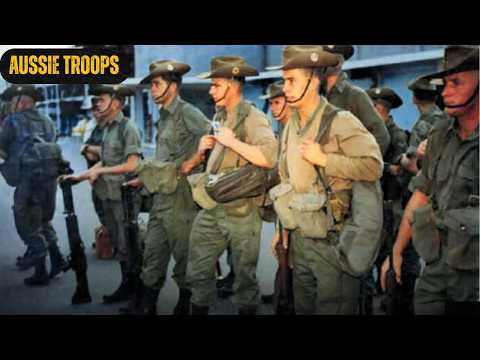
He flew into Nui Dat on a Tuesday morning that smelled of diesel fuel and red dust. What greeted him was not an honor guard—it was a Land Rover driven by a captain named Morrison who saluted correctly and said almost nothing after that. Morrison drove him to a quartermaster tent where a staff sergeant with a face like old leather looked up from a cleaning kit and then immediately looked down at Webb’s boots with an expression Webb had never seen directed at his footwear.
The sergeant’s name was Callaway. Twenty-nine years old. Eleven months in Vietnam. More operational hours in jungle patrol than most officers twice his age—and absolutely no intention of pretending otherwise.
“Your boots are going to get you killed, General.”
Webb’s jaw tightened. He was a general officer. He was a guest. He had walked through jungle on six separate occasions and had not been killed. He said all of this—not with those exact words, but with the tone of a man who expects to be believed.
Calloway nodded with the expression of a man who has been told by the map that a bridge is out, and is watching a driver explain that the map must be wrong. Then he said, “It is not your life I am worried about, sir.” Webb stared at him. Calloway met his eyes without blinking. “It is the lives of the five men you will be standing next to.”
That was the moment. Not dramatic. Not spectacular. Just a staff sergeant in a canvas tent speaking a simple truth to a general who was not accustomed to being contradicted—and the truth was so plain and so irrefutable that Webb could not find the sentence to argue against it. In twenty-two years of military service, no one had ever framed the issue that way. His choices were not about his own risk. They were about the risk he imposed on others simply by being present.
He stood in that tent four seconds longer than he should have. Then he said, “What do you recommend?”
And Calloway began, methodically and without ceremony, to rebuild him from the ground up. The boots went first—Australian jungle issue, softer soles, different tread pattern, almost no sound when placed carefully on wet earth. Then the canteen—collapsible canvas, no sloshing, no clinking. Every metal attachment on Webb’s webbing was removed or taped over. His dog tags went into a cloth pouch pressed flat against his chest. The metal eyelets on his boot laces were wrapped in black electrical tape. His pistol belt was set aside. Calloway handed him an Australian SLR—the L1A1. Heavier than the M-16, different balance, different controls.
“The Viet Cong know the sound of an M-16 firing inside a group of SLRs. They will know something is wrong. They will know you are there.”
Webb held the unfamiliar weapon in hands that had carried rifles for two decades and felt, for the first time since arriving in Vietnam, genuinely uncertain. Not afraid. Uncertain. It was a sensation he had not experienced in a very long time. He did not yet know that this sensation was the most important thing Callaway had given him.
That evening, Morrison walked Webb to the SAS compound—a section of the base separated by its own wire and its own silence. No music. No voices. The guards checked credentials without conversation. Inside, the lights were off. The men who would deploy with Webb the following morning were already sleeping or doing something so close to sleeping that the distinction did not matter.
Webb lay on a cot in the dark and stripped and reassembled the L1A1 by touch until the mechanism felt familiar. Then he stared at the canvas overhead and listened to the jungle outside the wire and thought about the photograph. The men with the wrong hats. The men with the soft boots. The men who had made an enemy that was killing Americans by the thousands decide that one particular province was simply not worth entering.
At 4:30 in the morning, a hand touched his shoulder once. Webb came awake without sound—a skill retained from Korea. A shape stood over him in the darkness. “Time, sir.” Then it moved away without waiting.
The briefing tent was lit by a single red-lens torch. Six men sat on ammunition crates in a horseshoe. None stood when Webb entered. None saluted. The man at the point had eyes that seemed to collect light rather than reflect it. He gestured to an empty crate with the casual authority of a man who had long since stopped distinguishing between ranks. His name was Sergeant Daniel Price. Thirty-one years old. Forty-seven long-range reconnaissance patrols in eleven months.
He spoke without introduction. “Mission is ten days into the long high hills. We watch. We record. We come back. We do not engage unless we have no choice. If we have no choice, we break contact and we move. We do not hold ground. We do not chase. We do not call for support unless we are already dying and there is nothing else left.” He paused and looked directly at Webb. “You are third in the order of march. You step where Davies steps. You stop when Davies stops. You breathe when I breathe. Any question you have, you keep until we are back inside this wire. Outside the wire, silence is the only answer to everything.”
Webb had commanded men in combat. He had taught tactics at the War College. He had written doctrine that shaped the training of hundreds of officers right now executing operations based on his ideas. And sitting on that ammunition crate in the red darkness, he felt something he had not expected. He felt like a recruit. Not a humble man pretending. An actual recruit at the beginning of something he did not yet understand, in the presence of a man who understood it completely.
They moved out at five. Single file through the perimeter wire and into the tree line. Within thirty seconds, Webb understood that everything he knew about moving through jungle was approximately correct for a different war, in a different country, against a different enemy. He had learned to move through terrain. The Australians moved through sound. Every step was placed with the deliberateness of a surgeon, and the pace was not slow in the way that caution is slow. It was slow in the way that invisibility is slow. In forty minutes, they covered perhaps 250 meters.
Webb’s instinct screamed. American doctrine was built around speed and aggression—finding the enemy, fixing him, destroying him before he could disperse. 250 meters in forty minutes was not a patrol. It was a crawl. It was surrender of the initiative. He wanted to say something. He looked at Davies ahead of him, moving with the fluid, economical silence of something that had grown up in exactly this kind of darkness, and he kept his mouth closed.
At 6:45, Price froze mid-step. Not a gradual deceleration—a complete and instantaneous stop, as though someone had removed the current from a machine. The signal traveled back in a fraction of a second. Webb pressed himself into the root structure of a teak tree and breathed very carefully through his nose. Five minutes passed. Then ten. His right leg began to cramp. He did not move. Insects landed on his face and neck. He did not move.
Then he heard them—voices, Vietnamese, quiet and conversational, moving along a trail Webb had not even registered as a trail, thirty meters to the north. Four men appeared in the gap between the vegetation, then eight, then twelve, then more. Heavy weapons. Ammunition loads. The relaxed pace of soldiers who believe they own the ground they are walking on.
Webb’s entire nervous system aligned into a single impulse: ambush. The situation was perfect. The enemy’s flank was exposed at a range where missing was almost impossible. The patrol had surprise, cover, and the initiative. This was exactly the kind of engagement that American after-action reports were built on, that careers were advanced on, that the Pentagon’s kill-ratio spreadsheets demanded. His finger found the safety selector of the L1A1—and he looked at Price and saw something that stopped his heart cold.
Price was not preparing to fire. Price was watching. Just watching. With the absolute unhurried attention of a man reading a book he has read before, taking note of details he missed last time. His face was the face of a scientist. His face was the face of a man who had already decided that these particular pieces on the board were more useful alive and moving than dead and still.
The column passed. Webb counted thirty-eight men. He watched them disappear into the green wall and felt something he recognized with some embarrassment as rage. He had been a soldier for twenty-two years. He had sat in briefing rooms and been shown photographs of enemy supply routes and told that the problem was locating the enemy—that the Viet Cong were ghosts, that they melted away before American patrols could bring them to contact. And he had just watched thirty-eight of them walk past at a distance he could have thrown a stone across. And a thirty-one-year-old sergeant from a country whose entire GDP was smaller than the Pentagon’s annual procurement budget had decided—without hesitation, without apparent regret—to let them go.
When Price signaled the patrol to move, Webb crawled forward and caught his sleeve. The gesture alone violated three of the rules he had been given. Price turned and looked at him with eyes that contained no anger and no impatience. Only the same calm evaluation—as though Webb’s confusion were a weather pattern he had observed before and knew how to read. Price put his mouth close to Webb’s ear and spoke in a voice so quiet it was almost indistinguishable from the ambient sound of the jungle.
“We have their direction of march, their weapons load, their strength, their pace, and their trail. In three days, rifle companies will use everything we just recorded to find their base camp and destroy it and everything in it. If we fire now, we kill nine, maybe twelve, and every Viet Cong within five kilometers knows exactly where we are and exactly what size force we are. We trade twelve bodies today for our six bodies tomorrow morning.” He pulled back and looked at Webb. “We are not here to count coup, General. We are here to think.”
Webb lay in the rotting vegetation of the jungle floor and felt twenty-two years of professional certainty rearrange itself around a new center of gravity. He had been trained to see the enemy as a target, as a problem to be solved with violence, as a variable to be eliminated from the equation. And Price was telling him—with the patience of a man explaining something obvious to someone who should already understand it—that the enemy was information first and a target second. That restraint was not cowardice. That silence was not passivity. That the most powerful thing a small patrol could carry into the jungle was not a weapon, but a camera and a map, and the discipline to use them correctly.
The third day brought the first test. Price halted the line with a signal so small Webb almost missed it—then pointed back along their own trail. They were being followed. Webb’s instinct screamed: speed, distance, radio. But Price turned the patrol back toward the threat, looping off the trail to overlook the path they had already walked. They were not fleeing the hunter. They were becoming the ambush.
Three trackers appeared, crouching over boot impressions two meters from where Webb lay. He could see the man’s eyelashes. The tracker stared at the ground for two full minutes, stood, and moved on—convinced their quarry was still ahead.
On the sixth day, contact came with no warning. “Go.” Five rifles fired as one, then the patrol simply vanished. Behind them, mortars shredded the empty ground where they had stood thirty seconds earlier. “We gave them nothing to hit,” Price said. “That is the whole job, General.”
Back at Nui Dat, Webb faced Jackson. “I was wrong.” He wrote it all down—thirty-two pages.
Calloway was killed four months later. Webb kept the notebook for the rest of his career. The jungle has one question: are you paying attention, or are you making noise?
So tell us—which kind of soldier are you?
Report this article
Select a reason for reporting:






