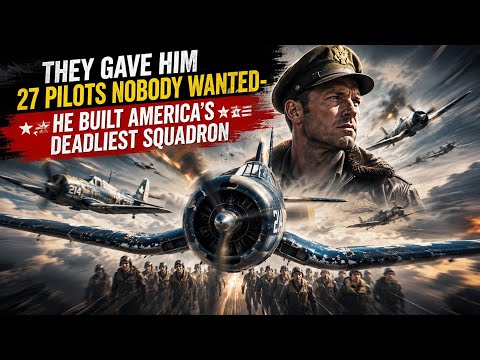
In the early hours of September 1943, a decision was made on a Pacific island that seemed utterly insignificant. A squadron number—VMF-214—unused for six weeks, was assigned to a major with a troubled file and no unit. The man was Gregory Boyington: thirty years old, court-martialed, with a reputation that followed him across two continents. Within four months, the squadron he built from that empty number would destroy 97 Japanese aircraft in 84 days of combat, produce nine ace pilots, and earn a Presidential Unit Citation. Boyington himself would be shot down over Rabaul, listed as missing, awarded the Medal of Honor while the Marines believed him dead, and then pulled from a prison camp near Tokyo after 20 months—by men who had spent two years honoring a corpse.
None of that was clear in September. What was clear was a major nobody wanted, holding a squadron number nobody claimed, waiting for pilots being cut from other rosters. To understand why the Marines put Boyington in that position, we must read the file that accumulated behind him in reverse. The institution did not misjudge the man. It assessed him correctly—then failed to notice that the same traits that made him unfit for peacetime service would make him lethal in a war it had not yet fought.
Born in Coeur d’Alene, Idaho, in December 1912, he grew up mostly in a logging town in Washington called St. Mary’s, where the sawmill set the rhythm of everything. He was small, broad-shouldered, and physically stubborn in a way that pushes a boy into wrestling. That stubbornness took him to the University of Washington, where he studied aeronautical engineering, wrestled on the varsity team, and worked summers in a mining camp carrying tools.
His engineering training mattered later in ways easy to overlook. Boyington understood airframes, loads, and the math of what a wing could take. When he later flew a plane the Navy considered difficult, he flew it with precise knowledge of how much stress the structure could endure before it stopped being an airplane.
He joined the Marine Corps through the reserve officer training program. He went to Pensacola in 1936 and got his wings in March 1937. Early fitness reports were unremarkable: competent, aggressive in the air, a natural formation pilot. Had his career stopped there, he would have been just another capable interwar pilot in a service full of them.
But it didn’t stop there. Boyington drank in a way his generation tolerated, yet it was noticed. He brawled in bars and sometimes outside them. He married young, had three children, but the marriage collapsed under alcohol and money that was never there when needed. Creditors wrote to his commanders—which in the late 1930s Marine Corps was not just a personal embarrassment but an official one. An officer’s debts were a matter of military business. By 1941, there were formal complaints in his file about unpaid bills, and the finance office had begun the slow bureaucratic process of court-martial.
That was the year the Central Aircraft Manufacturing Company began secretly recruiting American military pilots to serve in China. The arrangement was designed to look like private employment. Pilots resigned their commissions, signed civilian contracts, and traveled on passports describing them as missionaries, students, or agricultural experts. The pay was $600 a month plus a $500 bonus for every confirmed Japanese plane destroyed. At a time when a Marine first lieutenant earned a fraction of that—and with a court order garnishing his wages—the math was not complicated. Boyington resigned in August 1941 and sailed for Burma.
He flew P-40s with the American Volunteer Group—the outfit the world would soon call the Flying Tigers. He was there during the months when a small force of outdated fighters and improvised tactics halted the Japanese advance at Rangoon and the Burma Road. He was, according to the men who flew with him, aggressive, combative, frequently drunk, and very hard to kill. He claimed six kills in China. AVG combat records credited him with far fewer, and the argument over those numbers has persisted ever since among people with the same documents drawing different conclusions about how to read them.
The most conservative reading gives him two aerial victories. Some tallies allow higher numbers when adding aircraft destroyed on the ground—a category the AVG paid for but the U.S. military did not count. Boyington insisted on six for the rest of his life. The discrepancy is small in absolute terms but enormous in what it ultimately meant, because a decade of American aviation history ended up resting on the truth of those numbers.
He left China in April 1942 under circumstances that were not honorable in any light. He had clashed repeatedly with Claire Chennault. There were unpaid bills in Kunming and a departure that broke his contract. AVG records classified his termination in terms that closed several doors behind him.
He returned home four months into a war, expecting a welcome for a man with combat experience against Japanese aircraft. He did not get one. The Marine Corps, from which he had resigned in 1941, had its own file. He was thirty—an age the fighter community considered old—and he had voluntarily left the service during a national emergency to fly for money. He spent months in Washington pacing corridors, sitting in waiting rooms, pleading his case to anyone who would listen. He wrote letters. He used every name he knew. Eventually, his reinstatement was approved: he was promoted to major and sent to the Pacific.
Even then, the pattern held. He arrived in the New Hebrides, was assigned to VMF-122, and served as executive officer without making any notable mark during a period when the fighting had moved beyond Guadalcanal. Then he broke his leg. The story later told involved a drunken evening and a fall; Boyington’s own account and the official one do not agree on the details. What is not disputed is that the leading fighter squadrons in the combat theater were now stuck with a thirty-year-old major, a healing leg, no combat victories in American service, and a file that made every commander wonder what had been handed to him.
So when the empty squadron designation VMF-214 came up and Boyington lobbied for it, the decision to assign him there was not born of confidence. It was closer to offloading a burden. The Marine Corps had a squadron number, a major with no better use, and a flow of pilots coming through the replacement pool at Turtle Bay on Espiritu Santo who needed somewhere to go.
Here the popular story and the documentary record begin to diverge—and we should slow down, because that divergence is the most interesting thing about the whole case. The story, as usually told and as Boyington himself told it in his 1958 memoir, is that he took the Marine Corps’ castoffs, misfits, and men their previous squadrons had abandoned—disciplinary cases, brawlers, pilots no commander could control—and turned them into the deadliest fighter squadron in the Pacific, thereby proving the military establishment wrong about them all at once.
Personnel records complicate this. Of the 27 pilots who formed the original squadron, most were simply replacement pool pilots—the way every fighter pilot in the theater rotated between assignments. Some had already flown combat tours in the Solomons and scored aerial victories. Some were fresh from training and had never seen combat. A few had records with real problems. What they shared was not disgrace. It was availability. They were in transit within a theater that produced men in transit constantly. Boyington took them because they were available, and because he needed 27 bodies in less than a month.
That does not make the myth a lie. It makes it a shorthand for reality. What Boyington actually did was harder and less romantic than simply assembling rejects. He took a group of pilots who had never flown together, had no shared training cycle, no established formation habits, and no reason to trust one another—and made them work efficiently in less than four weeks in the most dangerous airspace in the Pacific. Squadron cohesion is usually built over months in rear areas. He did not have those months. He had until operations began.
The name came from the men in a tent at night doing what pilots do when given an empty identity. Someone suggested “Boyington’s Bastards,” a name that described the situation with a precision no one could refute. It was accurate about their commander, their status, and the circumstances of their birth. A public affairs officer pointed out that no U.S. newspaper would print it—which was true and consequential in 1943, because squadrons that attract press attract support. The alternative was “the Black Sheep.” It carried the same meaning in an acceptable form. It was a name the sergeants would let pass.
They designed a patch to match. A shield with a black sheep, a diagonal bar across it, a Corsair silhouette, and 12 stars. The diagonal bar is the heraldic mark of illegitimate service. They put it on the planes. Whatever the personnel records said, the squadron had decided what it would be, and painted that decision on the side of its aircraft before it shot down a single enemy plane.
The Corsair they were given—the Vought F4U—deserves its own pause, because the plane was as much a part of what happened as the men who flew it. It was the fastest carrier-designed fighter in the world when it appeared, built around the Pratt & Whitney R-2800 Double Wasp, an 18-cylinder radial generating 2,000 horsepower. The propeller needed to absorb that power was 13 feet in diameter, which created a ground-clearance problem and produced the bent wing that made the aircraft instantly recognizable. It carried six .50-caliber machine guns and could absorb punishment that would have destroyed the fighters it faced.
The Navy had also decided it was not ready for carrier operations. The long nose blocked forward visibility on approach. Low-speed stall behavior was abrupt and unforgiving, and the landing gear bounced hard enough to lift the plane back into the air over the arresting wires. Carrier qualification was deferred. The plane went to the Marines, who flew it from grass strips and steel matting on islands where the runway does not move. Pilots called it “the Ensign Eliminator,” and it was not a term of affection. It killed men in training. It killed men on the landing pattern who had survived everything the Japanese had thrown at them.
But when flown by someone who understood what it was, it was a machine that could dictate the terms of a fight. It was faster in level flight and in a dive than the Zero. It could not turn with a Zero, and any pilot who tried did not live long enough to make the mistake twice. The correct use of a Corsair was to arrive from high altitude with speed, make one pass, and leave with the same energy you came with. The Zero, in the hands of a skilled pilot, was still the best close-in dogfighter below 300 knots. Its weakness was structural. It had no armor behind the pilot and no self-sealing fuel tanks, because Mitsubishi had traded protection for the weight savings that gave it its extraordinary maneuverability. Half a second of .50-caliber fire in the right place ended it. Corsair pilots who learned to push the fight into the vertical, where their power and dive speed gave them an advantage the Zero could not match, won consistently. Those who tried to turn with it died.
Boyington had flown P-40s in China against Japanese aircraft, and the P-40 had taught him the same lesson with a smaller engine: dive, shoot, climb high, come back. He understood the Corsair’s advantages from the moment he flew it. He understood something else too—that a squadron of pilots who had not trained together could fight well if the tactics were simple enough to execute without communication.
That was the second thing he did after taking command. He reduced what he taught them to the simplest possible form. The doctrine he pushed in every meeting was not clever. It was that the man behind you is the reason you are alive, and you are the reason he is. Nothing you do personally in a fighter matters as much as the survival of the pilot assigned to your section and his coverage of the airspace behind your tail. Gunnery skill was useful. Aggression was useful. But neither would save a pilot who was jumped from above by an enemy his wingman never called out.
This was what the Marine Corps taught. Every fighter organization on both sides taught it. What Boyington did was refuse to leave it as a principle and make it the only principle, because he had four weeks and could not build a complex system. The pilot who breaks formation to chase a target is stealing the protection of the man he was assigned to protect. That was the frame—not a discipline problem, but a theft. It landed on a group of aggressive, confident pilots in a way a lecture on formation safety would not have.
There is a version of this story that presents those instructions as a paradox, because the men were supposed to be individualists being told to conform. The paradox is mostly literary. Aggressive fighter pilots understand mutual protection immediately because the math is clear and the consequences of getting it wrong appear within a week of reaching combat. What Boyington gave them was not a radical conversion. It was a short list they could execute on their first mission without ten months of training.
They flew that first mission from the Russell Islands in mid-September 1943. They escorted bombers, then began working forward through the airfields the Americans had taken and rebuilt as the Solomons campaign rolled north. Munda on New Georgia, which had been a Japanese airfield weeks earlier and still smelled like one, came later. From those strips, the squadron flew escort for B-24s, Dauntlesses, and Avengers, and ran fighter sweeps whose only purpose was to go where the Japanese were and provoke a response.
The strategic situation shaped everything they did. The entire American effort in the South Pacific was pointed at Rabaul, on the northeastern tip of New Britain—the fortress that anchored Japanese power in the region. Rabaul had a magnificent natural harbor, five airfields, roughly 100,000 troops in the area, and a concentration of naval and land-based aviation that had been reinforced steadily since 1942. Everything the Allies did in the Solomons was pressure directed toward it.
For their part, the Japanese were losing something in those months that was harder to replace than aircraft. Their naval aviators before the war had been the best-trained carrier pilots in the world—the product of a selection process so rigorous it produced small numbers of exceptional men. Those men had been dying since the Coral Sea, Midway, and the long attrition of Guadalcanal. Their training pipeline could not produce replacements of the same quality or at the same rate the war demanded. By late 1943, the average experience level of Japanese fighter pilots over the Solomons was far below that of their American opponents, and the gap was widening every month.
That is the context in which the Black Sheep’s numbers should be read. They fought well. They also fought at a time when an American squadron flying a superior aircraft with sound tactics could inflict losses on an opponent who had already sent his best men. Both things are documented in the records. The squadron’s achievement is not diminished by the second, but the history that omits it is not history.
The shoot-downs began almost immediately. In the first week of the first tour, the squadron was scoring, Boyington was scoring personally, and the pattern of the campaign set in. The squadron would fly north, meet Japanese fighters over Kahili or Ballale or Bougainville, and come home with confirmed kills. Not every mission produced an engagement. Many were long, boring, uncomfortable hours strapped into a cockpit over water doing nothing but holding position and watching the sky and hoping the engine kept running, because a Corsair with a failed engine over those stretches of ocean was a death sentence with a slow fuse.
Pilot names began to be known. Chris Magee, who had also flown in China with the AVG and who read philosophy in his tent and refused to wear a parachute, finished his tours with nine kills. John Bolt, who would later become the only Marine ace in two wars, flying Sabres over Korea. Bob McClurg, Don Visser, Bill Case. Nine of them reached five kills or more—an exceptional concentration for a unit that lasted only four months. And Boyington, who had been told he was too old, began scoring in a way no one in the theater could ignore.
On October 4 over Bougainville, he shot down three Japanese fighters in a span post-action reports estimated at about a minute. He wrote it up in the dry administrative prose combat reports require, and the number went into the record, and the record began to attract the attention of correspondents who were always looking for a story they could shape into a headline.
The story they found was the radio taunts, and the day those taunts became famous was in mid-October over Kahili. Kahili was the Japanese airbase on southern Bougainville, protected by a large fighter force. Boyington took a formation of Corsairs there, circled the field where the Japanese could see him, and broadcast a challenge on a frequency he knew they monitored. He told them his altitude. He told them his position. He invited them up.
One account says he did it in Japanese using phrases he had learned; another says a Japanese controller answered in English and gave him a wrong altitude, so Boyington positioned above that altitude and waited for the Zeros to climb to the place he had chosen. The details differ between accounts, as Boyington’s own accounts changed over the years. What the records confirm is that the taunts happened, that they were broadcast clearly, and that they succeeded at least once in setting up a major engagement that went the Americans’ way.
The announced result of the Kahili sweep was 20 Japanese fighters destroyed with no American losses. Post-war comparison of Japanese loss records with American claims—conducted systematically for most major Pacific battles—indicates that claims by all air forces on all sides were inflated, often by more than double. This was not lying. It was the nature of combat in which multiple pilots fire at the same aircraft and see smoke they believe is destruction, and no one has time to watch a target until it hits the water. The Kahili numbers are almost certainly inflated, as are the corresponding Japanese claims for the same day. The engagement, however, occurred. The Americans were the stronger side, and a squadron one month old had made that happen.
What matters more than the exact count is what those taunts did to the American side. Boyington was doing something to his pilots when he keyed the microphone. A formation that announces its position and invites a fight enters the battle in a different psychological posture than a formation waiting to be attacked. He was setting the terms before the engagement began. His commanders called it reckless, and it was, but after Kahili they stopped saying it where reporters could hear.
The squadron finished its first combat tour in the second half of October and went to Australia for rest—which for these men meant two weeks in Sydney behaving in ways that left marks on their records. Then they came back.
The second tour began in late November and ran to the first week of January, and it was flown over harder ground. The target now was Rabaul itself. The Americans had secured the western coast of Bougainville and built an airfield at Torokina, bringing their fighters within reach of New Britain. From late December, the strikes went directly to Rabaul, into airspace defended by the largest remaining block of Japanese air power in the theater.
Boyington’s personal tally climbed through those weeks. He scored four in one day over Rabaul just before Christmas. The count passed 20 in naval service, and the press that had discovered him began doing the arithmetic in public. The arithmetic was about a record. The American record for aerial victories at the time stood at 26 by Eddie Rickenbacker from World War I, and within the Marine Corps at Joe Foss’s 26 over Guadalcanal. If Boyington’s six China kills were counted, he had reached or passed that number. If only his officially credited AVG victories were counted, he had not. Everyone involved understood the ambiguity and most chose to ignore it. The reporters needed a number, and Boyington gave them one. Headquarters, which wanted the story for reasons that had nothing to do with accuracy, did not correct the record firmly. Boyington himself, who had been arguing about those six kills since Kunming, was not about to start conceding them now.
So a thirty-one-year-old major flew into the most heavily defended airspace in the South Pacific in the last days of December and the first days of January, with reporters waiting at Torokina for him to come back with the number. It is difficult to read the record of those final missions without noticing the pressure that had been built around him, and difficult not to wonder at the pressure he was under.
On January 3, 1944, Boyington led a strike of about forty-four fighters to Rabaul. It was his 125th combat mission across two wars and two air forces. The formation broke up, as such things usually do, into individual engagements scattered across thousands of feet of altitude. Boyington and his wingman, Captain George Ashmun, dropped behind Japanese fighters flying below them. Ashmun was a good pilot doing exactly what he had been taught: he stayed with his leader. Both engaged a much larger number of Japanese aircraft, and Ashmun’s Corsair was hit and caught fire. Boyington tried to drive the fighters off him. Ashmun went into the water and did not come out. Boyington claimed two kills in those minutes, which would have brought his total to 26 in naval service and 28 with China. Then his own Corsair was hit in the fuselage at the main fuel tank. Fire spread beneath him, and there was no time. He got out at low altitude, fell fifty feet to his parachute, and landed in the water off New Britain.
Japanese aircraft found him in the water and strafed him. He was hit in several places from the fight and the jump and the strafing runs, and he stayed in his raft in the open sea while aircraft passed over him. After several hours, a Japanese submarine surfaced near him and took him aboard.
The identity of the pilot who shot down Boyington remained disputed for nearly eighty years. A Japanese pilot named Masajiro Kawato claimed for decades that he had done it, gave interviews, met Boyington, and built a public identity around the claim. Later research in Japanese unit records indicated Kawato was not flying in that engagement, and the claim is now generally regarded as unsupported. Boyington, who spent his life defending his disputed numbers, was gracious about it in public and skeptical in private. The most honest answer available is that the pilot who put rounds into his engine and tank over Rabaul that morning was not identified in any surviving record.
What happened next was outside the war as most people understood it. Boyington was moved to Rabaul, then Truk, then Japan, where he was not handed over to the POW system but to a facility at Ofuna near Yokohama that was not registered with the Red Cross and whose prisoners did not officially exist. A naval interrogation center. Its inmates were aviators and submariners the Japanese believed had technical intelligence value, held without POW status, without notification to their governments, and without any of the protections that status entailed.
The conditions have been documented in detail by the men who survived them. Interrogation, beatings administered by guards on a schedule that had nothing to do with anything the prisoners did, and starvation rations for men who arrived already injured. Boyington was later moved to Omori, a camp built on an artificial island in Tokyo Bay, where he was put to work and survived the last year of the war watching B-29s pass overhead. He spent 20 months in Japanese hands. He came out weighing far less than he had gone in.
Meanwhile, the war continued without him, and the squadron he had built did not outlast him by more than a week. The Black Sheep’s second combat tour ended on January 8, five days after he went into the water. The pilots were returned to the 11th Marine Aircraft Group replacement pool and distributed to other units. The squadron designation was later reactivated with an entirely different set of men, and they flew from the carrier Franklin in 1945, where they took heavy losses in the kamikaze attack that nearly destroyed the ship. But the Black Sheep as an organization—as a specific set of men who flew for 84 days over the Solomons—ended in the second week of January 1944.
Their final record was 97 Japanese aircraft destroyed, plus others damaged and strafed on the ground. Nine ace pilots, a Presidential Unit Citation, and a commander whose fate no one knew. The Marine Corps listed Boyington as missing in action. No confirmation of his capture came through any channel. The Japanese did not report him because prisoners were not reported. His plane did not return. His wingman did not return, and the men who saw him last saw him going down low over the water with fighters around him.
In March 1944, two months after Rabaul, the Marine Corps submitted a recommendation for the Medal of Honor for him. The citation described the air operations, the total kills, the command of a squadron assembled from available pilots, and the results it achieved. It was written about a man the Corps had every reason to believe was dead.
That fact deserves a moment, because of what preceded it. The institution that had processed Boyington’s debts, that had noted his drinking in fitness reports, that had told him he was too old to fly fighters and taken months to grant him the reinstatement he had to beg for in the corridors of Washington—that institution was now preparing the paperwork for its highest award, not as a reward to a living officer it had decided to promote, but as an obituary.
He was alive in Tokyo Bay, in a camp that did not appear on any list, and the medal did not reach him until another year and a half had passed.
American forces reached Omori in late August 1945. The prisoners had known for weeks that something had changed—from the absence of raids, from the behavior of the guards, from the supply drops that came down from the sky in the final days. Boyington was liberated on August 29 and came home to a country that had spent nearly two years memorializing him. There were parades. There was a war bond tour. There was a press corps that had made him a legend and was now delighted to discover the legend was alive.
Somewhere in that period, a reporter hung the nickname “Pappy” on him on the grounds that he was a decade older than the men he had led, which the public loved, and it stuck for the rest of his life. His pilots had mostly called him “Gramps.”
On October 5, 1945, at the White House, President Harry Truman put the Medal of Honor around his neck. He also received the Navy Cross for the same period of service. The citation Truman read was the one written in the spring of 1944, when everyone believed they were honoring a dead man. He was 32 years old. He had the Medal of Honor, the Navy Cross, 22 officially credited victories in American service, 28 claimed, and no idea what he was going to do next.
What happened next is the part the story usually skips quickly. Boyington’s post-war life was not three decades of unrelieved grimness. The Marine Corps had no clear use for him. He was a national figure with a personnel file, but the peacetime service that emerged after 1945 was less accommodating of him than the wartime one had been. He retired in 1947 and was advanced to colonel on the retired list on the basis of his combat awards—an administrative honor, not a command. The alcoholism that the war had given a purpose and a context no longer had either. He worked as a beer salesman, a wrestling referee, a jewelry salesman, and a series of other jobs that did not last. Marriages began and ended. Money remained a problem, exactly as it had been in 1939. He was, for a stretch in the 1950s, a Medal of Honor recipient with a drinking problem and no career—a category the country has never quite known how to handle.
He wrote a book, Baa Baa Black Sheep, published in 1958, which sold well and shaped the story permanently. It is vivid, funny, self-aware, and unreliable. Boyington was honest about his drinking in a way that was unusual for the period, and imprecise about operational details in a way that historians have been correcting ever since. The idea of the castoffs, the rejects, the squadron of the unwanted was largely his creation, built on top of a real squadron whose actual composition was more ordinary, and it did not diminish what he had done.
In 1976, NBC turned the book into a television series, and a generation that had never heard of Rabaul learned about the Black Sheep from a show that treated the whole thing as a comedy with airplanes. Several surviving pilots objected publicly to the way the series portrayed them. The show ran for two seasons.
He sobered up eventually and spent his later years talking about alcoholism to people who needed to hear it from someone who had lived it. He signed autographs at air shows. He went to squadron reunions and sat with men who were now in their sixties and had been twenty-three over Bougainville. He died on January 11, 1988, at 75, and was buried at Arlington.
So what is actually in this record, once you strip away the television series and the memoir and the wartime headlines? A squadron that lasted four months and destroyed a large number of enemy aircraft in a period when aircraft and tactics and the declining quality of Japanese pilot training all converged in one direction. A commander who had a genuine talent for making unpolished pilots effective quickly, who understood a difficult airplane better than most, and whose willingness to provoke a fight produced results in a campaign whose only purpose was attrition. A group of pilots who were not rejects but were assembled from a pool with no shared history, and who fought better than a unit formed that way had any right to. And underneath it, the thing the myth was reaching for, even when it got the facts wrong.
The Marine Corps assessed Gregory Boyington accurately every time it evaluated him. He was a problem drinker who did not pay his debts and did not respond well to authority, and he had left two organizations under clouds. Every officer who read that file and concluded he was a risk was reading it correctly. There was no failure of oversight. The system worked as designed. What the system could not do was distinguish between a man who was unfit and a man who was unfit for peacetime. The traits that made Boyington a burden in a barracks in 1940—the refusal to accept orders he considered stupid, the willingness to enter situations everyone else avoided, the indifference to how things looked as long as they worked—were the same traits that made him useful over Rabaul in 1943. The file had no box for that. Files do not.
He got through because he would not stop arguing, and because a sympathetic officer signed a piece of paper at the right moment. That is the entire gap. Remove the argument or the signature, and Boyington spends the war commanding a training unit, and the name VMF-214 goes to someone else, and none of this exists.
The uncomfortable question the record leaves behind is not whether the Corps misjudged him. It is how many identical files were read the same way, correctly, by conscientious officers applying reasonable standards, and their owners were turned away. Those men are not in the history books because the thing that would have made them visible never happened to them. Boyington is the exception the argument rests on. Exceptions are thin evidence.
The squadron flew for 84 days. It was assembled in less than four weeks by a man under a court order to garnish his own wages. Its aircraft was the type the Navy had refused to put on carriers, and its airspace was the one everyone else worked to avoid. Nine of its pilots became aces. Its commander went into the water on his 125th combat mission, was strafed in his raft, picked up by a submarine, and spent 20 months in a camp that did not officially exist while his country awarded him its highest honor on the assumption that he was dead.
All of it is documented. The primary sources are in the description, and they are more precise and more interesting than any summary of them, including this one. What those sources do not contain is an answer to the question: how do you build a selection system that screens out the truly unfit without also screening out the Boyingtons? Eighty years of people reading the same documents has not produced an answer to that one either.
So here is the question I leave with you: if the same file landed on your desk today—the debts, the drinking, the insubordination, the wreckage of a career—would you have the judgment to see the war fighter buried inside the problem, or would you do the sensible thing and sign the rejection?
Report this article
Select a reason for reporting:






