Imagine a pitch-black night in the dense jungles of Phuoc Tuy province, Vietnam. A four-man Australian SAS patrol lies motionless, meters from an enemy camp. They are not just silent—they are invisible, their bodies coated head to toe in black mud and charcoal, completely naked save for their weapons. This was not madness. It was a calculated tactic born from desperation, a radical solution to a deadly problem that threatened mission success and the lives of every trooper.
The Australian Special Air Service Regiment (SASR) operated deep behind enemy lines, conducting long-range reconnaissance and prisoner snatch missions. Their enemy was not only the Viet Cong and NVA but the brutal jungle itself. The relentless monsoon and sweltering humidity turned their uniforms into instruments of torture. Wet clothing caused severe fungal infections, agonizing skin rot, and—most critically—noise. Every movement produced a betraying swish and squelch that could alert sentries and doom the patrol.
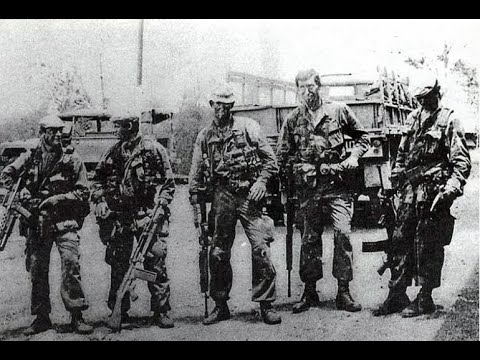
Faced with this catch-22, the SAS commandos made a decision that defied military doctrine: they stripped off their uniforms entirely. “To eliminate the noise, they had to eliminate the uniform itself,” one veteran later explained. Naked, their acoustic signature dropped to near zero. They moved like shadows, their skin blackened with mud to break up the human silhouette. They became the black ghosts—silent, terrifying phantoms that haunted the enemy’s worst nightmares.
The physical cost was immense. Leeches, ants, thorny vines, and infections tormented their exposed bodies. But the psychological impact on the enemy was devastating. “When a sentry saw a glistening, naked figure rise from the ground without a sound, primitive fear took over,” recounted one SAS officer. That split-second of paralysis was all the troopers needed to strike. The naked patrols were not an act of madness but a testament to extreme discipline and sacrifice, pushing human endurance to its limit in the quest for absolute silence.
This is the story of how a few brave men, covered in mud and armed with nothing but their wits and weapons, became the most feared ghosts of the Vietnam War.
The naked patrols were never official doctrine. They were born in the field, passed between troopers in hushed briefings, refined by trial and blood. A patrol leader had to weigh the mission’s demands against the terrible vulnerability of his men, and the call was never made lightly. “You didn’t strip off for a stroll,” one veteran recalled. “You did it because the job required you to be a ghost, and ghosts don’t wear boots.”
The transformation began hours before the final approach. The men would find a concealed patch of deep mud or a slow-moving creek, and there, in near-total darkness, they would strip away every layer of their identity—uniform, webbing, boots, even their dog tags. Each item was carefully cached or buried, to be recovered only if the patrol survived. What remained was a rifle, a knife, a radio, and the raw human animal beneath.
The mud was applied with the same care a painter gives a canvas. Faces, necks, arms, legs, feet—nothing was left pale. The troopers understood that a single gleam of skin could catch a sliver of moonlight and betray them all. They worked the mixture into every crease and hollow, then checked one another in the dark, running fingers over shoulders and spines to find any missed patch. “You became the ground,” another recalled. “Not like the ground. You became it.”
Then came the crawl. With no fabric to snag on thorns and no gear to rattle against itself, the men could move in ways impossible for a fully equipped soldier. They slithered through vine thickets that would have trapped a uniformed man, pressed their bodies into the contours of the earth, and slipped through shallow water with barely a ripple. Their breathing was measured, their movements glacial, each limb placed with the precision of a surgeon.
Enemy sentries, meanwhile, stared into a jungle they thought they knew. They listened for the telltale sounds of a patrol—the snap of a twig, the clink of metal, the rustle of canvas. They heard nothing. And when a shape finally resolved from the darkness—wet, black, and utterly silent—it was already too late. The hesitation that followed was not cowardice; it was the mind refusing to accept what the eyes reported. In that frozen instant, the black ghosts closed the distance.
Yet the tactic demanded more than courage. It demanded a kind of surrender—to the jungle, to the mud, to the fear that never fully left a man’s chest. The troopers who carried out these patrols did not speak of them often afterward, and when they did, their voices carried a weight that words struggled to hold.
Not every patrol ended in legend. Some ended in silence of a different kind—a man left behind in the mud, his body never recovered, his name spoken only in the regiment’s private rituals. “We lost good men out there, and the jungle kept them,” one veteran said, his voice flat. “That’s the price nobody puts in the citations.”
The naked patrols were eventually phased out as the war wound down and the SASR withdrew from Vietnam in 1972. But the lessons—and the scars—remained. The regiment’s reputation for extreme stealth and ruthless efficiency was cemented, and the black ghosts passed into the quiet lore of special forces, a story told to new troopers not as a boast but as a warning about what the job could demand.
Years later, historians and veterans would debate whether the psychological terror inflicted on the enemy justified the physical toll on the troopers themselves. There is no clean answer. War rarely offers one. What remains is the image: a handful of men, stripped of everything but their weapons and their will, crawling through the dark to become something the enemy could not name and could not fight.
“We weren’t trying to be heroes,” one of them said, decades on. “We were trying to do the job and get our mates home. The mud, the nakedness—that was just the cost of silence.”
And perhaps that is the truest legacy of the black ghosts: not the terror they inspired, but the discipline they embodied—the willingness to shed every comfort, every protection, every trace of self, for the mission and for the men beside them.
What would you have done, facing that same choice between safety and silence?
Report this article
Select a reason for reporting:






