In the dying light of 1942, two mighty fleets slipped through the black waters of the Atlantic, their destinations unknown, their mission cloaked in absolute secrecy. This was Operation Torch—the largest amphibious invasion in history up to that point—and it would change the course of World War II. As the ships converged on North Africa, thousands of young soldiers—farm boys from Kansas, shopkeepers from London, and veterans from Dunkirk—prepared for a battle that would define their generation.
The world held its breath. In Washington and London, Allied commanders had spent months planning a daring strike to wrest control of North Africa from the Axis powers. If successful, it would cut off Rommel’s supply lines, open a second front, and pave the way for the liberation of Europe. But failure meant catastrophic losses and a prolonged war.
Among the troops was Private Joe McAdams, a young man from Kansas who had never traveled beyond his home state. “We didn’t know where we were going,” he recalled. “Norway, France, Italy, China—it was all a mystery. Then, on the fifth day, they handed us small booklets. The first line read: ‘You will perform your duty in North Africa as a soldier of the United States Army.'” The news sparked a mix of excitement and anxiety. What lay ahead in that distant land?
For George Metcalfe, a greengrocer from London, the journey was equally surreal. “I’d never seen such a collection of men—from Glasgow, New York, London, Melbourne, Cape Town, Montreal, Chicago, Birmingham, Wellington, Bethnal Green. It was time for this international team to get to work.” As the convoys approached the Strait of Gibraltar, the tension was palpable. Every ship, every soldier, every sailor knew that the eyes of the world were upon them.
The plan was audacious: simultaneous landings at Casablanca, Oran, and Algiers. “We were to secure the ports, then push east to Tunisia, trapping Rommel’s Afrika Korps between our forces and the British Eighth Army advancing from the east,” explained one officer. The Allies aimed to sever the Axis’s supply lines and open a new front, but the enemy was not idle. German and Italian reinforcements poured into Tunisia, determined to hold their ground.
On November 8, 1942, the first waves hit the beaches. At Casablanca, French coastal batteries opened fire, and the battleship Jean Bart’s heavy guns thundered, threatening to turn the tide. But American naval firepower and precise bombing silenced the defenses. Meanwhile, in Algiers, French resistance crumbled within hours, and by dawn, Allied troops controlled the city. The landings were a stunning success, but the fight was far from over.
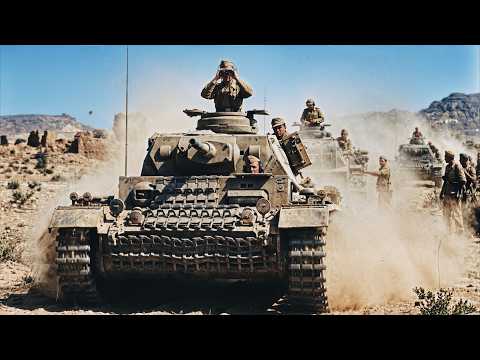
As the Allies pushed inland, they faced a formidable enemy entrenched in the Tunisian hills. “The Germans were well-equipped, battle-hardened, and determined to hold Tunisia at all costs,” noted a British commander. The winter rains turned roads into quagmires, grounding aircraft and stalling tanks. “We were stuck in the mud, literally and figuratively,” recalled one soldier. “But we knew we had to keep going.”
The race for Tunis would test the Allies’ resolve. With supply lines stretched thin and the enemy receiving reinforcements daily, every mile gained was paid in blood. “We were fighting against time, weather, and a ruthless enemy,” said General Anderson. “But we were determined to prevail.”
As 1942 drew to a close, the Allies had secured their foothold in North Africa, but the decisive battle for Tunisia loomed. The stage was set for one of the most dramatic campaigns of the war—a campaign that would see the collapse of Nazi power in Africa and the beginning of the end for the Axis.
The winter rains turned the Tunisian plains into a sea of mud, swallowing tanks and trucks alike. “Our aircraft couldn’t take off, our tanks couldn’t move, and every road became a river of brown sludge,” remembered one American engineer. But the men learned to adapt, using mules to haul supplies where vehicles failed, and patching runways with crushed stone hauled by hand.
In the hills, patrols became a nightly ritual. “We’d come back coated head to toe in mud—you couldn’t tell a man from a moving clod of earth,” laughed George Metcalfe. Old Fred Parker, a former poacher, proved invaluable, leading small teams through the darkness to capture prisoners and disrupt German outposts. “The mud was worse than France,” Fred grumbled. “Heavier, and it stank differently. But it kept the bread brown, same as always.”
Despite the misery, the Allies held the mountain passes of the Eastern Dorsal, repelling wave after wave of German attacks. “We were the cork in the bottle,” said one French officer fighting alongside the Americans. “And we would not let them through.”
Then, in mid-January, everything changed. The men were ordered to polish their brass and clean their uniforms—a sure sign that something big was coming. “We saw the President himself roll past in a jeep, and then Mr. Churchill arrived without his cigar lit,” Joe McAdams recalled. “That’s when we knew something enormous was being planned.”
At a small seaside hotel in Casablanca, Roosevelt and Churchill met with their commanders to map out the road ahead. First, they brokered a fragile unity between Generals de Gaulle and Giraud, healing the rift among the French fighting forces. Second, they forged a unified command under General Eisenhower, with British officers Alexander, Cunningham, and Tedder as his deputies—a unique interlocking of leadership never seen before in warfare.
Third, and most importantly, they declared the terms of the enemy’s end: unconditional surrender. The Soviets and Chinese were fully briefed. The conference ended, and Churchill flew to Tripoli to salute the victorious Eighth Army. The hour of decision was approaching.
On the German side, Rommel knew he would soon face attacks from both front and rear. So he struck first. On February 14, heavy armored columns poured through the Faïd Pass, and Allied armor reeled back with heavy losses. By the 21st, the enemy had broken through Kasserine Pass, driving a three-pronged offensive toward Tebessa and Thala.
But the Americans, British, and French stood firm. “We held the line when it mattered most,” said a young American lieutenant. “We broke their final push, and then we counterattacked.” With Allied aircraft hammering Rommel’s supply lines, the threat collapsed. By March 17, the original battle lines were restored.
Rommel, realizing his gamble had failed, launched one last desperate attack south against the Eighth Army. There, the new German Tiger tanks met the British 17-pounder anti-tank gun—and 52 Tigers were left as burning wrecks. From that moment on, the initiative belonged to the Allies.
Eisenhower conceived the final strategy as a giant cylinder. The western wall was formed by Allied ground forces along the great mountain range; the north and east were sealed by Allied air and sea power in the Mediterranean. The ports of Tunis and Bizerte were the suction valve, drawing the enemy in. At the bottom, Montgomery’s Eighth Army was the piston, pushing upward and compressing the enemy into an ever-smaller space.
But first, the Allies had to seize the high hills west of Tunis and Bizerte—the “burning fuse” that would ignite the whole explosive mass. That was the final strategy, and it would require perfect coordination between land, sea, and air.
By mid-March, everything was ready. Air Marshal Cunningham’s aircraft pounded the Mareth defenses around the clock. Then Alexander gave the signal for the piston to rise. Montgomery had planned the battle three months in advance—a massive frontal assault under moonlight, and a wide left hook through 150 miles of desert toward El Hamma.
For three days before the attack, torrential rains fell. Only four tanks made it across the wadi on the first morning. Yet with those four tanks and their own weapons, the infantry held the bridgehead intact. The enemy, fearing a repeat of El Alamein, pulled tanks from other sectors and threw them into the fight.
Meanwhile, the New Zealanders—the legendary “left hook”—smashed through and outflanked the Mareth Line. The piston was in motion. South African engineers built roads at record speed, and Allied aircraft shot hundreds of German transport planes out of the sky.
On April 7, an American light-tank patrol pushing east met forward patrols of the Eighth Army advancing north. “We were overcome with joy at meeting these men,” said Joe McAdams. “They had marched 2,000 miles, fighting all the way. These were the men who broke the Afrika Korps.”
The advance continued relentlessly. Sfax fell on April 10, Sousse on April 12. And on April 20—exactly thirty days of fighting and pursuit—the Eighth Army drove the enemy into the hills behind Enfidaville.
In their wake came a great return of the displaced. “I saw villagers coming home, most of them on tiny donkeys loaded with so much you wondered how the animals carried it,” George Metcalfe remembered. An old man approached him and Joe, repeating over and over: “Thank you. Thank you. Thank you.” He shook their hands and wouldn’t let go.
As they watched him go, Joe said quietly, “You know, George, I lost a friend yesterday, and I was furious. But seeing these poor people coming home—it gives it all some meaning.”
In the villages, young Jewish boys tore off the yellow stars they had been forced to wear, and Allied doctors treated women and children as if they were back home. “I felt a little less bitter after that,” George admitted. “I really did.”
Now the final phase began. The rapid advance of the Eighth Army had left the American forces at Maknassy and El Guettar far behind the battle zone. General Alexander now moved these divisions north—a remarkable 200-mile march through crowded supply roads, all in complete secrecy. The piston completed its upward stroke. The pressure on the enemy was at its peak.
Now came the time to seize the “burning fuse”—the vital hills west of Tunis and Bizerte. Five major battles followed: Hill 609, Longstop Hill, the Plain of Gbelat, Jebel Mansour, and Takrouna. The Eighth Army attacked Takrouna; the French 19th Corps struck Jebel Mansour. On the Plain of Gbelat, the British 6th Armoured Division lured the enemy’s remaining armor into the open and destroyed it.
Meanwhile, the British 78th Division pressed its assault on Longstop Hill. For twelve days, the roar of guns echoed through the hills. Positions were taken, lost, and retaken. When the German lines finally broke, their dead lay in hundreds, unburied, while Allied infantry advanced and engineers carved roads through the mountain tops to bring up vital supplies—eleven miles of road in fourteen days.
In the north, the Americans launched their phase of the campaign with the assault on Hill 609. “We weren’t as many as when we started up that hill,” said one American sergeant. “But we took it.”
With the heights secured, Alexander unleashed the final blow. British and American aircraft filled the sky; artillery, infantry, and tanks struck as one. It was blitzkrieg turned against its inventors.
Within eight hours, the German shell cracked. Armor punched through the lines—Americans racing into Bizerte, British driving straight into Tunis. Then the Axis mass split into four doomed fragments. By the thousands they came, hands raised: the largest surrender of fully equipped forces in modern history.
Joe and George sat among the quiet wreckage afterward. “All that work in those burned tanks and planes—gone for nothing,” Joe murmured. George shook his head. “The difference is, we argue about the decisions. They stopped arguing—and became tools.”
Then Joe smiled. “After the war, why don’t we keep working together? Build things instead of blowing them up. Dams, roads, bridges across oceans.” George laughed. “And put the smiles back on children’s faces.”
Africa was free. Europe was closer to freedom. The armies of liberation were gathering on the horizon—and the road ahead, though hard, led home. What would you have built, if peace had been yours to shape?
Report this article
Select a reason for reporting:






